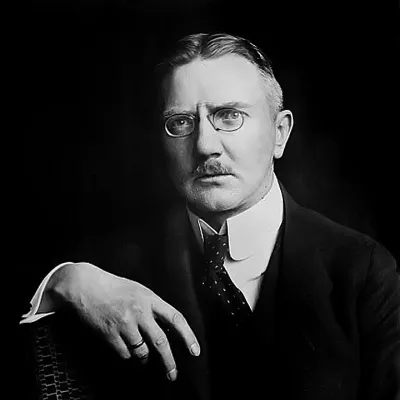
Hjalmar Schacht
Human Design Chart
Biography
Schacht married twice and had four children. He died on 3 June 1970 at age 93 in Munich, Germany.
Hjalmar Schacht as a Generator 1/3 in Human Design
Generator 1/3 — Design at a Glance
Hjalmar Schacht revealed himself as someone with immense endurance and inner reserves of strength. His Generator design endowed him with the ability to be productive over long periods, comparable to a strong workhorse that efficiently uses its energy – provided he acts in harmony with his internal impulses.
The mechanics of his design dictated that this power was not unleashed through constant initiating but rather by reacting to external signals. His strategy involved waiting until his Sacral Center – the motor of his actions – gave a clear “yes.” Upon receiving this inner signal, he would then react with concrete action. This path of gut-level reaction was key to his effectiveness.
If Hjalmar Schacht did not live by this principle, for example by taking on tasks that did not intrinsically please him or being hindered at his heart project when still full of energy, it inevitably led to frustration and a lack of strength. Burnout threatened if he wasted his resources on things he actually had no interest in. Conversely, he was rewarded with deep satisfaction through following his impulses. His strength therefore lay not in pushing against the current but in powerfully responding to what truly engaged and motivated him.
Emotional Authority
Hjalmar Schacht showed a decision-making stance that did not arise from immediate intellectualization but rather from an internal emotional wave. His inner authority was Emotional Authority, carried by the defined Emotional Center. This meant that his feelings fluctuated constantly; he saw the world colored through his current mood. What seemed absolutely right in one moment could appear completely negative in the next. For his design, it was crucial that this initial emotional impression did not represent the final truth. Quick, spontaneous judgments based on a current emotional state often proved misleading and could lead to negative consequences. Instead, his nature required patience: he had to reconsider decisions multiple times and let them rest overnight. Only when the initial emotional heat subsided and clarity and calm set in was the process complete. This delay served not as hesitation but as necessary maturation of insight. Especially for long-term, life-defining decisions, this mechanism proved a central protective shield against superficial misjudgments. Hjalmar Schacht had to learn to take his time and ask himself multiple times to recognize the deeper truth behind the current emotional wave.
The 1/3 Profile — Investigator / Martyr
Hjalmar Schacht revealed himself as someone who combined theoretical knowledge with practical experience inseparably. His Profile 1/3 shaped him into a researcher and experimenter: Line 1 drove him to study fundamentals and assess responsibility in proper measure, while Line 3 fostered an adventurous spirit and risk-taking behavior. This configuration meant that his life revolved around learning through trial and error. Often the energy of the first line took control; then he hesitated before implementation out of fear of not knowing enough yet. But the third line demanded testing and learning from mistakes. Self-earned insights were thus his core theme. When Hjalmar Schacht made a judgment, he had previously examined the matter both theoretically and practically to the heart and soul. One could trust this judgment as it arose from a synthesis of reason and practical life experience. Over time, he learned to be more selective in handling risks and recognize the value of personal goals rather than blindly following expansionist urges. His ability to deeply examine fantasies and focus on meaningful experiences helped him penetrate mystery. Thus, he became an authority whose assessments were based on thorough examination, not mere speculation or uncontrolled risk.
Single Definition — Defined & Open Centers
Hjalmar Schacht was a person with strong inner willpower and a pronounced need for control over his resources. His defined Heart Center gave him the ability to make promises and keep them, which strengthened his self-esteem. He enjoyed working but preferred to follow his own rhythm rather than instructions. This trait allowed him to be successful while finding balance between work and rest.
His defined Sacral Center generated enormous vitality daily, which he used for activities that fulfilled him. He responded to questions with a clear yes or no, helping him set boundaries and avoid energy waste. Through this sharpness in reaction, he could effectively use his strength and prevent frustration.
The defined Solar Plexus Center served as his inner authority. He learned to wait out the emotional wave before making decisions. This patience gave depth and clarity in relationships and business negotiations. His emotions colored the environment, making him attractive but also requiring others to deal with his fluctuations.
Additionally, Hjalmar Schacht had a defined Spleen Center, giving him intuition and an instinct for health. He trusted spontaneous warning signals and lived in the moment, protecting himself from dangers and promoting well-being. His defined Root Center provided constant pressure that propelled him forward and helped him deal with stress.
In contrast, his Head, Ajna, and Throat Centers were open. This led to him sometimes being distracted by mental doubts or the need to find answers. He tended to take on others' thoughts and could struggle to clearly articulate his own voice. His open G Center meant he did not have a fixed identity but defined himself through relationships and places, making him flexible yet vulnerable to external influences.
Channels for community, logic, intuition and individual power.
Hjalmar Schacht was characterized by relentless logic that questioned and corrected patterns. The Judgement Channel 58-18 connected the Root Center with the Spleen; Gate 58 pushed for 'better and more', while Gate 18 checked what was healthy or balancing. This created a sentry evaluating if structures served the collective. His decisions were marked by an intense desire for new experiences. The Recognition Channel 41-30 connected Root to Solar Plexus: Gate 41 generated restlessness and fantasy about 'what could be', while Gate 30 emotionally heated these impulses, fostering a strong need for experiential exchange. Simultaneously, he had sharp survival intuition. The Power Channel 57-34 linked Spleen with Sacral; Gate 57 kept him alert to dangers through intuitive insight, while Gate 34 supplied sacral energy for spontaneous and individual response. This combination allowed quick, instinctive judgments without mental delay. In interpersonal dynamics, he sought clear agreements within groups. The Community Channel 37-40 connected Solar Plexus with Heart; Gate 37 aimed at recognition and belonging, while Gate 40 provided work for the loved ones but needed breaks. This demanded carefully balanced contracts sealed by emotional clarity and willpower. Additional influences came from Gate 31 (transference of leadership), Gate 28 (risk awareness in here-and-now), and Gate 27 (caring role). On the personality side, Gates 3 (mutation to order), 19 (resource consciousness) as well as on design side Gate 22 (calm openness) and Gate 55 (emotional mood swings) were active. This configuration shaped a person who logically perfected, intuitively survived, and emotionally sought binding community structures.
Collective Circuitry — Circuit Signature
Hjalmar Schacht's design showed a continuous, simple energetic structure. All defined centers – Spleen, Root, Solar Plexus, Heart, and Sacral – formed one single, connected flow. This gave him a coherent, undivided expression.
The Understanding Circuit linked his Spleen and Root Centers via the Judgement Channel. This created an ability for focused, logical analysis free from emotional influence targeting future structures. Parallel, the Meaning Circuit worked through the Recognition Channel between Solar Plexus and Root Center. Here flowed emotional waves from the past to reflect experiences and share them collectively.
In the Ego Circuit area, the Community Channel connected Heart with Solar Plexus Center. This fostered cooperative dynamics in giving and taking as well as group resource creation without direct connection to individual life force. Finally, the Integration Circuit via the Power Channel secured a link between Sacral and Spleen Centers. This enabled intuitive perceptions directly into actionable energy now, strengthening individual survival through spontaneous reactions.
The combination of these four circuits resulted in a profile that linked rational planning with emotional reflection, nurtured cooperative social structures while always relying on intuitive immediate action capability.
Right Angle Cross of the Unexpected 4
Hjalmar Schacht's Human Design profile bore the signature of the 'Right Cross of the Unexpected'. This configuration shaped a life dynamic where seemingly random or surprising turns were not mere disruptions but catalytic moments. For him, unexpected events often served as keys to new insights or necessary course corrections.
In Human Design terms, this cross describes a specific energy distribution that responds to unpredictability. Instead of striving for strict predictability, there was an openness towards the unexpected as a source of inspiration and impetus for action. What others saw as chaos or irritation became in his system a trigger for clarity or innovation. The mechanics of this design suggested he was particularly vigilant and receptive during moments of surprise, as these situations broke through rigid daily structures to reveal deeper connections.
It was not about passive acceptance of randomness but an active integration of the new. The energy of this cross demanded a stance of vigilance towards what emerged spontaneously. Through this configuration, he was programmed to derive benefit from the unpredictable and integrate it into his personal strategy. The unexpected thus served as a compass that diverted him from established paths to guide him onto routes that could not have been discerned through logic alone. This dynamic fundamentally shaped his experience of time and events.
Saturn Return · Uranus Opposition · Chiron Return · 2nd Saturn Return — Life Cycles
Hjalmar Schacht's design indicated a tendency towards strategic turning points that condensed into clear life phases. His first Saturn Return around the age of 26 often marked the transition from education to stable structuring of everyday life. This was concretely evident in 1903 when he married Bertha Emma Clara Luise Sowa – a step that solidified his personal foundation and laid the groundwork for future commitments.
The Chiron Return, a cycle of unfolding incarnation purpose, occurred at age 49 for Hjalmar Schacht. During this phase, one's potential became increasingly experiential if one followed their inner authority. In 1926, he left the German Democratic Party – not merely a break but an alignment with deepening life task and a step away from structures no longer in line with growing self-understanding.
The second Saturn Return around age 56 often brings maturity and authority in career or public role. For Hjalmar Schacht, this was evident in 1933 when he was again appointed President of the Reichsbank. This positioning reflected cumulative experience and placed him at a level where his specific competencies were applied at the highest level. The sequence of these cycles illustrated an evolution from private stabilization through political reorientation to professional peak position.
Generator · Emotional Authority — Synthesis
He was a Generator whose life was marked by a deeply rooted drive for testing and perfection (Channel Judgment). Sacral energy provided endurance for constant experimentation and learning (Profile Researcher/Experimenter), while he always sought to recognize and correct patterns. This led to an ongoing process of weighing and reconsidering, reinforced by emotional waves – decisions matured over time to gain deep insights. The ability to keep promises and apply his own willpower (defined Heart Center) underpinned this approach and created trust in his judgments.
A central paradox lay in the combination of a need for constant review and emotional authority. While logical systems drove him to question everything and improve it, his emotional wave required time and patience to gain clarity. This led to tension between the quick urge for correction (Gate 18) and the necessity to let feelings mature before taking definitive steps – an interplay between logical analysis and emotional depth that shaped his decision-making.
4 Defined Channels
Incarnation Cross - Right Angle Cross of the Unexpected 4
Solar Return
The Solar Return shows the moment when the sun returns to its exact birth position - your personal solar year.
Life Cycles
Discover the life cycles with a detailed triple view (birth chart, cycle chart, composite).
Human Design Profile
- Type
- Generator
- Strategy
- To respond - wait for something to respond to
- Authority
- Emotional Authority
- Profile
- 1/3 - Investigator / Martyr
- Definition
- Single Definition
- Incarnation Cross
- Right Angle Cross of the Unexpected 4
- Date of Birth
- 22.01.1877 11:00
- Place of Birth
- Tinglev, DEN
Frequently Asked Questions
What is Hjalmar Schacht's Human Design type?
Which Profile did Hjalmar Schacht have?
What was Hjalmar Schacht's Authority?
What incarnation cross did Hjalmar Schacht have?
When was Hjalmar Schacht born?
Discover your own Human Design
Are you also a Generator? Find out in a personal reading how to use your sacral energy correctly and discover deep satisfaction.
More Personalities
Back to overviewAaliyah

Alexia

Angèle

Anne-Marie

Arcángel

Arno