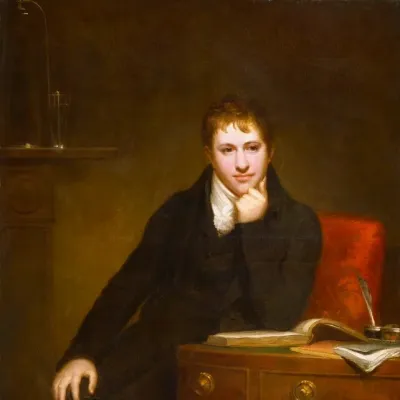
Humphrey Davy
Human Design Chart
Biography
Died 29 May 1829, Genf, Switzerland.
Humphrey Davy — Projector with Profile 4/6
Projector 4/6 — Design at a Glance
Humphrey Davy worked as a Projector with a dense, focusing aura that intensely influenced his surroundings. His design endowed him with the ability to immediately recognize systemic errors – much like a bright light beam revealing darkness. However, this direct perception could be uncomfortable when communicated without filters. His strategy was not to blind others with his own brightness but to attract them through his own harmony. When he lived in accordance with this inner alignment, people actively sought him out for advice.
Since his Sacral Center was undefined, Humphrey Davy did not have constant intrinsic life energy. Instead, he went through phases of high productivity followed by necessary rest periods for regeneration. Ignoring this rhythm led to exhaustion; adhering to the strategy – waiting for valuable invitations – secured him success and recognition. If he did not live by this principle, his non-self theme "Bitterness" would come to light. His character trait was thus to guide others through targeted shining rather than confronting them with direct criticism.
Splenic Authority
Humphrey Davy exhibited an immediate and intuitive reaction to his environment as a basic attitude. His inner authority lay in the defined Spleen Center, a system for health and survival intelligence. This configuration required that his Emotional and Sacral Centers be open, which is typical for Projectors or Manifestors.
The Spleen Center served as an alarm system. It provided him with spontaneous inner knowledge about whether a situation, person, or environment was healthy or harmful. This impulse was subtle and occurred only once at the moment it was needed. Therefore, Humphrey Davy had to remain vigilant not to ignore this first instinct or have it overridden by other influences. Decisions did not arise from long-term planning but rather in the moment of occurrence. The spontaneous impulse served directly his well-being and enabled him to rigorously distance himself from harmful influences.
Since this Spleen voice was effective only in the present, his needs and assessments changed short-term. Long-term commitments were difficult for his design as they restricted the necessary freedom. Flexibility and the ability to act spontaneously shaped his life path. A retreat to find decisions could be helpful to clearly perceive the subtle signaling of the Spleen Center and not have it obscured by external noise. His design suggested that he should commit himself as little as possible so that his survival intelligence could fully come into effect.
The 4/6 Profile — Opportunist / Role Model
Humphrey Davy's Human Design profile indicated a tendency to stand out in the first decades of life through intense experimentation with relationships and friendships. As a 4/6, Line 6 before the Saturn return initially appeared as if it were Line 3: an area of learning through direct experience and social exchange. This characterized his early years as a phase of exploration before the deeper structure of his Profile unfolded.
With the activation of Line 6, a character contradiction became apparent: the heart's desire for belonging (Line 4) conflicted with the head's need for detached wisdom and meaning-seeking (Line 6). Humphrey Davy thus appeared torn between wanting to be part of a community and feeling driven to contemplate the greater purpose of life. This dynamic could be confusing, as it made his big heart cautious – opening up only partially to avoid being hurt by "wrong" people.
In later years, he was expected to live up to the high standards of a wise role model. His role increasingly defined itself through cooperation and the ability to guide others. The mechanics of his Lines described an evolution from an experimental seeker to a stabilizing authority that acted emotionally controlled but always kept in mind the protection of the community and the justice of its conditions. His path was marked by this tension between emotional engagement and rational distance.
Split Definition — Defined & Open Centers
Humphrey Davy appeared as someone who was under constant internal pressure to ask questions and understand connections. This tendency resulted from his defined connection between the Head Center and Ajna Center. He had a firm way of conceptual thinking, but it did not provide direct energy for implementation. Instead, his mind served to shape inspirations while he waited for the right moment to pass them on to others to avoid frustration.
Parallel to this, Humphrey Davy possessed a defined Heart Center, which gave him constant willpower and a strong ego. He tended to determine his life himself and keep promises, strengthening his self-esteem. Additionally, his Spleen Center was defined, giving him a reliable instinct for health and well-being in the present moment. This combination of mental clarity, willpower, and intuitive security formed the foundation of his personality.
In contrast, Humphrey Davy revealed himself through several undefined centers, making him vulnerable to external influences. His open Throat Center led to uncertainties in communication; he tended to feel the pressure to attract attention or speak inappropriately if he did not wait for natural timing. The open G Center meant that he did not have a fixed identity but found it through interaction with his environment and appropriate places. He was dependent on others initiating him to find direction and love.
Additionally, his open Sacral Center absorbed the energy of others, which could exhaust him if he did not pay attention to his limits. His undefined Solar Plexus made him absorb foreign emotions and amplify them, causing emotional waves that were not his own. Finally, his open Root Center took on external stress, driving him to hyperactivity when he tried to rid himself of this pressure through action rather than recognizing it as non-self.
Channels for instinctive devotion and abstract comprehension.
Humphrey Davy showed an instinctive ability to recognize what his environment needed – often before people themselves knew it. This ability was rooted in the Channel of Devotion 44-26, which connected the Spleen Center with the Heart Center. Through Gate 44 (Awareness) and Gate 26 (Egotist), he had a fine sense for market gaps and tribal needs. He used this intuitive assessment to convincingly convey ideas or products, driven by the willpower to influence the "tribe" to his benefit. Simultaneously, the Channel of Abstraction 64-47 propelled him: Here Gate 64 (Confusion) in the Head Center connected with Gate 47 (Understanding) in the Ajna Center. His mind filtered every experience through a kaleidoscope of mental images to find hidden connections behind the facts. This mental unrest did not serve direct problem-solving but created space for inspiring stories and new perspectives that he had to share with others.
Additionally, further gates shaped his essence: Gate 36 (Crisis) brought cyclical movements and emotional energy free, while Gate 11 (Memory) used visual memories to harmoniously assess situations before acting. Gate 12 (Restraint) added a mutative, almost poetic quality that reacted to emotional mood. Gate 6 (Friction) provided the biological protective reflex and emotional wave movement for growth. On the personality level, Gates 61 (Inner Truth), which sought silence and individual knowledge, as well as Gate 43 (Breakthrough), which wanted to communicate spontaneous insights – often accompanied by fear of rejection. In the design, Gate 4 (Formulate) supported this process through logical formulas for future security, while Gate 57 (Intuitive Clarity) as a complex integration gate in the Spleen Center sharpened consciousness for the here and now. Humphrey Davy thus lived in tension between instinctive salesmanship, abstract mental search for meaning, and the urge to carry inner truths outward.
Collective Circuitry — Circuit Signature
Humphrey Davy showed a tendency towards abstraction and thinking about past experiences. His design connected the Head with the Ajna Center through the Channel of Abstraction (64-47). This part of the Meaning-Finding Circuit channeled his energy into visual grasping and emotional wave movements that drew cyclically from the past. He did not just reflect events logically but sought the deeper meaning behind experienced emotions to share these insights later with others.
Parallel to this, a separate power worked: The Ego Circuit connected his Heart with Spleen Center through the Channel of Devotion (26-44). This connection promoted cooperation and resource exchange within a group. Since there was no direct connection to the Sacral Center, this energy was timeless and required pauses for regeneration. Humphrey Davy supported his environment through mediation skills without having continuous drive.
Both circuits formed two independent blocks within his split definition. The abstract search for meaning in the Head-Ajna area did not flow directly with the cooperative resource building in the Heart-Spleen area energetically. Instead, they existed as side-by-side forces: on one hand, internal processing of emotional past data, and on the other hand, practical giving and taking in a social context. This separation shaped his way to switch between introspective reflection and external support without both areas automatically transitioning into each other.
Right Angle Cross of Eden 4
Humphrey Davy carried the right cross of Eden 4 in his design. This configuration shaped a fundamental stance characterized by a deep drive for inner transformation and spiritual ascent. In Human Design, this cross is understood as a path of purification where external experiences serve to cleanse and elevate the interior. It was not just an intellectual concept but an energetic structure that propelled him beyond the visible.
The mechanics of this cross describe a process in which challenges and suffering do not function as endings but rather as catalysts for a higher level of consciousness. Humphrey Davy was programmed by this configuration to grow from the depths of his experiences. The energy of the right cross of Eden 4 often acts like a filter: it takes the raw materials of everyday life and personal history and transforms them into a subtler, more spiritual form. This meant that his path was defined less by external fame than by inner clarity. The structure fostered the ability to overcome the transient and align with something eternal. It was a design that required stillness and reflection to fully integrate the transformative power of this energy. Humphrey Davy lived this dynamic by confronting the profound aspects of his nature without slipping into superficiality.
Saturn Return · Uranus Opposition · Chiron Return — Life Cycles
Humphrey Davy's design laid a tendency towards structural anchoring and institutional responsibility, which condensed into clear life phases. This configuration described a path where inner stability was strengthened through external recognition and formal positions.
In 1806, at the age of 28, he delivered the Bakerian Lecture to the Royal Society. For his design, this was a typical moment of the first Saturn return: a cycle in which years of groundwork matured into a tangible, visible result that solidified professional identity. The mechanics of this transit promoted a need for a solid foundation and public proof of competence.
Later, in 1820 at the age of 42, he experienced an Uranus opposition coinciding with the start of his presidency of the Royal Society (until 1827). This transit often marked a turning point towards greater authority and societal leadership, where old structures were questioned or expanded. Davy took on a central role that further developed his established position.
Finally, in 1827 at the age of 49, he reached his Chiron return. In this fulfillment cycle, where his incarnation cross should unfold, he wrote his will due to persistent health issues. This moment signaled approaching life purpose and confrontation with final decisions, focusing on the essential amidst physical strain.
Projector · Splenic Authority — Synthesis
He was a projector who through the connection of Spleen Center and Heart Center (Channel Devotion) possessed a deep instinctive intelligence. This allowed him to recognize patterns and subtly engage in the well-being of others – he saw where improvements were possible. His profile as Networker/Role Model suggests that throughout his life, he sought a balance between the desire for community and the necessity of operating from a distant observer position. The defined connection between Head Center and Ajna Center strengthened this drive to understand things and share knowledge, making him a natural inspirator.
A central paradox in his design lay in the interplay of instinctive perception (Spleen Center) and mental pressure to answer questions (defined Head Center). On one hand, he had a fine antenna for what was right or wrong; on the other hand, the necessity drove him to analyze this knowledge and put it into words. This likely led to internal tension as the spontaneous impulse of the Spleen Center was slowed by the mental process – an ongoing weighing between instinctive wisdom and rational understanding.
2 Defined Channels
Incarnation Cross - Right Angle Cross of Eden 4
Solar Return
The Solar Return shows the moment when the sun returns to its exact birth position - your personal solar year.
Life Cycles
Discover the life cycles with a detailed triple view (birth chart, cycle chart, composite).
Human Design Profile
- Type
- Projector
- Strategy
- Wait for the respectful invitation
- Authority
- Splenic Authority
- Profile
- 4/6 - Opportunist / Role Model
- Definition
- Split Definition
- Incarnation Cross
- Right Angle Cross of Eden 4
- Date of Birth
- 17.12.1778 05:00
- Place of Birth
- Penzance, United Kingdom
Frequently Asked Questions
What was Humphrey Davy's Human Design type?
Which Profile did Humphrey Davy have?
What Authority did Humphrey Davy have?
What incarnation cross was assigned to Humphrey Davy?
When was Humphrey Davy born?
Discover your own Human Design
Are you also a Projector? Find out in a personal reading how to unfold your leadership qualities and recognize the right invitations.
More Personalities
Back to overviewSissy Spacek

Alain-Fournier

Anémone

Ann-Margret

Bourvil
Hergé