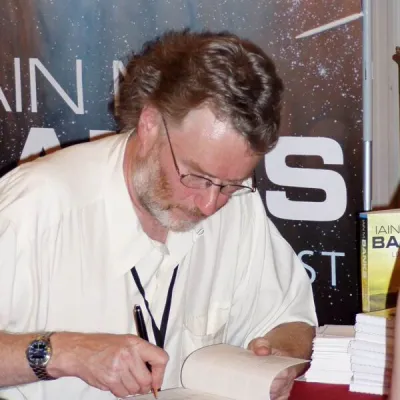
Iain Banks
Human Design Chart
Biography
On 3 April 2013, Banks announced on his website that he had been diagnosed with terminal cancer of the gallbladder and was unlikely to live beyond a year. In his announcement, Banks stated that he would be withdrawing from all public engagements and that The Quarry would be his last novel. The dates of publication of The Quarry were brought forward at Banks's request, and will be 20 June 2013 in the UK and 25 June 2013 in the US. Banks's death was announced on 9 June 2013. Banks is survived by his wife.
Human Design Analysis: Iain Banks as Projector 3/5
Projector 3/5 — Design at a Glance
Iain Banks was someone who could identify systemic errors with immediate precision. His Human-Design type Projector gave him an aura that worked like a focused flashlight: it shed light exactly on those areas in the environment that were still in darkness or not functioning properly. However, this ability to recognize flaws in the system instantly could be counterproductive if he addressed these shortcomings directly. Such direct interventions often provoked resistance from others, similar to how bright light shining unwelcome into someone's face would blind rather than illuminate.
The more effective impact of his nature came through restraint. By himself radiating harmoniously – for example, by setting an example with a functioning relationship or successful project – he became attractive. Others then sought contact voluntarily and asked about his insights. The strategy was to wait for a respectful invitation rather than acting on his own initiative. This protected him from the non-self theme of bitterness that arose when his advice was imposed unwelcomely or not recognized.
Furthermore, his undefined Sacral Center shaped his energy flow. He did not have a constant intrinsic source of life energy but worked in intensive phases of high productivity followed by necessary rest periods for regeneration. This rhythm contrasted with the demands of conventional work structures that expect continuous performance. If he lived according to this design – waiting for invitations and respecting his energy cycles – he was rewarded with success; ignoring these mechanisms led sooner or later to exhaustion and bitterness.
Splenic Authority
Iain Banks showed a tendency towards spontaneous, instinctive decision-making in the immediate moment. His design suggested that he trusted a fine inner alarm system that provided him with immediate knowledge of rightness and safety. This ability stemmed from his authority in the Spleen Center. For the Spleen to function as an internal authority, both his Emotional and Sacral Centers were open; this configuration is typical for Projectors or Manifestors.
The Spleen Center served as a health and alarm system with pronounced survival intelligence for him. His instinct and physical well-being acted as reliable indicators of whether he was in a suitable environment or company. Decisions therefore had to be made in the moment, since the first spontaneous impulse was correct and immediately beneficial to his health. This allowed him to effectively take care of himself and rigorously shield against harmful influences.
At the same time, this Spleen impulse was very subtle and occurred only once at each respective moment. It could easily be ignored or drowned out by external influences, requiring high vigilance. Since Iain Banks could only know what was right for him in the moment, plans could change short-term. Long-term commitments hindered this flexibility; his design therefore preferred much freedom and spontaneous arrangements over rigid guidelines.
The 3/5 Profile — Martyr / Heretic
Iain Banks lived as an experimenter and hero. His design determined that he first had to try everything himself to generate knowledge. This Line 3 of the Explorer required learning through personal failure and accepting fate without premature judgment. Only these practical experiences allowed him to offer solutions for others – the role of Line 5, the Helper.
This dynamic created a strong attraction. Others projected their hopes onto him because they wanted to learn from his accumulated life experiences. For Iain Banks, however, this was a thin line. The risk with Line 5 is public humiliation if experiments fail in front of an audience. To maintain his dignity and not disappoint the projection, he could withdraw or develop arrogance as a protective mechanism.
His life followed the pattern: first accepting personal failure (Line 3), then appearing as a hero with the knowledge gained (Line 5). This did not always mean success on the first attempt but rather the necessity of finding competence through resignation and experience. The tension between private experimentation and public expectations shaped his interaction with the world. He had to learn that his value does not depend on immediate success, but results from the authenticity of his lived experiences made accessible to others.
Split Definition — Defined & Open Centers
Iain Banks was characterized by a firm internal architecture that combined mental clarity with intuitive bodily intelligence. His defined Head and Ajna centers created a persistent mental pressure towards inspiration and questioning. Since these centers were not directly connected to motors, he could not act on this impulse alone; instead, he served as a source that inspired others to think. This conceptual work flowed into his defined Throat center, making his communication reliable and transformative. His defined G center gave him a stable identity and direction, while the defined Spleen center ensured spontaneous, momentary perception for health and values.
This stability was in tension with his open Heart, Sacral, Solar Plexus, and Root centers. Without constant personal willpower, he tended to adopt external expectations or overextend himself through attempts at self-validation rather than trusting his inner authority. His open Sacral center meant that generative energy was not consistently available; he risked exhaustion if he catered to the urge for permanent availability instead of respecting his natural rhythm of work and rest. Emotionally, his open Solar Plexus absorbed environmental moods, making him vulnerable to conditioned reactions in confrontations rather than living his own emotional truth. Finally, his open Root center amplified external stress, putting him at risk of entering a cycle of overwork and burnout through hyperactivity or attempts to relieve pressure. The challenge lay in not undermining the defined mental and identity strength by trying to stabilize these open areas with willpower or emotional control.
Channels for logic, inspiration and intuitive mastery.
Iain Banks exhibited a dynamic between the impulse for public inspiration and the demand for logical scrutiny. His design featured the Inspiration Channel 1-8, which should have acted through authentic role modeling: Gate 1 expressed a mutative perspective creatively, while Gate 8 made this contribution accessible to the public. This configuration did not work through explanations but by living his unique identity and thereby inspiring others to express their own uniqueness. Simultaneously, the Channel of Wavelength 48-16 promoted deep dedication to perfection. Gate 48 sought vital information, while Gate 16 refined skills through repeated experimentation to mastery. This combination transformed skill into talent that required recognition and resources to fully develop.
This natural flow contrasted with his personality carrying the Logic Channel 63-4. Here, Gate 63, the Gate of Doubt, constantly filtered patterns for their consistency, while Gate 4 attempted to formulate answers. This skeptical mind rejected unfounded beliefs and demanded practical evidence. An internal dialogue emerged: The design wanted to simply act and inspire through presence, while the personality demanded consistent, verifiable patterns. Banks lived in this tension between intuitive action and intellectual distance. While his body was designed for perfecting talents through dedication and repetition and making them publicly visible, his mind questioned the validity of each step. This structure shaped an attitude where creative impulses were only considered sustainable if they passed the filter of logical skepticism. The power lay not in blind faith in inspiration but in the ability to connect intuitive depth with rigorous scrutiny to create something enduring and truthful that touched emotionally as well as intellectually.
Collective Circuitry — Circuit Signature
Iain Banks showed a dynamic tension between emotional transformation and rational analysis. His design connected two separate energetic poles that did not flow directly into each other but worked parallel. The Knowledge Circuit propelled his innate path forward. Here, the Inspiration Channel (Gates 1-8) linked the Throat center with the Identity center. This configuration promoted impulsive expression and individual authenticity driven by inner inspiration. The energy was pulsing and acoustically marked.
Simultaneously, the Understanding Circuit acted as a corrective element. It consisted of two independent parts: One channel connected the Head center to the Ajna center (Logic, Gates 63-4), another linked the Throat center with the Spleen center (Wavelength, Gates 16-48). This structure promoted unconditioned logic and strategic future planning. Since the centers came from different groups – on one hand Throat, Identity, and Spleen, on the other Ajna and Head – these energies existed as separate forces. The Split Definition meant that Iain Banks’ expression could be both inspiring and logically coherent without the emotional wave directly merging with rational analysis. This created an integrated but polarized dynamic in handling knowledge and identity.
Right Angle Cross of Contagion 1
Iain Banks carried the 'Right Infection Cross' in his Human Design. Since the specific mechanical effect of this configuration is not specified in the available data, a detailed character description or behavioral classification cannot be derived from it. The presence of this element marks a structural feature in the chart whose concrete life expression lies outside the scope of the provided raw content. It must be noted that this configuration was part of his energetic landscape without defining any specific pattern of infection or transmission. Therefore, the analysis is limited to naming the structure itself; no further interpretations are possible based on the current factual situation. The design presents this component as a given element whose function cannot be elaborated upon in this context. Iain Banks lived with this configuration without it leading to any specific behavior or life task being derived from it. The mechanics remain undefined at this point.
Saturn Return · Uranus Opposition · Chiron Return · 2nd Saturn Return — Life Cycles
Iain Banks’ Human Design indicated a tendency towards consolidation, where years of groundwork condensed into established success. This was particularly evident during his Saturn Return cycles. The first of these cycles often marked the transition from experimentation to solid foundation. In 1980, at age 26, Banks wrote 'The Wasp Factory.' This novel made him instantly famous worldwide and represented exactly this mechanical condensation: years of hard work culminated in a public achievement that stood the test of time.
Even his second Saturn Return cycle confirmed this pattern of validation and recognition for established competence. In 2012, at age 58, Banks received the Premio Ignotus for 'The State of the Art' in the category of 'Best Foreign Story.' This event underscores the function of the second cycle: it does not serve a new beginning but rather validates already achieved positions. Banks’ chart shows a clear line where these planetary cycles shaped phases of stabilization and recognized success. The mechanics described here do not represent sudden luck, but rather the natural maturation of potential into visible, respected achievement within a defined timeframe.
Projector · Splenic Authority — Synthesis
Iain Banks' Human Design reveals a central thread of recognition and transformation. As a Projector with defined Head, Ajna, and Throat Centers paired with a Spleen Authority, he possessed the ability to recognize patterns (Gate 62) and gain deep insights (Gate 48). These mental abilities channeled through his defined Throat Center into an expression of creativity and inspiration (Channel 1-8), influencing and changing others – a process enhanced by the connection to the G Center. The Profile as an Explorer/Hero (3/5) suggests that he gathered experiences himself before passing on knowledge and solving problems for others, which was evidenced in his proven success.
A central paradox lies in the tension between his ability for deep analysis and his need for recognition. His defined Head and Ajna Centers enabled logical thinking (Channel 63-4), yet the open energy of his Heart Center points to an underlying insecurity driving him to seek appreciation through creative achievement. This dynamic manifested in the necessity to express his uniqueness (Channel 1-8) while simultaneously seeking validation from others to fully develop his talent.
3 Defined Channels
Incarnation Cross - Right Angle Cross of Contagion 1
Solar Return
The Solar Return shows the moment when the sun returns to its exact birth position - your personal solar year.
Life Cycles
Discover the life cycles with a detailed triple view (birth chart, cycle chart, composite).
Human Design Profile
- Type
- Projector
- Strategy
- Wait for the respectful invitation
- Authority
- Splenic Authority
- Profile
- 3/5 - Martyr / Heretic
- Definition
- Split Definition
- Incarnation Cross
- Right Angle Cross of Contagion 1
- Date of Birth
- 16.02.1954 04:10
- Place of Birth
- Dunfermline, United Kingdom
Frequently Asked Questions
What was Iain Banks' Human Design type?
What Profiles did Iain Banks have in Human Design?
What Authority did Iain Banks have?
What incarnation cross did Iain Banks have?
When was Iain Banks born?
Discover your own Human Design
Are you also a Projector? Find out in a personal reading how to unfold your leadership qualities and recognize the right invitations.
More Personalities
Back to overviewSissy Spacek

Alain-Fournier

Anémone

Angeli

Ann-Margret

Bourvil