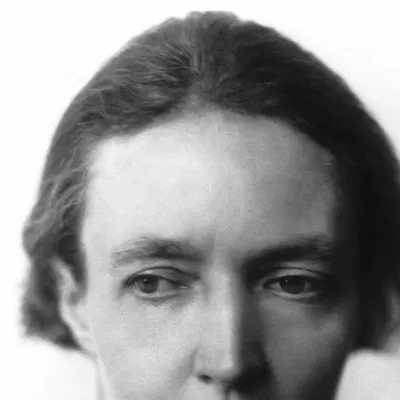
Irène Joliot-Curie
Human Design Chart
Biography
After a marriage to her mother's assistant, chemist Frederic Joliot 9 October 1926, they investigated the formation of electrons and positrons by the passage of hi-energy radiation through matter in 1933. They were able to determine the conditions under which these formations could occur. In 1934 they worked on alpha rays and the radioactive isotope of nitrogen, winning a Nobel Prize in chemistry for their work the following year.
In 1950 they were denied further participation in the Atomic Energy Board due to their outspoken involvement with the communist party during the German occupation for the prior decade.
She died of leukemia, the same as her mother, on 17 March 1956, Paris, France.
What does Manifestor 4/6 mean for Irène Joliot-Curie?
Manifestor 4/6 — Design at a Glance
Irène Joliot-Curie acted as a trailblazer with the power of a visionary. Her design shaped her similarly to an emperor in ancient Rome: She had a clear vision of a new future, but did not lead detailed battles or wars herself; instead, she gave impulses and let others do the work. This initiative inevitably encountered resistance because her forward-thinking mindset was often misunderstood. She polarized strongly; some followed her great dreams enthusiastically while others rejected or even hated her precisely due to this superiority.
To minimize friction and find the right following, it was crucial for Irène Joliot-Curie to communicate her intentions and visions early and precisely. This strategy of informing served to clear up misunderstandings before she acted. If she lived by this strategy faithfully, her inner state rewarded her with a sense of peace. Deviations from or ignoring this need, on the other hand, led to deep, lasting anger. This emotional indicator signaled whether she was in harmony with her nature as an initiator or struggling against the resistance of circumstances without providing the necessary information.
Ego Authority
Irène Joliot-Curie possessed rare authority in the ego center, a configuration that only projectors or manifestors can have. Her design was marked by open emotional, sacral, and spleen centers, making her highly susceptible to influence. Her inner truth manifested not through thinking but in spontaneous, uncensored speech. She had to learn to listen to what came out of her immediately rather than trusting the thoughts that served her open centers and often reflected foreign interests.
This mechanism required a clear distinction between mind and own will. When Irène Joliot-Curie followed what was truly at heart, she possessed the power to achieve goals and keep promises. This consistent action could appear selfish outwardly but was essential for her integrity. Her drive aimed either towards personal gain or the desire to transcend boundaries and be a pioneer in new paths. It always came down to her effort being worthwhile for herself.
A central aspect of her design was the necessity of pauses. Continuous work led this configuration not to success, but to exhaustion and illness. After achieving a goal, Irène Joliot-Curie had to pause to regenerate her energy. Only through this rhythmic process could she sustainably apply her willpower without overloading herself. Her strength thus lay not in constant action, but in clear alignment with her own will and respectful adherence to her limits.
The 4/6 Profile — Opportunist / Role Model
Irène Joliot-Curies life path followed the dynamics of Profile 4/6. In her first three decades, Line 4 dominated with its strong need for belonging and network binding. She experimented intensively in this early phase, particularly in the realm of relationships and friendships, driven by the heart's desire for connection. This period was marked by searching for the right place within a community, often hoping for external support to free herself from feelings of being overwhelmed.
Around age thirty, Line 6 activated, initiating a fundamental shift. The inner conflict between the desire for community (Line 4) and the need for distance as well as individual wisdom (Line 6) became central. Irène Joliot-Curie had to learn to carefully protect her big heart so as not to be hurt by false bonds. At the same time, she developed the ability to integrate strangers and outsiders into her sphere. This integration served to bring in innovations and strengthen the community. Her development led from an experimental network member to the role of a wise exemplar who could drive deep changes on a collective level without losing sight of the connection between individuality and community.
Single Definition — Defined & Open Centers
Irène Joliot-Curie's Human Design profile laid a stable and reliable foundation for expression and action. Her defined Throat Center transmuted the energies of the G Center (Identity) and Heart Center (Willpower) into clear communication. This expression was steady and honest when it came from her inner authority. She had a firm sense of self-identity and direction in life. The defined Heart Center gave her willpower; she kept promises and set her own pace. This triple definition created structure rather than impulsive fluctuations.
At the same time, Irène Joliot-Curie was situationally sensitive through open centers. Her open Head and Ajna Centers allowed a flexible mind without mental pressure but left her vulnerable to others' inspiration or confusion. She tended to wonder if she needed to find answers that were not her own. The open Sacral Center meant no constant vital energy; instead, she absorbed the environmental energy flow and risked exhaustion from borrowed power. Similarly, the open Solar Plexus Center acted as a barometer for foreign emotions while the open Spleen Center mirrored sensitivity to health and well-being in the environment. The open Root Center took on external stress, leading to cycles of pressure absorption and attempts to release it through activity. These open centers were not personal traits but mirrors that protected her from conditioning if she did not identify with them.
Channels for logical leadership and courageous self-assertion.
Irène Joliot-Curie emerged as a leadership figure who established authority not through sheer power, but through logical persuasion and material responsibility. Her design combined the ability for collective guidance with the will to secure results on the physical plane.
This dual focus was most prominently shaped by two central channels. The Alpha Animal Channel 7-31 connected the G Center with the Throat Center and laid the groundwork for leadership based on tested patterns and future perspectives. Here, Gate 7 acted as the 'power behind the throne,' providing the logical role to lead societies while Gate 31 spoke as a collective leader. This configuration required Irène Joliot-Curie to first gain community trust before she could effectively lead; her voice had influence because she understood trends and represented people's needs, not by claiming absolute authority. She sought her own sphere of influence, her 'pack,' from which to guide the way.
Parallel to this, the Money Line Channel 21-45 connected the Heart Center with the Throat Center and brought material responsibility into focus. This channel expressed the will to take control over resources and protect the tribe. Gate 21, the Hunter, sought control to calm his heart while Gate 45, the Gatherer, represented the authoritarian voice of 'I have or I do not.' For Irène Joliot-Curie, this meant she worked best when she recognized her own independence and set the rhythm of her work herself. She had to learn to assert her will in a way that protected her interests while also serving the community's welfare.
Additionally, individual gates contributed to structure: Gate 47 promoted collective understanding from past experiences, while Gate 22 supported openness and calm listening. Gate 26 allowed her to introduce innovations into conservative structures, and Gate 8 drove her to act individually for group goals. Finally, Gate 35 sought change through interaction and new experiences. Together, these elements formed a profile of a leader who logically argued, took on material responsibility, and always kept the collective context in mind.
Collective Circuitry — Circuit Signature
Irène Joliot-Curie's Human Design profile was characterized by a clear separation of two energetic poles: one rational, future-oriented thought structure and another traditional resource logic based on cooperation. As a simple definition, Throat, Identity, and Heart Centers formed a cohesive flow.
The Mind Circuit operated through the channel 'The Alpha Animal' (31-7), which connected the Throat with the Identity Center. This promoted the ability to articulate logical strategies and structured insights free from emotional conditioning. The focus was on improving societal structures through clear rationality and visual future thinking, emphasizing the sharing of these rational insights.
Parallel to this, the Ego Circuit operated through the channel 'The Money Line' (45-21), which also connected the Throat with the Heart Center. Here, it was not about individual self-presentation but tribal cooperation and material security. This channel supported resource accumulation and prosperity through mutual support in giving and taking. As this circuit did not connect to the Sacral Center, there was no constant life force; instead, it required periods of rest for regeneration to produce necessary resources for the tribe.
The tension lay in the coexistence of these two forces: on one hand, emotionless strategic future thinking by the Mind Circuit, and on the other, conservative traditional resource security through cooperation in the Ego Circuit. Both streams converged at the Throat Center, enabling a form of communication that united rational visions with practical, resource-oriented intentions while always remaining separate.
Right Angle Cross of Rulership 3
Irène Joliot-Curies design carried the signature of the right cross of governance. This configuration shaped an internal stance that was not defined by external direction or imposition of structures, but rather by a quiet, authoritative presence. It was a pattern where leadership emerged from depth, far removed from loud dominance or visible control.
The mechanics of this cross describe energy respected for its authenticity and unwavering nature. Irène Joliot-Curie lived in dynamics where her authority did not need to be enforced; it simply was there as a constant presence in the room. This fundamentally differed from active exercise of power. Instead, it was about the ability to establish order or affirm others' paths through mere existence and integrity.
Without specific biographical events in the raw content, the analysis remains at this structural property: Irène Joliot-Curie embodied a form of governance based on inner stability. Others responded to this quality not out of fear of punishment or obedience, but due to the natural aura of someone who knows who they are and where their limits lie. This quiet authority formed the foundation of her interaction with the world, a background hum of constancy in an often chaotic environment.
Saturn Return · Uranus Opposition · Chiron Return · 2nd Saturn Return — Life Cycles
Irène Joliot-Curies life followed a clear structure of consolidation, expansion, and fulfillment. In 1925, at age 28, she completed her doctoral thesis. This marked the first Saturn return cycle: a phase where years of groundwork condenses into a stable foundation and establishes one's competence.
Ten years later, in 1937 at age 40, the Uranus opposition occurred. She was appointed to a teaching position at Sorbonne. This cycle often demands reorientation or breaking with established structures to find new expression; her appointment here signaled an expansion of her sphere of influence and new authority in her field.
In 1945, at age 48, she reached the Chiron return. She was appointed alongside Frédéric Joliot-Curie as one of three commissioners for the Commissariat for Atomic Energy. In this fulfillment cycle, her incarnation cross unfolds increasingly; meaning and purpose become experiential. Her role in this high-ranking position showed the bloom of her life's mission, derived from her design.
The second Saturn return cycle concluded in 1956 when she died at age 59 from leukemia. This cycle often brings a final delineation or closure to a long chapter. Her death marked the end of a phase of intense structuring and public engagement that had been shaped by her previous cycles.
Manifestor · Ego Authority — Synthesis
Her life's work was characterized by a deep drive to change the world through logical analysis and strategic action (Understanding Circuit, Channel of Alpha). This manifested in her commitment to scientific research and her ability to grasp and communicate complex connections (defined Throat Center). The profile as a networker and role model suggests she always sought connections and wanted to share her knowledge, with Line 4 connecting the desire for belonging with Line 6's detached, reflective stance. Authority in the ego revealed a will that expressed itself spontaneously - an inner voice guiding her while also being influenced by openness.
A central paradox lay in the tension between her ability for collective leadership (Gate 31) and the need for independent thinking and action inherent to a Manifestor. She could inspire others and move them to act, while maintaining a certain distance and not fully conforming to others' expectations. The recurring career events marked by Saturn and Uranus cycles underscore this contrast: the pursuit of recognition and influence (Saturn) in tension with the desire for innovation and freedom (Uranus).
2 Defined Channels
Incarnation Cross - Right Angle Cross of Rulership 3
Solar Return
The Solar Return shows the moment when the sun returns to its exact birth position - your personal solar year.
Life Cycles
Discover the life cycles with a detailed triple view (birth chart, cycle chart, composite).
Human Design Profile
- Type
- Manifestor
- Strategy
- To inform others before acting
- Authority
- Ego Authority
- Profile
- 4/6 - Opportunist / Role Model
- Definition
- Single Definition
- Incarnation Cross
- Right Angle Cross of Rulership 3
- Date of Birth
- 12.09.1897 22:00
- Place of Birth
- Paris, France
Frequently Asked Questions
What is Irène Joliot-Curie's Human Design type?
What Profile did Irène Joliot-Curie have in Human Design?
What Authority did Irène Joliot-Curie have?
What was Irène Joliot-Curie's incarnation cross?
When was Irène Joliot-Curie born?
Discover your own Human Design
Are you also a Manifestor? Find out in a personal reading how to use your initiation power peacefully and dissolve resistance.
More Personalities
Back to overviewChristian-Jaque
Kesha

Laurent-Eynac
Lucebert
Masaccio
Papus