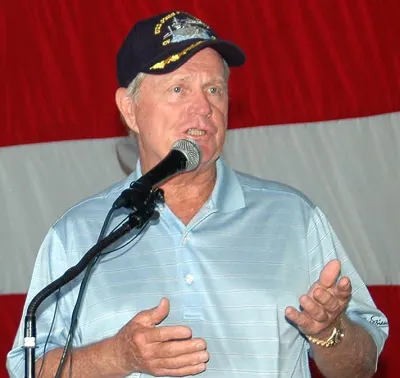
Jack Nicklaus
Human Design Chart
Biography
Nicklaus is the son of Helen and Charlie, a pharmacist who had three drugstores in Columbus. His dad wasn't just verbally supportive of Jack, he went with him to events and Jack considers his dad his best friend. Burly, blond and 5' 10" he is known by the nickname of "Golden Bear." He was born color-blind and has always needed help in picking his wardrobe.
He won his first major championship, the U.S. Amateur, in 1959, as a 19-year old sophomore at Ohio State University. Two years later, he won it again as a senior. In January 1962 he turned pro and won his first U.S. Open that same year. During the 1960s and most of the 70s he dominated the sport as no one else ever had. He won 88 tournaments, including 19 majors. Nicklaus is known as a sportsman in the truest sense of the word, a gentleman and nice guy. To his two U.S. Amateur championships he added four U.S. Open titles, three British Opens, five Professional Golfers' Association titles and five Masters championships. In 1986, at 46, he won the 50th Masters Tournament for the sixth time. At 56 he won his 100th tournament of his professional career. He continues to play in the Seniors Tournaments. Nicklaus has also earned worldwide acclaim as an architect and builder of golf courses, which number nearly 100.
Both Nicklaus and his wife, Barbara, grew up in Columbus, OH, but they didn't meet until their first week at Ohio State. Married on 7/23/l960, they have five kids: Jack Jr., Steve, Nan, Gary and Michael. The oldest son, Jackie, is himself a golfer of promise and winner of the prestigious North and South Amateur.
The kids are one reason Nicklaus has not played as many tournaments as most other professional golfers.
What does Generator 5/1 mean for Jack Nicklaus?
Generator 5/1 — Design at a Glance
Jack Nicklaus revealed himself as someone with immense endurance, comparable to a workhorse that only optimally uses its strength when it receives an inner confirmation for the task. His design suggested that success and deep satisfaction do not arise from constant pushing forward but rather through precise responses to life impulses. The central mechanism of his Generator type is 'Reacting instead of Initiating'. His large sacral energy becomes free primarily when he can respond to signals from the environment.
If he initiates independently or acts against his inner feeling, he risks frustration and energy deficiency. Two stumbling blocks characterized this pattern: On one hand, the danger of investing energy in things where no genuine interest existed, which could lead to burnout over time. On the other hand, the frustration when prevented from pursuing his heart project, even though his inner self was still full of power and wanted to continue. The motto 'Do not initiate but react' was the key to avoiding these pitfalls. When Jack Nicklaus responded to a signal from life and his sacral center answered with a clear 'Yes', he could follow up with actions that no one could stop him from taking. Living by this principle rewarded him with a deep sense of fulfillment; ignoring it led to persistent frustration.
Sacral Authority
Jack Nicklaus demonstrated decision-making rooted not in the head but deeply within his body. As a Generator, his inner authority was identical to his strategy: sacral authority. This mechanism fundamentally simplified his process as he did not need external advisors to know if a path was right for him. Instead, he reacted to external stimuli through an immediate physical resonance.
This reaction often manifested as 'gut feeling' - a grunting, humming or loud 'Mhm'. If this response was positive, it followed with a noticeable surge of energy. Jack Nicklaus then felt vital and alive; his energy seemed inexhaustible. He tackled his tasks with great enthusiasm and immersed himself in his work without questioning an abstract purpose. The joy in the work itself was confirmation.
Supporting this sacral intuition was his active spleen center, functioning as a supporting authority that enabled quick, instinctive reactions. Jack Nicklaus had direct access to his physical well-being and instinctive perception. He could reliably guide himself from these deep impulses, allowing him to react spontaneously and precisely to situations without long deliberation. His strength lay in recognizing the right moment through feeling in the body and acting immediately with full force.
The 5/1 Profile — Heretic / Investigator
Jack Nicklaus was characterized by Profile 5/1 as someone who gathered profound intuitive knowledge to offer practical guidance to others. His presence had a magnetic effect; people instinctively sought his solutions and advice. This dynamic created an ongoing tension between his inner need for withdrawal for detailed research (Line 1) and the external expectation of delivering immediate answers as a 'hero' (Line 5).
Line 1 demanded careful risk assessment and meticulous work. Jack Nicklaus had to intuitively examine opportunities and dangers before acting. Without this thorough preparation, unrealistic expectations loomed. Simultaneously, Line 5 challenged him to set clear boundaries in crisis situations and establish practical solutions to avoid confusion. He led by showing limitations that created new possibilities.
The challenge lay in protecting himself from overload. The constant demand for his knowledge could quickly lead to exhaustion if no clear limits were set. Similar to an expert who tires under the weight of countless questions, Jack Nicklaus had to learn to say 'No'. Only this way did he maintain balance between his private research work and public role as a problem solver. This ability to conserve energy through restraint enabled him to sustainably use his gifts without exhausting himself.
Split Definition — Defined & Open Centers
Jack Nicklaus was defined by a design with extremely high internal determination: five defined centers created a consistent structure in thinking, energy, and expression. His defined Ajna Center guaranteed continuous mental conception; he processed data and theories always in the same trustworthy way, independent of external influence. This mental clarity flowed directly into his defined Throat Center, which served as a pivot point for manifestation. What he thought could be consistently and clearly spoken or acted upon without this ability wavering.
The driving force came from his defined Sacral Center, a source of continuous vital energy. This energy was only available through reaction to external requests, not through mental initiatives. Parallel to this, his defined Spleen Center functioned as intuitive survival intelligence; it provided spontaneous, momentary judgments about health and well-being that he could trust in the present. His defined Root Center delivered a set stress pressure that physically propelled him forward and helped him deal with life's pressures.
At the same time, Jack Nicklaus was open in four centers, making him vulnerable to external conditioning. The open Head Center meant missing consistent inspiration; he tended to be distracted by doubts or seeking answers from others rather than trusting his own inner clarity. His open G Center lacked a set identity or direction; it mirrored the environment and had to learn that being at the wrong place also means meeting the wrong people. The open Heart Center was lacking in consistent willpower; he was vulnerable to the pressure of making promises or proving himself, which often ended in frustration as the energy for this did not exist. Finally, his open Solar Plexus absorbed the emotions of the environment; he could become confused between his own and others' feelings and tended to interpret emotional waves from others as his own instability. This openness required him not to identify with absorbed stress or emotions but to trust his defined inner authorities in Sacral, Ajna, and Spleen.
Channels for change, insight and caring preservation.
Jack Nicklaus was characterized by a pulsating rhythm of chaos and order. This energy was melancholic and unpredictable, yet aimed at evolutionary change. The Mutation Channel 60-3 connected his Root Center with the Sacral Center. Gate 60, the Gate of Limitation, required accepting boundaries, while Gate 3, the Gate of Order, helped navigate the confusion of new beginnings. This Juxta-Channel energy was conditioning to his environment and forced adaptation. When the inner pulse stopped, tension arose, perceived as melancholy. The key lay in not rationalizing these moods but patiently waiting for a sacral reaction to initiate change.
Alongside this formative energy, he carried the Structuring Channel 43-23. This connected Ajna with Throat and allowed him to receive inspired knowledge through spontaneous insights (Gate 43) and clearly express them (Gate 23). His thinking often felt prematurely pressed; he had to learn to communicate his innovative perspectives in a way that could be understood without having to plan ahead.
The Preservation Channel 27-50 connected his Sacral Center with the Spleen Center. Through Gate 27 (Care) and Gate 50 (Values), he showed a natural ability to take responsibility for the tribe and preserve traditions. His aura attracted trust, yet he had to ensure that he first cared for himself to effectively support others.
Additionally, Gates like Gate 56 (Inspiration through Abstraction) and Gate 28 (Decision in Here and Now), shaped his mental stimulation and risk management abilities. This configuration described a person who brought change by respecting internal rhythms and clearly structuring knowledge.
Individual Circuitry — Circuit Signature
Jack Nicklaus was characterized by two parallel, energetically separate fields. The Knowledge Circuit drove the urge for individual transformation and new expression. In him, this circuit connected the Ajna Center with the Throat Center through the Structuring Channels (Gates 43-23) and Mutation Channels (Gates 3-60). This generated a pulsating, acoustic impulse to linguistically set his own innovations and deviations from the known into the world. The energy here was focused on the present moment to establish unique identity through creative expression.
Completely independently of this, the Protector Circuit acted as timeless, tactile power. It connected Jack Nicklaus' Sacral Center with the Spleen Center via the Preservation Channel (Gates 27-50). This connection focused on instinctive family protection, nourishment, and preserving genetics. It was about care, defense, and feeding – primal energies of mother and father that secure survival.
As Jack Nicklaus had a Shared Definition, these two systems existed side by side without direct energetic flow between them. The tension lay between the acoustic urge to individualize through mutation and the silent, tactile necessity to protect and nourish his family and genetics. These separate poles shaped his experiential world as two distinct, non-connected life domains.
Left Angle Cross of Distraction 2
Jack Nicklaus revealed himself as someone whose structural dynamics of Distraction played a central role. His design was marked by the 'Left Hand Distraction 2', indicating a profound orientation: Dealing with distracting forces did not form an incidental side plot but a core characteristic of his inner architecture. This configuration suggests that distraction for him was not merely a disruptive factor, but must be understood as a structural element of his personality. It was less about superficial lack of concentration and more about a fundamental life task to engage with the nature of distraction and integrate or navigate these forces. Since no specific Gates or Channels are mentioned in the raw content, the interpretation is limited to the name of the Cross. This underscores that the general dynamics of Distraction functioned as a defining element of his experiential world. Jack Nicklaus’ path was thus determined by the necessity to recognize and cope with this structural imprint in daily life without deviating into external explanations or biographical details not derived from the chart. The mechanics here are clear: Distraction was no mistake, but a defining aspect of his human structure that remained ever-present and significantly influenced his actions and perceptions.
Saturn Return · Uranus Opposition · Chiron Return · 2nd Saturn Return — Life Cycles
In this phase of his life, Jack Nicklaus showed himself as someone who condensed previously gathered experiences into a robust identity. The first Saturn Return, occurring around the age of 29 to 30, marks a critical turning point in the life cycle. It demands the integration of personal identity and responsibility, with years of groundwork often ripening into a stable outcome.
In 1971 at the age of 31, Jack Nicklaus won the PGA Championship. This success fell precisely within the window of this Saturn Return and served as concrete evidence for the mechanics: The phase of maturation culminated in a visible affirmation of his position. It was not an accidental victory but the moment when internal structuring bore fruit externally. The design indicated that this period was meant to take on responsibility and clearly define one's role in life. Winning the PGA Championship illustrated how the integration of identity and duty could manifest as a tangible, measurable success once the cycle of the first Saturn Return is completed.
Generator · Sacral Authority — Synthesis
A central red thread runs through the design: the deep connection to sacral energy (Generator Type, Sacral Authority) and the unrelenting drive to transform this into concrete results. The defined mental center enables the development and processing of concepts while Channel 3/60 signals a constant quest for novelty and adaptability to changes – a pulsating energy accompanied by melancholy. Profile Hero/Researcher (5/1) reinforces this aspect, emphasizing the need to acquire knowledge and make it accessible to others to solve problems. This process is not without friction, as the focus on one's path and thirst for knowledge always carries the risk of overexertion or distraction from external expectations.
The design reveals a central paradox between deep engagement and potential burnout. The immense sacral energy (Generator) promises endurance and creative power but faces the danger of burnout through the need for constant problem-solving (5/1 Profile) and willingness to embrace new possibilities (Channel 3/60). While the defined mental center can provide concepts, the knowledge circuit implies a continuous search for new insights, leading to a cycle of learning, application, and renewed search – an apparent contradiction between the desire for depth and the dynamics of change.
3 Defined Channels
Incarnation Cross - Left Angle Cross of Distraction 2
Solar Return
The Solar Return shows the moment when the sun returns to its exact birth position - your personal solar year.
Life Cycles
Discover the life cycles with a detailed triple view (birth chart, cycle chart, composite).
Human Design Profile
- Type
- Generator
- Strategy
- To respond - wait for something to respond to
- Authority
- Sacral Authority
- Profile
- 5/1 - Heretic / Investigator
- Definition
- Split Definition
- Incarnation Cross
- Left Angle Cross of Distraction 2
- Date of Birth
- 21.01.1940 03:10
- Place of Birth
- Columbus, OH, United States
Frequently Asked Questions
What is Jack Nicklaus' Human Design type?
What Profile does Jack Nicklaus have?
What authority does Jack Nicklaus possess?
What incarnation cross does Jack Nicklaus have?
When was Jack Nicklaus born?
Discover your own Human Design
Are you also a Generator? Find out in a personal reading how to use your sacral energy correctly and discover deep satisfaction.
More Personalities
Back to overviewAaliyah

Aldair

Alexia
Angèle

Anne-Marie

Arcángel