
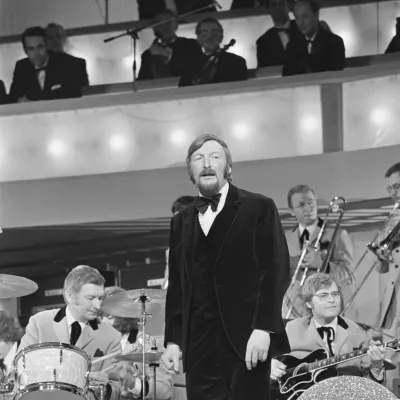
James Last
Human Design Chart
Biography
James Last — Generator with Profile 1/3
Generator 1/3 — Design at a Glance
James Last was revealed as someone with remarkable endurance and great energetic potential. His design as a Generator suggested that he possessed powerful sacral energy driving him like a workhorse – strong and steady, provided he found inner motivation for his tasks. This energy was not released through pure initiative but only became effective when he responded to impulses from his environment. The motto of his design was therefore: Not initiate, but react.
His most successful strategy involved waiting for signals and reacting only after receiving a clear 'yes' from within before taking action. If James Last lived in harmony with this mechanism by responding instinctively to offers, his design rewarded him with deep feelings of fulfillment and satisfaction. Conversely, ignoring this principle – such as through constant initiative without inner confirmation or compulsive actions that lacked resonance – led to frustration and energy loss. Two main risks shaped his energetic profile: either he wasted his strength on tasks without passion, leading to exhaustion, or he was held back from his heart project despite the internal power still being present. His path to effectiveness thus lay in patiently reacting to life rather than constantly pushing forward.
Sacral Authority
James Last lived as a Generator whose decision-making was marked by sacral authority. This inner voice did not manifest in the head but in the body: as spontaneous gut reactions to external stimuli. His design indicated that he trusted these physical signals – such as an internal 'mmh' or sudden surge of energy – when his sacral motor kicked in, making him feel vital and act with great enthusiasm. This allowed him to pursue activities without rigid purposefulness but out of pure interest and joy.
Central for James Last was the strategy of waiting for the right impulse. Since his Emotional Center was open, he could not immediately judge emotionally; this protected his sacral authority from hasty decisions driven by moods. Instead, he reacted to what made him alive in the moment. If his Spleen Center was also activated and connected with the Sacral Center, he had a quick, instinctive perception. This enabled spontaneous reactions and direct access to his physical well-being. He let himself be guided by this intuitive security, which enhanced his ability to act effectively and satisfyingly in the here and now rather than getting stuck in lengthy deliberations.
The 1/3 Profile — Investigator / Martyr
James Last's design was characterized by the Profile type 'Researcher/Experimentor' (1/3). This configuration established a fundamental attitude that linked learning with practical experimentation. His life followed a pattern of trial and error: The first line of his profile drove him to collect theoretical knowledge and understand fundamentals, while the third line fostered the need to test these insights in reality.
This dynamic meant that James Last did not draw conclusions purely from speculation. If he deemed something good or right, he had previously analyzed it intellectually as well as practically tested it. His authority rested on this double-check – theory and practice needed to align.
The mechanics of line 3 described a process where mistakes were not seen as failures but as necessary learning moments. Sometimes the energy of the first line could dominate, leading to a feeling that he did not know enough yet to act. But his design required exactly this step into the unknown, since true knowledge was only gained through personal experience and navigating difficult situations. James Last's path was thus marked by the synthesis of analytical preparation and the courage to embrace the experimental process of life to create order from confusion.
Split Definition — Defined & Open Centers
James Last's Human Design profile indicated a tendency towards constant mental activity and clear communication. His defined Ajna Center ensured that he processed concepts in a trustworthy manner; his mind was always engaged in the process. This mental structure flowed directly into his also defined Throat Center, allowing him to reliably express what he thought. His voice served as a focal point for conveying inner information outward.
At the same time, James Last had an enormous vital energy source through his defined Sacral Center. This provided him with a constant energy base that only worked sustainably when he responded to questions rather than initiating himself. His defined G Center gave him a firm sense of self-identity and direction, while the defined Spleen Center allowed spontaneous intuitive judgments in the present moment. The defined Root Center supplied the necessary pressure to advance in the material world and manage stress.
In contrast, James Last was vulnerable through open centers to certain conditioning effects. His open Head Center meant that he did not have a constant access to inspiration; he tended to take on mental pressure or questions from others as his own problems, which could lead to confusion. His open Heart Center lacked consistent willpower energy, making it tempting for him to prove himself through promises – a trap since he could not sustain this energy indefinitely. Furthermore, his open Solar Plexus absorbed the emotions of his environment like a sponge. He had to avoid personalizing these foreign feelings to remain emotionally stable and not get trapped in cycles of assumed guilt or false identification with others' moods. This openness required conscious distancing to maintain clarity from his defined centers.
Channel 43-23: Structuring — Channels & Gates
James Last's design was characterized by a strong orientation towards rhythmic innovation and the ability to establish new cultural directions. This tendency primarily resulted from Channel 14-2, which connected Gate of Power Competence (14) with Higher Knowledge (2). This configuration gave him the resources to lead others into a new direction through his aura and drive mutations in collective style. Additionally, Channel of Mutation 60-3, linking Limitation (60) with Order Principle (3), created a pulsating, often melancholic rhythm of change that made innovations arise as spontaneous impulses rather than planned events.
In the realm of communication, James Last was marked by Channel of Curiosity 11-56. Here he connected seeking ideas (11) with inspiration (56), making him a storyteller who used captivating narratives rather than facts to convey perspectives. Parallel to this, Channel of Structuring 43-23 structured his expression: spontaneous insights (43) were translated through assimilation (23) into clear, efficient concepts that changed the audience's thinking.
The basis of his energy was formed by Channel of Preservation 27-50. Through care (27) and traditional values (50), he ensured stability and provision within his environment, fostering trust. This nourishing aspect stood in tension with Channel of Maturation 53-42, which focused on completing experience cycles fully. James Last learned through finishing projects and reflecting on the wisdom gained from them.
Additionally, individual Gates like Gate 10 (Complexity in G Center) and Gate 29 (Saying Yes in Sacral Center) connected his identity with genetic behavioral patterns and fostered a persistent life-affirmation. Gate 8 contributed to personal development, while Gate 45 supported hierarchical structures in expression. Overall, these mechanisms shaped a person who worked through rhythmic renewal, narrative power, and cyclical learning.
Individual Circuitry — Circuit Signature
James Last's design was shown as a configuration of separate, parallel operating energy fields. A force connected the Ajna with the Throat Center, channeling the ability for structured communication and expression of ideas. This connection was marked by the Knowledge Circuit, which in him integrated mutations (Channel 3-60), rhythmic structuring (Channel 43-23) and the Beat (Channel 2-14). This promoted an innovative, acoustically pulsing expression style that transformed new knowledge. Parallel to this, the Purpose Circuit also operated through Ajna and Throat Center but with different focuses: curiosity (Channel 11-56) and maturation (Channel 42-53). Here it was about emotionally processing the past and sharing these insights. A third, completely separate area consisted of a connection between Sacral and Spleen Center via Channel 27-50 in the Archer Circuit. This represented instinctive protection, care, and preservation of resources or family. Since James Last had a Split Definition, these areas did not exist as a continuous flow. The communicative, innovative energy (Ajna-Throat) stood independently next to the deep, instinct-driven protective and nurturing energy (Sacral-Spleen). He lived with these distinct power centers that each dealt with their own themes like individual identity, emotional reflection or genetic preservation without energetically mixing directly.
Right Angle Cross of Laws 1
James Last's design was marked by the right cross of Law 1. This configuration described a fundamental stance that focused on recognizing and applying principles to secure order in life. It was an energy that created structure and established rules to ensure stability.
In Human Design, this cross marks a specific focus: the ability to formulate laws or guidelines necessary for the functioning of a system. For James Last, this manifested as a strong impulse to bring clarity into complex situations. He did not act through chaotic innovation but rather by establishing frameworks within which others could operate.
This mechanism meant that his influence often lay behind how things were organized. It was less about individual genius in the romantic sense and more about creating an infrastructure that enabled success. The right cross of Law 1 demands consistency and reliability. James Last's chart suggested he lived these values by optimizing processes and setting standards.
Without mentioning specific events in raw content, the analysis remains on this structural level. His design promoted a kind of leadership based on legislation and order. He was someone who laid the foundation upon which others could build. This trait defined his role in every environment he moved through: as guarantor for stability and clear guidelines.
Saturn Return · Uranus Opposition · Chiron Return · 2nd Saturn Return — Life Cycles
James Last's design set a tendency towards cyclical phases of condensation and sudden change. His first Saturn return around age 28 often marked the transition from individual development to binding responsibility. This was evident in 1957 with the birth of his daughter Caterina, an event that permanently shaped the structure of his private environment and required a new level of care.
With the Uranus opposition at about age 40 came a moment of sudden breakthrough or public affirmation. In 1969, James Last received the MIDEM trophy as well as the German Schallplattenpreis for his arrangement of The Threepenny Opera. This success underscored how his design allowed unexpected recognition on a broad scale when creative impulses met a receptive audience.
The Chiron return around age 49 functioned as an achievement cycle, in which inner alignment increasingly manifested in outer life – not as healing but as the blossoming of one's purpose. In 1978, James Last toured with Gheorghe Zamfir and released the album “Memories.” This reflected a phase where his artistic identity fully came to prominence and found international resonance.
The second Saturn return around age 56 brought confrontation with structural limits or errors of earlier decisions. In 1985, James Last had to face that certain investments did not exist and he was up against high demands. This period highlighted how his design forced him in this phase to review stability and reality, which was a harsh lesson in handling material responsibility.
Generator · Sacral Authority — Synthesis
James Last was a Generator with sacral authority whose life was marked by a deep drive towards activity and the need to keep energy moving. The profile as an Investigator and Experimenter (1/3) points to a process of continuous learning and testing, where he gained insights through trial and error. This curiosity and desire for practical experience corresponded with the defined Ajna Center, which enables consistent conceptual thinking – a combination that enabled him to explore new paths and develop innovative approaches (Channel 14-2). The repeated cycles showed that he experienced both successes and crises, with experimentation and testing always being central aspects of his life.
A central paradox in his design lay in the interplay between energy and melancholy. As a Generator, he possessed immense sacral power (Sacral Center), driving him to create and advance things. At the same time, the Knowledge Circuit with its aspects like Mutation and Channel 14-2 points towards deep melancholy – a feeling of change and farewell from old, often connected with creative processes. This apparent tension between vital energy and melancholic depth shaped his work and created a unique expression of his identity.
6 Defined Channels
Incarnation Cross - Right Angle Cross of Laws 1
Solar Return
The Solar Return shows the moment when the sun returns to its exact birth position - your personal solar year.
Life Cycles
Discover the life cycles with a detailed triple view (birth chart, cycle chart, composite).
Human Design Profile
- Type
- Generator
- Strategy
- To respond - wait for something to respond to
- Authority
- Sacral Authority
- Profile
- 1/3 - Investigator / Martyr
- Definition
- Split Definition
- Incarnation Cross
- Right Angle Cross of Laws 1
- Date of Birth
- 17.04.1929 00:30
- Place of Birth
- Bremen, Germany
Frequently Asked Questions
What was James Last's Human Design type?
What profile did James Last have?
Which authority guided James Last?
What incarnation cross did James Last have?
When was James Last born?
Discover your own Human Design
Are you also a Generator? Find out in a personal reading how to use your sacral energy correctly and discover deep satisfaction.
More Personalities
Back to overviewAaliyah

Alexia

Alizée

Angèle

Anne-Marie

Arcángel
