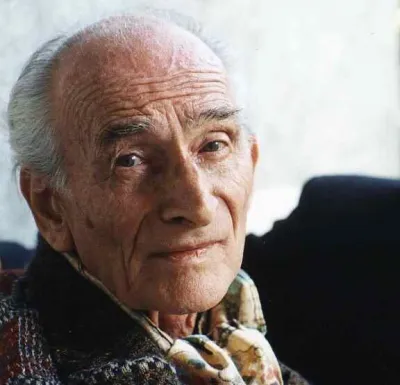
Photo: Wikimedia Commons
Jean Anouilh
Human Design Chart
Biography
A tailor's son, Anouilh grew up in Bordeaux. He was in his teens when he moved to Paris after graduating from high school. He studied law briefly and then joined an advertising firm. His passion for theater had already been firmly planted when he was still a student. As a young man, he served briefly as secretary to the great French director-actor-teacher Louis Jouvet, learning quickly that a play needed to be vested in human truth, whether it dealt with a legendary Greek figure, an archbishop, a saint or a seamstress.
He was known for his idiosyncrasies, wryness of inventions and depth of humanity in a world that he clearly perceived as inhuman. His wide range of interests included writing dialogue and scripts for movies and the translation and adaptation of Oscar Wilde's "The Importance of Being Earnest" and three Shakespearean comedies. He never hid his loathing of television, comparing it to something "between the plague and cholera."
Ferociously private and slightly dour, he looked more like an accountant than a writer with his closely cropped hair and round-rimmed eyeglasses. Anouilh seldom gave interviews. His best work was written in the prolific first half of a career than spanned roughly 50 years.
He lived in Switzerland for many years, where he had his first heart attack in 1983.
Died of a heart attack on 3 October 1987, Lausanne, Switzerland; Anouilh was survived by his wife, one son and three daughters.
The Human Design of Jean Anouilh: Manifesting Generator 3/5
Manifesting Generator 3/5 — Design at a Glance
Jean Anouilh's design inclines towards a hybrid approach to work: He combines the constant, enduring energy of a Generator with the lightning-fast, step-skipping power of a Manifestor. This configuration allowed him to quickly draw things into his life and push multiple projects forward simultaneously. However, this speed carries the risk of overlooking important intermediate steps or blocking himself through too many simultaneous initiatives, which could lead to frustration – the central non-self theme of this type.
The mechanics of his design did not require him to initiate independently but rather to respond to inner impulses. Only through this response and regular verification of approval from his sacral center could he transform his immense creative power into deep satisfaction. When his internal "yes" was present, a productive play mode would kick in, where variety rather than monotony drove the process forward. Without this strategy of reaction and continuous affirmation, his creativity risked becoming aimless as his tendency towards haste would go unchecked. Thus, his design marked him as someone who found his greatest effectiveness through conscious selection of impulses and maintaining play in his work, rather than getting lost in chaos from parallel, unfinished tasks.
Emotional Authority
Jean Anouilh's design shaped a specific decision-making strategy: He had to let his feelings mature before taking action. His inner authority lay in the defined Solar Plexus Center. In Human Design mechanics, this means that the Emotional Center – if defined – always represents the leading instance, regardless of other defined centers in the chart. Jean Anouilh was subject to emotional waves, a constant up and down of his feelings. The world appeared to him colored by his current mood; a moment of enthusiasm could quickly shift into negative perspectives. His immediate feeling, however, was only a snapshot, not a final judgment. Quick, spontaneous reactions from this emotional heat would often have had negative consequences for him. Instead, his design required patience and conscious hesitation. He needed to sleep on decisions multiple times to give intense feelings time to dissipate. With this distance, he gained emotional detachment, leading to clarity and calmness. This process was essential for long-term realignments in his life. Only by waiting out the waves instead of immediately following them could he recognize his true inner truth and make stable, sustainable decisions. The necessity of this waiting period formed the foundation of his inner orientation.
The 3/5 Profile — Martyr / Heretic
Jean Anouilh's Design inclined him towards generating knowledge not through theory but through radical self-experience and trial and error. As an experimenter (Line 3), he initially believed little in preordained truths; instead, he learned from his own failures and experimentation processes. This line steered his ego inflation and the drive to gain control through extreme strategies by recognizing other people's mechanisms.
This self-learned practical knowledge shaped him as someone who could solve others' problems – a role projected onto him by his environment due to his Line 5 energy. As a hero and savior, he was attractive to those wanting to learn from his experiences. This projection flattered his self-image but also made him dependent on external recognition. When he publicly failed in trying new paths, the pain was intense as it shattered his heroic role.
The mechanics describe a cycle: first experimental learning and failing (Line 3), followed by the need for withdrawal for processing and healing (Line 5). Jean Anouilh thus showed himself to be someone who oscillated between the urge to present his authority and the need for recovery. His modesty often crumbled in moments of great recognition, which propelled the cycle of inflation and necessary withdrawal phase. This tension defined his life task: to gain practical wisdom through his own mistakes and then offer this as healing or solution for others while dealing with the burden of these projected expectations.
Split Definition — Defined & Open Centers
Jean Anouilh's design created a massive, constant energy and expression machine. His defined centers – Sacral, Throat, Solar Plexus, Spleen, and Root – formed a robust structure of generative life force that translated directly into clear communication. The defined Sacral Center provided reliable vitality, while the also defined Throat Center acted as a pivot point to make this energy effective in the world as messages and actions. However, his physical responsiveness was filtered through the emotional authority of the defined Solar Plexus Center. Anouilh relied on waiting out the ups and downs of his emotional wave before making decisions; immediate action without this patience led to frustration because his inner truth only revealed itself over time. The defined Spleen Center also provided spontaneous, intuitive security in the present moment, supported by the constant pressure of the defined Root Center to maintain the life impulse.
In contrast, his open centers made him vulnerable to external influences. His open G Center meant that identity and direction were not internally set but had to be initiated through environment and relationships; he tended to question who he was or where love could be found rather than having a firm internal compass. Similarly, the open Head and Ajna Centers left him susceptible to mental pressure and confusion. He could easily get entangled in other people's thoughts or try to find answers to questions that were not his own instead of trusting his emotional clarity. His open Heart Center lacked consistent willpower; he was not built to prove his worth by giving and keeping promises but had to learn not to exhaust himself in competitions or the need for recognition. His strength lay in channeling his sacral energy through emotional patience and releasing the search for a fixed identity or mental certainty.
Channel 12-22: Openness — Channels & Gates
Jean Anouilh's design set a tendency towards an expression style strongly determined by the emotional wave. The Openness Channel 22-12 connected his Solar Plexus Center with the Throat Center. This meant that his readiness for social interaction and articulation depended on his current mood state. Gate 22 brought passion and drama, while Gate 12 maintained a cautious restraint ensuring he only spoke or acted when the timing was right. His emotional authority thus dictated when his words could have transformative impact; forced interactions often led to misunderstandings.
Parallel to this, there was a deep drive towards technical perfection of talents through the Wavelength Channel 48-16. This channel connected the intuitive depth of the Spleen Center (Gate 48) with dexterity in the Throat Center (Gate 16). Jean Anouilh instinctively sought life-critical information and perfected his skills through repeated experimentation. This combination transformed raw skill into a true talent based on precise mastery. It was a process of gradual refinement where inner intelligence merged with outer expertise to communicate a unique wavelength.
These expression and learning processes were embedded in a cyclical maturation process carried by the Ripe Channel 53-42. This channel connected the Root Center with the Sacral Center, demanding complete processing of experiences. Jean Anouilh had to go through cycles until their end to gain wisdom from them. Only through this reflection could he build new experiences on old lessons.
Dominant was the Sun in Gate 15 (Line 3), representing collective behavior and logical structures. This energy directed his individual channels towards societal patterns. His emotional openness served not only personal mood but adaptation to collective rhythms. The perfection of his skills aimed at understanding these large connections and structuring them logically.
Collective Circuitry — Circuit Signature
Jean Anouilh's design presented itself as a tension field between emotional creativity and cool strategy, separated by deep processing of past experiences. As Shared Definition, these energies did not flow in one stream but existed as isolated clusters.
A first block connected the Throat with the Solar Plexus Center through the Openness Channel (Gates 12/22). Here a pulsating, acoustic creativity was at work. Jean Anouilh showed the ability to express his unique path and new insights through emotional waves. This energy was rooted in the present moment and served identity finding through authentic expression.
Parallel to this, there existed a second independent cluster of Throat and Spleen Center connected by the Wavelength Channel (Gates 16/48). This represented focused visual ratio. Unlike the emotional openness of the first cluster, here strategic planning and sharing logical insights without emotional involvement aimed at the future.
A third completely separate area linked Sacral and Root Centers via the Ripe Channel (Gates 42/53). Here a cyclical, descending processing took place. Jean Anouilh reflected on past events to find meaning in them. This energy was inexplicable and wave-like, contrasting with the clear logic of the Understanding Circuit.
The mechanics thus showed three parallel realities: acoustic, emotional identity; visual, strategic reason; as well as cyclical sense-making from the past. None of these forces flowed directly into each other but existed as side-by-side independent potentials that Jean Anouilh could use differently depending on the situation.
Right Angle Cross of the Vessel of Love 2
Jean Anouilh's design carried the signature of the right cross of the Love Vessel 2. This specific configuration determined a fundamental disposition that was not defined by external actions or visible deeds, but rather by the sheer presence of this energetic structure in his chart. Since there were no additional mechanical details such as Gates or Channels present, its impact on his behavior remained abstract and purely conceptual. It was an inner quality that worked as a background characteristic without specific behavioral patterns being derived from it. Jean Anouilh lived with this energetic imprint, which is understood in Human Design as a certain archetypal state. Without additional factors like defined Centers or active Channels, this Cross configuration could not provide concrete strategic impulses. It remained a static property of his design, an energetic underpinning of his existence. Thus, Jean Anouilh was marked by this specific name within his inner compass without it translating into discernible patterns of action. The mechanics here only provided the name of this structure but did not offer tools for its expression. This shaped his essence on a level beyond observable actions and manifested exclusively in the theoretical alignment of this Cross – or rather: as such a configuration existed.
Saturn Return · Uranus Opposition · Chiron Return · 2nd Saturn Return — Life Cycles
Jean Anouilh's design indicated a tendency towards finding deeper integration of his professional identity during the Chiron Return phase. This cycle did not mark a healing process of old wounds in a mythological sense, but rather served as an achievement stage: His own incarnation cross unfolded increasingly if strategy and authority were observed, making purpose and meaning tangible. It was a blooming period when life's mission became concrete.
In 1956, at the age of 46, Jean Anouilh published the work 'The Waltz of Toradors'. This event exemplified this mechanical dynamic: The publication was not coincidental but an expression of how his inner structure condensed outwardly over years according to his design. The Chiron Return functioned here as a catalyst that transformed hidden potentials into visible results. Jean Anouilh did not appear as someone healing old wounds, but rather as one whose specific path and contribution in this life phase reached their full significance. The mechanics describe this period as a moment of clarity and confirmation of one's purpose, independent of external environmental influences.
Manifesting Generator · Emotional Authority — Synthesis
Jean Anouilh lived a lifestyle deeply influenced by the interplay between inner reaction and outer expression. His design as a Manifesting Generator with defined Throat and Sacral Centers points to someone who possessed abundant energy but primarily had to release it through reacting to impulses – rather than initiating independently. This combination of quick response and inner strength fueled his ability to design complex human dramas often marked by apparent spontaneity, yet deeply rooted in the observation of life. The connection to the Solar Plexus Center intensified this tendency by adding an emotional depth that influenced his decisions and creative processes but also required time for maturation.
A central paradox in Anouilh's design lies in the tension between the need for expression – manifest through the defined Throat Center – and the inner authority of the emotional center, which requires a certain restraint and waiting for emotional clarity. This contrast led to a dynamic interaction between impulsive creativity and reflective depth that was reflected in his works.
3 Defined Channels
Incarnation Cross - Right Angle Cross of the Vessel of Love 2
Solar Return
The Solar Return shows the moment when the sun returns to its exact birth position - your personal solar year.
Life Cycles
Discover the life cycles with a detailed triple view (birth chart, cycle chart, composite).
Human Design Profile
- Strategy
- To respond - wait for something to respond to
- Authority
- Emotional Authority
- Profile
- 3/5 - Martyr / Heretic
- Definition
- Split Definition
- Incarnation Cross
- Right Angle Cross of the Vessel of Love 2
- Date of Birth
- 23.06.1910 01:00
- Place of Birth
- Bordeaux, France
Frequently Asked Questions
What was Jean Anouilh's Human Design type?
What Profile did Jean Anouilh have in Human Design?
What Authority did Jean Anouilh have?
What incarnation cross did Jean Anouilh have?
When was Jean Anouilh born?
Discover your own Human Design
Are you also a Manifesting Generator? Find out in a personal reading how to unfold your multi-talents and direct your energy wisely.
More Personalities
Back to overviewAldair
Alizée

Angeli
Arletty
Artus

Balthus