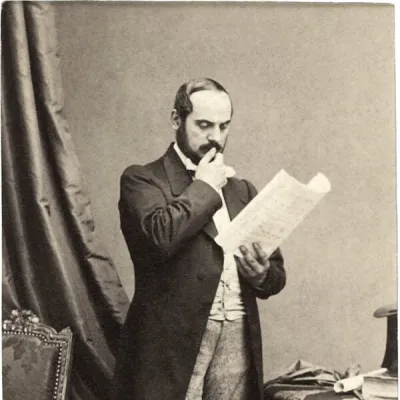
Jean-Baptiste Arban
Human Design Chart
Biography
He died on 8 April 1889 at age 64 in Paris. Arban's trumpet method of 1864 is often referred to as the "Trumpeter's Bible". It is still studied by modern brass players. The Arban Method book is available by various publishers.
Jean-Baptiste Arban — Generator with Profile 4/6
Generator 4/6 — Design at a Glance
Jean-Baptiste Arban revealed himself as someone with remarkable inner endurance. His design as a Generator endowed him with a strong sacral energy source, making him a powerful „workhorse“ – provided he had internal confirmation for his tasks. This configuration offered the potential to effectively materialize things in life, not through mere initiation but through a specific reactive approach.
The mechanics of his design required him to wait for impulses from the environment and react accordingly. If his sacral center signaled a clear „yes“, he could respond with full force. This strategy of „reacting from the gut“ was key to his effectiveness. When Jean-Baptiste Arban lived in harmony with this nature, his design rewarded him with deep feelings of satisfaction and fulfillment. His energy then flowed unimpeded and productively.
However, if he went against this inner logic – for instance by initiating without internal confirmation or expending energy on things that found no resonance – another state emerged. Then frustration and energy loss up to burnout threatened. Equally problematic was being held back from his heart project while still full of power. His design thus suggested: Only through reacting to true internal signals could Jean-Baptiste Arban use his immense strength sustainably and satisfyingly.
Emotional Authority
Jean-Baptiste Arban showed a decision-making stance that did not rely on spontaneous impulses but required time and distance. His design carried emotional authority, meaning his defined Emotional Center was the source of his inner truth – independent of other defined centers in the chart. This configuration subjected him to a natural emotional wave, a permanent up-and-down of feelings. The world appeared always colored by his current mood; what seemed inspiring at one moment could appear negative the next. Since this immediate feeling was only a snapshot and not necessarily the deeper truth, quick, spontaneous decisions were risky for him and often led to negative outcomes.
Instead, his mechanics required patience. Jean-Baptiste Arban had to give himself time to let decisions mature by sleeping on them multiple times. He should hesitate and wait for inner calmness. Over time, intense feelings subsided, he gained emotional distance and clarity set in. Only after this process was completed did he act. This strategy was especially crucial for long-term life decisions as they could have a significant impact on his life course. By waiting out the emotional waves, he arrived at a more comprehensive understanding and avoided errors that would arise from premature reaction.
The 4/6 Profile — Opportunist / Role Model
Jean-Baptiste Arban's design laid out a life dynamic revolving around the inner conflict between the Heart (Line 4) and Head (Line 6). In his first three decades, he acted with an experimental spirit; actively seeking community and belonging while Line 6 still behaved like a Line 3. This phase was marked by a big heart that cautiously checked whom it opened to in order to avoid injury.
After the return of Saturn, around age 30, the full characteristics of Line 6 were activated. Here emerged a clear tension: The desire to be part of a group clashed with the urge to stand above as a wise role model and question principles. His development led him away from being purely a network seeker towards someone who acted through persistence and process loyalty.
Line 4 brought leadership qualities through exemplary behavior; he prepared resources for his environment and respected traditional hierarchies. Simultaneously, Line 6 demanded gratitude in detail and trust in the path to the goal. For him, the process itself became the goal, never complete but always meaningful. His task was to integrate these two poles: not ignoring the emotional vulnerability of the heart while functioning as a cooperative role model with overview and wisdom. This configuration shaped his later life through a balance between human proximity and distant insight.
Triple Split Definition — Defined & Open Centers
Jean-Baptiste Arban revealed himself as someone with an extraordinarily stable inner structure and a clear, powerful presence. His design was marked by a rare abundance of defined centers: Throat, G Center, Heart, Sacral, Solar Plexus, and Root were set in stone. This endowed him with a reliable identity (G Center) and the ability to embody his direction with magnetic certainty. His willpower (Heart Center) was always at his disposal, enabling him to keep promises and control resources autonomously. The defined Sacral Center served as the source of his energy; it generated a constant vital force that waited for reactions to become effective. Simultaneously, the defined Solar Plexus acted as an emotional authority: Arban needed time to go through his emotional waves and gain clarity before making decisions. The persistent pressure from the Root Center propelled him forward.
In contrast, Head, Ajna, and Spleen remained open. This openness did not signify weakness but mental flexibility. Arban tended not to identify with fleeting thoughts or doubts coming from the environment (open Head and Ajna Centers). Instead, he remained an observer of his own mental processes, protecting himself from accepting others' answers as his truth. The open Spleen Center made him vulnerable to conditioned fears or a need for external validation of well-being. He tended to feel insecure when not in an environment that provided a sense of safety and health. Nevertheless, he learned not to misinterpret these impulses as his own intuition but rather use them as mirrors of his surroundings while basing his decisions on the solid foundation of his defined emotional and sacral authorities.
Channels for community, leadership, focus and presence.
Jean-Baptiste Arban revealed himself as someone who exercised leadership not through authority but through logical plausibility and collective trust. His design inclined him to recognize patterns only when invited to do so, stemming from the Alpha Animal Channel 7-31, which links logical leadership with a view towards the future. Here, Gate of Role (7) and Gate of Leading (31) worked together: Arban had to earn trust as someone who understood current trends. Success came only after being chosen by the majority; he represented them rather than ruled over them.
At the same time, there was a strong inner pressure towards concentration within him. The Concentration Channel 52-9 connected Root Center with Sacral Center through Gate of Non-doing (52) and Gate of Focusing (9). This format energy challenged him to remain still, keep distractions at bay, and perfect details precisely. He gathered his energy as in a yoga pose to correct processes step by step and confirm them. This calm pressure helped him fully immerse himself in one thing until it was close to its logical completion.
Emotionally, Arban sought his place within the whole through fair agreements. The Community Channel 37-40 linked Solar Plexus Center with Heart Center via Gate of Friendship (37) and Gate of Solitude (40). He needed time to gain emotional clarity and carefully formulate contracts. It was not about spontaneous deals but sustainable bonds where everyone had an honorable place.
Spiritually, his authentic self-presentation served as a signal for others. The Awakening Channel 10-20 connected G Center with Throat Center through Gate of Appearance (10) and Gate of Now (20). By simply being himself, he lived self-love and acceptance. This awareness unconsciously inspired those around him to live out their own nature, which prompted genuine invitations and avoided resistance.
Collective Circuitry — Circuit Signature
Jean-Baptiste Arban's design placed him in three distinct areas of life. In the Understanding Circuit, he shared rational insights for societal improvement driven by the Alpha Animal Channel (Throat and Identity Centers) as well as Concentration (Sacral and Root Centers). This promoted a future-oriented structuring without emotional influence. Parallel to this stood the Ego Circuit for cooperation within the tribe, connected through the Community Channel linking Heart and Solar Plexus Centers. Here it was about the balance of giving and taking; lacking a connection to the Sacral Center, pauses for resource regeneration were essential. The Integration Circuit ensured individual survival via the Awakening Channel connecting Throat and Identity Centers. This channel bundled forces from reacting to life, proper behavior, and intuitive knowledge in manifestation in the present moment. Although the triad definition formed three central areas - mind, ego, and integration - these existed as parallel, not directly connected energies. The separation between groups meant that rational future visions, tribal support, and individual survival strategies ran alongside each other without a single continuous flow. Jean-Baptiste Arban navigated between logical distance, communal responsibility, and intuitive presence in the here and now.
Right Angle Cross of Planning 1
Jean-Baptiste Arban revealed himself as someone whose internal compass was oriented towards strategic alignment and long-term vision. His design highlighted a pronounced ability to develop complex plans and implement them consistently. This stance stemmed from the configuration of his right cross in Planning 1. This aspect grants the gift of seeing the big picture while clearly identifying the path forward. It is not about spontaneous action but rather a deeply rooted need to bring order out of chaos and approach goals with deliberation. For Jean-Baptiste Arban, this planning competence was not an optional tool but a central component of his life energy. It shaped how he approached challenges: through foresight and organizational skill. The mechanics of this cross support a stance of patience and strategic thinking that enables one to maintain perspective even in uncertain times and take steps with long-term significance. This inner order helped him define his intentions clearly and implement them step by step into reality without being distracted by short-term diversions.
Saturn Return · Uranus Opposition · Chiron Return · 2nd Saturn Return — Life Cycles
Jean-Baptiste Arban's design showed a tendency towards radical transformation, especially when old structures were dismantled to make way for new self-understanding. This mechanism was evident during the phase of his Uranus opposition, a time of breaking through where his true potential became publicly visible. In 1864, at age 39, he published his world-renowned method „La grande méthode complète de cornet à pistons et de saxhorn par Arban“ and received appointment as Professor for Cornet à Pistons at the École Militaire. This event marked the peak of this transformation phase: years of groundwork condensed into a solid, public outcome that reinforced his new authority in music pedagogy. The Uranus opposition did not act here as chaotic destruction but as necessary break with the known to establish his mission in a new form. Through this publication and academic positioning, his inner development was carried outward and institutionalized. It was a moment of confirmation where previous knowledge was systematically compiled and recognized as standard work. Thus, the dynamic power of this astrological transit was fulfilled: old patterns were resolved to make way for a clearly defined public role that anchored his expertise sustainably.
Generator · Emotional Authority — Synthesis
Jean-Baptiste Arban lived a life marked by the dynamic tension between inner clarity and the need for connection. His defined sacral authority and the associated ability to respond to impulses from life (rather than initiate them) formed the foundation of his actions. This responsiveness was strengthened by a strong G Center, which gave him a firm self-identity but also plunged him into an internal conflict between the desire for community and the longing for independent thought—a pattern that became particularly evident in later phases of life. The defined throat allowed him to communicate his inner truth clearly while the connection to heart ensured a resolute orientation towards goals.
A central paradox lay in Arban's strong ability to concentrate and logically analyze (Channel 52-9) alongside being an emotional type whose decisions were influenced by an internal wave. This led to a constant interplay between the need for clarity through waiting and the energy flowing from reacting to the present moment. The combination of defined authority, strong self-image, and the drive to engage in relationships points towards someone who was both profound and socially active—a mediator between inner world and outer action.
4 Defined Channels
Incarnation Cross - Right Angle Cross of Planning 1
Solar Return
The Solar Return shows the moment when the sun returns to its exact birth position - your personal solar year.
Life Cycles
Discover the life cycles with a detailed triple view (birth chart, cycle chart, composite).
Human Design Profile
- Type
- Generator
- Strategy
- To respond - wait for something to respond to
- Authority
- Emotional Authority
- Profile
- 4/6 - Opportunist / Role Model
- Definition
- Triple Split
- Incarnation Cross
- Right Angle Cross of Planning 1
- Date of Birth
- 28.02.1825 03:00
- Place of Birth
- Lyon, France
Frequently Asked Questions
What was Jean-Baptiste Arban's Human Design type?
What Profile did Jean-Baptiste Arban have in Human Design?
Which Authority guided Jean-Baptiste Arban?
What incarnation cross was assigned to Jean-Baptiste Arban?
When was Jean-Baptiste Arban born?
Discover your own Human Design
Are you also a Generator? Find out in a personal reading how to use your sacral energy correctly and discover deep satisfaction.
More Personalities
Back to overviewAaliyah

Alexia

Alizée

Angèle

Anne-Marie

Arcángel