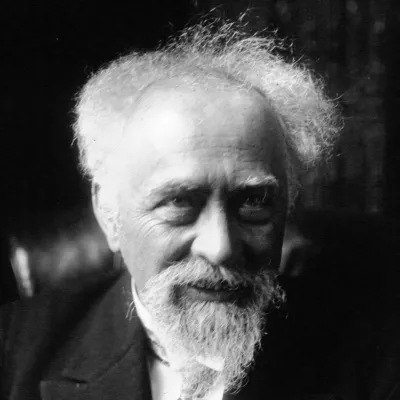
Jean-Baptiste Perrin
Human Design Chart
Biography
Perrin died 17 April 1942, New York, NY.
What does Generator 4/6 mean for Jean-Baptiste Perrin?
Generator 4/6 — Design at a Glance
Jean-Baptiste Perrin revealed himself as someone who did not unleash his power through spontaneous initiatives but rather through quick responses to external impulses. As a Generator, he possessed considerable sacral energy that enabled him tremendous endurance – comparable to an unstoppable workhorse when properly utilized. His design, however, required a specific strategy: Not taking the first step himself, but waiting for signals from the environment and reacting accordingly. When his inner self signaled a clear "yes", he could act with full power; ignoring this internal confirmation or forcing himself to take on tasks without inner resonance led to frustration or energy loss.
This mechanism shaped his life path significantly. The deepest satisfaction and sense of fulfillment came only when he lived in harmony with this reactive nature. Attempts to work against this flow – such as constant initiating without impulse or interrupting his heart projects – inevitably led to inner emptiness and exhaustion. His strength did not lie in leading from the front, but rather in powerfully and enduringly responding to life when it called upon him. Thus, he transformed passive stimuli into active, sustainable creative force so long as he respected the rhythm of his own energy and did not fight against it.
Sacral Authority
Jean-Baptiste Perrins decision-making was based on Sacral Authority. As a Generator, this was his inner guidance, closely intertwined with his strategy and simplifying the process. His reactions did not arise from intellectual planning but as a direct physical response to external stimuli. This "gut feeling" manifested in spontaneous vocal expressions like grunts or hums, along with a noticeable surge of energy. When his Sacral Center was activated, he felt vital and energized. This enabled him to tackle tasks with great enthusiasm without the need for an externally imposed sense of purpose. The joy in the activity itself propelled him forward.
A prerequisite for this clear guidance was an open Emotional Center, ensuring that no impulsive emotional waves overlapped the sacral response. Additionally, his activated Spleen Center acted as a supportive instance. Through its connection to the Sacral Center, it facilitated quick, spontaneous reactions and immediate access to instinctive perception. Jean-Baptiste Perrin could reliably orient himself by this physical well-being. His energy was inexhaustible as long as he listened to these inner signals and did not act against his natural rhythm. This shaped his life as someone who immersed himself in activities that spoke to him from within.
The 4/6 Profile — Opportunist / Role Model
Jean-Baptiste Perrins Design laid out a clear developmental arc: In the first three decades of his life, he acted experimentally, driven by his Profile 4/6 Line 3 inclination to seek connections and test various relationship patterns actively. With the onset of his Saturn Return, this dynamic shifted fundamentally. Perrin found himself in an internal conflict between a deep desire for belonging (Line 4) and a simultaneous longing for spiritual distance and contemplative solitude (Line 6). This tension shaped his later years, during which he was increasingly perceived as a wise role model. His interactions were characterized by cautious selectivity; his Heart Center opened only to those who did not disappoint his high expectations of cooperation and trust. Line 4 imparted an awareness of inadequacies and the fear of failure, while Line 6 drew him towards inner peace and tranquil spirituality. He learned that true silence only sets in when this entire emotional circuit is fulfilled, rather than fleeing into self-deception. His life thus demonstrated the path from a social experimental field to a responsible yet reserved role as a mentor, finding his purpose through successful collaborations.
Split Definition — Defined & Open Centers
Jean-Baptiste Perrin revealed himself as someone with a constant, specific mental function. His defined Ajna Center created a trustworthy form of conceptual thinking; he was not easily influenced by others present and used his mind to process data. This mental activity flowed directly into his defined Throat Center, allowing him to articulate what he thought. His voice served as the focal point for messages that he communicated with ease and clarity.
The energy base for this came from his defined Sacral Center. As a guardian of an immense power source, Perrin generated a specific amount of vitality daily. This sacral response revealed whether energy was available for a task through immediate yes or no tones. He tended to react productively rather than initiate in order to avoid frustration and exhaustion. His defined Spleen Center supported this with spontaneous intuition; he made trustworthy judgments in the moment and used his existential consciousness for health and well-being. The pressure of his defined Root Center helped him move forward in the world and cope with stress by materializing or making corrections.
In contrast, his Head Center was open. Perrin had no constant way to process mental information. He tended to be overwhelmed by others' doubts and confusion or answer meaningless questions. His open G Center meant he did not have a fixed identity; he adapted to the environment and gathered directions through external initiations. His open Heart Center led him not to be designed to be willful. He avoided making promises or proving his worth because he lacked the constant energy for it. Finally, his open Solar Plexus absorbed emotions from the environment. Perrin amplified these feelings and had to learn not to identify with them to remain emotionally stable and handle confrontations correctly.
Channels for logical clarity, pattern recognition and growth.
Jean-Baptiste Perrin revealed himself as someone whose mind was inclined to translate complex patterns into logically organized systems. This attitude resulted from Channel Accepting 17-62, which connected the Ajna Center with the Throat Center. Through Gate 17, he visualized mental structures, while Gate 62 translated these into precise language and details. This created an inner pressure to express opinions only when they were integrated into his existing worldview; anything that could not be logically categorized was incomprehensible.
At the same time, Channel Judgment 58-18 drove him to continuously question and correct existing patterns. Connecting Root Center (Gate 58) with Spleen Center (Gate 18), he sought perfection and functionality. However, this urge for correction was not arbitrary criticism but a mechanism to make life more cheerful for the collective. He found his greatest satisfaction in suggesting solutions when others explicitly asked him, which minimized conflicts and increased the effectiveness of his advice.
His experiential horizon was shaped by Channel Maturation 42-53, linking Root and Sacral Centers. This channel required completing cycles – from beginning to end – before a new phase could start. Only through thorough completion and subsequent reflection did he gain wisdom to pass on. Prematurely ending a cycle led him to repeat it.
Additionally, Gates like 52 (focus on pattern correction) and 48 (deep logical analysis) sharpened his ability for detailed investigation, though they tended towards frustration without implementation. Gate 33 promoted the necessary withdrawal for reflection, while Gate 11 used visual memories to assess situations before acting. This configuration shaped a person who acquired knowledge through logical order, critical examination, and complete cyclical experience.
Collective Circuitry — Circuit Signature
Jean-Baptiste Perrin's design inclined him towards analytical clarity and emotional reflection as two separate yet parallel forces. As someone with Split Definition, he had no continuous energetic connection between these areas; they operated independently.
The Understanding Circuit marked him through Channel Accepting (Gates 17–62), connecting Ajna Center with Throat Center. This allowed him to directly translate visual ideas into words and share logical insights. Simultaneously, Channel Judgment (Gates 18–58) between Spleen and Root Centers acted. Here intuitive perception merged with urgent action capability, promoting quick strategic decisions – always free from emotional influence.
Completely separate from this, the Meaning Circuit operated through Channel Maturation (Gates 42–53). This linked Sacral Center with Root Center and endowed him with a cyclical energy that looked back on past experiences. While the Understanding Circuit provided future-oriented rationality, this second stream served to reflect emotional waves from the past and draw collectively learnable insights from them. Both circuits shaped his essence: on one hand, the cold logic of progress; on the other, the deep, wave-like processing of historical emotions – without these spheres directly overlapping.
Right Angle Cross of Service 3
Jean-Baptiste Perrin's Human Design configuration inclined him towards profound dedication to the well-being of others. This setup, known as the right cross of service, shaped his lifestyle through a strong desire for altruistic action and self-sacrifice. He was not primarily driven by personal fame or individual accolades but found fulfillment in dedicating himself to others and prioritizing their needs over his own.
This mechanism describes an inner alignment where service becomes the central expression of being. It was not merely about fulfilling duties, but a genuine dedication that grew from the core of his personality. Jean-Baptiste Perrin lived this dynamic by channeling his energy into serving the community or specific individuals often without expecting external recognition. His path was marked by the willingness to put himself aside to help and support others. This attitude formed the foundation of his interactions with the world; it defined his contribution less through visible power structures than through quiet, enduring care. The configuration imparted him a deep understanding that true significance lies in giving and bearing for others, which consistently directed his actions.
Saturn Return · Uranus Opposition · Chiron Return · 2nd Saturn Return — Life Cycles
Jean-Baptiste Perrin's design promoted development where inner maturity and external recognition met clearly in phases. His first Saturn Return around the age of 27 marked the transition from a learning phase to independent responsibility. This was concretely seen in 1897 with his doctoral thesis on cathode rays and X-rays – a milestone that condensed years of groundwork into a solid academic foundation.
The subsequent Uranus Opposition around the age of 40 often brought a period of breaking free from old structures for new authority. For Perrin, this energetic shift manifested in 1910 through his appointment as Professor at the Sorbonne. Here he stepped into a role that not only imparted knowledge but established him as an acknowledged figure.
The second Saturn Return around the age of 56 confirmed long-term integrity on his path. This cycle often brought final recognition of life's work. In 1926, Perrin received the Nobel Prize in Physics. This distinction was less a sudden stroke of luck than the visible crowning of a consistently pursued scientific line prepared by earlier milestones. His chart thus described a clear progression: from laying the foundation to acquiring authority and finally to the ultimate validation of his work.
Generator · Sacral Authority — Synthesis
Jean-Baptiste Perrin was a Generator whose life was marked by deeply rooted sacral energy. This driving force, combined with a defined mental center (Ajna), led to an unceasing process of understanding and organizing information (Channel Accepting). He found joy in the work itself and discovered inner vitality through action – as long as it aligned with his sacral response. The recurring turning points in career and recognition (Saturn Return, Uranus Opposition) attest to a capacity to focus energy on tasks that truly came to him and sustainedly satisfied him.
At the same time, he lived an internal conflict highlighted by the profile of Networker/Role Model. The need for community (Line 4) stood in contrast to the desire for independent thought and reflection (Line 6). This dualism between social interaction and introspective contemplation shaped his decisions, with a central role played by focusing on logical structuring and sharing insights (Understanding Circuit). He thus always navigated between the wish to connect and the drive for individual meaning.
3 Defined Channels
Incarnation Cross - Right Angle Cross of Service 3
Solar Return
The Solar Return shows the moment when the sun returns to its exact birth position - your personal solar year.
Life Cycles
Discover the life cycles with a detailed triple view (birth chart, cycle chart, composite).
Human Design Profile
- Type
- Generator
- Strategy
- To respond - wait for something to respond to
- Authority
- Sacral Authority
- Profile
- 4/6 - Opportunist / Role Model
- Definition
- Split Definition
- Incarnation Cross
- Right Angle Cross of Service 3
- Date of Birth
- 30.09.1870 19:30
- Place of Birth
- Lille, France
Frequently Asked Questions
What was Jean-Baptiste Perrin's Human Design type?
What Profile did Jean-Baptiste Perrin have in Human Design?
What Authority did Jean-Baptiste Perrin have?
What incarnation cross did Jean-Baptiste Perrin have?
When was Jean-Baptiste Perrin born?
Discover your own Human Design
Are you also a Generator? Find out in a personal reading how to use your sacral energy correctly and discover deep satisfaction.
More Personalities
Back to overviewAaliyah

Alexia

Angèle

Anne-Marie

Arcángel

Arno