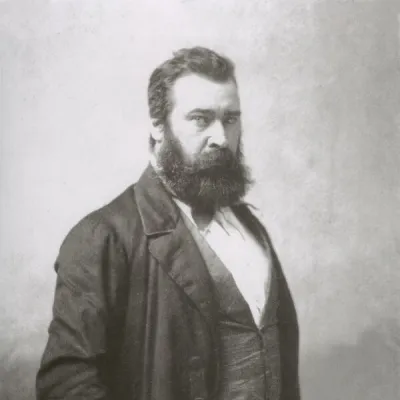
Jean Francois Millet
Human Design Chart
Biography
Jean Francois Millet as a Manifestor 2/4 in Human Design
Manifestor 2/4 — Design at a Glance
Jean Francois Millet's design established a foundational stance as a pioneer and visionary. He was a Manifestor, a configuration designed to set impulses in motion and move others without having to walk the entire path himself. Similar to an emperor in ancient Rome, he had the power to devise grand plans and send others—his 'soldiers'—to realize these goals. However, this role brought with it a specific challenge: His thinking often extended beyond that of his surroundings, leading him to be frequently misunderstood. His visions polarized people; some followed him enthusiastically while others rejected or even hated him due to these grand dreams. To minimize friction and find the right followership, it was crucial for his design to inform others precisely about his intentions at the right time. This was his strategy. When he adhered to this principle and held onto his inner authority, his system rewarded him with a sense of inner peace. Conversely, when he lived against his design, he felt instead a persistent, deep-seated anger. Thus, his life was shaped by the tension between his leading role and the need for clear communication to avoid misunderstandings and maintain his peace.
Splenic Authority
Jean Francois Millet's design inclined towards immediate, intuitive decision-making. His inner authority lay in the defined Spleen Center—the body's health and alarm system. This configuration required both the Emotional and Sacral Centers to be open; only Projectors or Manifestors can carry this specific authority.
The Spleen Center endowed him with a pronounced survival intelligence. It manifested as spontaneous internal knowledge about whether a situation, environment, or society was healthy for him. His instinct and physical well-being served as reliable indicators: The first impulse in the moment made the right decision. This allowed him to rigorously shield against harmful influences and effectively care for himself.
However, this impulse was delicate and fleeting; it could easily be drowned out. Therefore, high vigilance was necessary not to ignore this voice. Since what was right became known only at that moment, plans often changed at the last minute. Long-term commitments were difficult; instead, he needed much freedom and flexibility. A retreat for decision-making could be helpful, yet spontaneity remained central to his health and well-being.
The 2/4 Profile — Hermit / Opportunist
Jean Francois Millet's design inclined towards a tension-filled balance between a deep need for withdrawal and the urge to connect with his closest community. As a 2/4 Profile known as 'Natural Talent / Networker', he constantly oscillated between Line 2 of the Hermit and Line 4 of Community. This configuration created an internal dynamic where the necessity to be alone to gain clarity directly competed with the desire to spend time with chosen people.
It was crucial for him to build a safe environment in which he could clearly communicate these needs: when he sought company and when he wanted solitude. During his 'Me-Time', he immersed himself in internal processes to find peace. Only after this need for isolation was satisfied did Line 4 re-emerge, allowing him to come out of his retreat to nurture his network. This cycle enabled him to reflect on the knowledge of his contacts and develop new ideas from it.
Additionally, Gate 48 in the second line shaped themes such as depth and degeneration in his perspective. Without experimental elements (Gate 16), this depth often remained unresolved. The Pluto side of this gate warned against giving up positive qualities, while an misguided desire for harmony could lead to decay when deep values were threatened. Parallel to this, Gate 39 in the fourth line showed a strong fixation and provocative character that required careful judgment before action to manage mutations in timing.
Single Definition — Defined & Open Centers
Jean Francois Millet's Human Design profile points towards a tendency for clear, identity-strong communication that stems from a firm internal compass. His defined G Center gave him reliable self-identity and a sense of direction; he knew who he was and where his path led without needing external validation. This inner security flowed into his defined Throat Center, which served as an anchor to bring this truth into the world through speech or action. His voice did not come from thought but rather from this deep sense of Being and Love, making his expression authentic and consistent.
Additionally, he had a defined Heart Center that gave him willpower. He could make promises and keep them, which strengthened his self-esteem. Simultaneously, his defined Spleen Center acted as intuitive authority: it provided spontaneous judgments about health and well-being that he could trust without rational justification.
In contrast, his open centers shaped a high sensitivity to external fields. His open Head and Ajna Centers made him receptive to mental inspirations from others but tended towards confusion when trying to solve other people's questions as if they were his own. He often questioned whether he had the right answer instead of trusting his inner intuition. The open Solar Plexus Center absorbed emotional waves from the environment; he needed to learn not to personalize every felt mood or flee from confrontation. Finally, his open Root Center took on external stress, leading to a cycle of excessive action to release pressure rather than simply observing and letting go.
Channels for willpower, reflection and intuitive clarity.
Jean Francois Millet's Human Design profile points towards a tendency for deep reflection paired with the ability to clearly express intuitive truths in the moment. He gathered experiences like a natural listener and sorted them patiently before sharing them. This happened through the Lost Son Channel 13-33, connecting his G Center with his Throat Center. Gate 13 listened and stored secrets; Gate 33 withdrew to think about these memories until a deeper truth revealed itself. This configuration promoted the role of witness, preserving life stories as lessons for the collective.
Simultaneously, Jean Francois Millet showed spontaneous insights that were directly put into words. The Brainwave Channel 57-20 connected his Spleen Center with his Throat Center. Here intuitive knowledge flowed from Gate 57 as a wave of knowing to Gate 20, the Now Gate. This enabled him to communicate existential wisdom in the moment and encourage others to awaken their own inner survival intelligence. His verbal outbursts often hit the core of an issue faster than deliberate thought.
On a material level, the Money Line Channel 21-45 between Heart and Throat Centers was at work. Gate 21, the Hunter's Gate, sought control and service while Gate 45, the Gatherer's Gate, claimed authority over resources. This channel drove him to take responsibility and master the material realm through willpower, always seeking a balance between work and the need for personal independence.
Additional Gates shaped his inner world: Gate 48 enabled pattern recognition and logical correction but also led to frustration without implementation. Gate 39 activated adrenaline for mutations through provocation and analysis. Gate 38 set boundaries to preserve individual integrity under pressure. Gate 46 fostered dedication to the process and love for the body as a temple. Gate 62 provided patient detail work and logical fact-finding, while Gate 56 translated mental processes into evocative narratives. Gate 40 sought liberation through work but expected recognition and rest as reward.
Tribal Circuitry — Circuit Signature
Jean Francois Millet's Human Design profile points towards impulsive, creative communication. The Knowledge Circuit in him connected his Throat Center with the Spleen via Channel 20-57. This generated sudden flashes of insight – innovative ideas that were immediately put into words without extensive planning.
Parallel to this, energy flowed through the Meaning Circuit between Identity and Throat Centers (Channel 33-13). Here it was about sharing personal experiences and searching for meaning in past events. Jean Francois Millet expressed his emotional truth to touch others and enable shared learning experiences.
A third aspect came from the Ego Circuit, connecting Heart and Throat Centers (Channel 21-45). This involved communication about resources and material well-being within collaborations. It was an exchange of values and giving and taking in relationships, always interrupted by necessary pauses for regenerating strength.
All these centers – Throat, Spleen, Identity, Heart – belonged to a single energetic group in Jean Francois Millet. They did not operate independently but as a connected system: creative impulses from the Spleen flowed directly into the emotional expression power of Solar Plexus and will-supported communication of the Heart through the central Throat Center. This shaped a way of living his identity through spontaneous, meaning-making, and resource-aware expressions.
Right Angle Cross of Tension 3
Jean Francois Millet's design indicated a tendency towards inner conflict, characterized by the tension between the desire for self-validation and the necessity to engage in relationships. This tension arose from the connection of Gate 39 in the Solar Plexus Center with Gate 12 in the Emotional Center through the right cross of tension 3.
Gate 39 conveyed a strong need for appreciation and the feeling of being special, driving him to assert his own identity and significance. At the same time, Gate 12 in the Emotional Center activated the ability to deeply empathize with other people's feelings and share them. This connection created a dynamic tension: While one part of him sought individual recognition, another was drawn towards emotional connections with others.
This configuration did not mean he was torn between two opposing poles but rather that both energies were active simultaneously. The challenge lay in integrating these forces instead of experiencing them as contradictory. Through the right cross of tension 3, Jean Francois Millet learned how to combine his personal ambitions with empathy. This allowed him to find his own voice and build genuine connections with others without losing himself or overwhelming them.
Saturn Return · Uranus Opposition · Chiron Return · 2nd Saturn Return — Life Cycles
Jean Francois Millet's design indicated a tendency towards profound structural life changes often marked by external recognition or binding contracts. These patterns were evident in his Saturn Returns, approximately 29-year cycles where inner maturity meets outer reality, demanding fundamental decisions.
In 1841 at the age of 27, Jean Francois Millet married Pauline-Virginie Ono. This first Saturn Return signaled the need to take responsibility and commit to a relationship – a step that marked a phase of binding and building in his chart. The tragic end of this marriage in 1844 underscored the severity of this transition.
His second Saturn Return occurred in 1868 when Jean Francois Millet was 54 years old. At this age, he was awarded the Order of a Knight of the Legion of Honor. For his design, this marked the peak of a long phase of validation and societal integration. The Saturn Return here did not function as punishment but rather as a moment of crystallization: What had been built over decades now took an official, unshakeable form. This recognition served as external validation for his inner development and work, clearly signaling that he had found his role within the structure of his time.
Manifestor · Splenic Authority — Synthesis
Jean Francois Millet lived a life marked by deep internal authority and a strong drive towards transformation. As a Manifestor (Design), he acted as a pioneer whose visions often surpassed those of others. This ability to chart new paths was reinforced by the definition of the Communication and Manifestation Centers (Centers) – an expression of energy that emerged from within and unfolded in the world. The Channel of the Lost Son (Channels/Gates) points towards a cyclical process of experience, reflection, and ultimately shared wisdom, while the right cross of tension 3 suggests a constant search for new experiences and insights.
Simultaneously, Millet's design revealed a central paradox: the tension between the need for isolation and connectedness (Profile). Line 2 of the Natural Talent required withdrawal to gain inner clarity, while line 4 of the Networker nurtured the desire for exchange and community. This interplay between solitude and companionship was also reflected in his Spleen Authority (Authority), which provided spontaneous impulses towards separation and protection of his well-being, while he was simultaneously driven by creative energy (Knowledge Circuit) to interact with and change the world.
3 Defined Channels
Incarnation Cross - Right Angle Cross of Tension 3
Solar Return
The Solar Return shows the moment when the sun returns to its exact birth position - your personal solar year.
Life Cycles
Discover the life cycles with a detailed triple view (birth chart, cycle chart, composite).
Human Design Profile
- Type
- Manifestor
- Strategy
- To inform others before acting
- Authority
- Splenic Authority
- Profile
- 2/4 - Hermit / Opportunist
- Definition
- Single Definition
- Incarnation Cross
- Right Angle Cross of Tension 3
- Date of Birth
- 04.10.1814 20:00
- Place of Birth
- Gruchy, France
Frequently Asked Questions
What was the Human Design type of Jean Francois Millet?
What profile did Jean Francois Millet have?
What authority did Jean Francois Millet possess?
What incarnation cross did Jean Francois Millet have?
When was Jean Francois Millet born?
Discover your own Human Design
Are you also a Manifestor? Find out in a personal reading how to use your initiation power peacefully and dissolve resistance.
More Personalities
Back to overviewBaekhyun

Balthus
Beyoncé

Christian-Jaque

Fergie

Halston