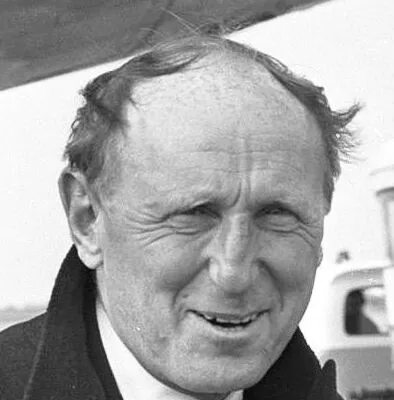
Jean Marie Pfaff
Human Design Chart
Biography
He was the goalkeeper during Euro 1980 and Euro 1984, and the 1982 and 1986 World Cups.
Jean Marie Pfaff — Projector with Profile 2/4
Projector 2/4 — Design at a Glance
Jean Marie Pfaff's design tends towards a focused and penetrating presence. As a projector, her aura appeared as a bright light beam directed specifically toward weaknesses or uncertainties in her environment. This configuration grants the ability to recognize systemic errors or hidden connections in others instantly – often before they themselves become aware of the problem.
The challenge of this design lies in communication style. When Jean Marie Pfaff expressed her observations directly and unsolicited, it could be perceived as critical or uncomfortable by those around her, much like a light beam shining directly into someone's face. However, the mechanics of her chart reveal a more elegant approach: By embodying harmonious patterns herself, she became attractive to others. People would then come to her voluntarily for advice rather than having to impose it.
Since projectors do not have a constant level of intrinsic life energy, Jean Marie Pfaff relied on phases of rest to prevent burnout. Her path involved waiting for respectful and honest invitations. Only through this recognition could she use her energy efficiently and be rewarded with success. Without such a strategy, the non-self theme of bitterness threatened, a feeling of injustice or frustration towards a world that did not accept her leadership.
No Inner Authority
Jean Marie Pfaff lacked an inner physical authority – a rare trait indicating either a mental projector or reflector. As a mental projector, there was no activation of centers below the throat center; decision-making thus did not stem from a firm internal compass but rather through exchanges with many different people. In these dialogues, energetic interactions in open centers awakened latent potentials, making information from various perspectives accessible. This high resonance capability served to identify the right environment and suitable conversation partners.
The evaluation of this diverse influx was a complex process requiring time and solitude. Only in tranquility could Jean Marie Pfaff discern the thread, distinguish meaningful from irrelevant information, and develop specific intelligence: filtering, organizing, and structuring essential data from an abundance of information. This formed the central capital for success as a projector. A key element lay in being in an environment that promoted well-being, enabling a trusting exchange with the right people to deepen her sense of what truly belonged to Jean Marie Pfaff and was correct.
The 2/4 Profile — Hermit / Opportunist
Jean Marie Pfaff's design tends towards oscillating between the need for withdrawal and the desire for community. This Profile 2/4 created internal tension: on one hand, the longing for solitude for self-reflection; on the other, the urge to spend time with familiar people. Crucial for this configuration was clear communication of these needs – both signals 'I need space' and 'I want company'. During phases of isolation, Jean Marie Pfaff could immerse herself in internal processes, maintain calmness, and gain clarity. Fulfilling this need for inner peace activated Line 4: the will to seek out a network and share experiences with others. The mechanics show a cycle of appropriation and reflection. Through Gate 5 (Line 2), serenity and self-control emerged; stable rhythms served energy conservation. Simultaneously, Gate 64 (Line 4) brought initial confusion, which was resolved by inner certainty. This line inspired the environment and fostered friendships as it waited for appropriate opportunities from the network. The combination allowed evaluating knowledge from social contacts during solitary times to develop new ideas. Thus, Jean Marie Pfaff demonstrated someone who created security through clear boundaries: withdrawal for condensing experiences, connection for sharing insights. This shift was not contradictory but a functional process where solitude formed the basis for authentic connection and vice versa, the network provided material for inner work.
Single Definition — Defined & Open Centers
Jean Marie Pfaff's Human Design reveals a tendency towards constant mental pressure to question and form concepts. The definition between the Head Center and Ajna Center created a permanent inner drive to understand connections – not as energy for implementation, but as inspiration for others. This mental process was always active; thinking could neither be stopped nor controlled, which made meditation difficult but provided a reliable source of ideas.
At the same time, her design showed high receptivity to external influences in areas such as communication, identity, and energy. The open Throat Center tended to feel pressured to demand attention through speaking rather than waiting for natural invitations. The open G Center indicated a lack of stable identity; Jean Marie Pfaff adapted to her environment and often sought direction or love in relationships instead of accepting them as reflections of her own truth.
The open Heart Center led to seeking validation through promises or competition – a cycle that lowered self-worth upon failure. The open Sacral Center absorbed the energy of others, leading to exhaustion if boundaries were not set. Additionally, the open Solar Plexus Center amplified foreign emotions, which could lead to confusion about one's own feelings. Furthermore, the open Spleen Center acted through fears of survival security and the open Root Center through absorption of external stress.
The challenge lay in not transforming mental pressure into hasty actions or defining oneself through external validation. Instead, it was important to trust inner authority: waiting until timing was right and recognizing that identity, energy, and emotional clarity come from the correct environment – not from personal striving.
Channels for logical analysis through critical doubt.
Jean Marie Pfaff's design revealed a tendency towards analytical skepticism paired with a deep need for inner clarity. The Logic Channel 63-4 connected the Head Center to the Ajna Center and created a mind that constantly filtered patterns to test their consistency. Doubt was here no obstacle but essential for logic; only through logical experimentation and proof did an answer function. This channel served the collective by making well-founded predictions, yet it did not solve personal future questions when mental pressure encountered no resistance, which could lead to fear as the mind was designed to be useful to others.
Additionally, Gate 5 in the Rhythm Cross influenced her design. It represented the fundamental rhythm of all life processes and required stable habits and rituals to build energy and set one's own pace. Pattern perfection led here to clarity in the energy channel. Gate 35 stood for change through interaction; true satisfaction arose only later from understanding the meaning of experiences made.
On a personal level, Gates 61 and 43 shaped her inner experience. Gate 61, part of the Knowing Circuit, described the struggle for silence and recognizing inner truth through spontaneous thought mutation. It distinguished between personal, general, and unknowable knowledge. Gate 43 allowed breakthroughs in individual insights from internal dialogue. The task was to clearly communicate this new knowledge, which led to recognition but also brought fear of rejection. Jean Marie Pfaff thus appeared as someone who connected external logic with inner, mutative truth.
Collective Circuitry — Circuit Signature
Jean Marie Pfaff's design revealed a tendency towards structured, rational analysis. She showed herself as someone who wanted to clearly recognize logical connections and share these insights with others – ideally free from emotional coloring or conditioning. This aligned with the Understanding Circuit, whose core energy lies in using logic, strategy, and focus to improve society and shape a better future.
In Jean Marie Pfaff's case, this circuit was active through the Logic Channel connecting the Head Center to the Ajna Center. The Head Center often provided spontaneous impulses or questions while the Ajna Center translated these into focused thoughts and visual images. As both centers were directly connected, there emerged a coherent flow from intuition towards concrete thought structure. This was 'emotionless ratio' since the Solar Plexus Center is not part of this circuit; knowledge acquisition thus relied purely on reason and strategic thinking, not emotional evaluation.
As someone with simple definition, Jean Marie Pfaff possessed this specific energetic connection as a consistent part of her design. The energy worked consistently: she absorbed impulses, processed them logically in the Ajna Center, and aimed to further disseminate the resulting clear structures. This mechanism shaped her way of organizing information and strategically applying it to make complex issues understandable.
Right Angle Cross of Consciousness 4
Jean Marie Pfaff's design indicates a tendency towards a deep, often unconscious search for meaning behind material existence. This configuration shows someone who does not take life as a superficial experience but rather as a space where spiritual truths must be practically tested and lived. The right consciousness cross 4 describes a specific energetic orientation: it is about transforming suffering or challenges into wise insight. Those carrying this structure tend to learn through personal experiences and encounters with fate, rather than accumulating theoretical knowledge alone. The energy of this cross acts like an inner compass, directing the focus towards connecting the mundane with the transcendent. It is not a passive stance but an active engagement with how higher principles can be effectively applied in concrete actions. Thus, Jean Marie Pfaff was shown to be someone whose life path was strongly marked by this integrative force – the drive to turn what has been learned into action and thereby build a bridge between individual experience and universal truth. This mechanism explains the often observed intensity and deep reflection that accompanies such a design.
Saturn Return · Uranus Opposition · Chiron Return · 2nd Saturn Return — Life Cycles
Jean Marie Pfaff's design indicated a tendency towards structural anchoring, which manifested in clear career transitions. In 1982, at age 29, he moved to FC Bayern Munich. This marks his first Saturn return, a cycle where years of groundwork and inner maturity often condense into a stable institutional outcome. The energy of this transit supports the foundation for long-term commitments and the establishment of a stable framework in public life.
Later, his chart showed a phase of dissolving old structures. In 1990, at age 37, his football career ended. This falls within the Uranus opposition period, a time when established patterns often need to dissolve to make way for new, freer expressions. This transit demands the release from past role identities and can be experienced as a necessary break that clears the path for a newly defined life phase, free from the constraints of earlier commitments.
Projector · No Inner Authority — Synthesis
Jean Marie Pfaff's life seems marked by a deeply rooted need for understanding and clarity. The definition between Head Center and Ajna Center (Logic Channel) creates a constant mental pressure to filter patterns and formulate questions – a process that drives him to analyze and penetrate the world around him. This is reinforced by his profile as a natural talent/networker, oscillating between withdrawing into inner reflection (Line 2) and the need for connection with selected individuals (Line 4); a dynamic interplay where moments of reflection provide clarity for interactions. He projects his energy onto others to shed light on their blind spots – a skill that must be used carefully.
Pfaff's design harbors a paradox between the drive for logical analysis (Mind Circuit) and the lack of inner authority. He relies on exchange with others to reach decisions, as he lacks clear internal guidance. This leads to high resonance in open centers, providing him with diverse perspectives but also making him vulnerable to external influences. The documented events – a career change and the end of his active playing days – show how external circumstances and choices shape his life journey while he constantly seeks constancy in patterns (Channel 63-4).
1 Defined Channel
Incarnation Cross - Right Angle Cross of Consciousness 4
Solar Return
The Solar Return shows the moment when the sun returns to its exact birth position - your personal solar year.
Life Cycles
Discover the life cycles with a detailed triple view (birth chart, cycle chart, composite).
Human Design Profile
- Type
- Projector
- Strategy
- Wait for the respectful invitation
- Authority
- No inner authority - learn more
- Profile
- 2/4 - Hermit / Opportunist
- Definition
- Single Definition
- Incarnation Cross
- Right Angle Cross of Consciousness 4
- Date of Birth
- 04.12.1953 19:30
- Place of Birth
- Lebbeke, BEL
Frequently Asked Questions
What is Jean Marie Pfaff's Human Design type?
What is Jean Marie Pfaff's Profile in Human Design?
Which authority determines Jean Marie Pfaff's decision-making?
What incarnation cross was assigned to Jean Marie Pfaff?
Discover your own Human Design
Are you also a Projector? Find out in a personal reading how to unfold your leadership qualities and recognize the right invitations.
More Personalities
Back to overviewSissy Spacek

Alain-Fournier

Aldair

Anémone

Ann-Margret

Bourvil