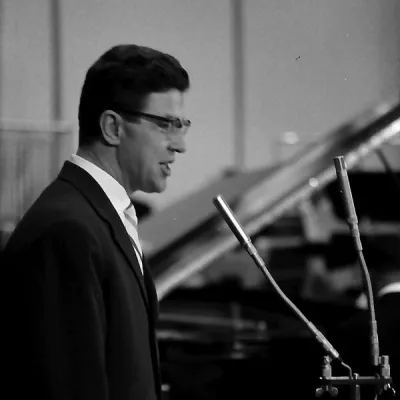
Joachim E. Berendt
Human Design Chart
Biography
After World War II he helped founding the Südwestfunk (SWF) radio network in the then French occupation zone of Germany. From 1950 till his retirement in 1987 he was in charge of the Jazz department of the SWF.
In 1952 the first German edition of Berendt's Jazz Book was published. It became a definitive book on Jazz translated into many languages and is still being updated and reprinted. For almost 40 years Berendt produced the Jazz program of the Baden-Baden station of the German public radio and TV network ARD. His weekly TV show Jazztime Baden-Baden and his daily radio shows were pioneer work in advancing and popularizing Jazz in post-war Germany. Berendt later focused on world music and was one of its early promoters.
Berendt initiated and organized many Jazz festivals (American Folk Blues Festival, Berliner Jazztage, World Expo Osaka). He was producer of many records, mainly for MPS Records, and supported the Jazz & Lyrik project, combining Jazz performances with readings of poetry.
Berendt was awarded, amongst others, the critic's award of German television, the culture award of Poland, and twice the Bundesfilmpreis.
Berendt died on 4 February 2000 at the age of 77 after a traffic accident which he was involved in as a pedestrian. The accident happened in Hamburg.
What does Generator 1/3 mean for Joachim E. Berendt?
Generator 1/3 — Design at a Glance
Joachim E. Berendt, as a Generator, possessed immense endurance and acted as a powerful energy carrier, comparable to a workhorse that unleashes its strength when given the right task. However, his functional principle did not rely on initiative but rather on reaction. The central strategy was to wait for external signals from life and only act once his Sacral Center sent a clear 'yes' – an inner signal guiding him.
This mechanism was crucial for his satisfaction. When he reacted instead of initiating, he generated deep fulfillment and could not be stopped by anyone. Conversely, two specific dangers loomed: acting against his inner interest or trying to force things without joy led to wasted energy and frustration up to burnout. Similarly harmful was being held back from his heart project while still full of power.
Deviation from the reactive principle inevitably resulted in a lack of energy and persistent frustration for him. His design thus manifested in the ability to materialize through endurance and intuitive reaction from the gut – always provided he followed this inner compass rather than external constraints or self-willed starts without impulse.
Sacral Authority
Joachim E. Berendt did not base his decisions on intellectual deliberation but on immediate physical signals. His design positioned sacral authority as the primary instance, meaning he responded to external stimuli with an internal resonance. This response often manifested through sounds like a grunt or 'Mhm' and noticeable energy surges in the lower abdomen.
As a Generator, his strategy was to wait for this impulse before acting. This mechanism greatly simplified his decision-making process since strategy and inner authority were identical. A prerequisite for clear guidance was an open emotional center, ensuring that the sacral response wasn't distorted by short-term emotional waves. When his sacral motor kicked in, he felt vital and alive. He then had seemingly inexhaustible energy and tackled tasks with great enthusiasm.
This design promoted a life of satisfaction where he could immerse himself fully in activities without them being strictly goal-oriented. The authenticity of his actions stemmed from this physical perception. Through the connection between strategy and authority, Joachim E. Berendt lived a structure that enabled him to move through life with joy, driven by direct confirmation from his body rather than external expectations or logical planning.
The 1/3 Profile — Investigator / Martyr
Joachim E. Berendt emerged as an individual whose judgments were based on a strict combination of theoretical knowledge and practical experience. His design suggested he did not blindly accept information but ran it through a double filter: first studying the fundamentals, then empirically testing in reality. This approach aligned with Profile 1/3, the Researcher and Experimenter. Here integrity arises only through this synthesis; what was neither studied nor tested practically was deemed untrustworthy for him.
An internal tension existed between Line 1's fear of ignorance – the feeling of not knowing enough to act – and the drive of Line 3 to learn through trial and error. This dynamic propelled him to sort out trivialities and focus on what truly mattered. When Joachim E. Berendt deemed something good, he had both intellectually understood it and practically validated it. His role was to function as a quality controller for stimulation. He sought the essential and did not let superficial stimuli pass by unnoticed. His judgment was the result of a long process of testing and reflection, giving his recommendations particular credibility.
Split Definition — Defined & Open Centers
Joachim E. Berendt revealed himself as a person with a massive, constant internal infrastructure. His design was characterized by five defined centers: the Sacral Center provided a reliable source of vital energy and responsiveness; the Ajna Center ensured continuous mental conceptualization; the defined Throat enabled reliable manifestation and communication; the Spleen Center offered spontaneous intuition and a strong health instinct; and the Root Center generated a constant forward drive. This configuration created high internal stability, so he did not rely on external validation.
In contrast, Head, G-Center, Heart, and Solar Plexus were open. These opennesses did not indicate deficits but situational permeability. The open Head Center lacked firm mental pressure; Joachim E. Berendt tended to engage with questions that were not his own or sought inspiration from outside rather than generating it internally. The open G-Center implied no rigid identity or fixed life direction; he reflected more the environments and people around him, which could lead to feeling uncertain in relationships or places if they were incorrect.
The open Heart Center meant a lack of constant willpower or ego energy. Joachim E. Berendt was vulnerable to making promises to prove his worth, although he lacked the energy to maintain them long-term – a typical pattern for an open heart often expressed as feelings of inadequacy. Finally, his open Solar Plexus absorbed emotions from the environment rather than generating its own; he reflected and amplified others' moods, which made him vulnerable to emotional conditioning.
The central challenge lay in not squandering the immense energy of his defined centers through initiated action from the open areas – especially by promising willpower (Heart) or seeking a fixed identity (G). Instead, his mechanics worked best when he steered his energy through reacting to external impulses (Sacral) and intuitive assessment of the moment (Spleen), rather than initiating from the mind or emotional contagion.
Channels for change, focus, curiosity and intuitive mastery.
Joachim E. Berendt showed himself as someone whose energy oscillated between pulsing change and calm focus. This tension resulted from two dominant format channels. The Channel of Mutation 60-3 connected the Root Center with the Sacral Center through the Gate of Limitation (60) and the Gate of Order (3). This generated an unpredictable, melancholic energy of evolutionary transformation. Joachim E. Berendt had to learn to accept limitations and move beyond the confusion of a new beginning without steering the process with arguments. In the pauses between these adrenaline-charged impulses, the new developed underground; he brought change into his environment as soon as the pulse arrived.
Simultaneously, the Channel of Concentration 52-9 also between Root and Sacral Center, through the Gate of Non-action (52) and the Gate of Focusing (9). This channel demanded logical precision and the ability to hold still in order to perfect patterns. Joachim E. Berendt evaluated details intensively and kept his body calm, like in a yoga pose, until his Sacral Center reacted. This concentration created an inner discipline that countered the chaotic drive of mutation.
Additionally, the Channel of Curiosity 11-56 shaped his way of communicating. Through the Gate of Ideas (11) and the Gate of Inspiration (56), he connected abstract concepts with narrative power. Joachim E. Berendt was less interested in dry facts than in weaving stories that taught or entertained others. He functioned as a storyteller who magically linked ideas to illustrate his philosophical viewpoint.
The final channel was the Channel of Wavelength 48-16, which connected intuitive depth (Gate 48) with technical skill (Gate 16). Through repeated practice and identification with an ability, Joachim E. Berendt transformed pure technique into real talent. His mechanics required engagement and dedication to achieve mastery; he used his inner intelligence to perfect skills and make them accessible to others. This combination of mutation, concentration, narrative curiosity, and talented depth defined his unique profile.
Collective Circuitry — Circuit Signature
Joachim E. Berendt's design laid a tendency towards pulsing, acoustic creativity that was shown through the Knowledge Circuit. This connected his Sacral and Root Centers via Channel 3-60 (Mutation). This connection promoted the emergence of new, unique identities and the courage to deviate from the existing, driven by vital energy bringing change into the world.
Parallel to this, the Understanding Circuit worked with two separate segments. One part connected his Throat and Spleen Centers (Channels 16-48, 9-52), enabling focused visual insight and strategic sharing of logical connections. The other segment of this circuit again connected his Sacral and Root Centers, thereby underpinning rational structuring through vital energy. These two groups were not directly linked but existed as parallel forces: on the one hand emotional mutation, on the other cool reason.
The Meaning Circuit followed by connecting his Ajna and Throat Centers (Channel 11-56). This allowed Joachim E. Berendt to reflect past experiences and share these insights verbally with others to learn from history. Through their shared definition, these circuits did not act as a single flow but distinct areas: the transformative power of mutation in knowledge, the strategic clarity of understanding, and the reflective depth of meaning energy shaped his work alongside each other.
Right Angle Cross of Laws 2
Joachim E. Berendts Human Design profile indicated a tendency towards a deep, often unconscious orientation to inner or outer principles of order. He was someone whose life path was marked by the search for structure and an understanding of systemic relationships. This aligned with the mechanics of the Right Cross (Cross 2), which implies a fundamental alignment with rule sets and the principle of 'how things work'. For him, it wasn't about superficial adaptation but rather grasping the underlying logic of a system. Joachim E. Berendt sought out the laws that govern processes and tried to understand these structures. This orientation acted as a strong inner compass influencing his actions and perceptions. The mechanics of this cross describe a life task where understanding order is paramount. Joachim E. Berendt lived in a world defined by such principles; he oriented himself towards them to find meaning and stability. This structural alignment shaped the way he experienced reality and responded to it. It was an approach of systemic analysis, coupled with the need to recognize the rules that govern life or specific areas within it. Joachim E. Berendt thus sought not only answers but also the laws from which these answers arise.
Saturn Return · Uranus Opposition · Chiron Return · 2nd Saturn Return — Life Cycles
Joachim E. Berendts life was marked by a clear cyclical structuring, highlighted by Saturn returns. These astronomical events serve as milestones in Human Design for institutional anchoring and structural maturity, where years of groundwork condense into tangible form.
In 1952, at the age of 30 during his first Saturn return, his first German jazz book was published. This moment illustrates the typical dynamics of this cycle: internal definition and knowledge were poured into a graspable public form that created acceptance and structure. It marked the beginning of a firm positioning in cultural space.
His second Saturn return occurred in 1981 when he was 59 years old. That year, Südwestfunk broadcasted his production 'Nada Brahma. The World is Sound'. This event underscores the deepening and expansion of his previous achievements. While the first return laid the groundwork, the second confirmed and expanded upon his established role. The mechanics of Saturn returns describe precisely this process: nothing is improvised but existing structures are solidified, validated, and integrated into a larger whole. Joachim E. Berendts design effectively utilized these phases to carry his expertise from written documentation to media dissemination, with each return bringing a new level of recognition and stability.
Generator · Sacral Authority — Synthesis
Joachim E. Berendt lived deeply in reaction and experimentation. His sacral design paired with open throat indicates someone activated by external impulses which he expressed unfiltered. The combination of Generator type and Researcher/Experimentor profile amplifies this aspect: an ongoing search for new experiences, testing concepts in practice, and sharing this knowledge. He was not an Initiator but reacted to life, making his energy available for deep exploration and authentic communication. His defined Root Center also points to a consistent drive to follow these impulses and move forward – an inner drive that unfolded fully through reaction.
A central tension field in Berendts design lies between the need for deep exploration (Knowledge Circuit) and potential emotional openness. While he engaged intensively with topics and shared his knowledge, he was simultaneously vulnerable to the energies of his environment. This dynamic created a creative space where new insights could emerge but also carried the risk of being overwhelmed by external influences. The ability to navigate this tension seems key in finding his unique voice and contribution.
4 Defined Channels
Incarnation Cross - Right Angle Cross of Laws 2
Solar Return
The Solar Return shows the moment when the sun returns to its exact birth position - your personal solar year.
Life Cycles
Discover the life cycles with a detailed triple view (birth chart, cycle chart, composite).
Human Design Profile
- Type
- Generator
- Strategy
- To respond - wait for something to respond to
- Authority
- Sacral Authority
- Profile
- 1/3 - Investigator / Martyr
- Definition
- Split Definition
- Incarnation Cross
- Right Angle Cross of Laws 2
- Date of Birth
- 20.07.1922 18:00
- Place of Birth
- Berlin-Weißensee, Germany
Frequently Asked Questions
What was Joachim E. Berendt's Human Design type?
What profile did Joachim E. Berendt have?
Which authority guided Joachim E. Berendt's decisions?
What incarnation cross did Joachim E. Berendt have?
When was Joachim E. Berendt born?
Discover your own Human Design
Are you also a Generator? Find out in a personal reading how to use your sacral energy correctly and discover deep satisfaction.
More Personalities
Back to overviewAaliyah

Alexia

Alizée

Angèle

Anne-Marie

Arcángel