
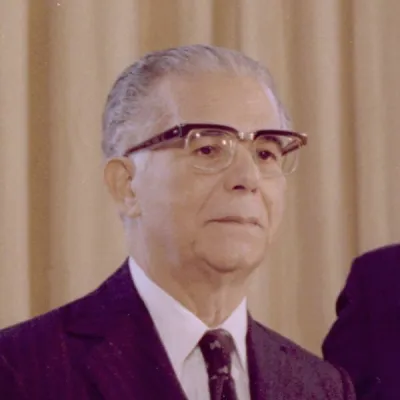
Joaquín Balaguer
Human Design Chart
Biography
Human Design Analysis: Joaquín Balaguer as Generator 4/6
Generator 4/6 — Design at a Glance
Joaquín Balaguers design points to a tendency towards great endurance, which could only unfold if he responded to impulses from his environment. As a Generator, he had plenty of sacral energy, comparable to the strength and stamina of a workhorse - provided he had energy for his tasks. His success principle did not lie in taking initiative but rather in responding. When a signal came from life and his inner 'gut feeling' agreed, he could respond with action leading to deep satisfaction and a sense of fulfillment.
If Joaquín Balaguer acted against this inner drive or tried to initiate things without an internal resonance, he faced two major pitfalls. First, he tended to waste energy on tasks that did not interest him, making him vulnerable to burnout. Second, he suffered from frustration and a lack of energy when prevented from pursuing his heart's project despite having the strength to continue. Thus, the motto of his design was clear: do not initiate but respond. Only in harmony with this principle could nothing stop him; otherwise, he faced persistent frustration. His energy became free primarily when he responded to life and acted from the gut.
Emotional Authority
Joaquín Balaguers inner authority was the defined emotional center. This dictated a specific decision-making strategy: immediate reactions proved deceptive snapshots that often did not reflect his deepest truth. Instead, his essential decisions required time cycles and multiple reflections.
The mechanics of this emotional authority described a wave of feelings swinging perpetually between highs and lows. Joaquín Balaguer saw the world colored by his current mood; what excited him in one moment might seem negative in another. Since this immediate feeling was only a first impression, spontaneous decisions from this state risked negative consequences.
The solution lay in patience. Joaquín Balaguer had to take time for decisions to mature. The process of 'sleeping on it' was central: by letting a decision rest overnight and asking himself multiple times, the intense emotional waves subsided. Only with this temporal distance did he regain emotional detachment. Then clarity and calmness set in. This mechanism held regardless of other defined centers in his chart; the emotional center always took precedence for authority if defined. Thus, Joaquín Balaguer showed himself to be someone who reached profound insights through a conscious avoidance of haste and use of natural time cycles rather than being led by passing moods.
The 4/6 Profile — Opportunist / Role Model
Joaquín Balaguer was someone whose life was marked by the tension between the urge for belonging and the claim to wise distance. In his first thirty years, he experimented intensively in relationships and friendships, driven by Line 4 of his Profile 4/6. This phase was characterized by a drive towards strategic networking and seizing opportunities to gain influence in social structures. There was always the risk of burnout if quantity took precedence over quality or rest phases were neglected, typical for this line.
With the activation of Line 6 after his first Saturn return, his focus shifted toward meaning-making and authority. Joaquín Balaguer now faced an internal conflict between his 'heart,' seeking emotional bonds, and his 'head,' striving for higher truth. He was vulnerable to propaganda and gullible in early phases but developed over time the ability to precisely assess others' expressive power. This growth allowed him to act as a role model while always being cautious not to hurt his heart through false people. If his high ideals or expectations of his wisdom-filled role could not be met, depression loomed. His design challenged him to aim for craftsmanship and immortality in his actions while seeking balance between social integration and individual wisdom.
Quadruple Split Definition — Defined & Open Centers
Joaquín Balaguer had a fully defined design, which gave him constant and unchanging presence. All nine energy centers were fixed, so situational fluctuations due to environmental influences did not occur; his mechanics were consistently active and independent of external validation. This created a permanent internal engine: The connection between Head and Ajna Centers provided continuous mental pressure and inspiration, while the defined Sacral and Root Centers supplied constant vital energy as well as stress pressure.
Since no centers were open, Joaquín Balaguer generated his impulses internally. He did not rely on external confirmation but had a reliable self-identity (G Center), willpower (Heart Center), and emotional depth (Solar Plexus Center). His challenge was to accept this constant pressure without impulsively acting out. The strategy involved waiting and reacting, as all energy sources were constantly „switched on“.
The defined Throat Center allowed him to express his thoughts and emotions reliably if he followed his inner authority. The Spleen Center gave him spontaneous intuition in the present moment. Joaquín Balaguer appeared as someone who acted with a firm internal compass, free from the uncertainty of open centers. His energy was not only present but structured and constant, allowing him to rely on his own resources in every situation rather than reflecting or seeking them from the environment. This completeness shaped his essence as an autonomous unit that clearly possessed its own truth and direction.
Channels for community, logic, focus, reflection and judgment.
Joaquín Balaguer's personality was marked by the Community Channel 37-40, which provided a deep drive to create stable structures through fair agreements and mutual benefit. Particularly dominant was the solar energy of Gate 40: It dictated a strict rhythm of intense readiness for collective work followed by the compelling need for rest to avoid burning out. This cycle of engagement and withdrawal shaped his essence more strongly than other aspects; he sought his place in the whole but did not overextend himself beyond his strength.
This social foundation was in tension with his logical apparatus. The Logic Channel 63-4 gave him a skeptical mind that filtered patterns continuously and only accepted what could be practically verified. Doubt was no obstacle for him, but essential to truth; unfounded belief had no place. Parallel to this, the Judgment Channel 18-58 fueled an insatiable drive towards perfection and correction of patterns. He judged what served life or hindered it to ensure satisfaction in the collective.
To support these analytical processes, the Concentration Channel 52-9 offered a calm tension that kept him still and enabled him to focus with undivided attention on details. This formative energy helped him to screen out distractions and apply his energy precisely as long as he was truly committed to something. Completing this structure was the Lost Son Channel 13-33, which ensured that Joaquín Balaguer collected experiences, withdrew to reflect upon them, and transformed them into wisdom before sharing them. Thus, his design combined the ability for long-term reflection with immediate logical analysis and striving for communal benefit.
Collective Circuitry — Circuit Signature
Joaquín Balaguer's design set a tendency towards a tension-filled coexistence of rational future planning and emotional past processing. This configuration marked him as someone who created logical structures while simultaneously undergoing wave-like emotional processes.
The Understanding Circuit connected two separate energetic islands in him. On one hand, Head and Ajna Centers flowed together, enabling focused visual logic for societal improvement. On the other hand, Sacral, Root, and Spleen Centers were directly linked, connecting strategic intuition with tribal survival instinct. These two groups did not exchange directly but existed parallel: cool ratio on one side, instinctive strategy on the other.
Parallel to this, the Meaning Circuit worked. Here, Throat and Identity Centers were directly connected, creating a channel to articulate emotional insights from the past and define his essence through sharing experiences. The energy was cyclical and wave-like, in contrast to the linear logic of the Understanding Circuit.
In the Ego Circuit, Heart and Solar Plexus Centers were directly linked. This promoted a principle of mutual giving and taking within the community. Since there was no connection to the Sacral Center, constant life force was lacking; instead, this configuration required necessary rest pauses for regenerating resources for the tribe. Joaquín Balaguer thus moved between structuring willpower, emotional reflection, and cooperative support, with each separate energetic system working in parallel.
Right Angle Cross of Planning 3
Joaquín Balaguers Human-Design legte eine klare Tendenz zur strategischen, langfristigen Planung und Organisation fest. Er zeigte sich als jemand, der komplexe Strukturen entwarf und Prozesse effizient steuerte. Diese Fähigkeit bildete das Fundament seines Handelns: die systematische Vorwegnahme von Entwicklungen, um Handlungsspielräume zu sichern.
Diese Ausrichtung entsprang der Konfiguration “Das rechte Kreuz der Planung 3”. Sie beschrieb nicht spontanes Improvisieren, sondern eine tief verwurzelte Notwendigkeit, den Überblick ür größer Zusammenhange zu behalten. Joaquín Balaguer lebte mit einer inneren Logik, die es ihm erlaubte, Schritte weit im Voraus zu berechnen und Ressourcen gezielt einzusetzen. Es ging dabei nicht um Kontrolle um der Kontrolle willen, sondern um die Schaffung von Stabilität durch klare Strukturen.
Seine Art zu planen war methodisch und zielgerichtet. Er suchte nach Wegen, wie sich Systeme langfristig halten ließen, ohne dass ständige Korrekturen nötig wurden. Diese Haltung prägte seine Entscheidungen: Bevor er handelte, prüfte er die Tragfähigkeit der zugrunde liegenden Architektur. So entstand ein Muster, in dem Organisation zum Schutz vor Chaos diente und Strategie zur Voraussetzung für jede Bewegung wurde. Joaquín Balaguer nutzte diese Mechanik, um in unsicheren Zeiten Halt zu bieten – durch das Entwerfen von Ordnungen, die über den Moment hinaus Bestand hatten.
Saturn Return · Uranus Opposition · Chiron Return · 2nd Saturn Return — Life Cycles
Joaquín Balaguers Lebensweg zeichnete sich durch zwei entscheidende Wendepunkte aus, die seine innere Entwicklung und äußere Positionierung prägten. Mit 51 Jahren, im Jahr 1957, trat er in den Chiron-Return ein. Dieser Zyklus markierte eine Phase der Blüte, in der sich sein Lebenszweck zunehmend erfullte. Seine Wahl zum Vizepräsidenten der Dominikanischen Republik stand exemplarisch für diese Entfaltung: Das Inkarnationskreuz wirkte sichtbar, Sinn und Richtung wurden erfahrbar, sofern er zuvor seiner Strategie gefolgt war.
Sechs Jahre später, 1963 im Alter von 57 Jahren, durchlief Joaquín Balaguer den zweiten Saturn-Return. Dieser Zeitraum brachte oft eine tiefe Krise oder Neuordnung mit sich. Statt weiterer Expansion stand nun die Frage der Struktur und Beständigkeit im Raum. Der Militärputsch gegen Juan Bosch, unterstützt von der CIA, ereignete sich genau in dieser sensiblen Phase. Dieses Ereignis unterstrich die turbulente Natur des zweiten Saturn-Returns: Alte Strukturen wurden herausgefordert oder radikal verändert. Für Joaquín Balaguer bedeutete dies nicht nur politische Machtverschiebung, sondern auch eine konfrontative Auseinandersetzung mit den Grundlagen seines eigenen Handelns und seiner Rolle in der Gesellschaft. Die Mechanik zeigte hier, wie äußere Krisen innere Reifeprozesse beschleunigen oder erzwingen können. Beide Zyklen formten gemeinsam das Bild eines Lebens, das zwischen Erfullung und notwendiger Härte oscillierte.
Generator · Emotional Authority — Synthesis
Joaquín Balaguer war ein Generator dessen Leben von einer tiefen Energie und dem Bedürfnis geprägt war, auf äußere Impulse zu reagieren. Diese sakrale Reaktion, gekoppelt mit einem definierten emotionalen Zentrum, führte zu einem inneren Prozess des Abwägens und Reifens vor Entscheidungen. Der Kanal der Logik (Gate 63/4) deutet auf einen Verstand hin, der ständig Muster analysierte und nach Korrektheit suchte, während die Verbindung von Herz- und G-Zentrum eine starke Identität und den Wunsch signalisierte, in Gemeinschaft zu wirken – ein Mensch, der sowohl inneren Antrieb als auch äußere Bestätigung brauchte.
Ein zentrales Paradox lag in der Spannung zwischen dem Bedürfnis nach Reaktion und der emotionalen Welle. Balaguer war nicht dazu bestimmt, Dinge anzustoßen, sondern auf das Leben zu antworten, doch die emotionale Autorität erforderte Geduld und Abwarten. Dies führte vermutlich zu einem inneren Konflikt zwischen dem Drang, aktiv zu werden, und der Notwendigkeit, Klarheit durch das Durchleben emotionaler Zyklen zu gewinnen. Die Kombination aus definierter Wurzel-Zentrum und Herz-Zentrum deutet auf einen Menschen hin, der sowohl Widerstandsfähigkeit als auch die Fähigkeit besaß, Ressourcen zu mobilisieren und Beziehungen zu pflegen.
5 Defined Channels
Incarnation Cross - Right Angle Cross of Planning 3
Solar Return
The Solar Return shows the moment when the sun returns to its exact birth position - your personal solar year.
Life Cycles
Discover the life cycles with a detailed triple view (birth chart, cycle chart, composite).
Human Design Profile
- Type
- Generator
- Strategy
- To respond - wait for something to respond to
- Authority
- Emotional Authority
- Profile
- 4/6 - Opportunist / Role Model
- Definition
- Quadruple Split
- Incarnation Cross
- Right Angle Cross of Planning 3
- Date of Birth
- 01.09.1906 20:00
- Place of Birth
- Villa Bisonó, Dominican Republic
Frequently Asked Questions
What is Joaquín Balaguer's Human Design type?
What Profile did Joaquín Balaguer have?
What Authority did Joaquín Balaguer have?
What incarnation cross did Joaquín Balaguer have?
When was Joaquín Balaguer born?
Discover your own Human Design
Are you also a Generator? Find out in a personal reading how to use your sacral energy correctly and discover deep satisfaction.
More Personalities
Back to overviewAaliyah

Alexia

Angèle

Anne-Marie

Arcángel

Arno
