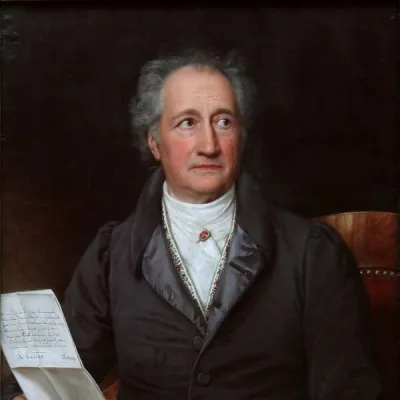
Johann Wolfgang von Goethe
Human Design Chart
Biography
Goethe took up residence in Weimar in 1775 following the success of his first novel, The Sorrows of Young Werther (1774), and joined a thriving intellectual and cultural environment under the patronage of Duchess Anna Amalia that formed the basis of Weimar Classicism. He was ennobled by Karl August, Duke of Saxe-Weimar, in 1782. Goethe was an early participant in the Sturm und Drang literary movement. During his first ten years in Weimar, Goethe became a member of the Duke's privy council (1776–1785), sat on the war and highway commissions, oversaw the reopening of silver mines in nearby Ilmenau, and implemented a series of administrative reforms at the University of Jena. He also contributed to the planning of Weimar's botanical park and the rebuilding of its Ducal Palace.
Goethe's first major scientific work, the Metamorphosis of Plants, was published after he returned from a 1788 tour of Italy.
Human Design Analysis: Johann Wolfgang von Goethe as Manifesting Generator 6/2
Manifesting Generator 6/2 — Design at a Glance
Johann Wolfgang von Goethe revealed himself as a person with an unique hybrid energy: He possessed the constant power of a Generator, yet he also had the ability for lightning-fast action. His design required him to react to external impulses rather than initiating on his own. This sacral energy was his driving force, but it only worked satisfactorily when he waited to be approached.
At the same time, Johann Wolfgang von Goethe could skip steps and quickly pull things into his life. However, this speed carried risks: Often he was too quick, skipped important stages or started multiple projects simultaneously without inner consent. Such an approach often led to frustration as he then had to catch up or felt overwhelmed.
Deep satisfaction arose for him only in the "Play Mode". When he sought variety and regularly checked whether his inner self still affirmed his current path with a clear yes, he could fully unleash his creative power. Then it was no obstacle for Johann Wolfgang von Goethe to handle various tasks simultaneously. Crucial always was the resonance of his sacral center: Only when this was positive did his speed become a blessing rather than a source of exhaustion.
Emotional Authority
Johann Wolfgang von Goethe demonstrated a decision-making process that necessarily required time and distance. His design featured emotional authority in the defined Solar Plexus Center. This configuration was subject to a constant emotional wave with strong ups and downs of feelings. The world appeared to him always colored by the current mood: a moment full of enthusiasm could shift into deep skepticism in the next. However, this immediate feeling was only a snapshot, not the final truth. Spontaneous decisions based on this fleeting emotion proved risky and often negative.
The mechanics of his authority dictated patience. The longer he let a decision rest, the deeper his understanding became. This required multiple nights of reflection and conscious hesitation to detach from the initial emotional heat. Over time, intense feelings subsided, creating an emotional distance. Only then did clarity and calmness set in. This process was particularly crucial for long-term life decisions, as they influenced the entire course of life. Johann Wolfgang von Goethe had to go through this cycle of emotions to arrive at his true inner truth rather than being led by the first impulse.
The 6/2 Profile — Role Model / Hermit
Johann Wolfgang von Goethe's design points to a two-phase developmental process. In the first three decades of his life, he was someone who learned through experimenting and seeking personal experiences. This phase was characterized by trial and error; mistakes served not as failures but as necessary steps in gathering knowledge. The mechanism behind this approach is the 6-line in Profile 6/2 (Role Model/Natural Talent), which acts like a 3-line before Saturn returns, that is, until around age thirty. It drives one to be open and experience the consequences of unions and commitments directly.
After this age, his fundamental attitude changed fundamentally. Around age thirty, he withdrew to gain distance. This withdrawal was not isolation in a negative sense but rather a period of intense reflection on accumulated experiences. Here, the 2-line came into play, requiring selectivity and patience for the right moment. Johann Wolfgang von Goethe used this phase for healing and deep self-knowledge. He looked back from a metaphorical "cave" to understand patterns in his past. The end result of this long process was wisdom. From this distance, he became an example for others embodying the ability for deep introspection. People sought him out to partake in life lessons that emerged from synthesizing earlier actions with later reflection.
Split Definition — Defined & Open Centers
Johann Wolfgang von Goethe revealed himself as someone with a clear inner identity and direction, shaped by his defined G Center. This gave him a constant sense of his own mission and the ability to show others new perspectives without being dependent on their approval. His daily vitality came from his defined Sacral Center; he acted not through initiation but responded to life with a steady energy flow that found satisfaction in correct application.
His expression was reliable and direct, supported by his defined Throat Center, which transmuted messages from his inner self into the world. Here, his Solar Plexus served as an emotional authority: Goethe waited patiently until his emotional wave had clarified before making decisions or acting. This emotional depth allowed him to grasp connections over time rather than reacting impulsively to highs and lows. Additionally, he possessed a spontaneous intuition in the present moment through his defined Spleen Center, which instinctively cared for health and well-being. The constant pressure of his defined Root Center drove him towards movement and survival security.
In contrast, Head, Ajna, and Heart Centers were open. Goethe tended to be led by mental inspiration or a need for willpower, which could appear as a conditioned trap. He was vulnerable to picking up foreign doubts or trying to prove his worth through promises – a pattern of not-self that he had to overcome to maintain his inner authority. His design challenged him to use these open areas as mirrors for others rather than identifying them as his own truth.
Channels for intimacy, presence, action, ambition and change.
Johann Wolfgang von Goethe revealed himself through an intense drive towards merging, where his emotional clarity was inseparable from the patience of waiting. This attitude stemmed from Channel 59-6, which connected the sexual energy of the Sacral Center with the emotional wave of the Solar Plexus. For him, intimacy did not mean immediate closeness but a process: first building friendship, then seeking deep connection. Ignoring his inner reaction led to confusion; using it correctly fostered fertility in relationships and creative endeavors.
This focus on the personal was complemented by additional channels. Channel 10-20 promoted constant awareness of the present moment and one's own existence, while Channel 34-10 strengthened him to follow his individual convictions and love himself. Channel 34-20 endowed him with a powerful presence that could only be correctly channeled through sacral reaction to avoid slipping into chaotic activity.
Additionally, Channels of Transformation 54-32, which linked ambition with constant effort, and Transience 36-35, which drove him towards new experiences and emotional growth, were at work. Individual Gates like Gate 55 (emotional awareness) or Gate 9 (detail work) rounded out this picture by providing specific skills for pattern recognition and handling mood swings. Goethe's design thus leaned towards deep, patiently cultivated bonds marked by individual authenticity and experience-based wisdom.
Individual Circuitry — Circuit Signature
Johann Wolfgang von Goethe revealed himself through a deeply rooted inner confirmation that arose from the connection of his Sacral Center with the Identity Center in the Focusing Circuit. This Channel 10-34 promoted strong self-worth and firm convictions, where energy was individualistically directed inward. Since the Throat Center was missing in this circuit, this inner strength often remained difficult to express externally. Parallel existed in the Meaning-Finding Circuit a separate connection between Solar Plexus and Throat Center (Channel 35-36), which processed and shared emotional waves of the past. Another independent piece formed the Ego Circuit with Channel 32-54, connecting Spleen and Root Centers to promote intuitive transformation. In the Guardian Circuit, Sacral and Solar Plexus Centers worked together through the Pairing Channel (6-59), supporting instinctive protection and care. Finally, the Integration Circuit linked Throat, Sacral, and Identity Centers via Channels 20-10 and 20-34, making power from life in the present effective. These shared structures did not form a unified energy but parallel forces: inner constancy stood alongside emotional processing and intuitive adaptation. Goethe's design thus shaped consolidated individuality and cyclical emotional reflection as coexisting experiences without all centers flowing directly into one another. The mechanics emphasized self-confirmation and finding meaning in past events, while external articulation remained limited by the missing direct connection in the Focusing Circuit.
Left Angle Cross of Spirit 2
Johann Wolfgang von Goethe had the design of the 'Left Cross of Spirit 2'. Since there are no specific mechanisms such as Gates or Channels in the provided data, a detailed behavioral analysis cannot be derived from this configuration. The chapter only refers to this cross as a whole. Without the underlying structure of individual elements, the characterization is limited to this nominal assignment. There are no descriptive contents that would allow for a deeper classification or explanation of resulting tendencies. Therefore, only the presence of this specific Cross-configuration in the design is noted here. No further conclusions about personality traits or life patterns can be drawn from the given facts as the necessary depth of detail is missing. The emphasis lies solely on naming the element without content filling. This reflects that the input material did not provide a basis for further interpretation. Johann Wolfgang von Goethe's chart contained this aspect, but without additional mechanical explanations it remains an isolated fact. Nothing is invented or assumed beyond what is explicitly stated in the raw content. The presentation strictly adheres to the given information about the cross and its lack of description.
Saturn Return · Uranus Opposition · Chiron Return · 2nd Saturn Return — Life Cycles
Johann Wolfgang von Goethes design indicated a tendency towards structural turning points where inner maturation processes were translated into outer reality. This was evident in his first Saturn Return: In 1776, he became Geheimer Legationsrat and a member of the Geheimes Consilium. This cycle marked the transition from development to established position, a moment when years of groundwork condensed into a viable social role.
The Uranus Opposition around 1789 (age 40) brought a phase of expansion and new responsibility, evidenced by the birth of August von Goethe. Here, the desire for freedom and change conflicted with existing structures, often leading to a redefinition of personal roles.
His Chiron Return in 1797 (age 48) was an achievement cycle where his incarnation purpose increasingly unfolded. This was evident through the appearance of the epic 'Hermann and Dorothea'. It did not involve healing old wounds but rather the blossoming of his life task, where meaning and purpose became tangible.
His second Saturn Return in 1805 (age 56) brought another consolidation phase marked by Schiller's death on May 9. This cycle demanded a renewed engagement with structure and boundaries, often accompanied by the loss of reference persons or structures that had previously provided support.
Manifesting Generator · Emotional Authority — Synthesis
Johann Wolfgang von Goethe lived a life deeply influenced by an inner interplay between initiation and reaction. As a Manifesting Generator (MG), he possessed the ability to quickly initiate and realize things, yet this always rested on a foundational sacral energy (Sacral Center) waiting for external stimuli (Channel of Pairing). This combination allowed him to act as a driving force while also requiring moments of intense reflection and waiting to gain clarity (Emotional Authority). The recurring cycles—especially the Saturn Return in 1776 and the Chiron Return in 1797—manifested phases of increased activity and creative unfolding, followed by periods of deep self-reflection.
A central paradox in Goethe's design lay between the drive for transformation through communication (defined Throat Center) and the necessity of emotional maturation. He could powerfully carry messages outward, yet the emotional wave demanded patience and sleeping on decisions. This tension was evident in a life style marked by an experimental spirit (6/2 Profile), followed by phases of intense reflection and sharing of acquired wisdom. The Focusing Circuitry reinforced this inner alignment and adherence to individual convictions.
6 Defined Channels
Incarnation Cross - Left Angle Cross of Spirit 2
Solar Return
The Solar Return shows the moment when the sun returns to its exact birth position - your personal solar year.
Life Cycles
Discover the life cycles with a detailed triple view (birth chart, cycle chart, composite).
Human Design Profile
- Strategy
- To respond - wait for something to respond to
- Authority
- Emotional Authority
- Profile
- 6/2 - Role Model / Hermit
- Definition
- Split Definition
- Incarnation Cross
- Left Angle Cross of Spirit 2
- Date of Birth
- 28.08.1749 12:30
- Place of Birth
- Frankfurt, Germany
Frequently Asked Questions
What was Johann Wolfgang von Goethe's Human Design type?
What were Johann Wolfgang von Goethe's Profiles?
What authority did Johann Wolfgang von Goethe have?
What incarnation cross did Johann Wolfgang von Goethe have?
When was Johann Wolfgang von Goethe born?
Discover your own Human Design
Are you also a Manifesting Generator? Find out in a personal reading how to unfold your multi-talents and direct your energy wisely.
More Personalities
Back to overviewAldair

Alizée

Angeli

Arletty

Artus

Balthus