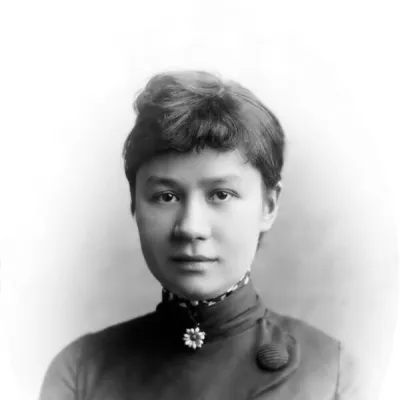
Johanna Bonger
Human Design Chart
Biography
Jo Bonger was the the fifth daughter of the insurance broker Hendrik Christiaan Bonger (5 June 1828, Haarlem - 1904), and Hermine Louise Weissman (19 February 1831, Amsterdam - 18 June 1905). Of the ten children they got, three died early.
She studied English and became teacher English at age 22. Via her in Paris living brother Andries, she met Theo van Gogh, the brother of Vincent. Theo asked her to marriage her summer 1887, but she refused as she was in love with another. But her love was not answered, and she became emotionally upset. November 1888 she went to Paris and met Theo again. January 1889 they engaged and on 18 April 1889 she married Theo van Gogh in Amsterdam. They moved to the Cité Pigalle in Paris and got a son Vincent Willem van Gogh (31 Jan 1890, Paris –28 Jan 1978, Laren).
After the suicide attempt of her brother-in-law Vincent van Gogh (27 July 1890, Auvers, died 29 July), Theo became depressed. Theo suffered from syphilis and died of dementia paralytica on 25 January 1891 in Den Dolder. She returned to the Netherlands with her son and lots of then worthless letters and painting of Vincent van Gogh. She started to promote the work of Van Gogh and translated his letters in English (since 1915).
Between 1894 and May 1897 she had a love affair with the painter Isaac Israels. On 21 Augustus 1901 she married the painter and jurist Johan Cohen Gosschalk (3 Nov 1873, Zwolle - 18 May 1912, Amsterdam). They lived in the villa Eikenhof in Bussum, in 1903 they moved to Amsterdam. In 1905 they organised a major Van Gogh exhibtion in the Stedelijk museum of Amsterdam. In 1914 she published the letters of Vinncent to Theo. From 1915 till 1919 Bonger lived in New York, where she translated Vincent van Gogh letters in English. Piece by piece she sold the work, making sure that Vincent got International status.
Human Design Analysis: Johanna Bonger as Manifestor 2/4
Manifestor 2/4 — Design at a Glance
Johanna Bonger emerged as a pioneer with the task of showing new paths. Her design corresponds to that of an Manifestor, a figure who develops visions and brings them into the world, much like an emperor in ancient Rome sending soldiers instead of fighting himself. This role often led her to be misunderstood; her forward-thinking ideas polarized those around her. While some people were drawn to her big dreams and followed her lead, she encountered rejection or even hatred from others. The conflict between attraction and repulsion formed a central pain point in her life. To find the right followers, it was crucial for Johanna Bonger to inform others about her intentions early on and precisely. This strategy of informing served to minimize misunderstandings and generate resonance. If she followed this path, her design rewarded her with an inner sense of peace. Living against this nature, however, left her feeling persistent, deep-seated anger. Her life energy was geared towards leading the world into a new future not through direct confrontation but by setting clear impulses and communicating her visions.
Splenic Authority
Johanna Bonger's design featured a tendency toward spontaneous decision-making in the moment, primarily to protect her health. As a Projector with authority in the Spleen – a defined center that functions as a health and alarm system – she possessed an acute survival intelligence. This showed not as long-term strategy but as a fine, singular impulse in the here and now. Her instinct and physical well-being were reliable indicators of whether an environment or society was beneficial.
Since the Spleen Center carried this authority, Johanna Bonger had to make decisions on the spot; her first spontaneous impulse was always the right one and served immediately to uphold her integrity. This allowed her a rigorous demarcation against harmful influences of all kinds. However, this inner signal was very subtle and came only once per situation, requiring high vigilance not to overlook it or be overwhelmed by external pressure.
This mechanism necessitated flexibility and freedom in her life. Since she could only know what was right for her at the moment, her internal signals and thus also her preferences changed repeatedly in the short term. Long-term planning proved difficult to impossible as fixed commitments contradicted this fluid process. Her design therefore demanded a lifestyle that allowed spontaneity and minimized rigid commitments to align with the natural dynamics of her inner authority.
The 2/4 Profile — Hermit / Opportunist
Johanna Bonger exhibited a constant interplay between a deep need for withdrawal and the desire for meaningful community. Her design set up an underlying tension: On one hand, she was drawn into her 'cave' to regenerate; on the other, she sought exchange with her trusted network. This dynamic required clear signals to her environment – when she needed company and when silence was necessary.
This structure stemmed from her Profile 2/4. Line 2 conveyed the hermit aspect, while line 4 created a connection to community. In her phases of isolation, Johanna Bonger delved into internal processes to gain clarity. Only once this inner balance was restored did she actively engage with others. This rhythmic shift served not only for recovery but also productivity: She used alone time to reflect on knowledge from her network and develop new insights.
The depth of her solitude was marked by Gate 48, bringing themes like degeneration and a profound perspective into play. This gave her withdrawal phases an intense, almost transformative quality. Simultaneously, the energy of Gate 39 with its emphasis on timing and careful judgment came into effect. Johanna Bonger had to learn to moderate her impulses; without this moderation, her fixated character could easily have seemed provocative. Through awareness of her own rhythm – clearly delineating 'me-time' from community time – she was able to use the tension between solitude and network work to form brilliant ideas based on synthesis from inner reflection and external input.
Split Definition — Defined & Open Centers
Johanna Bonger revealed herself through a stable, reliable presence in communication and willpower. Her design featured four defined centers: Throat, Heart, Spleen, and Root. This configuration gave her a constant voice that spoke directly from inner conviction and intuitive perception. She possessed the ability to keep promises and use her resources self-determinedly, driven by clear willpower. Her intuition served as a reliable compass needle in the present moment, while her defined Root Center provided a steady pressure to move forward despite obstacles and master existential challenges.
At the same time, Johanna Bonger was marked by six open centers: Head, Ajna, G, Sacral, and Solar Plexus. This openness made her sensitive to external influences in areas of inspiration, mental thinking, identity, energy, and emotions. She tended to pick up on mental questions or emotional moods from her environment without them automatically becoming her own. Instead of identifying with these borrowed energies, her defined structure served as an anchor. Thus, she could distinguish between what came from outside – such as temporary confusion or foreign emotions – and her inner truth. The tension between this stable action competence and the receptive openness required constant boundary setting: She had to learn not to react to every inspiration or emotional wave but use her defined sources of will and intuition as filters. This allowed her to remain clear in a complex world without getting lost in the instability of open areas.
Channels for ambitious action and meaningful life struggle.
Johanna Bonger showed herself as someone who strove for material sovereignty through acts of will and simultaneously waged a stubborn fight for her individual integrity. Her design laid a tendency towards material responsibility, paired with an adrenal-driven search for personal meaning.
The Channel of the Money Line 21-45 connected her Ego Center to the Throat Center. This created dynamics between Gate 21, which needed control to rest, and Gate 45, which authoritatively decided: “I have or I do not.” Johanna Bonger had to assert her will to be independent and function as her own boss. She worked best when she could follow her natural rhythm and keep control over her resources, since delegating responsibility burdened her heart.
Parallel to this, the Channel of Life Struggle 38-28 between Root and Spleen Center was at work. Gate 38 generated pressure to defend individual integrity against external forces while Gate 28 intuitively recognized which struggle had value. Johanna Bonger possessed the stubborn determination to walk her own path and engage only in struggles she deemed meaningful according to her inner strategy. This created a balance: She controlled what she could (work/resources) and declined unnecessary fights.
Additional Gates like Gate 39 (Provocation/Mutation) or Gate 48 (Pattern Recognition/Depth) complemented this profile through selective analysis and collective frustration recognition, while Gates such as 26 (Innovation in Ego) and 18 (Correction/Discrimination) supported the ability to adapt and political correction. Gates like 12 (Holding Back/Poetry) and 20 (Here and Now/Authenticity) rounded out the picture by focusing on authentic action in the moment. Johanna Bonger lived this tension between material mastery and individual uniqueness.
Individual Circuitry — Circuit Signature
Johanna Bonger was marked by two parallel, unconnected energetic streams. On one hand, the Knowledge Circuit worked through the Channel of Life Struggle (28-38), connecting Spleen and Root Centers. This created a pulsating, acoustic energy: She sought her own path, used intuitive security (Spleen) and transformed it into endurance under pressure. It was about individual identity and transformation through emotional resonance, not tribal cooperation.
Parallel to this, the Ego Circuit existed via the Money Line (45-21), connecting Throat Center and Heart. Here, tribe-oriented resource management focused on giving and taking, material well-being, and mutual support. Since this center did not connect to the Sacral Center, it required rest pauses for regenerating power for the tribe.
As a person with split definition, Johanna Bonger lived these two systems side by side without them directly flowing into each other. The tension lay between the innovative, individual drive of the Knowledge Circuit and the conservative, tradition-influenced cooperation of the Ego Circuit. She had to learn to separate the emotional wave of her individuality from the timeless, touch- and smell-oriented demands of tribal resources to effectively use both areas.
Right Angle Cross of Tension 3
Johanna Bonger revealed herself through an internal dynamism that relied on tension as the driving force. Her design carried the 'right cross of tension 3', meaning she did not seek harmonious balance but generated energy from friction and resistance. This configuration suggested that Johanna Bonger did not perceive conflicts or challenges as obstacles to be avoided, but rather as necessary fuel for her development. The tension was her motor; without it, her inner drive would have been extinguished. She utilized this dynamic potential by engaging in situations that created pressure. This mechanism described an active use of friction to shape her path, rather than a passive acceptance of life's blows. Johanna Bonger lived this tendency by confronting the complexity and tensions of her environment instead of retreating from them. The energy of this configuration worked like a spring mechanism: the greater the pressure, the stronger the counterforce she could mobilize. This shaped her way of dealing with life circumstances – not through avoidance of stress but through its transformation into actionable impulses. Her inner nature was designed to create new order out of dissonance, where the process itself, navigating through tension, represented the true value for her personal evolution.
Saturn Return · Uranus Opposition · Chiron Return · 2nd Saturn Return — Life Cycles
Johanna Bonger's development was structured by three defining cycles that solidified her role as guardian of the Van Gogh legacy. In 1891, at age 29 and during her first Saturn return, she received Theo and Vincent van Gogh's estate. This cycle often marks a transition into a phase of responsibility where earlier efforts condense into a stable structure; here, her task as custodian of the artistic heritage was crystallized.
Ten years later in 1901 at age 39, the Uranus opposition impacted her life when she married painter Johan Cohen Gosschalk. This period often brings unexpected turns or breaks that shatter old patterns and enforce new perspectives – a dynamic change in her relationship life that recalibrated her personal context.
The peak of her life mission was revealed in 1914 at age 52 during the Chiron return: she published the correspondence between Theo and Vincent van Gogh. This fulfillment cycle allows one's incarnation cross, if followed by their strategy, to reach its full bloom and become experientially meaningful. The publication was not just an event but a visible unfolding of her life purpose: conveying the true story of the Van Gogh brothers to the world.
Manifestor · Splenic Authority — Synthesis
Johanna Bonger was a figure marked by the constant interplay between inner clarity and the urge to carry it outward. Her defined Spleen authority pointed to deep, instinctive knowledge that helped her navigate the world and care for herself (Spleen Center). This internal navigation system was reinforced by a defined Heart Center – strong willpower and the ability to control one's own resources. This combination allowed her to act authentically even under pressure and make decisions from deep inner wisdom (Heart & Spleen Centers). The Channel of Money (21/45) indicated a natural aptitude for resource management and the capacity to take responsibility for others.
A central tension field in her design lay in the interplay between the need for internal peace and the necessity to express oneself. An open Solar Plexus Center made her receptive to other people's emotions (Solar Plexus), while a defined Throat Center intensified the desire to communicate them (Throat Center). This dynamic led to constant confrontation with her own emotional experience and questioning how much of it was truly hers. The Life Struggle Channel (38/28) underscored this inner process – a struggle for authenticity and finding meaning in the here and now.
2 Defined Channels
Incarnation Cross - Right Angle Cross of Tension 3
Solar Return
The Solar Return shows the moment when the sun returns to its exact birth position - your personal solar year.
Life Cycles
Discover the life cycles with a detailed triple view (birth chart, cycle chart, composite).
Human Design Profile
- Type
- Manifestor
- Strategy
- To inform others before acting
- Authority
- Splenic Authority
- Profile
- 2/4 - Hermit / Opportunist
- Definition
- Split Definition
- Incarnation Cross
- Right Angle Cross of Tension 3
- Date of Birth
- 04.10.1862 02:00
- Place of Birth
- Amsterdam, Netherlands
Frequently Asked Questions
What is Johanna Bonger's Human Design type?
What profile did Johanna Bonger have?
Which authority did Johanna Bonger possess?
What incarnation cross did Johanna Bonger have?
When was Johanna Bonger born?
Discover your own Human Design
Are you also a Manifestor? Find out in a personal reading how to use your initiation power peacefully and dissolve resistance.
More Personalities
Back to overviewChristian-Jaque

Kesha

Lucebert

Marilyn

Masaccio
Papus