
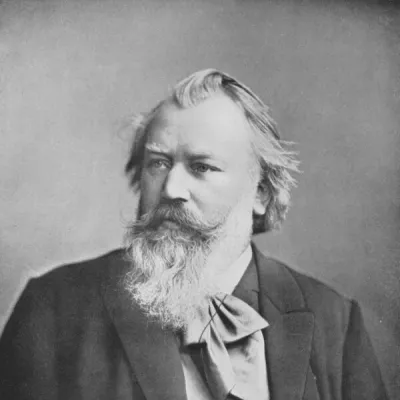
Johannes Brahms
Human Design Chart
Biography
Brahms was the son of a seamstress, lame and homely, 17 years older than her husband, who lavished affection upon the boy. With a strong attachment to her until her death in 1865, Brahms cried out over her grave, "I no longer have a mother. I must marry!" His father was a double bass player who literally eked out a living playing in a cafe near Hamburg. At one time his dad tried raising chickens and rabbits, at another time, attempted business in a small shop; he even considered emigrating to America. Jakob Brahms instilled in his son a desire for bourgeois respectability and comfort, but also a restless independence. Adept as a youngster, the boy first played piano professionally at 13 in taverns near the Hamburg docks where sailors just in from long voyages came to bed down with the ladies of the town. Always courteous to prostitutes, who found him an eager if awkward lover, his caustic side was more likely to surface with society women. He like to do all the courting; if a woman showed initiative, he put her off. Though he had at least seven major, unconsummated relationships with respectable women, he slept only with prostitutes.
As a child prodigy, Brahms performed a piano concert at age 15 and gained fame during his lifetime. Even when famous, Brahms lived modestly, dressed with economy and took pride in spending little on his food. He had no extravagant tastes and even in his passion for collecting original manuscripts of great masters, observed a frugal budget. Nonetheless he loved good food and drink, and when dining with friends, enjoyed a more liberal palate.
Gruff, acerbic and orderly, he never married.
Johannes Brahms — Generator with Profile 4/6
Generator 4/6 — Design at a Glance
Johannes Brahms possessed immense sacral endurance that made him a powerful workhorse. His design suggested he acted like a strong working horse: extremely resilient and energy-rich, provided he had inner motivation for his tasks. This energy was not released through self-initiative but emerged in the moment of reacting to external impulses.
The central mechanism of his Generator involved waiting for signals from the environment and then responding to the internal 'yes' of his sacral nature. Reacting rather than leading was the source of his deep satisfaction and fulfillment. If this strategy did not come into play, two specific dangers loomed: first, wasting his energy on tasks he felt no intrinsic joy in, which led to long-term exhaustion. Second, suffering when prevented from pursuing his heart's project despite still feeling an inner urge to continue working.
If Johannes Brahms initiated independently without prior impulse, it resulted in persistent frustration and a noticeable lack of energy. His success thus depended directly on whether he managed to react instinctively rather than fighting against the current of his own nature. Only in harmony with this reactive principle could his immense creative power flow unimpeded and protect him from burnout.
Sacral Authority
Johannes Brahms made decisions not in his head but waited for a deep physical resonance. His design featured sacral authority, unique to Generator types, which also served as an internal decision-making process. This simplified his approach: he responded to external stimuli with a clear signal from the lower abdomen—a gut feeling, a grunt, or a felt surge of power. Physical expressions like 'Mhm' or 'Hm-hm' were the measure of authenticity; they indicated whether something spoke to him.
When this inner motor was activated, Brahms felt vital and alive. He then had an inexhaustible energy that allowed him to complete his work with great enthusiasm. Born to walk through life with joy and satisfaction, he immersed himself in activities without external constraints. Fulfillment arose from the act itself, not from abstract goals.
His activated Spleen Center supported this instinctiveness by enabling quick, spontaneous reactions and decisions. He had immediate access to his physical well-being and instinctive perception. This combination of sacral and spleen energy allowed Johannes Brahms to reliably orient himself toward his inner, physical impulses rather than following intellectual deliberations. His life force flowed where his body signaled a clear 'yes'
The 4/6 Profile — Opportunist / Role Model
Johannes Brahms lived with an internal conflict between the heart's desire for belonging (Line 4) and the head's drive for intellectual distance and meaning-seeking (Line 6). In his youth, before Saturn returned, he intensely experimented in relationships and friendships, where Line 6 initially seemed like a Line 3. This phase was characterized by cautious openness; his heart remained secretive and single-minded to avoid injury from false people. Timing and conflict avoidance were crucial as an unguarded mouth easily led to tensions.
With the activation of Line 6, his approach fundamentally changed. Early pessimism transformed into unwavering hope and optimism. Brahms learned to accept every interaction as a necessary step toward greater unity. In later years, he was expected to meet high standards as a wise role model. He stood out through cooperation while his large heart remained selective. This constant balance between emotional bonding needs and the search for higher meaning shaped his entire life span, from experimental networker to wide mentor.
Split Definition — Defined & Open Centers
Johannes Brahms revealed himself through a massive inner stability characterized by four defined centers: G, Heart, Sacral, and Root. This configuration gave him a clear sense of self-identity and direction (G Center), coupled with the ability to keep promises and determine his own resources (Heart). His defined Sacral Motor provided constant vital energy geared towards responding rather than initiating, while the defined Root Center generated persistent pressure for forward movement.
This stable foundation contrasted with his six open centers: Head, Ajna, Throat, Solar Plexus, and Spleen. Without their own mechanisms for mental inspiration or conceptual thinking, these areas were situational and dependent on external invitations. The open Solar Plexus absorbed foreign emotions, leading to confusion if it identified too closely with them. An open Spleen meant that spontaneous decisions were risky and a deep survival fear was present, which was compensated by clinging to false security.
Brahms tended to get stuck in mental uncertainty when trying to force answers rather than waiting for resonance. His open Throat Center naturally attracted attention only when he wasn't actively seeking it. The combination of defined willpower and an open emotional field created a dynamic where inner stability coexisted with outer sensitivity. He learned that his strength lay in reacting to what was offered to him, rather than personalizing mental pressure or others' emotional waves. This architecture required patience to balance the gaps between his stable identity and the fluid nature of his open centers.
Channels for maturation through experience and inspiring pioneering power.
Johannes Brahms showed himself as someone who combined competitive ego energy with universal love. This configuration shaped how he advanced individualization and made initiation an art form. The Initiation Channel 51-25 connected Shock Gate (51) with Self Spirit Gate (25). This created a natural competitiveness aimed at strengthening others through authentic living and affirming their uniqueness. Here, initiation did not appear as a controllable act but rather as a mystical process that only became effective when it came from the outside or was triggered by an invitation.
Parallel to this, a cyclical process of meaning-making defined his experience. The Ripe Channel 42-53 linked Beginnings Gate (53) with Growth Gate (42). This mechanism required every experience to be fully processed and reflected upon to generate wisdom. Premature termination led to the repetition of the cycle. Johannes Brahms had to embrace experiences without rigid expectations to avoid frustration and translate lessons from the past into new information for the collective.
Additionally, other gates played roles: Gate 1 emphasized uniqueness and creative expression at the right time, while Gate 2 presented receptivity as a foundation for evolutionary directions. Gate 7 projected patterns for the future and promoted leadership perspectives. Gate 13 collected experiences for collective memory and enabled reflection in a temporal context. Gate 54 connected worldly success with mystical insight, often supported by a partner. Gate 60 required accepting limitations as prerequisites to transcendence, frequently accompanied by melancholy. Gate 21 directed material things and overcame obstacles through power but needed recognition in service of the community. This combination formed a personality rooted both in competition and deep reflection.
Collective Circuitry — Circuit Signature
Johannes Brahms revealed himself as someone whose inner stability and identity were strongly influenced by established convictions. His design linked Identity Center with Heart Center (Channel 25-51), generating profound, individualistic power. This configuration fostered robust self-esteem and the courage to live out his own individuality while encouraging others to do the same. However, since this circuit did not connect to Throat Center, these deep inner truths often remained difficult to express in words; they manifested more through presence than verbal explanation.
Parallel to this, Johannes Brahms linked Sacral with Root Center (Channel 42-53). This created a cyclical emotional processing of past experiences. Rather than rationally looking into the future, he reflected wave-like on past events to gain meaning and insights from them. These emotional cycles served to share with the collective and learn together from earlier occurrences.
As someone with split definition, Johannes Brahms' energy consisted of two clearly separated blocks: one centered around inner identity and stability, the other around an emotional-cyclical processing. These areas did not flow directly into each other but existed as parallel, side-by-side forces. One half of his design provided internal stability and quiet conviction, while the other engaged rhythmically with time and experience through emotions. This structure shaped how he could rest within himself and react emotionally to waves of the past without these two aspects merging energetically.
Right Angle Cross of the Sphinx 2
Johannes Brahms lived within the archetypal framework of the right Sphinx Cross. This configuration shaped his entire existence as a strategic orientation that aimed less at individual achievements and more at a deeper intention: preserving and passing on wisdom, and creating stability in a changing world. The right Sphinx Cross 2 did not function merely as a detail in his design but rather as a fundamental background against which his life unfolded. It implied an attitude of patience and inner holding, regardless of the specific Gates or Channels that were active. This dynamic created a protective space for long-term development and fostered the ability to conserve knowledge and make it accessible beyond the individual realm. For Johannes Brahms, this meant a life task characterized by constancy and the role of a custodian who provides structure without needing to be in the spotlight. The energy of this cross worked subtly but persistently, embedding his actions within a larger context of collective security and cultural memory. It was a quiet force aimed at laying foundations and ensuring that valuable insights are not lost but preserved for future generations.
Saturn Return · Uranus Opposition · Chiron Return · 2nd Saturn Return — Life Cycles
Johannes Brahms' design showed a tendency towards structural maturation that intensified in recurring astrological cycles. These phases marked times of consolidation, external success, and creative unfolding.
In 1860, at the age of 27, Brahms met publisher Fritz Simrock during his first Saturn Return. This cycle condenses years of groundwork into solid results; the encounter helped him gain significant recognition and consolidate his position.
In 1873, at 40 years old, Brahms stood in Uranus Opposition. This cycle often brings external acknowledgment or structural changes through environmental pressure. In this year, Wagner and Brahms jointly received the Bavarian Maximilian Order, a sign of societal anchoring of their work.
The Chiron Return around age 50 is a fulfillment cycle where one's incarnation cross unfolds and meaning becomes experiential. In 1883, during a stay in Wiesbaden, Brahms composed his third symphony in F major op. 90. The premiere on December 2, 1883 in Vienna showcased this inner bloom as a concrete work that sprang from his own depths.
His second Saturn Return occurred in 1889 at the age of 56. This cycle often cements an achieved status and life structure. The awarding of honorary citizenship by Hamburg underscored this final recognition of his role and contribution, firmly anchoring his position within the community.
Generator · Sacral Authority — Synthesis
Johannes Brahms lived deeply within the power of his sacral generator (Generator Type, Sacral Authority). A central red thread runs through his existence: the necessity to heed inner impulses and draw energy from activities that truly fulfilled him (Sacral Center, Channel 51-25). The recurring evidence of professional success and recognition at key moments in his life cycles (Saturn Return, Uranus Opposition, Chiron Return) suggests he was most effective when directing his energy towards tasks that vitalized him. His profile as a networker/role model (4/6 Line) reinforces this aspect by pointing to a natural ability to act through connection and collaboration – yet always in harmony with his own inner drive.
Simultaneously, his design revealed a central paradox: the conflict between the need for belonging (Line 4) and the desire for independent thought and reflection (Line 6). This contradiction reflected in a tension that compelled him repeatedly to find balance between investing his energy into communities and retreating to inner contemplation. The Centering Circuit points to strong individuality, while the open Emotional Center likely made him susceptible to external influences – an ongoing interplay between self-assertion and adaptability.
2 Defined Channels
Incarnation Cross - Right Angle Cross of the Sphinx 2
Solar Return
The Solar Return shows the moment when the sun returns to its exact birth position - your personal solar year.
Life Cycles
Discover the life cycles with a detailed triple view (birth chart, cycle chart, composite).
Human Design Profile
- Type
- Generator
- Strategy
- To respond - wait for something to respond to
- Authority
- Sacral Authority
- Profile
- 4/6 - Opportunist / Role Model
- Definition
- Split Definition
- Incarnation Cross
- Right Angle Cross of the Sphinx 2
- Date of Birth
- 07.05.1833 03:30
- Place of Birth
- Hamburg, Germany
Frequently Asked Questions
What was Johannes Brahms' Human Design type?
What Profile did Johannes Brahms have in Human Design?
Which Authority guided Johannes Brahms?
What incarnation cross did Johannes Brahms have?
When was Johannes Brahms born?
Discover your own Human Design
Are you also a Generator? Find out in a personal reading how to use your sacral energy correctly and discover deep satisfaction.
More Personalities
Back to overviewAaliyah

Alexia

Alizée

Angèle

Anne-Marie

Arcángel
