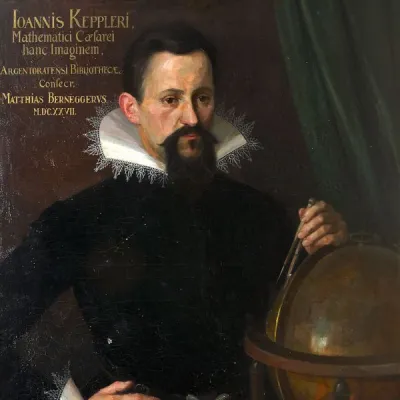
Johannes Kepler
Human Design Chart
Biography
Human Design Analysis: Johannes Kepler as Manifestor 2/4
Manifestor 2/4 — Design at a Glance
Johannes Kepler acted as a pioneer and visionary, whose design predestined him to lead the world into a new future. His Human-Design type was the Manifestor, a configuration one can imagine similarly to an emperor in ancient Rome. This emperor possessed the vision of a great empire but did not wage wars and battles himself; instead, he sent his soldiers out to conquer foreign lands for him.
This analogy clarifies Kepler's role: He carried great dreams that often did not resonate with everyone around him. A central pain point of his design was being misunderstood by others because he frequently thought beyond his environment. This led to a strong polarization; some people loved and followed him due to his visions, while others disliked or even hated him precisely because of these grand plans.
To navigate this dynamic and find the right followers, Johannes Kepler's strategy of informing others was crucial. He had to educate others timely and accurately about his visions. If he followed this path and his inner authority, his design rewarded him with a sense of inner peace. Conversely, if he lived against this pattern, it resulted in persistent, deep anger. His journey was thus characterized by the tension between his pioneering existence and the necessity to communicate clearly to reduce resistance and gain support.
Emotional Authority
Johannes Kepler showed a decision-making approach that followed deep inner rhythms: He did not react immediately to initial impulses but sought temporal distance before acting. This resulted from his emotional authority. Since his Emotional Center was defined, his perception was subject to constant wave movements—a continuous up and down of moods. At one moment an idea could inspire him, in the next the same thing appeared negative. However, these feelings were only snapshots, not ultimate truth.
Quick, spontaneous reactions out of this emotional heat would often have proven misleading for Johannes Kepler. His inner authority demanded patience. He used the strategy of "flirting" and let decisions be questioned multiple times to ensure they did not merely reflect fleeting moods. Only after he had slept on a decision and intense feelings had subsided did he gain the necessary emotional distance. Then calmness set in, and true clarity became visible. This process of moving through emotional waves was essential for him, particularly with long-term life decisions, to avoid distortions and recognize his deeper truth.
The 2/4 Profile — Hermit / Opportunist
Johannes Kepler revealed himself as someone who oscillated between the urge to withdraw and the need for connection. His design created a tension: On one hand, he sought solitude for internal reflection, while on the other, he missed the company of his trusted friends. This dynamic matched his Profile 2/4, the "Natural Talent / Networker." Here, the person constantly swings between two poles: Line 2, which requires time alone to gain clarity and calm, and Line 4, which awakens a desire for time with loved ones.
For Johannes Kepler, it was crucial to create a secure environment where he could clearly communicate his availability. He signaled externally when he sought company and when he wanted to withdraw undisturbed. During these phases of seclusion, he immersed himself in his internal processes. Once the need for solitude was satisfied, he emerged from his "cave" to reconnect.
This structure allowed him to process knowledge from his network in silence. He reflected on and evaluated impressions to develop new, unconventional ideas. Line 2 promoted joy in the unusual and willingness to provide energy for unorthodox projects. Through this clear separation of contact and reflection phases, he could utilise his internal processes to generate brilliant insights before sharing them again.
Split Definition — Defined & Open Centers
Johannes Kepler revealed himself through a consistent expression and reliable internal direction, supported by defined willpower. His defined Throat Center shaped a clear, though limited, communication style that always spoke from a deep identity. The also defined G Center gave him a stable self-image and a clear sense of his life mission, while the Heart Center provided the necessary energy to keep promises and manage personal resources. This configuration created a person who knew who they were and what they wanted.
At the same time, Kepler moved through a deep emotional wave. His defined Solar Plexus required patience; truth revealed itself to him only over time, not in impulsive moments. He tended to delay decisions until emotional clarity arrived rather than reacting to fleeting moods. This was complemented by his defined Spleen Center, which gave him a strong existential instinct for health and well-being in the present moment. His defined Root Pressure provided the necessary tension to move forward in the material world and cope with stress.
In contrast, Head, Ajna, and Sacral Centers were open. Kepler lacked a constant mental focus or firm theoretical doctrines; his mind was flexible and receptive to inspiration from the environment but tended towards confusion when he did not trust his inner authority. Without a defined Sacral Center, he had no constant generative energy source. He was prone to absorbing others' energy and amplifying it, which could lead to exhaustion if he did not learn to set boundaries and rest. His design therefore required situational adaptation: mental openness without dogmatic constraints and energetic frugality in the absence of a steady power.
Channels for devotion, leadership, emotional depth and critical judgment.
Johannes Kepler revealed himself through an unyielding internal watchman: Channel 58-18, the Judgement channel. As Sun Gate, Gate 58 defined this channel as his absolute life focus, driven by a logical urge for pattern correction and perfectionism. This energy constantly checked whether life was harmonious for the collective or needed to be corrected by linking Root Energy with the Spleen's sense of essence. Additionally, Channel 7-31, the Alpha Animal channel, described logical leadership based on trust and patterns; Kepler sought influence areas where he could guide through tested answers without exercising absolute authority. Socially, his articulation was presented through Channel 22-12, the Openness channel, a moodiness dependent on emotional waves that fluctuated between passion and restraint. Prioritized Gates like Gate 52 (Concentration) or Gate 17 (logical teaching) supported this structure in the background by providing reflective phases and an understanding of succession processes. Kepler's design was thus a combination of constant perfectionism, collective orientation, and emotionally driven expression.
Collective Circuitry — Circuit Signature
Johannes Kepler revealed himself through a split definition that allowed two independent energetic systems to operate within him. In the Knowledge Circuit, Channel 12-22 connected Throat Center with Solar Plexus. This generated a pulsating, acoustic expression of his individual identity, guided by emotional waves. He sought his unique path and transformed new knowledge through authentic communication.
Parallel to this, the Understanding Circuit operated as a separate unit. Here, Throat Center was linked with Identity Center (Channel 31-7) as well as Spleen with Root Centers (Channel 18-58). This created a focused, visual rationality for societal improvement, free from emotions. Kepler shared logical insights strategically for the future while his inner drive towards individual transformation was emotionally conditioned.
A third aspect came from the Ego Circuit (Stem Group). Channel 26-44 connected Heart and Spleen Centers. This promoted cooperation and resource management through dedication and tradition. Since this circuit lacked a connection to Sacral Center, there was no constant life force; Kepler therefore needed regular pauses for regeneration of his power for giving and taking within his stem group. The tension between emotionally-driven expression and cool strategy shaped his orientation.
Right Angle Cross of Service 4
Johannes Kepler's deeper, often unconscious motivation was shaped by the archetype of service. His design pointed to a fundamental orientation towards benefiting others and supporting processes. This inner attitude stemmed from the right cross of service (4), an unconscious motivational center that significantly influenced his actions.
In Human Design, this element describes a life task that lies less in personal glory than in enabling progress for others. Johannes Kepler was characterized by this configuration as someone whose energy was directed towards stabilizing or advancing systems and processes, often without having to be at the forefront himself. It was a quiet but powerful driving force that defined his work: an awareness of true significance lying in the ability to serve others and smooth their paths.
This orientation did not mean he was passive; rather, it channeled his efforts towards collective benefit. The right cross of service endows intuitive certainty about how best to support the overall system. For Johannes Kepler, this was not a conscious moral imperative in everyday terms but a deeply rooted energetic truth of his design. It shaped his interactions and decisions such that he naturally moved into roles that enabled connection, assistance, and continuous advancement. His life path was thus defined by an unspoken commitment to readiness for service, driving him to always seek ways to exert the greatest positive influence on his environment.
Saturn Return · Uranus Opposition · Chiron Return · 2nd Saturn Return — Life Cycles
Johannes Kepler exhibited a life structure in which external recognition and inner validation were closely intertwined. In 1599, at age 28, Tycho Brahe invited him to Prague – marking his first Saturn return. This cycle often marks the transition from experimentation to solid positioning; here, his preliminary work coalesced into a stable professional foundation.
The period around his second Uranus transit in 1611, when he was 40 years old, brought a profound turning point: the death of his wife Barbara. This opposition often acts as a breaking moment that dissolves old structures and forces reorientation, frequently accompanied by existential uncertainty.
Around age 50 (in 1621), Kepler entered his Chiron return. This cycle is not a healing process in medical terms but a phase of blooming and finding purpose. The symbolic release of his mother Katharina after the witch trial stands for overcoming long shadows and achieving personal liberation, where his life's purpose became clearer.
His second Saturn return in 1627 (age 56) crowned this development with the publication of the Tabulae Rudolfinae. This cycle stabilizes achievements from the first return; here, what was previously worked on was cast into a lasting, recognized work that solidified his position in his field.
Manifestor · Emotional Authority — Synthesis
Johannes Kepler was a Manifestor who lived through his emotional center a profound but not always linear decision-making process. This inner process, marked by rising and falling emotions, nourished his ability to act as a logical leader (Channel 31/7) – a pioneer who recognized patterns and communicated them into the world. The profile of a natural talent and networker reinforced this inclination towards internal reflection paired with the need for exchange and connection, where he oscillated between phases of withdrawal and seeking like-minded individuals.
A central paradox shaped his life: the tension between the drive to shape new things and transform knowledge (Knowledge Circuit) and the crises that his emotional wave brought along. Documented events showed that both professional successes and personal setbacks (such as losing a close person or dealing with family difficulties) deeply affected him and influenced his process of understanding – an interplay between creative energy and emotional processing.
4 Defined Channels
Incarnation Cross - Right Angle Cross of Service 4
Solar Return
The Solar Return shows the moment when the sun returns to its exact birth position - your personal solar year.
Life Cycles
Discover the life cycles with a detailed triple view (birth chart, cycle chart, composite).
Human Design Profile
- Type
- Manifestor
- Strategy
- To inform others before acting
- Authority
- Emotional Authority
- Profile
- 2/4 - Hermit / Opportunist
- Definition
- Split Definition
- Incarnation Cross
- Right Angle Cross of Service 4
- Date of Birth
- 27.12.1571 14:37
- Place of Birth
- Weil der Stadt, Germany
Frequently Asked Questions
What was Johannes Kepler's Human Design type?
What Profile did Johannes Kepler have in Human Design?
Which Authority guided Johannes Kepler?
What incarnation cross did Johannes Kepler have?
When was Johannes Kepler born?
Discover your own Human Design
Are you also a Manifestor? Find out in a personal reading how to use your initiation power peacefully and dissolve resistance.
More Personalities
Back to overviewAlain-Fournier

Angeli

Christian-Jaque

Juninho

Kesha

Lucebert