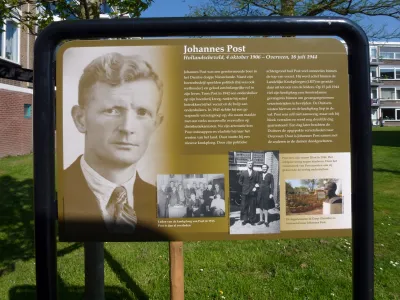
Johannes Post
Human Design Chart
Biography
Johannes Post was the youngest child of the farmer and reformed local ARP politician Jan Wolters Post (1 Sep 1863, Kerkenveld - 10 Oct 1942, Hollandscheveld) en Trijntje Tempen (11 Oct 1865, Hijken - 16 Feb 1937, Hollandscheveld). On 30 April 1887 they married and between 1888 and 1906 they got eleven children.
He followed one year MULO secondary education, then started working on the farm of his father. On 26 November 1929 Post married Dina Salomons (3 July 1903, Nieuw Buinen - 26 Febr 1991, Rijnsburg) in Borger, that year he started a farm for himself. He also engaged in the marketing of poultry, eggs and horses. They got nine children,of which their first child Jan Wolter (13 Oct 1930 - 20 Oct 1930, Nieuwlande) died after a week.
He joined like his father the Calvinistic Anti-Revolutionary Party (ARP), and became in 1935 alderman of Oosterhesselen. He was known as a hard-working, intelligent, non-conformist and highly principled personality, who was not afraid of taking risks. But he was also member of the Calvinistic Reformed Church and the Christian Anti-Revolutionary Party, who were fiercely opposed to communists and anarchists. In the dualistic Calvinistic view G'd' will has ordained his Universal government / will on earth. So oppression against it, as Isaiah proclaimed was a suicidal step.
When the German invasion started on 10 May 1940, he was shocked and wanted to fight. But the Dutch capitulation followed soon after the bombardment of the medieval city of Rotterdam (14 May 1940, 13h30). Unlike the Dutch communists, anarchists and left wing intelligentsia, who started the resistance movement soon, he was not on the Nazi death list. Even most Dutch Jews, had no idea of what was coming, as the Holocaust was implemented gradually by the Nazi's, in small steps, to prevent upheaval.
The Human Design of Johannes Post: Projector 1/3
Projector 1/3 — Design at a Glance
Johannes Post's Human Design profile indicates a tendency towards precise system analysis. As a Projector, he did not have an intrinsic constant energy source like other types but rather acted more like a focused flashlight: He could immediately see where errors lay in structures or relationships and "in the dark." However, this ability to identify weaknesses in systems could be perceived as unpleasant when he addressed them directly – comparable to shining a bright light into someone's face.
His optimal strategy was to wait for a respectful and sincerely meant invitation from others before giving advice. Instead of immediately correcting things, it was more elegant for him to attract people through his own harmonious behavior; then others would come to him on their own initiative to seek his insights. Since his Sacral Center was undefined, Johannes Post did not have consistent life energy. He experienced phases of high productivity and rapid workability followed by necessary rest periods for regeneration. Ignoring this rhythm often led to burnout. When he lived according to this design, he was rewarded with success; if he resisted the strategy of waiting for invitations, the non-self theme threatened bitterness. His influence therefore rested less on constant action than on targeted, invitation-based leadership and the ability to illuminate others' paths.
Self-Projected Authority
Johannes Post's Human Design reveals a rare inner authority: the authority in self. This configuration was exclusive to Projectors and significantly influenced his decision-making process. It combined extreme openness with the constant risk of being distracted by external motor energies. The central challenge lay in not getting lost in this sensory openness or constantly seeking external energy.
His inner truth resided in his identity. Johannes Post could arrive at clear decisions through two pathways. First, through self-conversations or dialogical exchange processes if he was invited to do so. Crucial here was listening to himself and distinguishing the spontaneous, unreflective speech of his true essence from calculated reasoning. This authentic expression enabled him to make his uniqueness visible to others.
Secondly, a physical feeling acted as a compass, drawing him geographically or thematically in certain directions or diverting him from them. By following this inner attraction and staying loyal to his personal direction, Johannes Post could become an orientation point for others. In this faithful adherence to his specific internal signals lay his greatest potential for success and effectiveness.
The 1/3 Profile — Investigator / Martyr
Johannes Post's Human Design reveals a tendency towards deep research and pragmatic experimentation. As someone with the Profile 1/3, Researcher/Experimentor, he demonstrated himself as someone who validated theoretical knowledge through practical application. His Line 1 conveyed the necessity of understanding the foundation and depth of things; it was about instinctively recognizing what is practically sensible. Clichés and platitudes were not dismissed but rather acknowledged as valuable collective accumulations of meaning.
This analytical basis met with the energy of Line 3, which defines responsibility through trial and error. For Johannes Post, learning was a process of trying out, where mistakes were not defeats but essential steps. The mechanics of his configuration emphasized that true mutation and development are impossible without self-sacrifice and going through setbacks. He recognized early on his role in this mutational process.
A judgment from Johannes Post was therefore considered particularly trustworthy: if he deemed something good, he had both intellectually penetrated it and practically tested it to the core. His life revolved around this synthesis of deep understanding and vigorous testing. The tension between the desire for complete planning (Line 1) and the urge to act (Line 3) shaped his path, yet at the end stood always the self-earned, tested insight in the center of his existence.
Single Definition — Defined & Open Centers
Johannes Post's Human Design profile points towards a clear, identity-defining communication style that is nonetheless marked by significant mental and emotional vulnerabilities. His defined G Center provided him with a firm sense of self-identity and direction; he intuitively knew who he was and where his path led. This inner security flowed into his defined Throat Center, allowing him to express his truth easily and honestly. His voice did not come from fleeting thoughts or emotions but rather from the stable core of his personality.
At the same time, a complex dynamic emerged through his open centers. The open Head and Ajna Centers made him susceptible to mental confusion and pressure to find answers to questions that were not his own. He tended to get caught up in intellectual whirlpools or interpret foreign opinions as his own truth. His open Heart Center lacked consistent willpower; he was vulnerable to trying to prove his worth through promises he could not keep, which led him into spirals of self-disapproval.
His open Sacral Center indicated an unstable energy flow. Johannes Post risked overextending himself on borrowed energy from others and falling into exhaustion because he did not know when enough was enough. His open Solar Plexus absorbed the emotions of his surroundings, making him appear emotionally unstable and prone to avoiding confrontation out of fear of rejection. The open Spleen Center amplified fears about well-being, leading him to cling to uncertain situations just to feel a false sense of security. Finally, his open Root Center absorbed external stress, making him vulnerable to burnout from the adrenaline-charged pressure situations in his environment. His challenge was to protect his clear voice and identity against these conditioning forces of non-self.
Channels for logical, future-oriented leadership.
Johannes Post's Human Design profile points towards a tendency for logical, collective leadership. He demonstrated himself as someone who showed his competence through understanding existing patterns and needed to be invited by his surroundings to lead effectively. This dynamic was shaped by the Alpha Animal Channel 7-31. This channel connected the G Center with the Throat Center, enabling leadership based on tested facts. Gate 7 provided the logical role of 'the power behind the throne,' while Gate 31 spoke as a collective leader. Post could show the way but had to wait until the majority wanted him to represent them.
Additionally, Gates involved pattern recognition and material control. Gate 48 allowed for recognizing deeper connections in the collective, yet often led to frustration because it offered knowledge without direct application. Gate 21 steered material life and required respect within the community to overcome obstacles through power. In the realm of resistance, Gate 38 showed a necessary aggression to defend individual integrity against harmful forces, while Gate 39 released adrenaline for mutations through provocation and analysis.
Reflection and emotional restraint rounded out his profile. Gate 33 promoted active withdrawal to process experiences and avoid repetition. Without this calm, errors threatened. Throat Center Gate 12 emphasized the influence of emotional mood on communication and was linked with poetry as well as individual creativity. It was a reserved quality that only came to expression after inner clarity. Johannes Post lived this mechanism as a combination of logical guidance, deep pattern recognition, and protection of his identity through targeted resistance and reflection.
Collective Circuitry — Circuit Signature
Johannes Post's Human Design profile points towards structured, rational knowledge acquisition. He showed himself as someone who analyzed logical connections and shared these insights with others – free from emotional coloring. This attitude resulted from his simple definition: A clear, direct energy flow shaped his essence without inner conflict or divided focus.
Central to him was the Understanding Circuit being active. In Johannes Post, this circuit exclusively connected the Throat Center with the Identity Center through the 'Alpha Animal' Channel. This connection generated a specific dynamic: The ability to think strategically and penetrate complex structures (Identity) was directly translated into expressive capability (Throat). It involved an 'emotionless ratio,' as the Solar Plexus Center was not involved. Johannes Post used this energy to improve things or steer societal developments towards a better future. The focus lay on sharing visual and logical insights, formatted and precise. With his simple definition, these forces worked as a continuous flow between thinking and speaking. There were no separate energetic blocks within this system; his identity and expression were inseparably linked through this one channel. This shaped his way of communicating: directly, strategically, and focused on the essentials, always with the aim to bring rational clarity into the world.
Right Angle Cross of Tension 3
Johannes Post exhibited a fundamental disposition marked by profound inner tension. His Human Design indicated the 'right cross of tension 3', suggesting a life where pressure and friction were not seen as flaws but rather as driving forces. This configuration does not describe a tranquil existence, but rather an ongoing process of enduring against resistance.
The mechanics of this cross imply that Johannes Post often found his identity through overcoming crises and resolving friction. It was not a state of easy flow, but one of active tension he had to carry. This energy compelled him to face challenges head-on, recognizing them as necessary parts of development. For him, peace was often just a brief interlude between phases of intense inner or outer conflict.
The tension in his design kept him alert and present. It prevented superficial adaptation to the environment and instead demanded authenticity through dealing with pressure. Johannes Post did not live this dynamic as a path of suffering in a negative sense but rather as a structural necessity of his essence. Friction was the engine that propelled him forward, helping him define his own substance by learning to remain stable under strain.
Saturn Return — Life Cycles
Johannes Post's design indicated a tendency towards structural consolidation and negotiation of boundaries, which became particularly evident during his first Saturn Return phase. This cycle marked a turning point for him where spontaneous impulses were replaced by long-term responsibility.
The first Saturn Return typically occurs around the age of 29 and signals the end of searching for identity in childhood or youth. For Johannes Post, this did not mean an abrupt change in nature but rather the necessity to review his previous life plans for their viability. What had previously been a provisional trial became now a binding foundation. This process required him to clearly define boundaries and take on commitments that extended beyond his personal horizon.
During this phase, Johannes Post learned that true freedom lies not in unbound drifting but in conscious choice of structures offering stability. The Saturn Return served as a corrective measure for earlier over-optimizations or unrealistic expectations. Through this experience, he gained maturity and applied his energy more purposefully. The challenge was to see the pressure of this new reality not as a limitation but as a foundation for sustainable development. By accepting these responsibilities, he created a stable framework within which his specific potential could be effectively realized over time. This cycle shaped his subsequent life path through an increased focus on durability and integrity towards himself and his environment.
Projector · Self-Projected Authority — Synthesis
Johannes Post was a Projector whose life was marked by a deep drive for understanding and the desire to share this knowledge. His design showed a natural ability to recognize patterns (Gate 7 in the Alpha Animal Channel) and identify weaknesses, coupled with a focusing aura that encouraged others to confront their own challenges. This gift manifested in his Explorer Profile (1/3), driving him towards continuous learning and experimentation – seeking proven insights through personal experience and then sharing them as logical leadership (Alpha Animal Channel). His defined Throat Knot indicated that his communication stemmed from a clear inner source.
Central to Johannes Post's essence was a paradox between the need for recognition – essential to activate his Projector energy – and the risk of losing oneself in external influences (Authority in Self). He lived in constant tension between wanting to offer his knowledge and the necessity to wait for an invitation. This openness to external energies, combined with his ability for logical analysis (Mind Circuit), led him repeatedly to face new challenges while simultaneously striving not to lose sight of his own inner truth.
1 Defined Channel
Incarnation Cross - Right Angle Cross of Tension 3
Solar Return
The Solar Return shows the moment when the sun returns to its exact birth position - your personal solar year.
Life Cycles
Discover the life cycles with a detailed triple view (birth chart, cycle chart, composite).
Human Design Profile
- Type
- Projector
- Strategy
- Wait for the respectful invitation
- Authority
- Self-Projected Authority
- Profile
- 1/3 - Investigator / Martyr
- Definition
- Single Definition
- Incarnation Cross
- Right Angle Cross of Tension 3
- Date of Birth
- 04.10.1906 01:00
- Place of Birth
- Hollandscheveld, Netherlands
Frequently Asked Questions
What was Johannes Post's Human Design type?
What Profile did Johannes Post have in Human Design?
Which Authority guided Johannes Post?
What incarnation cross was assigned to Johannes Post?
When was Johannes Post born?
Discover your own Human Design
Are you also a Projector? Find out in a personal reading how to unfold your leadership qualities and recognize the right invitations.
More Personalities
Back to overviewSissy Spacek

Alain-Fournier
Anémone
Ann-Margret

Bourvil
Hergé