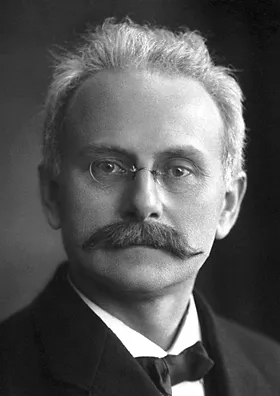
Johannes Stark
Human Design Chart
Biography
Stark's final humiliation came in 1947, when he was sentenced to four years in a labor camp by a German de-Nazification court.
He was awarded the Nobel Price in Physics, 1919.
He died 21 June 1957, Traunstein, Germany.
What does Generator 5/1 mean for Johannes Stark?
Generator 5/1 — Design at a Glance
Johannes Stark possessed an enormous, sacral endurance that made him a powerful workhorse. His design was characterized by the potential to generate large amounts of energy, comparable to a strong working horse. This power was conditional, however: it ignited primarily when he reacted to impulses from his environment rather than initiating independently. The strategy of his type involved waiting and then responding intuitively as soon as the inner signal "Yes!" came.
This mechanism carried two specific risks for Johannes Stark. First, there was a danger of burnout if he persisted in tasks that did not bring him joy and only wasted his energy. Second, he suffered from frustration when external circumstances prevented him from continuing to work on his heart project, even though his inner drive remained intact.
If Johannes Stark lived in harmony with this reactive strategy, his system rewarded him with a deep sense of fulfillment and satisfaction. If, however, he constantly initiated himself or ignored his internal signals, it inevitably led to persistent frustration and a noticeable energy deficit. His effectiveness thus depended crucially on whether he applied his enormous endurance where his inner self truly consented.
Sacral Authority
Johannes Stark lived as a Generator whose decision-making was shaped by Sacral Authority. This inner leadership manifested not in the Head Center but as an immediate physical reaction to external stimuli. His strategy involved waiting and arriving at the right moment – a process that was simplified for him because his Type Strategy matched his Inner Authority. In response to life, he felt a gut feeling or surge of energy, often audible as grunting, humming, or a confirming "Mhm." These signals marked the moment when his sacral motor kicked in.
This activation gave him vitality and inexhaustible energy. Johannes Stark tackled his tasks with great enthusiasm and immersed himself fully without being bound to any specific purpose. His life's task was to act with joy and satisfaction. Furthermore, his activated Spleen Center supported this dynamic. It allowed for quick, spontaneous reactions and a reliable access to instinctive perception as well as physical wellbeing. He followed this direct, body-based intuition that enabled him to make decisions swiftly and move confidently within the flow of his own energy.
The 5/1 Profile — Heretic / Investigator
Johannes Stark revealed himself as someone who gathered deep knowledge to offer practical solutions to others. His design as a 5/1 "Hero/Researcher" shaped this dynamic: Line 1 created the foundation for intensive research and withdrawal, while Line 5 made him a magnetic figure that others sought out for answers.
This configuration often led to Johannes Stark being consulted in crisis situations to provide practical solutions – an aspect of Gate 42 (Line 5). Yet, serving others in this way could quickly overwhelm him. Like the example of a scientist exhausted after long conferences and inundated with requests, Johannes Stark faced the risk of burnout if he did not set clear boundaries. Line 1 gave him the ability to maintain inner harmony despite external limitations (Gate 60), but the pressure from "environmental tyrants" and constant restlessness under constraints could be significant.
His challenge was to reconcile his need for withdrawal and concealment (Venus in Fall) with the expectations of his environment. Only by learning to say no as well, could Johannes Stark maintain a balance between his private research process and his public role as a problem solver. In this way, he optimally used his gifts without sacrificing himself or depleting himself through excessive dedication to others' questions and criticism.
Single Definition — Defined & Open Centers
Johannes Stark's design revealed a tendency towards vital endurance and instinctive self-preservation. As a Generator, he had a defined Sacral Center, providing him with a constant source of physical energy. However, this power was only effective when he waited for external stimuli and responded with spontaneous yes or no answers rather than initiating action himself. His defined Spleen Center provided a fine-tuned instinct for health and well-being in the present moment, while his defined Root Center supplied the necessary pressure to advance materially and transform stress into productive movement.
At the same time, Johannes Stark was vulnerable to external conditioning through several open centers. His open Head Center left him exposed to mental pressures; he tended to identify with questions or doubts of others rather than recognizing them as foreign noise. His open Ajna Center meant that his conceptual thinking was flexible but also carried the risk of adopting foreign opinions as personal truths or recoiling under the pressure to appear certain. The open Throat Center manifested in difficulty focusing attention; he often received communication spontaneously and reactively, instead of manifesting it through planning.
Additionally, Johannes Stark had an open G Center, which did not give him a fixed identity or life direction. He relied on relationships and places to initiate clarity about his self-image. His open Heart Center lacked consistent willpower; he easily fell into the cycle of wanting to prove his worth through promises, leading to frustration when these were unfulfilled. Finally, his open Solar Plexus absorbed the emotions of his surroundings, causing him to fluctuate between foreign moods rather than owning his own emotional waves. This configuration described a person who drew strength from reaction and instinct but was strongly influenced by their environment in mental, identity-related, and emotional aspects.
Channels for change, meaning and ambitious transformation.
Johannes Stark worked deeply underground to bring about evolutionary change. His design featured the Mutation Channel 60-3, connecting Root and Sacral Centers. This energy was unpredictable and melancholic; it required accepting limitation (Gate 60) to move beyond the confusion of a new beginning (Gate 3). The pulse of this power was on-off, creating inner tension when nothing happened. Stark had to learn to endure these silences until a new mutation passed through him.
Parallel to this, the Life Struggle Channel 38-28 shaped his attitude. He sought meaning in the struggles of his existence. Gate 38 urged defending individual integrity against external distractions while Gate 28 intuitively recognized which battles were worth fighting. This combination gave him a stubborn resolve to walk his own path and find significance in the obstacles that confronted him.
Additionally, the Transformation Channel 54-32 influenced him. Driven by ambition (Gate 54) and the desire for continuity (Gate 32), he sought recognition through consistent effort. This ambition was closely tied to awareness of his talents; motivated by fear of failure and a drive to prove his worth, he wanted to elevate himself on his own strength.
Individual Gates rounded out this picture: Gate 56 enabled him to transform mental processes into vivid narratives. Gate 42 emphasized the need to conclude experiences before new commitments entered. Gate 27 brought genetic care for the clan while Gate 19 pointed towards resources and secure territories. Gate 44 promoted awareness in relationships, and Gate 41 propelled him from one emotional experience to another, always focused on evolutionary development through crisis and change.
Individual Circuitry — Circuit Signature
Johannes Stark exhibited an energetic, pulsating nature that aimed at the present moment and his individuality. His design connected the Sacral, Root, and Spleen Centers in the Knowledge Circuit for a direct flow. The 3-60 Channel promoted mutative deviations from the known while the 28-38 Channel brought the Life Struggle as a driving force. This configuration supported the emergence of new knowledge and its emotional expression through the Throat Center to initiate change.
Parallel to this, in the Ego Circuit, an isolated energy between Spleen and Root Centers over the 32-54 Channel was at work. This area stood for transformation within the clan group, focused on cooperation and resource building. Since there was no connection to the Sacral Center here, this dynamic required necessary pauses for regeneration to maintain energy for collective creation. Thus, Johannes Stark lived with two distinct energetic strands: an impulsive, innovative stream of individual identity and a second, more conservative area of collective support that needed breaks to sustain its impact. Both systems coexisted side by side without directly merging.
Left Angle Cross of Limitation 1
Johannes Stark's Human Design indicated a tendency towards inner discipline and clear boundaries. He appeared as someone who sought structure to channel his energy effectively rather than letting it flow unchecked. This orientation stemmed from the left cross of Limitation 1 in his chart.
This configuration describes a process of learning through experience and setting necessary limits. It was not about rigid external rules but about developing an inner compass that helps distinguish between what is essential and what is superfluous. For Johannes Stark, this meant that he often could only fully unleash his power after first learning to restrict himself and maintain focus. The mechanics of this cross promoted a stance of patience and conscious selection. It was a path of refinement where every limitation was understood as an opportunity for deeper engagement. Rather than striving for endless expansion, his strength lay in precision and the ability to separate what is essential from what is peripheral. This shaped his approach to tasks and relationships: he sought clarity over breadth. Through this internal structuring, he could protect and strategically deploy his unique abilities without exhausting himself. It was a design that demanded respect for one's capacity while simultaneously providing the strength to achieve peak performance within these limits.
Saturn Return · Uranus Opposition · Chiron Return · 2nd Saturn Return — Life Cycles
Johannes Stark's Human Design was characterized by a strong impulse towards structural anchoring and public recognition. This tendency became evident in his first Saturn Return: at 26 years old in 1900, he habilitated himself and was appointed extraordinary professor in 1906. This cycle condensed years of groundwork into a stable professional foundation.
The subsequent Uranus Opposition then brought the dynamics of breakthrough: in 1913, he discovered the Stark effect and was elected corresponding member of the Göttingen Academy of Sciences. At age 39, a moment occurred where established structures were challenged by new insights, leading to a significant success.
His Chiron Return around his 48th year marked a profound realignment towards fulfilling his own purpose, which must be understood not as healing but as confrontation with his essence. In 1922, Stark resigned from his professorship in protest and withdrew. This step signaled the end of an old cycle and the beginning of a new, more authentic phase.
In his second Saturn Return at age 56, he again sought stability in external structures. In 1930, Johannes Stark joined the NSDAP. This highlighted the ongoing need for his design to locate itself within clear hierarchies and recognized systems to experience stability and significance.
Generator · Sacral Authority — Synthesis
Johannes Stark lived as a Generator whose sacral energy and endurance drove him towards profound engagement. His profile as Hero and Researcher (5/1) points to a natural aptitude for exploring knowledge domains to offer solutions – a process that was promoted by his ability to immerse himself in work as long as it evoked his inner sacral response. The defined Sacral Center power (Sacral Center) gave him constant vitality and the need to express this energy through active engagement, with the immediate bodily reaction to external stimuli being crucial for his decisions. This focus on personal projects and the associated creative drive shaped his life.
A central paradox in his design lay in the interplay between a thirst for knowledge and limitation. The circuit of Knowledge, particularly Channel of Mutation (3-60), indicated an ability towards transformation and uncovering new knowledge, coupled with pulsating, melancholic energy. Simultaneously, recurring cycles – from professional success through crises to political decisions – showed a pattern where the pursuit of insight and expression repeatedly hit limits or was restricted by external circumstances, forcing him to realign.
3 Defined Channels
Incarnation Cross - Left Angle Cross of Limitation 1
Solar Return
The Solar Return shows the moment when the sun returns to its exact birth position - your personal solar year.
Life Cycles
Discover the life cycles with a detailed triple view (birth chart, cycle chart, composite).
Human Design Profile
- Type
- Generator
- Strategy
- To respond - wait for something to respond to
- Authority
- Sacral Authority
- Profile
- 5/1 - Heretic / Investigator
- Definition
- Single Definition
- Incarnation Cross
- Left Angle Cross of Limitation 1
- Date of Birth
- 15.04.1874 06:00
- Place of Birth
- Freihung, GER
Frequently Asked Questions
What was Johannes Stark's Human Design type?
Which profile did Johannes Stark have?
What authority did Johannes Stark have?
What incarnation cross was assigned to Johannes Stark?
When was Johannes Stark born?
Discover your own Human Design
Are you also a Generator? Find out in a personal reading how to use your sacral energy correctly and discover deep satisfaction.
More Personalities
Back to overviewAaliyah

Alexia

Angèle

Anne-Marie

Arcángel

Arno