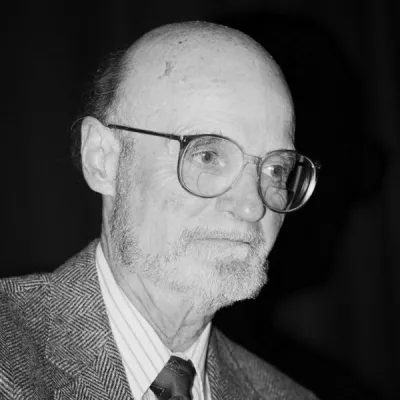
John Barth
Human Design Chart
Biography
John Barth had an older brother, Bill, and a twin sister Jill. He was married twice and had three children. Barth died on 2 April 2024 at age 93 in Bonita Springs, Florida.
John Barth — Generator with Profile 1/3
Generator 1/3 — Design at a Glance
John Barth was a Generator. His design featured defined Sacral Energy, giving him great endurance. He acted like a workhorse: strong and steady as long as he had energy for his tasks. This power did not ignite through spontaneous initiatives but rather in response to external impulses.
The strategy of his type lay in reacting instead of initiating. When a signal from life came and his Sacral Center responded with an internal 'yes', he could act, leading to deep fulfillment. Acting against this flow or suppressing his desire led to frustration and energy depletion.
Two pitfalls marked this pattern. First: doing things that did not interest him. This wasted his strength and inclined towards burnout despite his high potential for productivity. Second: being held back from his heart's project when he was still full of power. Both scenarios blocked the natural flow of energy.
Barth's path to effectiveness lay in patience for the right signal followed by action from gut instinct. Only this way could he unleash his materialization power without exhausting himself. His satisfaction depended directly on whether he followed or fought against this inner confirmation.
Emotional Authority
John Barth's design inclined towards emotional clarity after internal waves subsided. His inner authority was the defined Solar Plexus Center, meaning he was under constant emotional wave patterns that showed in a continuous up and down of his feelings. The world appeared colored by his current mood; one moment he could be totally enthused about something, the next seeing it entirely negatively.
This feeling in the moment was only a snapshot, an initial impression that did not necessarily represent his truth. Quick, spontaneous decisions based on emotion often had negative consequences. His design's mechanics required patience and conscious hesitation at important life choices. By allowing time to pass and rethinking decisions, intense feelings subsided. He gained emotional distance, leading to clarity and calmness. This process of waiting for emotions to settle was essential for him to gain deeper insights and prevent impulsive reactions. Only when this emotional wave had calmed could he recognize his true inner truth and act.
The 1/3 Profile — Investigator / Martyr
John Barth's design inclined towards the synthesis of theory and practice. He appeared as someone whose judgments were based on a double check: intellectually thorough and practically validated. This Profile 1/3, the Researcher-Experimentor, defined his life task as a cyclical process of theoretical study followed by practical validation through trial and error. Identity emerged only through the integration of knowledge and experience; pure theory led to paralysis, while action without reflection remained superficial.
Line 1 with Gate 16 described a lifelong learning process often taking place in daydreams and mental simulations. This allowed him to mentally rehearse skills and recognize patterns but also carried the risk of self-deception. The question was always when these plans could be realized. Here came Line 3 with Gate 37 into play. It demanded adaptability and the necessary trial-and-error process. Through this process, he developed practical wisdom and learned to secure resources through impartial focus on essentials.
The result of this configuration was highly reliable expertise personally tested. When John Barth deemed something correct, he had examined it both theoretically and practically down to his heart's core. His authenticity stemmed from the synthesis of lifelong learning along Line 1 with the necessary adaptability along Line 3. Self-earned insights were at the center of his design.
Split Definition — Defined & Open Centers
John Barth's design revealed a tendency towards immense, self-sustaining power. As an Manifestor Generator, he had defined Heart, Sacral, and Spleen centers, which endowed him with constant willpower, vital energy, and existential intuition. This combination allowed him to shape his life autonomously and control resources independently. His strategy was not to initiate but to wait for reactions in order to use his sacral energy efficiently.
At the same time, his emotional authority through the defined Solar Plexus center required patience. He had to wait out the waves of his feelings before making decisions to achieve clarity. This protected him from impulsive actions and allowed deep insights. His defined Root Center provided a constant life pressure that propelled him forward.
In contrast, Head, Ajna, and Throat centers were open. This made him susceptible to mental confusion and the pressure to find answers that weren't his own. He tended to engage with foreign questions or seek inspiration rather than trust his inner authority. The open G Center meant he lacked a fixed identity and was oriented by external initiation. This openness allowed him to adopt various roles and perspectives without being bound to a rigid self-image. Overall, John Barth emerged as someone who had to channel his strong energy through emotional patience to avoid resistance and fully realize his potential.
Channels for life purpose, community and mature growth.
John Barth's design exhibited a stubborn determination to forge his own path and find meaning in struggles. This was evident through the Life Struggle Channel 38-28: Gate 38 urged the preservation of individual integrity against external distractions, while Gate 28 recognized which battles were worth fighting. This connection conveyed the insight that existence is more than mere survival; it propelled him to actively engage with anything that gave life meaning, even if resistance was great.
At the same time, there was a deep need for belonging and fair agreements within a group. The Community Channel 37-40 linked the desire for recognition and place in the whole (Gate 37) with the will to provide for loved ones under conditions of reward and necessary breaks (Gate 40). This configuration emphasized that genuine connections do not arise spontaneously but require time to gain emotional clarity and secure, mutually beneficial agreements. It fostered the building of bridges between individuals for evolutionary progress without strict hierarchy.
Furthermore, the design shaped a cyclical learning process through complete experience. The Ripe-ness Channel 42-53 connected the energy to start new cycles (Gate 53) with the impulse towards growth and reflection (Gate 42). This mechanism required that experiences be carried through to completion before a new phase could begin. Premature termination led to repetition of the cycle until the wisdom contained within was gained. John Barth reflected these processes to learn from empirical history and prepare his insights so they were useful for others. The combination of these channels created a profile seeking individuality through struggle, social integration through fair agreements, and deep insight through patient ripening.
Individual Circuitry — Circuit Signature
John Barth's design showed tension between two separate energy fields. On one hand, the Knowledge Circuit through Channel 28-38 'Life Struggle' shaped his Spleen and Root Centers. This promoted the search for a unique path, mutation, and the development of an individual identity through intense inner struggle. On the other hand, the Ego Circuit operated over Channel 40-37 'Community', connecting Heart and Solar Plexus. Here it was about cooperation, creating resources together, and balanced give-and-take within the tribe. Since these two circuits were not connected in John Barth – a result of his Split Definition – they existed as parallel, independent forces. Crucial was the lack of connection to the Sacral Center in the Ego Circuit: without this constant flow of life energy, regular regeneration was essential to sustainably generate resources. Thus, John Barth had to balance between individual identity formation through 'Life Struggle' and collective commitment to support, with pauses being crucial to maintain energy for both areas.
Right Angle Cross of Planning 2
John Barths design showed a tendency towards strategic planning and vision. He was someone who recognized large-scale connections and developed long-term plans. This attitude stemmed from the configuration of the right cross in Planning 2. In Human Design, this aspect describes the ability to look beyond the immediate moment. It's not about daily tactics but recognizing patterns that unfold over years. John Barth had an internal map for long-term goals. His system was designed to place steps within a larger context. This allowed him to make decisions not in isolation but with consideration of future developments. The emphasis was on structural clarity needed to navigate complex undertakings. Without this visual component, his actions would often have remained fragmented. Instead, he could pursue a coherent direction. This trait shaped how he approached challenges: not through spontaneous reaction but through prepared strategy. His focus always lay on the end result of the journey, which determined the process of means selection. It was a mechanism for orientation in complex fields. John Barth used this gift to carve out a clear path in unclear situations. The planning served not to control others but to enhance his own ability to act in an unpredictable world.
Saturn Return · Uranus Opposition · Chiron Return · 2nd Saturn Return — Life Cycles
In this phase of life, John Barth showed unexpected disruptive changes and sudden breakthroughs in the usual rhythm. This dynamic resulted from the Uranus Opposition, a cyclical trigger for fundamental shifts. In 1973, at age 43, he jointly received the National Book Award for *Chimera*. This significant success point was directly connected to the mentioned cycle. The Uranus Opposition acted as a catalyst that dissolved old structures and created new space. Barth did not use this energy merely for destruction but for creating new forms. The award was no coincidence but the visible result of an internal shift. The mechanics show how external recognition often enters when inner resistance is broken through. Barth actively lived out this transformation process. His creativity benefited from the unpredictability Uranus brought. Instead of clinging to rigid patterns, he allowed himself to take new paths. This led to a deepening of his artistic expression. Success was thus an expression of his ability to handle change. He showed resilience and adaptability in a period of great uncertainty. The Uranus energy challenged him to reinvent himself. Barth met this challenge with openness. His work reflected the contemporary tension between tradition and innovation. The award confirmed his relevance during this transition. It was a moment of affirmation after intense inner work. Barth demonstrated how cyclical forces can be creatively utilized. His attitude was characterized by curiosity rather than fear of the unknown, which allowed him to grow out of crisis and reach new heights.
Generator · Emotional Authority — Synthesis
John Barth lived a life marked by a deep urge for research and willingness to experience. The combination of defined sacral energy, emotional authority, and the Profile of Researcher/Experimentor points to someone who found strength through reactions to the world – not through initiation. This process manifested in an ongoing cycle of experimenting, testing, and refining, where he gained deeper wisdom from each experience. The defined root base supported this endurance and drive to find meaning even in difficult situations, while the Heart Center underscored his ability to determine personal values and manage resources independently.
A central paradox in John Barths design lies in the interplay of emotional depth and an open Throat Center. On one hand, he needed time to gain emotional clarity and make decisions from this inner certainty. On the other hand, his expression was not fixed but responded to the environment and offered space for spontaneous expressions. This tension between the need for emotional maturity and openness to external influences created a dynamic personality that was both profound and adaptable.
3 Defined Channels
Incarnation Cross - Right Angle Cross of Planning 2
Solar Return
The Solar Return shows the moment when the sun returns to its exact birth position - your personal solar year.
Life Cycles
Discover the life cycles with a detailed triple view (birth chart, cycle chart, composite).
Human Design Profile
- Type
- Generator
- Strategy
- To respond - wait for something to respond to
- Authority
- Emotional Authority
- Profile
- 1/3 - Investigator / Martyr
- Definition
- Split Definition
- Incarnation Cross
- Right Angle Cross of Planning 2
- Date of Birth
- 27.05.1930 19:50
- Place of Birth
- Cambridge, MD, United States
Frequently Asked Questions
What Human Design type was John Barth?
Which Profile did John Barth have in Human Design?
What Authority did John Barth have?
What incarnation cross did John Barth have?
When was John Barth born?
Discover your own Human Design
Are you also a Generator? Find out in a personal reading how to use your sacral energy correctly and discover deep satisfaction.
More Personalities
Back to overviewAaliyah

Alain-Fournier

Alexia

Angèle

Angeli

Anne-Marie