
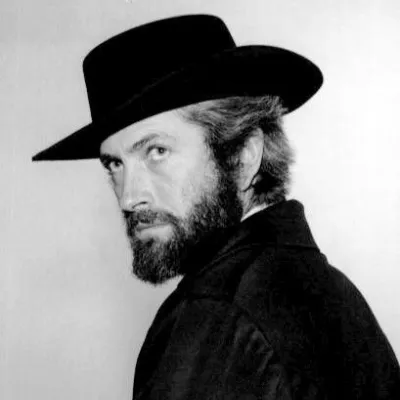
John Drew Barrymore
Human Design Chart
Biography
The son of actors John Barrymore and Dolores Costello who divorced in his infancy, John, Jr. claimed to remember seeing his father only once. His mother attempted to keep him from acting, sending him to St. John's Military Academy and intending that he go to college. But Barrymore rebelled and signed a movie contract at 17. Rather than apprentice in the theatre in small roles, he leapt into leading roles then quit at least twice before finally making his stage debut.
Barrymore married Cara Williams in 1952 and had one son with her, John Blyth Barrymore. They divorced in 1959. In 1960 he married Gaby Palazzolo, they had one daughter and divorced. He married Ildiko Jaid, had one daughter with her, Drew, and divorced. He was long estranged from his family, including his son (who has repeated many of his father's problems) and daughter, actress Drew Barrymore.
During the 1950s, he appeared in several notable films including the western, "High Lonesome." Barrymore had repeated scrapes with the law and was jailed numerous times for drunkenness and spousal abuse. In 1958 he changed his name to John Drew Barrymore and had a brief resurgence in film. His career derailed when he had further incarcerations in the ‘60s for drug activity. He appeared infrequently onscreen and became more and more reclusive, eventually disappearing into a California desert town to live, practicing yoga and meditation. In the mid '70s, he was back in circulation for occasional small bit films and on TV.
The sometime-actor died at age 72 on November 29, 2004 in Los Angeles. The cause of his death sas not disclosed.
Human Design Analysis: John Drew Barrymore as Manifesting Generator 3/6
Manifesting Generator 3/6 — Design at a Glance
John Drew Barrymore revealed himself as someone who possessed a unique combination of constant energy and lightning-fast implementation power. His design as an Manifesting Generator combined the endurance of a Generator with the direct impact of a Manifestor. He had a steady, sacral energy source, meaning that his deepest satisfaction did not come from merely initiating projects but rather from reacting to external impulses.
At the same time, his chart allowed him to skip steps and achieve results faster than other types could. However, this ability brought with it a specific challenge: The risk of missing important stages or getting lost in multitasking without obtaining inner consent. If John Drew Barrymore moved too quickly or worked on multiple things simultaneously without paying attention to his sacral resonance, it often led to frustration – his specific theme of Not-Self.
The path to deep satisfaction lay for him in the „Play Mode“. By allowing himself to work on various projects in parallel and constantly checking whether his inner self still responded with a clear „Yes“, he could optimally utilize his creative power. His energy worked best when seeking variety and not being forced to complete one thing before starting another, as long as only the inner resonance was in agreement.
Emotional Authority
John Drew Barrymore moved through a permanent emotional wave that significantly shaped his perception and decision-making. His design featured an emotional authority, meaning that the Solar Plexus Center was defined and thus took over internal guidance. In Human-Design mechanics, this rule is strict: Once the Emotional Center is colored, it takes charge of authority regardless of other defined centers in the chart.
This configuration created a specific challenge: His feelings were subject to constant ups and downs. What appeared absolutely right or inspiring at one moment could turn negative in the next. This emotional coloring was only a fleeting snapshot, not the final truth. Quick, spontaneous decisions based on this immediate emotion thus carried the risk of being wrong and leading to negative consequences.
John Drew Barrymore's strategy involved conscious delay. He needed time for a decision to mature. „Sleeping on important questions“ was not a sign of hesitation but rather a necessary mechanism for gaining clarity. As time passed, intense emotional fluctuations smoothed out. Only when an emotional distance emerged and calmness set in could he recognize the deeper truth of a situation. This process was especially crucial for long-term life decisions as they influenced his entire life course. Patience and allowing multiple reflection phases were thus key to grounded actions.
The 3/6 Profile — Martyr / Role Model
John Drew Barrymore's design laid out a two-phase life path: initially experimental action in youth, followed by a phase of withdrawal for reflection. Until around the age of 29.5 years, he primarily acted through Line 3 of his Profile 3/6. This developmental line required trial and error in the context of chaos and crises. Progress did not occur linearly here but rather through constant change and the necessity of cooperation with other people. In this first half of life, he sought answers through direct action and confrontation with unpredictable situations.
Only after his Saturn Return, around age 30, did Line 6 activate. This marked a turning point: The playful energy of Line 3 now received the wise guidance of Line 6, which sought an overview. John Drew Barrymore often appeared more withdrawn thereafter to integrate his previous experiences. Internally, he felt torn between the desire for further experimentation and the growing need for contemplative wisdom. He carried within him both the perspective of a young child and that of an old master. The goal of this mechanism was to overcome old doubts and form a new identity through valuable questions. Around age 50, this integration should lead him to become a charismatic role model for others through his charm and accumulated wisdom.
Split Definition — Defined & Open Centers
John Drew Barrymore revealed himself as a carrier of immense inner strength, characterized by a fully defined energy system. His design featured constant vital energy from the Sacral Center, strong-willed determination in the Heart Center, and a steady ability to handle stress through the Root Center. This combination created a robust physical and mental presence. At the same time, his mental field was active: The defined Head and Ajna Centers generated a continuous pressure to ask questions and form concepts, while the Throat Center translated these thoughts into communication. His emotional depth came from the Solar Plexus Center, which served as an inner authority demanding that decisions be made only after waiting for the emotional wave.
This wealth of defined energy stood in contrast to his open centers. The open G Center meant that John Drew Barrymore did not have a fixed, unchanging identity or life direction. Instead, he adopted identities from his environment; his "who" and "where" crystallized only in correct relationships and at appropriate places. If the place was wrong, he lost his direction and felt lost. The open Spleen Center also made him vulnerable to conditioned fears and false intuitions about health and safety. He tended to make spontaneous decisions to force a sense of security, which often relied on the fears of others.
The challenge of his design lay in not using the massive energy of the defined centers to enforce an identity. Rather than actively seeking a fixed role or acting impulsively out of fear, he was dependent on initiations from his environment. Only through waiting could his Sacral Center respond correctly and his emotional authority gain clarity. His strength did not lie in a rigid self-image but in the ability to adapt flexibly and provide energy once external circumstances properly initiated him.
Channels for change, intimacy, community and mental clarity.
John Drew Barrymore's design indicated a tendency towards pulsating, evolutionary change characterized by inner melancholy. This energy came from the Mutation Channel 60-3, which connected the Root Center to the Sacral Center. Gate 60 brought the limitation and pressure of transformation, while Gate 3 tried to create order out of the confusion of a new beginning. This channel required patience: John Drew Barrymore had to wait for his sacral response rather than dismissing melancholic phases with arguments. The change only occurred when he gave space to this inner moodiness and accepted the rhythm of pulsation.
Parallel to this, his design sought intense intimacy and merging. The Pairing Channel 59-6 connected the Sacral Center to the Solar Plexus Center. Here, Gate 59 drove sexual energy while Gate 6 steered an emotional wave of pleasure and pain. This combination created a deep desire for personal contact that required time to clarify. John Drew Barrymore often showed intensity in relationships, with his emotional wave determining when closeness was truly fruitful or if distance was necessary.
Another driver was the constant search for new experiences for emotional maturity. The Transience Channel 35-36 connected the Solar Plexus Center to the Throat Center. Gate 35 pushed for change and novelty, while Gate 36 perceived inexperience as a crisis or inadequacy. This drove John Drew Barrymore to continually face new situations to gain emotional depth. This restless longing served to gather wisdom through experience and make it accessible later, as he learned to accept the transience of feelings.
Collective Circuitry — Circuit Signature
John Drew Barrymore revealed himself as someone whose inner world was strongly shaped by the emotional processing of past experiences. His design activated the Purpose Circuitry, an energy that did not rely on cool logic but rather on intuitive understanding of connections through felt experience. This mechanism worked cyclically and visually: emotions would rise and fall again, a wave-like process that required time to draw meaning from the past.
Within this circuitry, he connected the Head Center with the Ajna Center in John Drew Barrymore. This created a direct flow between spontaneous impulses and the ability to shape them visually or narratively. Parallel to this, there was a second, separate connection between the Throat and Solar Plexus Centers. Here emotional coloring took place, allowing him to share his felt insights with the collective. It was not about rational analysis but rather about emotionally understanding historical contexts and passing on these lessons.
Besides this reflective side, there existed another independent energetic structure. The Knowledge Circuitry connected his Sacral Center directly to the Root Center through the Channel of Mutation. This gave him a pulsing, acoustic energy aimed at walking his own path and forming new identities. This force did not engage in direct exchange with the purposeful energy of the right chart half; it existed as a parallel, independent driving force for transformation and expression of his individuality. Through this shared definition, two different energy fields lived side by side: one reflecting and dividing, the other mutating and identity-forming.
Right Angle Cross of Consciousness 2
John Drew Barrymore's design featured the right consciousness cross structure 2. This configuration established a specific inner orientation whose exact mechanical workings are not further specified in the available data. It is an abstract architectural feature within his Human Design chart.
Since there was no detailed behavioral description or functional explanation for this cross in the raw content, interpretation remains limited to merely naming this structure. John Drew Barrymore lived with this aspect of his energetic map without deriving character traits such as specific action patterns, emotional tendencies, or strategic approaches from it. The mechanics of this cross functioned purely as a background structure without being assigned any concrete human translation or relatable life context in the given framework.
There were no indications of specific manifestations that appeared in his daily life nor events mentioned that would have confirmed this structure. John Drew Barrymore was thus someone whose design included this element, but its practical relevance or impact could not be explained within the scope of this analysis. The absence of a description does not mean the absence of the structure itself, but rather that it stands as an isolated fact without further mechanical classification.
Saturn Return · Uranus Opposition · Chiron Return · 2nd Saturn Return — Life Cycles
John Drew Barrymore's relationship development was shaped by two prominent astrological cycles that structured his partnerships. His design indicated a tendency to enter deep connections in specific life phases corresponding with inner maturity and a desire for change.
In 1960, at the age of 28, John Drew Barrymore married Gaby Palazzolo. This event fell during his first Saturn return cycle. Typically marking the transition to full adult responsibility; long-term internal orientation solidifies into stable life structures here. The marriage was a concrete anchoring of this new stability, a moment where previously developed elements took form and entered a lasting commitment.
Eleven years later in 1971 at age 39, he married Jaid Barrymore. This occurred during the Uranus opposition cycle. Often bringing a phase of breaking free from old patterns and a drive towards individual freedom or radical realignment, this connection emerged during a time marked by questioning existing boundaries and finding new, perhaps unconventional paths of connection. While Saturn return signalled structure, the Uranus opposition indicated a dynamic shift in the relational framework, opening John Drew Barrymore to another quality of partnership based less on traditional consolidation than personal autonomy and renewal.
Manifesting Generator · Emotional Authority — Synthesis
John Drew Barrymore lived a life marked by an inner dynamism: the constant interplay between initiation and reaction. As an Manifesting Generator, he possessed the ability to quickly initiate things, yet his design required him to react to impulses from his defined sacral center. This combination led to a life full of energy and creative power but could also lead to frustration through skipping important steps or splitting attention. The recurring need for emotional grounding and letting decisions mature (emotional authority) balanced his quick initiating energy, allowing him to find deep satisfaction in his actions when strategy and inner voice aligned.
A central paradox lay in the tension between his desire for connection and the absence of a defined throat center. He was open to others' influences, sought relationships and community, yet his identity remained fluid. This openness could make him vulnerable but also fostered an ability to adapt and take on various roles. The constant search for validation and belonging stood in contrast to the necessity of finding his own path and expressing his unique inner truth – a tension that shaped his life and made him a multifaceted individual.
6 Defined Channels
Incarnation Cross - Right Angle Cross of Consciousness 2
Solar Return
The Solar Return shows the moment when the sun returns to its exact birth position - your personal solar year.
Life Cycles
Discover the life cycles with a detailed triple view (birth chart, cycle chart, composite).
Human Design Profile
- Strategy
- To respond - wait for something to respond to
- Authority
- Emotional Authority
- Profile
- 3/6 - Martyr / Role Model
- Definition
- Split Definition
- Incarnation Cross
- Right Angle Cross of Consciousness 2
- Date of Birth
- 04.06.1932 15:52
- Place of Birth
- Los Angeles, CA, United States
Frequently Asked Questions
What was John Drew Barrymore's Human Design type?
What Profile did John Drew Barrymore have in Human Design?
Which authority guided John Drew Barrymore?
What incarnation cross did John Drew Barrymore have?
When was John Drew Barrymore born?
Discover your own Human Design
Are you also a Manifesting Generator? Find out in a personal reading how to unfold your multi-talents and direct your energy wisely.
More Personalities
Back to overviewSissy Spacek

Aldair

Alizée

Anémone

Angeli

Ann-Margret
