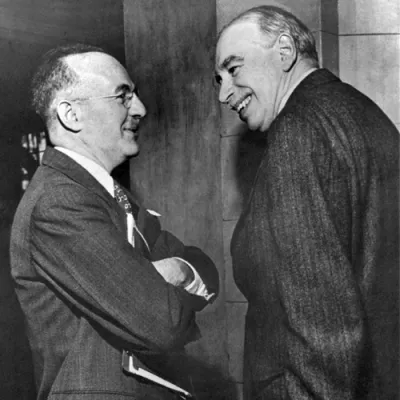
John Maynard Keynes
Human Design Chart
Biography
The son of a Cambridge administrator, Keynes excelled in his early schooling due to a lot of hand-holding by his parents. He loved his mother very much. His father not only coached him through every exam he ever took from Eton up to the Civil Service, but he also made the decision that math would be his course of study. His formal study ended when he placed a disappointing twelfth in his final exam at the end of his second year, at which point he turned to economics. Never studying the subject in a formal way beyond eight weeks tutorials with Alfred Marshall, he went on to become this century's most influential economist. The young Keynes had a habit of lying in bed and reading the poetry of Longfellow and his real education came from the Apostle, a secret society started at Cambridge in 1820 and originally devoted to a philosophy of life for the cloistered. Earlier members of the group were Bertrand Russell and Guy Burgess with few scientists among them. During Keynes' generation and after, many of the members were gay. From this group emerged the Bloomsbury group including Lytton Strachey, Duncan Grant, E. M. Forster, Demond McCarthy, Clive Bell, along with the added members Vanessa Stephen and her sister Virginia Woolf plus a few others. The artists and writers of the Bloomsbury provided him with a circle of friends, lovers, moral censors and financial dependents.
In 1906 Keynes left for London to take the Civil Service exam and sailed through it with his lowest scores being in economics. He worked in the India office from 1906 to 1908 and made his mark by writing a minor classic on Indian banking and finance.
Human Design Analysis: John Maynard Keynes as Projector 4/6
Projector 4/6 — Design at a Glance
John Maynard Keynes revealed himself as a person with a dense, focused aura that immediately recognized systematic errors. His design acted like a bright flashlight, pointing out weaknesses in structures or relationships and bringing light to the dark spots. However, this instinctive ability to identify the core of problems was only effective when it wasn't used through direct confrontation. Addressing deficits head-on would often trigger resistance from his environment, similar to shining a bright light directly into someone's face.
Instead, Keynes worked most effectively through passive, attractive presence. By living harmony and clarity in his own connections, he became an example for others. This natural glow attracted people who then sought out his assessment voluntarily. The waiting period for an honest invitation was not a sign of passivity but the crucial mechanism to avoid rejection and preserve his own energy.
Since his Sacral Center was undefined, he did not have constant life energy. Instead, he experienced cycles of high-intensity phases followed by necessary rest periods for regeneration. This pattern protected him from burnout and fundamentally differed from a steady energy flow. Living in harmony with this waiting strategy and selective guidance led to success. Deviations inevitably led to his non-self theme: bitterness.
No Inner Authority
John Maynard Keynes did not possess internal, physical authority. His decision-making ability arose solely through external interaction and resonance. As a mental projector, he activated his intelligence in dialogue with others. Through energetic interactions in his open centers, dormant potentials were awakened, providing him with information. This allowed him to view issues from many perspectives and express them differently. His high resonance capability helped him find the right environment and people for this trusting exchange.
Evaluating these diverse impressions was a complex process requiring time and solitude. In silence, John Maynard Keynes could discern the red thread, distinguish what made sense and belonged to him. Thus, he developed his specific intelligence: filtering out the essence from a mass of information, organizing it meaningfully, and structuring it. This formed his capital for success. A key factor for him was choosing an environment where he felt comfortable. There, he could discuss decision-making processes with suitable partners, deepening his sense of what was right. His openness was not a lack of structure but a tool to collect perspectives that were only organized in retreat.
The 4/6 Profile — Opportunist / Role Model
John Maynard Keynes showed himself as someone whose inner experience was shaped by the tension field between heart and head. His design tended towards initially exploring the world intensively before becoming a wide instance later on. In the first three decades of his life, Line 4 dynamics dominated. It drove him to gather experiences and bring about changes. This phase was experimental; he sought contact to shape his own reality without considering possible misunderstandings. The main goal was the experience itself, not its personal evaluation.
With the Saturn Return around age thirty, his focus fundamentally shifted. Line 6 became active and triggered a desire for wisdom and distance. Suddenly, he faced an internal conflict: His heart yearned for belonging to the community while his head sought to stand on a mountain and ponder the meaning of it all. This duality could be confusing. He was expected to become a role model that stood out through cooperation. But his heart remained cautious; it protected itself from opening up to the wrong people and getting hurt.
The task was not to use nostalgia as a backward glance but to let go of old doubts. Through valuable questions, a mutation in the individual circuitry should be achieved. He had to learn to translate the collected experiences of his youth phase into mature leadership without losing necessary distance from his own history.
Single Definition — Defined & Open Centers
John Maynard Keynes revealed himself as someone whose mind lived in a perpetual state of inspiration and conceptual pressure. His design was marked by the defined connection between Head Center and Ajna Center, creating a constant mental flow of questions, doubts, and theoretical concepts. This channel created an unchanging characteristic: the continuous need to understand connections and form consciousness without possessing the direct energy for physical manifestation of these ideas.
Since the Head and Ajna Centers were not connected to the energetic engines of his design, attempts to immediately translate this mental pressure into action often led to frustration or inner concern. The challenge was to accept inspiration as a pure question and wait until the timing was ripe for its transmission rather than directing the pressure inward, which could lead to self-doubt.
At the same time, nearly all other centers were open, making John Maynard Keynes situationally receptive to environmental fields. His open Throat Center meant that communication and attention were not self-directed; he tended to wonder if his words were being heard rather than waiting for the timing of an invitation. The open G Center left him without a fixed identity or direction, causing him to reflect in relationships and environments to receive initiations instead of asserting his own path.
The absence of a closed Heart Center lacked consistent willpower; he was vulnerable to the pressure of proving his worth through performance, which could lead to a cycle of promises and disappointment. His open Sacral Center made him sensitive to the energy of others, leading to overexertion if he did not trust his inner authority to set boundaries. Finally, his open Solar Plexus Center absorbed emotional waves from the environment while his open Spleen and Root Centers made him susceptible to fears and external stress. This openness required a constant distinction between his essence and conditioning influences of the world.
Channels for mental patterns and abstract comprehension.
John Maynard Keynes showed himself as a spirit intent on not just collecting experiences but translating them into narrative contexts that make sense. His mind worked like a kaleidoscope: it generated constant mental images and was under the perpetual pressure to deconstruct reality. This attitude resulted from Channel of Abstraction 64-47, which connected the Head Center with the Ajna Center. Through Gate 64, the Gate of Confusion, and Gate 47, the Gate of Understanding, every life experience filtered through a lens of possibilities. This mechanism often created uncertainty as the mind could never be one hundred percent sure. It was not a tool for solving practical problems but rather a process of self-reflection and gaining perspective.
The reward for this mental turbulence lay in the "aha moment". When patience was maintained, the initial confusion condensed into an inspiring story or new viewpoint that needed to be shared with the collective. Keynes’ design was thus unsuitable for factual security but brilliant for the intellectual interpretation of experience.
Additionally, other gates influenced him. Gate 35 demanded change through interaction and new experiences, where true satisfaction only came later from understanding the meaning behind these experiences. Gate 5 emphasized the fundamental rhythm of life; it was important to follow one's own routines to build energy and perfect patterns. Gate 63, the Gate of Doubt, pushed the mental process forward by urging an understanding of things and clarifying uncertain patterns through improvement. Finally, Gate 24 stood for mental mutations and renewal in the rhythm of the pulse. Here it was about discovering which knowledge held personal value, even if new ideas were not yet formulated. Together these configurations shaped a mind constantly seeking to understand and transform.
Collective Circuitry — Circuit Signature
John Maynard Keynes showed a tendency to process past events not through cool logic but emotionally and in wave-like patterns. His design suggested that understanding meaning from the past was a cyclical process: every thought had a clear beginning, middle, and end before it matured for transmission. This energy did not flow linearly but followed the rhythm of emotional waves, often inexplicable or illogical until they were fully run their course.
This pattern stemmed from the sense-making circuitry, which in him was specifically active through the abstraction channel (Gates 64 and 47). This channel connected the Head Center with the Ajna Center. Since both centers lie in the same group, there was a direct, continuous connection between the spontaneous richness of ideas in the head and focused processing in the Ajna. It involved structuring visual and emotional impressions from the past to grasp their deeper meaning.
The resulting insights were not intended for himself alone but should be shared with the collective. The goal was mutual learning from earlier experiences. Keynes’ design thus emphasized the need to first internally condense these felt perceptions visually and emotionally before carrying them outward. This circuitry’s energy acted as a bridge between individual reflection on the past and collective knowledge acquisition, always embedded in the natural rhythm of emotional ups and downs.
Right Angle Cross of Consciousness 2
John Maynard Keynes revealed himself as someone whose strategic orientation was deeply rooted in the realm of material resources and values. His design indicated a tendency to view wealth and possessions not just as external circumstances but as conscious expressions of inner value systems. This attitude shaped his actions: economic structures became for him a field where personal principles were made visible.
This alignment resulted from the configuration of the right consciousness cross in Human Design. This archetypal pattern focuses attention on how material goods and financial means are managed. It is not about mere accumulation, but rather a conscious engagement with the concept of value. The mechanics describe a process where the inner—personal standards for importance and security—is carried outward through the way resources are managed. For John Maynard Keynes, this meant that economic decisions always had a dimensional, value-based component. His chart indicated a tendency to stabilize and express his internal order through the shaping of material conditions. Thus, the management of means was a central expression of his identity and understanding of stability in the world.
Saturn Return · Uranus Opposition · Chiron Return · 2nd Saturn Return — Life Cycles
John Maynard Keyness design featured a clear structuring of life phases where inner maturation and external recognition were closely intertwined. In 1908, at age 25, he began his romantic relationship with painter Duncan Grant. This fell within the first Saturn Return, a cycle often marking the condensation of earlier experiences into stable commitments. Here it was shown how personal relationships served as foundations for later developments.
The dynamics changed in 1925 when Keynes, at age 42, married Russian ballerina Lydia Lopokova. This timing coincided with the Uranus Opposition, a phase of deep transformation and new self-determination. The marriage signaled a conscious realignment that went beyond traditional patterns to emphasize individual freedom.
The peak of this institutional anchoring occurred in 1942 when Keynes was elevated to Baron Keynes of Tilton at age 59. This marked the second Saturn Return, often leading to official confirmation of the lived path. The elevation was not merely a title gain but the visible crowning of a long-term development where personal integrity and public responsibility increasingly merged. His design thus promoted a process in which private loyalties and social status mutually stabilized, creating a sustainable foundation for his work.
Projector · No Inner Authority — Synthesis
He was a projector whose life was marked by a profound need to recognize patterns and shed light on the unknown (Projector Type, Gate 64/47). This drive towards abstraction, fueled by constant mental pressure (defined Head Center), led him to understand the underlying mechanisms of complex systems and make them accessible to others. His profile as a networker and role model (Line 4/6) suggests that he cultivated relationships to gain insights and ultimately took up positions from which he shared his visions—always in the tension between the desire for belonging and the need for independent thought. Recurring events in his life (relationship, marriage, nobility) coincided with significant cycles, indicating a deep resonance with collective energies.
A central paradox lay in his ability to gain profound insights—through the connection of Head and Ajna Center—as well as function without inner authority. He was dependent on exchanging ideas with others (mental projector) to validate perspectives and make decisions. This led to an ongoing interplay between the need for external validation and the capacity to show new paths through abstraction, making him a figure both influenced by and shaping the world.
1 Defined Channel
Incarnation Cross - Right Angle Cross of Consciousness 2
Solar Return
The Solar Return shows the moment when the sun returns to its exact birth position - your personal solar year.
Life Cycles
Discover the life cycles with a detailed triple view (birth chart, cycle chart, composite).
Human Design Profile
- Type
- Projector
- Strategy
- Wait for the respectful invitation
- Authority
- No inner authority - learn more
- Profile
- 4/6 - Opportunist / Role Model
- Definition
- Single Definition
- Incarnation Cross
- Right Angle Cross of Consciousness 2
- Date of Birth
- 05.06.1883 09:45
- Place of Birth
- Cambridge, United Kingdom
Frequently Asked Questions
What was John Maynard Keynes' Human Design type?
Which Profile did John Maynard Keynes have in Human Design?
What Authority guided John Maynard Keynes?
What incarnation cross did John Maynard Keynes have?
When was John Maynard Keynes born?
Discover your own Human Design
Are you also a Projector? Find out in a personal reading how to unfold your leadership qualities and recognize the right invitations.
More Personalities
Back to overviewSissy Spacek

Alain-Fournier

Anémone

Ann-Margret

Bourvil
Christian-Jaque