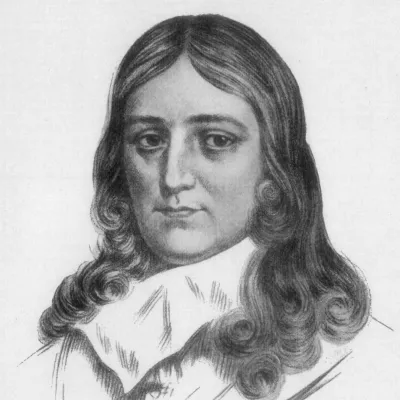
John Milton
Human Design Chart
Biography
He was the son of a scrivener, one of six children of whom three lived. He was a beautiful child with a good education who continued on to Cambridge where he lived so chaste a life that he was given the nickname of "lady." He lived at home from 1632 to 1638 when his mother died. As a gentleman, he traveled for a year.
Puritanical and serious, he married 17-year-old Mary in early 1643. She left him one month later but returned in 1644. They had four children, the first born in July 1646. One of the boys died and after the fourth birth in May 1652, Mary died.
A tutor and writer, Milton was generally beset by money problems. He married his second wife on 22 November 1656 and was widowed a second time when she died in childbirth 15 months later. He married his third and last wife in February 1663; a young sensible girl, Elizabeth Mynshull, who made his last years comfortable.
Milton became more radical in his views as he aged, becoming the master of invective. Losing his sight from his mid-30s, probably from retinal detachment, by March-April 1652 he was wholly blind and worked through secretaries. He adapted well to his blindness, but gout was a torment. Milton spent his last nine years in a cottage (now a museum) and died of consumption "in the middle of the night" on 8 November 1674 in Chalfont St. Giles, England.
Human Design Analysis: John Milton as Generator 1/3
Generator 1/3 — Design at a Glance
John Milton revealed himself as someone with immense endurance and an inner reservoir of strength. His design as a Generator endowed him with abundant sacral energy, making him seem like a strong workhorse – provided he had the right task ahead. This energy was not released through self-initiative but rather by responding to signals from his environment. Milton's motto was clear: Not to take the first step himself, but to wait until life presented a question or opportunity and then respond instinctively.
Living in harmony with this reactive strategy brought him deep satisfaction and fulfillment. His energy flowed naturally and sustainably when he followed it. However, if he went against this principle – for instance by doing things that did not bring him inner joy, or being kept from his heart project while still full of power – he quickly fell into frustration. These stumbling blocks led to a depletion of his energy and feelings of exhaustion. Milton thus learned that his success depended on whether he responded to real impulses rather than fighting against the current of his own nature. Only then could nothing stop him.
Sacral Authority
John Milton possessed a direct, physical decision-making process that shaped his everyday actions. As a Generator, his strategy was also his inner authority: sacral authority. This configuration simplified his choice process as he did not rely on external logic or emotional fluctuations but rather an immediate bodily response.
His decisions arose from reactions to external stimuli through a 'gut feeling' – felt as a surge of energy, grunting, or an internal yes-no signal. When his Sacral Center was engaged, he felt vital and energized; this energy allowed him to perform tasks with great enthusiasm and without obsessive purposefulness. He lived in the awareness that he was born to immerse himself fully in his tasks and experience joy and satisfaction.
Additionally, his activated Spleen Center acted as a supportive instance for sacral authority. This connection gave him the ability to respond particularly quickly and spontaneously to situations. His instinctive access to physical well-being served as a reliable compass. Milton used this intuitive perception to make grounded judgments in the here and now without falling into excessive overthinking or hesitation. Thus, his life energy unfolded most effectively when he listened to these immediate bodily signals and accepted them as guidelines for his actions.
The 1/3 Profile — Investigator / Martyr
John Milton was someone whose life was marked by a constant interplay between theoretical knowledge and practical experience. His design as an Investigator and Experimenter (Profiles 1/3) set a foundational stance: He sought insights through direct experimentation and learned from the resulting setbacks. This configuration described a person who not only planned but acted – similar to a scientist who is also an adventurer.
His judgment was particularly trustworthy, as he examined things both intellectually and practically before deeming them good. When Milton deemed something right, he had already walked that path himself. The energy of Line 1 emphasized the value of what was achieved over unattainable goals; dreams should be enjoyed without getting lost in hopeless possibilities. At the same time, he had to deal with a tendency towards self-aggrandizement when striving for new goals and not being content with what was already accomplished.
Line 3 brought the necessity of learning through mistakes along with it. Here, it was about adapting and resonating emotionally. A central point was the realization that self-blame is often unfounded. The immature side of this configuration could be self-destructive and undermine self-worth, but the goal was always to gain insight into being okay as one is. Thus, Milton lived in a process of constant testing, failing, and rising again, with each experience sharpening his inner truth.
Triple Split Definition — Defined & Open Centers
John Milton appeared as someone who was constantly under mental pressure to ask questions and understand connections. His design linked the Head Center and Ajna Center, creating a firm, trustworthy way of conceptual thinking. This connection generated permanent inspiration, often accompanied by confusion or doubt until clarity emerged. He had the ability to inspire others to think through his aura but lacked the direct energy to implement these thoughts alone. Instead, his defined Throat Center served as a channel to bring these mental concepts into the world verbally or in action, always dependent on the source he was connected with.
His actions were driven by a defined Sacral Center that provided immense vital energy. Milton reacted to life; his inner motor did not function through mental initiatives but rather through spontaneous agreement or rejection of external stimuli. This sacral power combined with a defined Root Center gave him a specific way to handle stress and pressure to maintain the life impulse. At the same time, he had a fixed identity and direction through his defined G Center, which gave him a deep sense of connection and self-love independent of external validation.
However, Milton was also vulnerable to conditioning influences in his open centers. His open Heart Center tended to compensate for a lack of willpower by trying to prove himself through promises or competition, often leading to frustration due to the missing necessary energy. Additionally, his open Solar Plexus absorbed the emotions of his surroundings, making him emotionally vulnerable and causing him to personalize foreign moods as his own. Also, his undefined Spleen carried fears about health and survival, which made him mistrust spontaneous decisions since they were often based on conditioned impulses that did not align with his true nature.
Channels for change, logical leadership and abstract comprehension.
John Milton appeared as someone who was under the internal pressure of carrying evolutionary change and exercising logical leadership. His design was characterized by the ability to bring innovation into existing structures while maintaining patience with himself until clarity emerged.
The Channel of Mutation 60-3 connected his Root Center with the Sacral Center, creating a pulsating energy of transformation often accompanied by melancholy when no new idea was present. Milton had to learn to accept this limitation and not fight against silence but wait for mutations to pass through him. This energy deeply affected his environment and demanded adaptability from those close to him.
At the same time, he possessed the Channel of Alpha Animal 7-31 between G Center and Throat Center, giving him potential for collective leadership based on logic and shared patterns. His voice had influence but his authority depended on being invited by the community. He led not through coercion but by gaining trust and showing a path without taking it away from others. His success was bound to the willingness of others to follow.
Mental processes were shaped by the Channel of Abstraction 64-47 between Head Center and Ajna Center, filtering every experience through kaleidoscopic mental images leading to confusion until an inspiring story or perspective crystallized. Milton sought meaning behind events, but his mind never delivered final answers but always opened up new possibilities.
Additionally, he carried Gates like 26 (Innovation in the Ego), 45 (Tribe Hierarchy), and 22 (Social Mutation) supporting his ability for subtle influence and building continuity. He sought his inner truth through Gate 61 while Gate 41 propelled him through emotional crises. Milton lived in the tension field between chaos and order, always ready to explore new directions.
Collective Circuitry — Circuit Signature
John Milton appeared as someone whose internal drive ran in three separate, unconnected streams. This triple definition created parallel forces: One stream connected the Sacral with the Root Center via Mutation (Channel 3-60). Here it was about one's own path and deviations from the known, supported by pulsating life energy. A second, isolated stream linked Throat and Identity Center via Channel 31-7 ('The Alpha Animal'). This promoted sharing rational insights and strategic structures for the future free of emotional influence. The third, also separate stream connected Head with Ajna Center through Abstraction (Channel 64-47). Here stood the reflection on past experiences to grasp their meaning and cyclically share these felt understandings with the collective. Since these groups were energetically separated, they existed as adjacent abilities: innovative mutation, cool rational strategy, and emotional past reflection. They did not flow into each other but shaped John Milton as a person who could simultaneously step onto new ground, build logical future structures, and abstract past meaning connections – each in independent, non-mixing layers of his personality.
Right Angle Cross of Rulership 4
John Milton's Human Design profile carried the signature of the right Authority Cross. This configuration shaped an attitude characterized by clear authority and a desire for structured leadership. In Human Design, this cross corresponds to a specific energetic alignment that helps its carrier create order and take responsibility in social or professional contexts. It was not about arbitrary power hunger but rather an internal logic of the system that enabled Milton to clarify complex situations through decisive actions. His energy often acted as a stabilizing force within his environment, as the right Authority Cross aims to transform chaos into manageable structures. This mechanical foundation significantly determined his way of handling authority: not through mere coercion but through an inner certainty about the correct direction. For Milton, this meant that in moments of uncertainty, he was often the person who pointed out a clear path or made decisions that initially unsettled others but ultimately led to necessary clarification. The design thus laid a tendency towards responsible leadership driven less by emotional impulsiveness and more by an inherent love for systemic order. This trait shaped his entire work and interaction with his environment, helping him maintain a firm stance even in turbulent times and guide others through this clarity without sacrificing his own integrity.
Saturn Return · Uranus Opposition · Chiron Return · 2nd Saturn Return — Life Cycles
John Milton's design inclined toward structural anchoring, which condensed into clear life phases. In 1638, at the age of 30, he undertook his journey to the continent and socialized with Hugo Grotius in Paris. This marked his first Saturn Return: a time when inner maturity often seeks external validation or new connections to stabilize previous development. The encounter with Grotius was no coincidence but an expression of this mechanical necessity to locate intellectual foundations within a broader context.
Ten years later, in 1649, the Uranus Opposition came into effect. At age 41, Milton was appointed Secretary of State for Latin Translations. This configuration demands a break with the known and sudden assumption of new responsibilities. The appointment was an external reflection of this inner pressure to prove oneself through radical change and establish a new role.
The Chiron Return around 1656 brought the phase of fulfillment. At age 48, Milton married Katherine Woodcock, who died in the same year. This cycle shows how one's essence intensifies; even if external circumstances like his wife's death were painful, it was a condensation of life purpose rather than healing old wounds. Finally, in 1663 came the second Saturn Return: at age 55, Milton married Elizabeth Mynshull. This marked the final solidification of his structure, a retreat into stable forms after previous upheavals.
Generator · Sacral Authority — Synthesis
John Milton lived driven by a deep urge to reach insights through continuous learning and experimentation (Profile Researcher/Experimentor). This process was inseparable from his sacral energy (Generator Type), which propelled him to delve deeply into topics and test them through practical application – as long as he felt inner confirmation (sacral authority). The defined Head generated a constant mental pressure to question things and understand, fueling his quest for knowledge and inspiring others. The mutation from Channel 3-60 suggests that he actively sought changes and was ready to depart from conventions to explore new paths.
Simultaneously, there was a paradox in his life between the need for continuous exploration and the limitation inherent with each fresh start (Channel 3-60). The melancholy brought by this channel points to an inner tension: the drive for innovation constantly clashed with acceptance of boundaries. This manifested in pivotal cycles of his life where both professional appointments (1649) and personal relationships (1656, 1663) were marked by phases of change and adaptation – a constant interplay between the desire for renewal and the necessity to deal with given circumstances.
3 Defined Channels
Incarnation Cross - Right Angle Cross of Rulership 4
Solar Return
The Solar Return shows the moment when the sun returns to its exact birth position - your personal solar year.
Life Cycles
Discover the life cycles with a detailed triple view (birth chart, cycle chart, composite).
Human Design Profile
- Type
- Generator
- Strategy
- To respond - wait for something to respond to
- Authority
- Sacral Authority
- Profile
- 1/3 - Investigator / Martyr
- Definition
- Triple Split
- Incarnation Cross
- Right Angle Cross of Rulership 4
- Date of Birth
- 09.12.1608 06:30
- Place of Birth
- London, United Kingdom
Frequently Asked Questions
What was John Milton's Human Design type?
Which Profile did John Milton have in Human Design?
What Authority guided John Milton's decisions?
What incarnation cross determined the fate of John Milton?
When was John Milton born?
Discover your own Human Design
Are you also a Generator? Find out in a personal reading how to use your sacral energy correctly and discover deep satisfaction.
More Personalities
Back to overviewAaliyah

Alexia

Angèle

Anne-Marie

Arcángel

Arno