
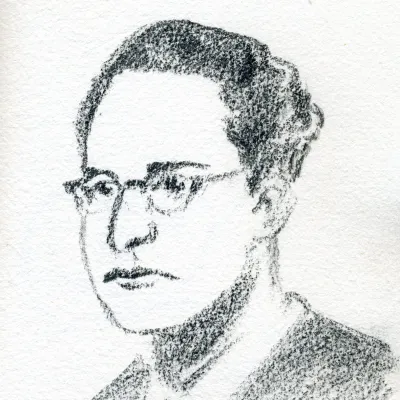
Jorge de Sena
Human Design Chart
Biography
Jorge de Sena as a Manifesting Generator 2/4 in Human Design
Manifesting Generator 2/4 — Design at a Glance
Jorge de Sena emerged as someone who worked with hybrid energy: he had the constant power of a Generator, yet possessed the ability to skip steps and quickly draw results into his life. As an Manifesting Generator, he primarily responded to inner impulses from his defined Sacral Center. This strategy of waiting for the "yes" of inner resonance was crucial to avoid frustration that would otherwise arise from acting too quickly or skipping important steps.
His nature tended to pursue multiple projects simultaneously, rather than focusing on just one thing. This multitasking ability was not a sign of lack of concentration, but an expression of his specific mechanics. As long as his inner authority approved of the projects, he found deep satisfaction in this variety. He entered a play mode where the creative force was fueled by the diversity of tasks. The requirement to complete one thing before starting the next stood in contrast to his energetic structure. Instead, he found satisfaction in simultaneously accepting and processing various impulses, provided he did not act before the inner signal but responded to life. This balance between quick implementation and patient response to the Sacral defined his work style and allowed him to maintain a lasting joy in creation despite the complexity of his many parallel interests.
Sacral Authority
Jorge de Senas' Human Design profile indicated a tendency towards spontaneous, physically anchored reactions to external stimuli. As a Generator, he possessed sacral authority, which also served as his strategy, thereby simplifying his decision-making process. This inner guidance was not shown through intellectual deliberation but as an immediate physical response: a surge of energy, a grunt, or an affirming "Mhm" when his Sacral Center was triggered. The prerequisite for this clear guidance was his open Emotional Center, ensuring that he did not get caught up in emotional waves but trusted in the direct, vital energy of his Sacral Center.
When his sacral motor was activated, he felt vital and alive, with an inexhaustible energy that allowed him to immerse himself in activities without aimlessness but with pure enthusiasm. Additionally, his activated Spleen Center acted as a supportive force. In conjunction with his Sacral Center, this enabled quick, spontaneous decision-making. He had direct access to his instinctive perception and physical well-being, which he relied on reliably to guide him. This configuration marked him as someone who acted in the present moment, driven by a deep, physical resonance that showed him where his true energy lay.
The 2/4 Profile — Hermit / Opportunist
Jorge de Senas' Design was characterized by a tension-charged dynamic between the need for deep withdrawal and the urge for social connection. As a person with Profile 2/4, the "Natural Talent/Networker," he constantly oscillated between two poles: Line 2, which demanded isolation and internal processing, and Line 4, which sought connection to the community. This configuration required him to communicate his boundaries clearly in order to protect his "me-time" as well as to enable targeted social interaction.
During his alone time, he immersed himself in internal processes to gain clarity. Only after satisfying this need did he emerge from his "cave" to maintain his network. He then reflected the knowledge gained from exchange during isolation, often leading to brilliant ideas.
His design also included specific challenges. Gate 44 (Line 2) emphasized a people-oriented approach over pure goal orientation. This was about integrating all forces, not just the powerful ones, to secure qualitative rather than purely quantitative successes. At the same time, Gate 33 (Line 4) carried the potential for transpersonal reflection and spiritual search. Without adequate pauses for regeneration, however, there was a risk of burnout, as this line required silence and contemplation about the meaning of life to renew itself. His path involved actively utilizing these quiet phases to renew energy and purpose.
Split Definition — Defined & Open Centers
Jorge de Sena's Human Design profile indicated a tendency towards persistent mental pressure and a deep, reliable identity. His defined Head and Ajna Centers created a constant stream of inspiration, questioning, and concept formation, but without the energy to directly implement these ideas. This often led to internal concern when he tried to immediately translate these thoughts into action. Simultaneously, his defined G Center provided a firm sense of self-identity and direction, allowing him to lead others with his inner security without being dependent on them.
His defined Throat Center enabled him to clearly communicate these mental processes and his identity. As a Generator with a defined Sacral Center, he had a vast reservoir of vital energy, but it could only be correctly activated in response to external impulses. Initiating actions without prior questioning led to frustration and exhaustion, as the sacral energy was not available.
In contrast, his open Heart Center made him vulnerable to the pressure to prove his worth through promises and willpower. He tended to question whether he was enough and tried to compensate for this perceived lack. His open Solar Plexus absorbed the emotions of his environment, leading to emotional confusion when he interpreted foreign feelings as his own. Additionally, his open Spleen Center fostered a fundamental fear of survival and a tendency towards spontaneity as a flight from uncertainty. Finally, his open Root Center took on external stress, leading to a cycle of perceived necessity to act quickly, followed by exhaustion when he did not release this foreign pressure.
Channels for inspiration, powerful manifestation and abstract comprehension.
Jorge de Sena was someone who drew attention to himself and his individual expression simply by being present, without actively seeking it. His design featured the Channel of Inspiration 1-8, connecting his G Center with his Throat Center. This configuration meant that he was a living example of creative individuality; his mere presence could inspire others to live their own uniqueness. It was not about explanations but about a bold, authentic presence that changed perspectives.
At the same time, he possessed immense physical vitality, flowing through the Channel of Charisma 34-20, connecting his Sacral Center with his Throat Center. This channel endowed him with the ability to act and manifest in the moment upon reacting to external stimuli. This energy was quick and direct, often so intense that it prevented him from sitting still. It served as self-affirmation through activity, which he could only effectively use when he listened to his inner, sacral resonance and not mental 'shoulds'.
In the mental realm, the Channel of Abstraction 64-47, connecting his Head Center with his Ajna Center, shaped him. His mind constantly searched the kaleidoscopes of experience to find patterns and stories. This process often led to confusion as he tried to understand the past and filter meaning from chaos. The reward for this patient search was the sudden appearance of clear, inspiring insights that he could then communicate.
Additionally, Gates of Awareness and Transformation (Gate 44), Cyclic Renewal (Gate 24), and Saying Yes to Challenges (Gate 29) were at play. These elements underscored his ability to transform through relationships and persistence, while also translating mental processes into vivid narratives (Gate 56). His design was a synthesis of charismatic action power, inspirational role modeling, and a deep, abstract search for the hidden meaning of things.
Individual Circuitry — Circuit Signature
Jorge de Sena's design featured a pulsating, acoustic expression style arising from the connection of Identity and Throat Centers in the Knowledge Circuit. This Channel of Inspiration promoted the urge to articulate a unique, mutated identity through language, with emotional waves from the Solar Plexus supporting this expression. Parallel to this, there was a separate, unconnected flow in the Meaning Circuit: Here, the Channel of Abstraction connected the Head with the Ajna Center. This generated a cyclical, visual processing of past experiences aimed at drawing meaning from history and sharing these insights with the collective. A third, also isolated force worked through the Integration Channel of Charisma, linking the Throat with the Sacral Center. This connection enabled him to draw strength from reacting to life and channel this intuitive action power in the present moment. Due to the shared definition, these three energetic streams—the identity-forming voice, the reflective intellectuality, and the intuitive life force—existed as parallel, non-fused systems. They shaped Jorge de Sena as someone navigating between the urge for individual articulation, analytical meaning-making, and immediate, charismatic impact in the now, without these areas forming a single, continuous flow.
Right Angle Cross of the Four Ways 3
Jorge de Sena's design indicated a tendency towards a deep, often painful confrontation with one's identity and the meaning of existence. This configuration, known as the right cross of the four paths, described a life task that could not be resolved through external fame or simple answers, but rather through an inner, often solitary process of self-discovery.
People with this structure often appeared as seekers who found the path to truth not through smooth paths, but through detours and failures. The mechanics of this cross linked the power of will with intuition and the ability to adapt, but created an inner tension that could only be resolved through accepted vulnerability. It was not a path of triumph in the traditional sense, but a path of transformation through suffering and insight.
Jorge de Sena lived this dynamic by facing the complex, often contradictory aspects of his existence. His energy did not focus on overcoming obstacles through sheer strength, but on understanding the deeper connections that shaped his life. This led to an attitude that was both critical and empathetic, as it arose from his own experience of fragility and the search for wholeness. The four paths symbolized not only physical journeys but also the mental and emotional stations that were necessary to achieve an authentic, though painful, truth about oneself.
Saturn Return · Uranus Opposition · Chiron Return · 2nd Saturn Return — Life Cycles
Jorge de Sena's design indicated a tendency towards structural rigidity that manifested in clear life phases. In 1944, at the age of 25, he completed his engineering studies at the University of Porto. This marked his first Saturn return, a cycle in which years of hard work often condenses into a solid, institutional result and personal identity aligns with societal expectations.
Later, in 1959 at the age of 40, he fled to Brazil after a failed assassination attempt on Salazar. This step fell into the Uranus opposition, a phase of sudden upheavals that breaks old structures and forces radical reorientation when the status quo becomes unsustainable.
In 1965, at the age of 46, he immigrated to the USA. This corresponded to his Chiron return, a fulfillment cycle in which the incarnation cross unfolds and meaning and purpose become experiential, provided the person has followed their strategy and authority. It was not a healing of old wounds, but a bloom of the life task.
Finally, in 1977, at the age of 58, he received the Great International Poetry Prize Etna-Taormina in Italy. This fell into his second Saturn return, a time of maturation and confirmation, in which the previously established structures prove their full viability and external recognition is found for the inner consistency. Jorge de Sena's life thus followed the rhythmic guidelines of his design, with each cycle presenting a specific quality of development and anchoring in reality.
Manifesting Generator · Sacral Authority — Synthesis
Jorge de Sena was a Manifesting Generator, whose life was marked by a dynamic interaction between sacral energy and mental pressure. Through the defined sacral center, he possessed a constant life force, which, however, through the connection to the Head Center (and thus the knowledge circuit) constantly provoked a drive towards understanding and inspiration. This combination led to a capacity for rapid idea development and implementation, yet also required a confrontation with mental anxiety and the need not to skip important steps. The profile as a natural talent and networker intensified this inner conflict by nurturing both the desire for withdrawal and clarity (line 2) as well as for community and exchange (line 4).
A central paradox in his design lay in the tension between the impulsive action of the Manifesting Generator and the inner need for reflection and connection. The cycles showed that he experienced both moments of professional success and recognition, as well as phases of crisis and flight. This suggests that although he was capable of forging new paths through his creativity and courage (Channel 1-8), he was also confronted with the consequences of his quick decisions and the constant need to reorient himself.
3 Defined Channels
Incarnation Cross - Right Angle Cross of the Four Ways 3
Solar Return
The Solar Return shows the moment when the sun returns to its exact birth position - your personal solar year.
Life Cycles
Discover the life cycles with a detailed triple view (birth chart, cycle chart, composite).
Human Design Profile
- Strategy
- To respond - wait for something to respond to
- Authority
- Sacral Authority
- Profile
- 2/4 - Hermit / Opportunist
- Definition
- Split Definition
- Incarnation Cross
- Right Angle Cross of the Four Ways 3
- Date of Birth
- 02.11.1919 09:50
- Place of Birth
- Areia, PORT
Frequently Asked Questions
What is Jorge de Sena's Human Design type?
What Profile did Jorge de Sena have in Human Design?
What Authority did Jorge de Sena have?
What incarnation cross did Jorge de Sena have?
When was Jorge de Sena born?
Discover your own Human Design
Are you also a Manifesting Generator? Find out in a personal reading how to unfold your multi-talents and direct your energy wisely.
More Personalities
Back to overviewAlain-Fournier

Aldair

Alizée

Angeli

Arletty

Artus
