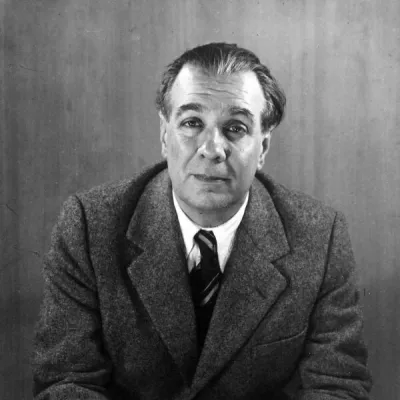
Jorge Luis Borges
Human Design Chart
Biography
Acclaimed as one of the greatest modern writers, he was compared to Edgar Allan Poe and Frank Kafka, a perennial candidate for the Nobel Prize in literature. His works were translated into more than 20 languages, and he won scores of literary prizes for his production of more than 35 volumes of writing.
Borges lived the last three months of his life in Geneva, Switzerland where he married his second wife in April 1986, inasmuch as the marriage would not be recognized in Argentina, where divorce is not legal. Died of liver cancer on 14 June 1986, Switzerland.
The Human Design of Jorge Luis Borges: Manifesting Generator 1/3
Manifesting Generator 1/3 — Design at a Glance
Jorge Luis Borges revealed himself as an Manifesting Generator, a configuration that combines sacral endurance with the ability for rapid implementation. His design inclined him to skip steps and quickly draw results into his life. However, this speed was a double-edged sword: Often he acted too fast and left necessary intermediate steps out, forcing him to backtrack and fill in gaps. Such setbacks triggered frustration, the specific non-self theme of this type. Additionally, Borges tended to respond simultaneously to numerous impulses and pursue multiple projects at once. Without inner consent, this creative drive quickly turned into exhaustion.
The solution lay in the strategy of reacting: He waited for external incentives before acting and regularly checked sacral approval – the internal “yes”. Only when this energy consistently confirmed that an activity still brought joy did he continue it. With proper application of this mechanism, Borges found deep satisfaction in his work. For him, the advice to focus on one thing was often counterproductive; instead, he needed variety and a playful mode to keep his energy flowing. His design allowed him to be efficient and versatile as long as he used inner resonance as a compass and did not fight against it.
Sacral Authority
Jorge Luis Borges showed decision-making based not on cognitive analysis but on immediate physical reactions. As a Generator, he possessed sacral authority that served as the primary instance and simplified his process. His orientation occurred through an internal “gut feeling” or energetic surge in response to external stimuli. He learned to pay attention to specific bodily sounds – like grunts, hums, or a confirming hmm – which confirmed whether something resonated with his energy.
When this sacral motor was engaged, Borges felt vital and alive. An inexhaustible energy allowed him to perform tasks with great enthusiasm and without obsessive purposefulness. This configuration predisposed him to fully immerse himself in his work and experience joy as well as satisfaction.
Additionally, the active Spleen Center acted as a supportive instance for sacral authority. This gave him the ability to respond particularly quickly and spontaneously to situations. Through immediate access to his instinctive perception and physical wellbeing, he could reliably be guided by these deep impulses, emphasizing his spontaneous reaction capability.
The 1/3 Profile — Investigator / Martyr
Jorge Luis Borges revealed himself as someone whose judgments were based on a double check: theoretical depth and practical experimentation. His design set a fundamental stance that collected knowledge but also validated it through experience. This stemmed from Profile 1/3, the Researcher and Experimenter. Line 1 drove him to remove obstacles and lay foundations, often accompanied by uncertainty about whether enough was understood. Simultaneously, Line 3 demanded action in the here and now, even if this meant making mistakes. For Borges, these errors were not failures but necessary data sources. His credibility emerged from this synthesis: If he believed something was right, it had withstood both logical analysis and real-world testing. The energy of Gate 59 supported this through the ability to clear blockages and bring unions together, while Gate 20 promoted constant self-reflection. This combination shaped a process where theoretical learning and practical experimentation intertwined. Borges lived this cycle of trial and error, balancing the fear of insufficient knowledge from Line 1 with the impulsive drive of Line 3. The result was an authority based on self-earned insight. His path was not a straight march but a continuous testing of hypotheses in reality, making his conclusions robust and trustworthy.
Single Definition — Defined & Open Centers
Jorge Luis Borges revealed a design that connected energy, direction, and expression in a clear line: defined Sacral, G, and Throat centers. His engine was the sacral response – an inner 'yes' or 'no', signaling available vitality. This power flowed through his defined G Center, giving him a constant identity and internal direction to his Throat Center. There, this energy transformed into concrete communication and action. Thus, he had the mechanical ability to act from his own truth without needing external validation for his core.
This stable core contrasted with his six open centers (Head, Ajna, Heart, Solar Plexus, Spleen, Root), which functioned as antennae. Without their own constant source in these areas, he was receptive to external influences. His open Head and Ajna Centers allowed him to absorb mental inspirations and concepts from the environment; he tended to identify with foreign questions or intellectual urges rather than observing them as transient phenomena. His open Heart Center made him vulnerable to the pressure of proving his worth through performance despite not having a constant willpower for it.
Emotionally, his open Solar Plexus acted like a mirror: absorbing and amplifying others' moods, leading him to experience foreign emotions as his own internal states. The open Spleen Center brought fundamental uncertainty about health and well-being; he unconsciously sought external confirmation of safety rather than trusting spontaneous intuition. Finally, his open Root Center absorbed the stress and chaos of the environment, creating a pressure from which he often escaped through activity instead of recognizing it as not his own state. His challenge lay in not confusing these absorbed states with his true, defined nature.
Channels for presence, self-acceptance and powerful execution.
Jorge Luis Borges revealed himself to be someone whose presence did not rest on intellectual construction but arose from physiological depth. His design inclined towards authentic existence that inspired others unconsciously to live their unique selves.
This effect stems from the Awakening Channel 10-20, connecting his G Center with his Throat Center. Through Gate 10 (Behavioral Principles) and Gate 20 (The Now), Borges spoke a wisdom lived rather than taught: self-love as the foundation of survival. He was in a constant state of awakening simply by being himself, creating clarity that minimized resistance and invited genuine engagement without him having to lead actively.
This stance deepened through the Exploration Channel 34-10, where his sacral life force from Gate 34 (Inner Convictions) connected with self-determined behavior at Gate 10. Borges followed his own convictions independently of societal pressure. His energy did not impose but centered on perfecting personal conduct. By acting from his sacral response, he demonstrated the advantage of self-acceptance and encouraged others to honor themselves.
The Charisma Channel 34-20 rounded this pattern off. It channeled the generative power of Gate 34 directly into the expression at Gate 20. This gave Borges a charismatic presence that only worked correctly when he responded to external stimuli rather than acting from internal drive. His vitality showed spontaneously when engaged in satisfying activities and unavailable for others, making his uniqueness a source of inspiration while living contrary to this response would have seemed selfish.
Individual Circuitry — Circuit Signature
Jorge Luis Borges revealed himself as someone with strong inner resilience and deeply rooted convictions that were often hard to put into words. His design connected the Sacral Center directly to the Identity Center through the Centering Circuit (Channel 10-34). This connection created an intense, inward-focused energy shaping his individuality and self-worth strongly. He had the power to reinforce himself and acknowledge others' uniqueness without needing to communicate this stance outwardly through the Throat Center.
Simultaneously, the Integration Circuit worked with two channels: Channel 20-10 (Awakening) and Channel 20-34 (Charisma). Here his Sacral Center connected via the Identity Center to the Throat Center. This configuration allowed him to realize intuitive power and proper behavior in 'The Now' through charisma. While the Centering Circuit caused a certain speechlessness regarding deep convictions, Integration offered a way for this inner substance to become effective. The combination of both circuits resulted in a personality that was individual and bold but whose expressive power depended strongly on immediate intuition and direct experience here and now. His energy was pulsating and acoustically marked, significantly influencing his mode of being and action.
Right Angle Cross of the Sleeping Phoenix 3
Jorge Luis Borges was marked by the right cross of the sleeping Phoenix 3. This configuration pointed to a deep connection with his roots and collective memory, combined with a specific kind of perception. The design suggested that Jorge Luis Borges often navigated between consciousness and subconsciousness, where dreams or intuitive insights played a central role. The energy of this cross promoted an understanding of cyclical patterns and the recurrence of themes from the past. It was not mere nostalgia but rather a mechanism to reinterpret old structures in new contexts. Jorge Luis Borges lived this dynamic by delving into the deeper layers of human experience. The mechanics described a person who gained clarity through uncovering hidden connections within themselves and history. This was not a passive process, but an active engagement with what is often overlooked or forgotten. Thus, the right cross of the sleeping Phoenix 3 conveyed a stance of silent observation and profound understanding that characterized Jorge Luis Borges.
Saturn Return · Uranus Opposition · Chiron Return · 2nd Saturn Return — Life Cycles
Jorge Luis Borges showed himself as someone whose creative power was clearly structured by astrological cycles. In 1941, at age 42, he published “Ficciones” along with an anthology of fantastic literature with Adolfo Bioy Casares. This moment fell on his Uranus opposition, a point where inner maturity often breaks outwards and clears new creative paths. The publications marked not only career milestones but also aligned with the mechanical dynamics of this cycle, which questions established structures and favors innovative expression forms.
Eight years later in 1949 at age 50, “El aleph” was published. This occurred during his Chiron return, a fulfillment cycle between ages 49 and 51. In Human Design mechanics, this phase does not signal healing of old wounds but rather the blooming of one’s incarnation cross: If a person lives according to their strategy and authority, their sense and purpose increasingly become tangible in life. For Borges, this was a clear sign that his previous work had matured into a coherent whole. The publication of “El aleph” thus directly connected with this inner completion, which was facilitated by the Chiron return and cemented his creative identity.
Manifesting Generator · Sacral Authority — Synthesis
Jorge Luis Borges’ life was marked by a deep, sacral-driven reaction to the world around him. The connection of his defined Sacral and Throat centers along with the Awakening Channel (10/20) pointed to a person who was set in motion by external stimuli and then acted with remarkable speed and clarity – a Manifesting Generator whose energy was drawn from the present moment. This reactivity, however, was not unbound; it anchored itself in the G Center, which provided strong inner direction and identity. Thus, his life merged the ability to react to impulses with a deep sense of self and an internal compass. The repeated emphasis on reaction and authenticity (sacral center, Gate 29) suggests that Borges’ creativity sprang from the honesty of his own feelings.
A central paradox in Borges’ design lies in the interplay between the defined G Center and open centers for emotions, root, and spleen. While the G Center suggests a firm identity, the undefined centers revealed high sensitivity to other people’s energies and vulnerability to external influences. This tension between inner stability and outer openness created space for deep empathy and understanding of human condition, yet carried the risk of being overwhelmed by fears and conditioning. Borges’ life was thus an ongoing navigation between holding onto an inner core and embracing the diverse currents of life.
3 Defined Channels
Incarnation Cross - Right Angle Cross of the Sleeping Phoenix 3
Solar Return
The Solar Return shows the moment when the sun returns to its exact birth position - your personal solar year.
Life Cycles
Discover the life cycles with a detailed triple view (birth chart, cycle chart, composite).
Human Design Profile
- Strategy
- To respond - wait for something to respond to
- Authority
- Sacral Authority
- Profile
- 1/3 - Investigator / Martyr
- Definition
- Single Definition
- Incarnation Cross
- Right Angle Cross of the Sleeping Phoenix 3
- Date of Birth
- 24.08.1899 03:30
- Place of Birth
- Buenos Aires, Argentina
Frequently Asked Questions
What is Jorge Luis Borges' Human Design type?
What Profile did Jorge Luis Borges have in Human Design?
What Authority did Jorge Luis Borges have?
What incarnation cross did Jorge Luis Borges have?
When was Jorge Luis Borges born?
Discover your own Human Design
Are you also a Manifesting Generator? Find out in a personal reading how to unfold your multi-talents and direct your energy wisely.
More Personalities
Back to overviewAlain-Fournier

Aldair

Alizée

Angeli

Arletty

Artus