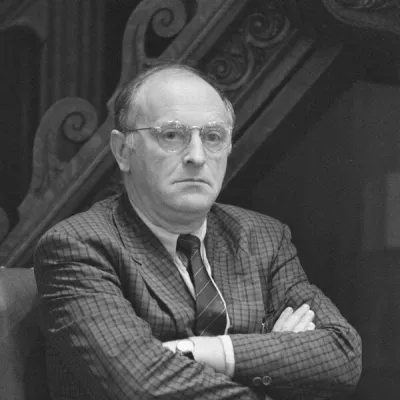
Joseph Brodsky
Human Design Chart
Biography
Brodsky was awarded the 1987 Nobel Prize in Literature "for an all-embracing authorship, imbued with clarity of thought and poetic intensity". He was appointed United States Poet Laureate in 1991.
Brodsky died of a heart attack on 28 January 1996 in New York, aged 55.
Joseph Brodsky as a Manifesting Generator 4/6 in Human Design
Manifesting Generator 4/6 — Design at a Glance
Joseph Brodsky's Human Design profile indicated a tendency towards rapid implementation, but this was based on a specific energetic foundation. As an Manifesting Generator, he had constant sacral energy, which gave him the power to quickly bring things into manifestation and skip steps in the process. This hybrid structure of manifestor speed and generator energy fundamentally shaped his approach.
The challenge lay in not abusing this pace as justification for hasty actions or pursuing multiple projects simultaneously without inner consent, leading typically to frustration, a common theme for this type. Instead, an effective strategy was responding to external impulses. Joseph Brodsky succeeded when his sacral center clearly confirmed that an idea or task continued to be of interest.
By adopting this stance—waiting for the reaction and continuously checking internal resonance—he avoided the trap of mere rushing. When strategy and authority aligned, he could also work on various things in parallel without breaking down. In this state, a 'play mode' emerged where variety became a source of deep satisfaction. His creative power thus ignited not through coercive initiatives but through playful responses to life while maintaining inner consent.
Emotional Authority
Joseph Brodsky's decision-making process was characterized by profound emotional wave movements that exposed spontaneous impulses as deceptive. His design established that his defined solar plexus center carried his internal authority, meaning a central rule: regardless of other defined centers, this emotional authority always took precedence in decision-making.
The mechanics of this configuration described a state of constant up and down movement of feelings. Joseph Brodsky saw the world colored by his current mood; a topic could appear inspiring one moment and negative the next. His immediate feeling was merely a snapshot, not a secured truth. Quick decisions based on current emotion thus carried high risk for negative outcomes.
The solution lay in time. The longer Joseph Brodsky let a decision mature, the deeper and more comprehensive he could understand the situation. This required patience and consciously 'sleeping over' choices. Through this distancing, intense feelings subsided, emotional distance gained clarity and calmness only after this process. This mechanism was particularly relevant for long-term decisions that significantly influenced his life path. The necessity to be patient and re-examine multiple times formed the core of his internal strategy to achieve clarity.
The 4/6 Profile — Opportunist / Role Model
Joseph Brodsky's design featured a clear developmental line: in the first half of his life, he intensely experimented with relationships before an inner conflict arose later between his heart's desire for belonging and his head's need for wise distance. As a Profile 4/6 person, Networker/Role Model, he lived this tension. The first thirty years were marked by Line-3 energy from Line 6, leading to much experimentation in friendships. After the Saturn return, the actual duality came into play: the heart (Line 4) yearned for community while the head (Line 6) wanted to climb the mountain to ponder existential questions. This created a lifelong confusion between emotional engagement and rational wisdom-seeking.
Central to his expression was the Sun in Gate 20. This gate marked the beginning of transpersonal consciousness, driven by intuition and the necessity to convey knowledge not theoretically but through practical power. As a teacher line, it challenged him to lead others by example and strengthen himself to empower others. Simultaneously, Gate 55 in the sex center with its sixth line emphasized the individual process of mutation, where material needs had to be met first before an awakened mind could unfold. For Joseph Brodsky, this meant that self-care was the foundation for any further spiritual development. His design ultimately expected him to serve as a role model and emerge through cooperation with others, always being cautious about whom he opened his heart to in order to avoid hurt.
Single Definition — Defined & Open Centers
Joseph Brodsky's design indicated a tendency towards constant reactive energy and emotional depth. His defined centers – Sacral, Solar Plexus, Spleen, Throat, and Root – formed the mechanical basis: vital power through response (Sacral), emotional clarity by waiting for the wave to pass (Solar Plexus), spontaneous intuition in the present moment (Spleen), reliable communication style (Throat), and specific stress pressure (Root). This configuration created a person who spoke their truth not from the mind, but from physical reaction and felt clarity.
At the same time, Head, Ajna, G Center, and Heart were open. Joseph Brodsky tended to question whether he was inspired or confused (open Head), rather than generating constant mental impulses. His open Ajna Center made him receptive to foreign concepts without claiming them as his own truth. The open G Center allowed his identity to be situational; he did not actively seek direction but waited to be initiated by environment and relationships. In the open Heart Center, there was a lack of constant willpower; he tended to want to prove worth through promises rather than simply being.
This mechanism meant: Joseph Brodsky was not an initiator of ideas or identities, but a resonance body. His strength lay in his ability to react to life (Sacral), let emotions settle (Solar Plexus), and act intuitively in the moment (Spleen). His weakness consisted of vulnerability to mental confusion and the pressure to prove himself. His design demanded patience: waiting for the right question to energetically respond; waiting for emotional clarity before making decisions. Thus, Joseph Brodsky was someone whose expression was authentic because it came from deep physical and emotional sources, not superficial intellectualization or willful action.
Channel 20-34: Charisma — Channels & Gates
Joseph Brodsky's design indicated a tendency towards charismatic, immediate articulation. His energy felt vital and urged him to translate intuitive insights into words or actions in the moment. This did not happen through deliberate thought but as a reaction to the present.
This radiance was created by Channel of Charisma 34-20. Here, raw physiological life force from the Sacral Center (Gate 34) connected with expressive power in the Throat Center (Gate 20). The result was the ability to direct generative power directly into the world, provided he waited for his inner response. Without this waiting period, energy easily fell into chaos; with it, it showed itself as self-reinforcing presence that inspired others without him having to actively try.
Simultaneously, Channel of Lightning Strike 57-20 gave him the gift of spontaneously naming existential truths. The intuitive insight from Spleen (Gate 57) flowed directly into verbal expression (Gate 20). This allowed Joseph Brodsky to communicate deep self-awareness in the here and now – the knowledge 'I am living now'. This combination of sacral power and intuitive clarity created a unique voice that did not argue but convinced through its immediate presence.
Another aspect was Channel of Union 59-6. He sought intimacy and merging, both creatively and interpersonally. His emotional wave (Gate 6) determined the timing for this closeness. It was important that he waited until emotions were clear before engaging. This protected him from misunderstandings and allowed deep, fruitful connections based on true resonance rather than superficial attraction.
Together, these channels shaped a person who was alive in the moment, spoke their truth without filters, and exerted a magnetic effect on their surroundings as long as they followed their inner authority.
Individual Circuitry — Circuit Signature
Joseph Brodsky's design indicated a tendency towards impulsive, acoustic outbursts that came from within and immediately pushed outward. This energy originated from his Knowledge Circuit, which in him connected the Throat Center with the Spleen – a Channel of Lightning Strike. Here, intuitive knowledge merged with the ability to speak it aloud in the present moment. Parallel to this, another separate force of the same circuit worked: It linked Solar Plexus with Root and enabled the release of emotions deeply rooted on the instinctual level.
Another strand, the Archer Circuit, connected Joseph Brodsky's Sacral Center – his source for life force – directly to the Solar Plexus. This Channel of Union brought together primordial protective instincts and emotional waves aimed at preservation and connection.
These two circuits were not interconnected but existed as parallel systems. One system propelled individual creative expression forward; the other ensured instinctive safety and emotional bonding. Supporting this dynamic were Integration Channels that connected charisma (Throat-Sacral) and power (Sacral-Spleen). They helped Joseph Brodsky draw his strength from reacting to life, guide it through intuitive knowledge, and articulate it in the moment. His design thus showed a clear structure: pulsating creativity and emotional depth flanked by instinctive protective behavior, all anchored in immediate presence.
Right Angle Cross of the Sleeping Phoenix 2
Joseph Brodskys Human Design shows the imprint of the right cross of the sleeping Phoenix. This configuration established a specific inner dynamics that aimed less at external action than at profound transformation. The 'sleeping' element indicated that the potential of this structure was not always actively or consciously lived but rather worked in the background, like a latent impulse waiting for the right moment. Traditionally, the Phoenix stands for rebirth and renewal after a process of decay; in this right cross configuration, it meant a tendency to internally go through old patterns or identities and reform them anew, often without being immediately visible from the outside.
For Joseph Brodsky, this resulted in a life path characterized by constant inner purification and the pursuit of authenticity. The energy of this cross promoted the ability to let something new and valuable emerge out of difficult or destructive experiences. It was not about loud proclamation but rather a subtle yet persistent process of self-discovery and renewal. This mechanical foundation created a person capable of embodying profound changes within themselves instead of merely striving for superficial ones. The structure supported a life characterized by inner resilience and the constant possibility of renewal, independent of external circumstances or societal expectations.
Saturn Return · Uranus Opposition · Chiron Return — Life Cycles
Joseph Brodskys Human Design showed a cyclical dynamics where the tension between sudden redefinition and long-term validation played out. This acted as a deep turning point for his identity and self-worth. The mechanics described a process in which the need for liberation (Uranus) met the necessity of recognition through success (Chiron).
In 1977, at age 37, an Uranus event occurred: Joseph Brodsky received American citizenship. This marked a moment of sudden liberation and redefinition of his external circumstances. The Uranus opposition signaled here a break with the old and the opening to new, unexpected perspectives.
Later, in 1987 at age 47, he experienced the Chiron return. Joseph Brodsky received the Nobel Prize for Literature. In Human Design, this cycle is not a process of healing past injuries but rather a phase of blooming and fulfillment. If he followed his strategy, his purpose unfolded increasingly. Success became tangible and gave his life a clear sense of coherence. The connection between both events highlighted the path from radical change to external validation of his essence.
Manifesting Generator · Emotional Authority — Synthesis
Joseph Brodsky lived a life marked by deep inner dynamics. The combination of manifesting generator energy and emotional authority created a person who possessed the ability to react quickly to opportunities (Spleen Center) while also needing thorough emotional processing for clarity. This interplay was evident in an ongoing alternation between impulsive actions and the need for reflection – a pattern reinforced by Line 4 in his Profile, which linked the desire for belonging with the search for individual truth (Line 6). The defined Throat Channel indicated that he could authentically communicate his inner world if he relied on his definition source.
A central paradox in Joseph Brodskys Human Design lay in the tension between the urge for quick implementation (manifesting generator) and the necessity of emotional maturation (emotional authority). He was capable of initiating things quickly, yet the emotional wave required time to validate decisions. This might have led him to overlook important steps or be caught in a cycle of action and correction – a conflict between Head (Line 6) and Heart (Line 4), which accompanied his life. The Uranus Cycle event concerning the acquisition of citizenship and the Chiron return in a year of significant success underscore this inner tension between adaptation and individual expression.
5 Defined Channels
Incarnation Cross - Right Angle Cross of the Sleeping Phoenix 2
Solar Return
The Solar Return shows the moment when the sun returns to its exact birth position - your personal solar year.
Life Cycles
Discover the life cycles with a detailed triple view (birth chart, cycle chart, composite).
Human Design Profile
- Strategy
- To respond - wait for something to respond to
- Authority
- Emotional Authority
- Profile
- 4/6 - Opportunist / Role Model
- Definition
- Single Definition
- Incarnation Cross
- Right Angle Cross of the Sleeping Phoenix 2
- Date of Birth
- 24.05.1940 16:50
- Place of Birth
- Leningrad, Russia
Frequently Asked Questions
What was Joseph Brodsky's Human Design type?
What profile did Joseph Brodsky have?
What authority did Joseph Brodsky have?
What incarnation cross did Joseph Brodsky have?
When was Joseph Brodsky born?
Discover your own Human Design
Are you also a Manifesting Generator? Find out in a personal reading how to unfold your multi-talents and direct your energy wisely.
More Personalities
Back to overviewAlain-Fournier

Aldair

Alizée

Angeli

Arletty

Artus