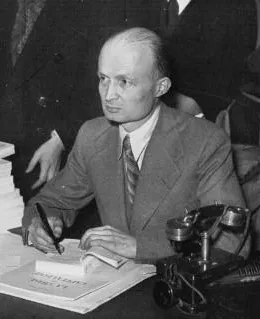
Joseph Peyré
Human Design Chart
Biography
He was fond of bullfighting and the trophy Joseph Peyré, presented annually by the Peña Garlin of taurine, rewards the triumph of novilladas summer.
What does Manifesting Generator 1/4 mean for Joseph Peyré?
Manifesting Generator 1/4 — Design at a Glance
Joseph Peyrés Design features a hybrid structure: He has the constant energy source of a Generator but also possesses through specific connections the ability to act swiftly. This configuration creates potential for immense dynamism and speed in daily life. His strategy involves not initiating himself, but responding to inner impulses. Only when his sacral center gives a clear "yes" is it advisable to proceed.
This mechanism carries two risks. First, he tends to skip steps and rush into things too quickly. If important phases are missed, he often has to backtrack to fill in gaps – a process that can lead to frustration. Second, the speed draws him towards pursuing multiple projects simultaneously. Without constant checks by his inner authority, this multiplicity threatens to turn into exhaustion.
However, when the strategy is followed – reacting rather than initiating and regularly confirming through the sacral center – he could draw deep satisfaction from his work. Under these conditions, parallel working was not a barrier but a source of his strength. He entered a playful mode where variety fed his energy instead of scattering it. His life task involves connecting this speed with the necessary inner resonance to avoid frustration and experience lasting fulfillment.
Sacral Authority
Joseph Peyré was a Generator whose decision-making process was characterized by a unique simplification: His strategy and his inner authority were identical. This was due to his defined Sacral Authority, which is exclusive to this type. The prerequisite for this clear structure was his open Emotional Center.
His inner guidance did not manifest as an intellectual deliberation but rather as an immediate physical reaction to external stimuli. Joseph Peyré received answers through a "gut feeling" – perceivable as a surge of energy or audibly through sounds like grunts, hums, or a confirming "Mhm". When his Sacral Motor engaged, he felt vital and energized. This response signaled him that an activity could be undertaken with great enthusiasm and without compulsive purposefulness. He was destined to immerse himself in his tasks and experience joy as well as satisfaction.
Additionally, his activated Spleen Center acted as a supportive authority. This configuration allowed him to react particularly quickly and spontaneously. Through direct access to his physical wellbeing and instinctive perception, he could reliably guide himself. The combination of sacral energy and spleen-supported intuition shaped his way of making decisions in the here and now, based on a deep, bodily "yes" or "no".
The 1/4 Profile — Investigator / Opportunist
Joseph Peyrés Human-Design shows a tendency towards deep research, which is always connected to the desire for a familiar community. As a 1/4 "Researcher / Networker", he did not seek isolated knowledge but longed to share this in a circle of close people. This configuration created a specific dynamic: The line 1 at Gate 36 drove him to thoroughly explore crises and resistances to generate progress from them. Yet, the line 4 at Gate 11 required a transpersonal perspective that could convey ideas so effectively as to inspire others – similar to prophets reaching people without prior knowledge.
This interplay also created an internal tension. The fear of being exposed by his loved ones because he did not yet know enough was a central theme. A lack of deep insight or trust would have caused him great heartache. Therefore, a loving environment with a solid foundation of trust was crucial for Joseph Peyré. Only in such a protected framework could his networking ability fully come into play and make him an authority on his heart issues. Without this basis, he risked holding back valuable knowledge or getting entangled in crises through resistance to change. His design clearly showed: Deep insight and social connectedness were inseparably intertwined.
Split Definition — Defined & Open Centers
Joseph Peyré revealed himself through a design with five defined centers, suggesting high inner stability and clear expression capabilities. His defined G Center gave him a firm sense of self-identity and direction in life; he knew where he belonged without needing to force others to follow his path. This inner security was supported by the defined Sacral Center, which provided a constant source of vitality. His energy did not serve arbitrary initiatives but reacted to external stimuli – a mechanism of reaction rather than initiation, to avoid frustration and find lasting satisfaction.
His communication was characterized by the defined Throat Center, serving as a pivot point to translate messages from his body into the world. This allowed for consistent expression provided he trusted his inner authority. The also defined Spleen Center fostered spontaneous intuition and strong survival awareness in the present moment; it warned him of dangers that his mind could not rationally grasp. Additionally, he had a defined Root Center, giving him a specific way to handle stress and providing the pressure to move forward in the material world.
In contrast, Head, Ajna, Heart, and Solar Plexus Centers were open. The open Head and Ajna Centers meant that he did not have consistent mental inspiration; he tended to be overwhelmed by doubts or questions from others if he did not listen to his inner wisdom. His open Heart Center made him vulnerable to the pressure of proving his worth through promises – a trap he had to avoid by not taking on commitments that did not align with his strategy. The open Solar Plexus Center allowed him to absorb and amplify emotions from the environment; he was dependent on observing these feelings as transient waves rather than personalizing them, to stay emotionally healthy.
Channels for inspiration, rhythmic flow and meaningful struggle.
Joseph Peyré revealed himself as someone who through his mere presence and authentic style encouraged others to live out their unique qualities. His design was marked by Channel of Inspiration 1-8, connecting the G Center with the Throat Center. This configuration meant that he did not influence through words or explanations but rather by demonstrating his individual direction openly. He lived his creative identity so openly that it drew attention and potentially changed the perspective of those around him. It was an art for him to stand as an individual and inspire others to be brave.
This inspirational effect was amplified by Channel of Beat 14-2, linking the Sacral Center with the G Center. This tantric channel gave him the ability to initiate new directions through a powerful, generative life force. By trusting his inner reaction, he could set innovative impulses and encourage others in their creative development without having to chase after them actively. His presence alone often offered others the key to finding their own direction.
Simultaneously, Joseph Peyré carried the energy of Channel of Life Struggle 38-28, connecting the Root Center with the Spleen Center. This gave him a stubborn determination to follow his own path and find deeper meaning in daily struggles. He sought values worth resisting for to preserve his individual integrity. This adrenalized energy drove him to resist distractions from his true nature and act as an example of other people's individuation processes.
Additionally, Gates like 36 (Crisis), 11 (Visual Memory), and 25 (Innocence) influenced his perception, while Gates like 62 (Logic) and 46 (Devotion) shaped his approach to details and the physical body. His design challenged him to harmonize these various energies – inspiration, transformative power, and combative integrity – to develop an authentic and impactful presence.
Individual Circuitry — Circuit Signature
Joseph Peyré revealed himself through a design characterized by two separate energetic focal points that did not flow directly into each other. On one hand, there was a direct connection between the Throat Center, Identity, and Sacral; on the other hand, Spleen connected with Root. This divided structure meant these energy fields existed parallel to each other without merging into a single stream.
In the Knowledge Circuit, these energies were concretely expressed. The first group linked identity and expression (Throat) with life energy (Sacral). Here Channel 'The Beat' (2-14) came into play, promoting rhythmic, pulsing expression, as well as Channel 'Life Struggle' (28-38), providing the energy for maintaining and asserting one's own path. This allowed Joseph Peyré to bring his unique identity into the world through powerful, acoustic or action-oriented expressions – a pulsating format energy that acts in the present moment.
The second group linked Spleen (Intuition/Survival) with Root Center (Pressure/Crisis). Channel 'Inspiration' (1-8) came into play here. It provided spontaneous mental impulses and flashes of insight, often arising as a reaction to external pressure or internal necessity. This inspiration served for quick orientation and survival in new situations.
Together, these two separate parts of the Knowledge Circuit formed the foundation for Joseph Peyré's path: on one hand, the pressure-driven intuitive spark for problem-solving (Spleen-Root), on the other hand, the powerful rhythmic implementation of his identity into actions and words (Throat-Identity-Sacral). It was about gaining new knowledge and transforming it through these specific, independent channels.
Right Angle Cross of Eden 1
Joseph Peyré's Human Design profile bore the signature of the right Eden Cross. This configuration establishes a specific life dynamic characterized by a strong impulse to create new structures and systems. In Human Design, this cross represents the archetype of the Builder or Founder whose energy is geared towards guiding the unknown into orderly paths.
Joseph Peyré was someone who not only reacted but actively shaped his environment. The mechanics of this design describe a person called to bring something new into existence – whether it be a concept, an organization, or an idea. It was a force that created order from chaos and often acted as a pioneer in doing so.
The underlying energy pushed towards breaking boundaries and questioning established patterns to build something lasting. Joseph Peyré lived this tendency towards initiation and structuring. His chart did not show a passive stance but rather a driving force seeking the realization of visions. This shaped his way of interacting with his environment: by creating frameworks in which others could act. The right Eden Cross often confers a certain authority and clarity in action, as the focus lies on results and functional implementation. Joseph Peyré was thus a shaper whose design aimed to leave lasting traces.
Saturn Return · Uranus Opposition · Chiron Return · 2nd Saturn Return — Life Cycles
Joseph Peyré's Human Design profile indicated a tendency towards sudden, disruptive breakthroughs that gained external recognition. In 1935, at age 43, he received the Prix Goncourt for his novel “Sang et Lumières”. This success was no coincidence but aligned with the mechanics of an Uranus Opposition in his chart.
This configuration marks a cycle of deep transformation and liberation from the old. Uranus here does not stand for gradual development but rather for a sudden break with established structures. The opposition indicates that this change is often triggered by external events or conflicts forcing the individual to take new paths. For Joseph Peyré, it meant that his creative energy was particularly potent during this period of life, breaking conventional boundaries.
The prize was visible proof of how this Uranian force worked: It created a moment of revelation and triumph over previous limitations. This phase saw his personal voice ringing loud and clear, supported by the dynamic tension of these planetary configurations. The success confirmed that he was exactly where his design had led him – into the space of innovation and unexpected fortune. This energy shaped his creative power sustainably and enabled him to find broad resonance with his work.
Manifesting Generator · Sacral Authority — Synthesis
Joseph Peyré lived a life marked by profound inner dynamics. His profile as a Manifesting Generator (MG) with sacral authority points to someone who, while capable of quickly initiating and shaping things, primarily acts through responding to internal impulses and external circumstances. The defined Throat Center connected to the Sacral Center allowed him authentic communication stemming from a vital source. The Profile as Researcher/Networker (1/4) reinforced this trait: he sought deep understanding and shared knowledge in his environment, though fear of exposure always accompanied him. The Channel of Inspiration (1-8) indicates that he was destined to influence others through his individual expression and give creative impulses.
A central paradox in Joseph Peyré's chart lies in the tension between his ability for quick initiation as an MG and the need for thorough research and deep connection of his 1/4 profile. He could react swiftly to opportunities but also tended to skip important steps or hesitate before sharing his knowledge. This led to internal conflict between a desire for creative freedom and fear of being inadequately prepared – a dynamic that also played out in the documented event of receiving an award after finding a way to express his inner voice.
3 Defined Channels
Incarnation Cross - Right Angle Cross of Eden 1
Solar Return
The Solar Return shows the moment when the sun returns to its exact birth position - your personal solar year.
Life Cycles
Discover the life cycles with a detailed triple view (birth chart, cycle chart, composite).
Human Design Profile
- Strategy
- To respond - wait for something to respond to
- Authority
- Sacral Authority
- Profile
- 1/4 - Investigator / Opportunist
- Definition
- Split Definition
- Incarnation Cross
- Right Angle Cross of Eden 1
- Date of Birth
- 13.03.1892 16:00
- Place of Birth
- Aydie, France
Frequently Asked Questions
What was Joseph Peyré's Human Design type?
What Profile did Joseph Peyré have in Human Design?
What Authority did Joseph Peyré possess?
What incarnation cross did Joseph Peyré have?
When was Joseph Peyré born?
Discover your own Human Design
Are you also a Manifesting Generator? Find out in a personal reading how to unfold your multi-talents and direct your energy wisely.
More Personalities
Back to overviewAlain-Fournier

Aldair
Alizée

Angeli

Arletty
Artus