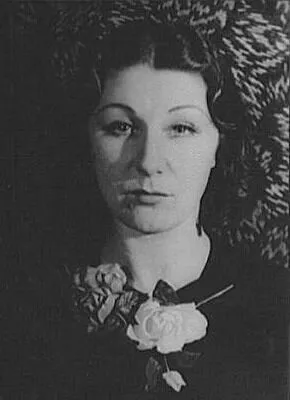
Judith Anderson
Human Design Chart
Biography
Anderson received a career boost when cast in Alfred Hitchcock's film Rebecca (1940). As the housekeeper Mrs. Danvers, Anderson was required to mentally torment the young bride, the "second Mrs. de Winter" (Joan Fontaine), even encouraging her to commit suicide; and to taunt her husband (Laurence Olivier) with the memory of his first wife, the never-seen "Rebecca" of the title. The movie was a huge critical and commercial success, and Anderson was nominated for a Best Supporting Actress Oscar.
Anderson was created a Dame Commander of the Order of the British Empire (DBE) in 1960 and thereafter was often billed as "Dame Judith Anderson". On 10 June 1991, in the Queen's Birthday Honours, she was appointed a Companion of the Order of Australia (AC), "in recognition of service to the performing arts".
Anderson was married twice and declared that "neither experience was a jolly holiday". She had a stepson. Anderson spent much of her life in Santa Barbara, California, where she died of pneumonia on 3 January 1992, aged 94.
Judith Anderson — Manifestor with Profile 3/5
Manifestor 3/5 — Design at a Glance
Judith Anderson's design showed a tendency towards pioneering leadership and visionary thinking. As a Manifestor, she was geared to actively steer the world into new directions, similar to an emperor in ancient Rome pursuing his vision of a great empire without having to fight battles himself. However, this role came with a specific pain point: She was often misunderstood and polarized her environment. Since her thoughts frequently reached further than those of her peers, she encountered a split reaction – while some were drawn to her big dreams and followed her, others rejected exactly these visions or even opposed them with hatred.
To navigate this dynamic, the strategy of informing was central for Judith Anderson. By proactively and clearly communicating her plans and intentions, she could find the right resonance and minimize misunderstandings. This allowed the appropriate 'followership' to identify and join her. Living according to this strategy and her inner authority rewarded her design with a deep sense of inner peace. In contrast, living against this design led to persistent anger, serving as a clear indicator that she was not in harmony with her natural disposition.
Emotional Authority
Judith Anderson's inner authority was the defined Emotional Center. This meant that her decision-making never reflected a snapshot of her current mood but followed a cyclical process. Her design generated permanent waves of emotional elevation and low points; the world appeared to her either in intense light or deepest darkness depending on where this wave stood. Acting impulsively based on this initial feeling impulse led to misjudgments, as the emotional reaction was only a provisional coloring, not the ultimate truth.
The mechanics of her authority required time and distance. Judith Anderson had to let decisions mature ideally through multiple sleeps to filter out the noise of immediate emotion. Only when intense feelings subsided and an emotional distance set in did true clarity and calm arise. This conscious process of delaying and letting oneself be questioned was no sign of weakness but the essential key to proper orientation. Especially for long-term life decisions that shaped her path sustainably, this patience was indispensable. The emotional wave served as a filter mechanism: What remained after the initial reaction had subsided was authentic; what appeared only in hype or low faded away. Through this strategic waiting, she protected herself from the negative consequences of spontaneous reactions and secured access to her deep, comprehensive insight.
The 3/5 Profile — Martyr / Heretic
Judith Anderson's design featured Profile 3/5, the Experimenter-Hero. This created a tension between her deep need to destroy old structures and start anew radically versus the external projection as a competent rescuer in crises. Line 3, marked by Gate 49, drove her to reject outdated principles and replace them through personal experimentation. This often led to dissatisfaction with the status quo and a learning process based on mistakes. She no longer belonged to the old order; her task was to break it, even if this appeared brutal or insensitive.
Simultaneously, Line 5, embodied by Gate 43, projected a hero role outwardly. Others saw in her someone with practical knowledge who could solve problems. However, she did not proactively share this knowledge but only during crises or upon request as the last resort. The challenge lay in that her public experimentation sometimes failed, which was a crucial learning factor for Profile 3/5. Her appeal lay in possessing a treasure of practical experiences and making these accessible to others once she herself had learned from their failures. She learned from her own setbacks and transformed them into insights that she then specifically passed on when the situation required it.
Single Definition — Defined & Open Centers
Judith Anderson's design was characterized by intense internal processing that relied on external initiation. Her defined Ajna Center ensured continuous independent conceptualization; she thought consistently and conditioned the mental field of her environment without being easily influenced. This mental stability combined with her defined Solar Plexus Center, which acted as an emotional authority. Judith Anderson demonstrated a practice of making decisions only after waiting for the emotional wave to pass in order to gain clarity rather than reacting impulsively to highs or lows.
This stable inner core contrasted with six open centers that absorbed environmental energies. Her open Head Center made her vulnerable to external mental pressure and confusion; she tended to be influenced by others' doubts or seek inspiration to fill mental gaps. Her open G Center meant a lack of firm identity; her direction was initiated by places and reference points, making her vulnerable to "borrowed" identities. The open Heart Center led to the risk of overcompensation: Judith Anderson might have taken on promises or proven herself to compensate for an apparent lack of willpower. Additionally, her open Sacral Center was situational in terms of energy; she tended to absorb others' "borrowed" energy and exhaust herself rather than knowing her own boundaries. Her open Spleen Center lacked spontaneous decision-making authority for health and well-being, making her vulnerable to impulsive, fear-driven reactions. Finally, her open Root Center absorbed external stress and adrenaline, putting her under pressure that she did not generate but only amplified.
Channels for spontaneous insights and emotional transformation.
Judith Anderson's design inclined towards mutative, innovative insights that often seemed "ahead of their time" and required time to be understood. This was enabled by the Channel 23-43, which connects the Ajna Center with the Throat Center. Through Gate 43 (Insight), she received spontaneous breakthroughs, which were processed and expressed through Gate 23 (Assimilation). This channel fostered a unique perspective that increased efficiency but required patience since her innovative thinking was not immediately accepted by all.
Simultaneously, Channel 35-36 drove a constant urge for new experiences. It connected the Solar Plexus Center with the Throat Center and utilized Gate 36 (Crisis) as well as Gate 49 (Revolution/Sacrifice). This emotional channel resisted restrictive patterns and actively sought change, often through creating crises to initiate movement. Judith Anderson exhibited a sensitive response to revolutions, guided by obedience to family or tribal principles. Gate 49 dominated her Personality Sun with about 70% energy and represented sacrifice and redistribution of resources.
The synthesis of these channels shaped her essence: the mutative intelligence of Structuring was driven by the emotional quest for Transience, always subordinate to deeper ancestral principles. Her challenge lay in letting go of control and allowing her mind to process knowledge at its own pace while simultaneously accepting emotional waves to make clear decisions. Through this configuration, she learned that feelings are transient and used her experiences to make wisdom accessible to others.
Individual Circuitry — Circuit Signature
Judith Anderson's design linked the Ajna and Throat Centers directly, suggesting a tendency towards structured articulation of thoughts. This Channel of Structuring (43-23) allowed her to translate inner visions into clear, tangible forms. Simultaneously, energy flowed between the Solar Plexus and Throat Centers through the Channel of Transience (35-36). This connection in the Meaning Circuit linked emotional waves from the past with external expression.
In simple terms, these two circuits formed a cohesive unit as all three centers—Ajna, Throat, and Solar Plexus—were directly connected. Judith Anderson was thus marked by dynamic tension: The pulsing, acoustic energy of the Knowledge Circuit drove the mutation of new identities while the cyclical-visual Meaning Circuit reflected and transformed past emotional experiences. Her expression in the Throat Center was therefore never purely intellectual or merely emotional but a synthesis of structured idea and felt history. She used this mechanism to articulate individual transformations and enable collective learning through the division process of her emotional cycles. The energy worked both as an impulsive pulse and a repelling wave, dissolving old patterns to reveal new meaning.
Right Angle Cross of Explanation 1
Judith Anderson's design included the configuration of the right cross of statement 1. However, since this specific aspect of her Human Design chart did not provide any further mechanical details or descriptive content, no character traits or behavioral dynamics could be derived from it. The presence of this designation alone was insufficient to determine concrete tendencies in her nature. Without underlying information about how this cross functions, it remained unclear how it influenced Judith Anderson's energy flow or decision-making process. It was therefore not possible to identify a specific life task or typical pattern for her that directly resulted from this configuration. While the design featured this structure, its potential impact in the chart remained undefined and could not be translated into human language due to the lack of explanatory mechanics. Judith Anderson carried this configuration, but its expression or significance remained open due to the absence of data. There was no indication that this cross played a special role in her life or how it manifested in her interactions with others. The analysis had to rely on other, better-documented aspects of her design since the right cross of statement 1 did not provide any interpretable information here.
Saturn Return · Uranus Opposition · Chiron Return · 2nd Saturn Return — Life Cycles
Judith Anderson's design indicated a tendency towards sudden, visible turning points that often came with public recognition. This structure was evident in 1940 when she was nominated for an Oscar as Best Supporting Actress at the age of 43 for her role in "Rebecca." This moment marked a Uranus opposition, a cycle often signaling unexpected breaks or sudden breakthroughs that disrupt previous life rhythms and create new visibility.
Another defining pattern was her fulfillment cycle around the age of 50. The Chiron Return is not a process of wound healing in the traditional sense but rather a phase of blooming where one's incarnation task unfolds increasingly, making meaning tangible. For Judith Anderson, this cycle became active in 1947 when she received the Tony Award as Best Actress at the age of 50 for "Medea." This success was not isolated but reflected the maturation of her inner strategy: after years of groundwork and adaptation, her specific gift entered a phase of confirmation and public recognition. Both events underscore how planetary cycles in the design can mark concrete life stations where internal dynamics manifest outwardly as measurable success.
Manifestor · Emotional Authority — Synthesis
Judith Anderson was a personality marked by the interplay of inner depth and the drive to shape something new. Her defined Ajna Center and Channel of Structuring pointed to a mind that constantly developed concepts and expressed them in formulations – a process filtered through the emotional ups and downs of her Solar Plexus Center. This ability to form and communicate innovative ideas was closely tied to her Profile as an Experimenter and Hero: she gathered experiences to pass on and inspire others. The open design of her centers for Identity, Willpower, and Life Force strengthened the tendency to allow external influences and to absorb energy from the environment, fueling both her creativity and making her vulnerable to conditioning.
A central paradox in Judith Anderson's design lay in the tension between the need for authenticity and the ability to adapt. Her undefined Heart Center indicated a lack of inner, constant willpower, while her Channel of Transience drove her to seek new experiences and initiate changes – a process often accompanied by emotional fluctuations. This dynamic led on one hand to an ongoing search for validation and on the other to a deep understanding of the fleeting nature of life, which strengthened her ability to move in different contexts and take on new roles.
2 Defined Channels
Incarnation Cross - Right Angle Cross of Explanation 1
Solar Return
The Solar Return shows the moment when the sun returns to its exact birth position - your personal solar year.
Life Cycles
Discover the life cycles with a detailed triple view (birth chart, cycle chart, composite).
Human Design Profile
- Type
- Manifestor
- Strategy
- To inform others before acting
- Authority
- Emotional Authority
- Profile
- 3/5 - Martyr / Heretic
- Definition
- Single Definition
- Incarnation Cross
- Right Angle Cross of Explanation 1
- Date of Birth
- 10.02.1897 00:15
- Place of Birth
- Adelaide, Australia
Frequently Asked Questions
What was Judith Anderson's Human Design type?
What Profile did Judith Anderson have in Human Design?
Which Authority guided Judith Anderson?
What incarnation cross did Judith Anderson have?
When was Judith Anderson born?
Discover your own Human Design
Are you also a Manifestor? Find out in a personal reading how to use your initiation power peacefully and dissolve resistance.
More Personalities
Back to overviewSissy Spacek

Anémone

Ann-Margret

Arletty

Arno

Artus