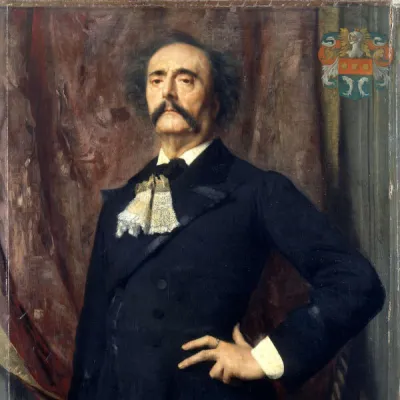
Jules Amédée Barbey d'Aurevilly
Human Design Chart
Biography
Jules Amédée Barbey d'Aurevilly as a Projector 3/5 in Human Design
Projector 3/5 — Design at a Glance
Jules Amédée Barbey d'Aurevilly radiated an aura described as a focusing flashlight. This intensity allowed him to immediately spot system errors in his environment and bring light into dark areas. His nature was to illuminate others by exposing weaknesses.
However, the mechanics of this Projector design were delicate: Directly addressing flaws often led to rejection, akin to shining a bright beam directly into someone's face. The effective strategy wasn't criticism but attracting through personal harmony. When he embodied a functioning order himself, people sought him out and asked for his perspective. This required waiting for a respectful invitation rather than forcing oneself upon others.
Since his design lacked a constant source of intrinsic life energy, his energy balance was cyclical. Phases of high activity and rapid work had to be balanced by rest phases to prevent burnout. Living according to this rhythm led to success; deviating from it resulted in the non-self theme of bitterness. His design inclined towards precise diagnosis, which only became effective when channeled through patience and invitation rather than direct confrontation.
Emotional Authority
Jules Amédée Barbey d'Aurevilly's design established an inner authority defined by a clear Solar Plexus Center. This meant that his emotional state was the decisive compass for decisions, independent of other defined centers in his chart. His perception of the world was subject to constant waves; moods swung between extreme enthusiasm and deep negativity. In moments of intense emotional outbursts, he often saw the same circumstances diametrically opposed - sometimes as great opportunities, sometimes as threatening risks. However, this immediate emotional reaction was only a provisional snapshot, not the final truth of his design.
Rapid, spontaneous judgments based on these initial impressions could have misled him. The mechanics of his emotional authority instead required patience and conscious hesitation. To gain clarity, Jules Amédée Barbey d'Aurevilly had to let decisions 'sleep' multiple times over. Only when the intense feelings subsided and an emotional distance was gained did calmness set in. This process of letting things simmer was essential for making long-term life decisions that truly aligned with his inner truth, rather than following fleeting whims. Through this temporal distancing, he filtered out the noise of current mood and accessed a deeper, more comprehensive understanding.
The 3/5 Profile — Martyr / Heretic
Jules Amédée Barbey d'Aurevilly's design set a foundational stance that showed as an electrifying mix of experimental adventurer and reserved hero. He had to initially try everything himself, due to the Line 3 of Profile 3/5 (Explorer/Hero) trusting little in predefined knowledge. This phase of adaptation through experience was often marked by illusions; mistakes were not only possible but necessary here to recognize ego projections and prepare consciously for obstacles.
Simultaneously, Line 5, the Hero's line, worked with a strong need for privacy and reflection. Jules Amédée Barbey d'Aurevilly needed retreat spaces to hide his intentions and wait for the right timing to reveal them. The tension lay in that his practical knowledge from public experiments of Line 3 attracted others - they saw him as an attractive storyteller or savior - yet failing before this audience was painful. His design required keeping secrets and only offering solutions to other people's problems once inner reflection was complete. Premature disclosure of these processes would have caused confusion. Instead, he ultimately used his actions driven by personal advantages for the good of the tribe, distilling general wisdom from personal mistakes and revealing it at the right time.
Split Definition — Defined & Open Centers
Jules Amédée Barbey d'Aurevilly revealed himself through an existential density and emotional depth that marked his entire being. His design featured defined Heart, Solar Plexus, Spleen, and Root Centers, which endowed him with an unshakable, self-determined presence. The defined Heart Center gave him strong willpower and the need to determine his life and resources himself; he knew his worth and kept promises that he made. At the same time, he had a defined Solar Plexus Center, meaning emotional clarity only came to him over time. He was designed to wait out the waves of his feelings before acting, as impulsivity at the heights or depths of these waves would have led to chaos. His defined Spleen Center offered him instinctive intelligence in the present moment, an intuitive recognition of what was healthy for his survival. This was complemented by the defined Root Center, which provided a steady pressure to maintain life impulse and stress resistance.
This strong core stood in contrast to his open centers: Head, Ajna, Throat, G, and Sacral. The open Head and Ajna Centers made him receptive to inspiration and concepts from the environment; he tended to absorb mental pressure waves of others or get entangled in questions that were not his own instead of consistently generating his own answers. His open Throat Center meant that communication was not always independent but dependent on external initiations and resonance; he could feel the pressure to gain attention or speak when he did not trust his inner authority. The open G-Center led to identity and direction being situational; he took on the energies of his environment and adapted instead of radiating a fixed, unchanging personality. Finally, his open Sacral Center made him vulnerable to the generative energy of others. He could amplify this energy but had no consistent personal reserve of vital force, so he had to learn to set boundaries and recharge himself rather than run on borrowed energy and exhaust himself. This configuration created a tension between inner strength in will, emotion, and instinct versus high receptivity to mental, communicative, and energetic influences from outside.
Channels for community spirit and the fight for life's meaning.
Jules Amédée Barbey d'Aurevilly's design laid a tendency towards stubborn determination, paired with the need for carefully weighed community contracts. This configuration marked him as someone who fought for individual meaning against resistance while simultaneously seeking his place through mutual loyalty.
The Life Struggle Channel 38-28 drove this attitude forward. It connected the Root Center to the Spleen Center via the Gate of the Fighter (38) and the Gate of the Player (28). This generated the pressure to maintain individual integrity and fight against external forces that distracted from one's own truth. At the same time, Gate 28 brought intuitive awareness as to whether a struggle was appropriate and worthwhile. Jules Amédée Barbey d'Aurevilly thus showed stubborn determination to follow his path even in poor odds, finding deep life meaning in these struggles.
Parallel to this, the Channel of Community 37-40 worked. It connected the Solar Plexus Center with the Heart Center via the Gate of Friendship (37) and the Gate of Solitude (40). This mechanism sought recognition and a place within the whole but also demanded reward and pauses for serving others. Jules Amédée Barbey d'Aurevilly waited for personal invitations into communities, as spontaneous contacts did not suffice. He built bridges between individuals to find an honorable place based on the insight that good deals take time and must be useful for both sides.
Additionally, prioritized Gates contributed to his imprint: Gate 44 promoted vigilance and transformation through interaction; Gate 24 sought knowledge in the rhythm of the pulse; Gate 33 required reflection and withdrawal for inner calm; Gate 19 emphasized resources, territory, and spiritual approach within the community. In the design, Gate 39 with its selective analysis and provocation as well as Gate 50 acted as a conservative reflex to protect values and traditions. These elements underscored the necessity of security, conscious choice, and maintaining tribal internal rules.
Tribal Circuitry — Circuit Signature
Jules Amédée Barbey d'Aurevilly's design presented two separate yet parallel functioning energetic poles. On one hand, the Knowledge Circuit drove him through the Life Struggle Channel (28-38). This connected Spleen and Root Centers directly. A pulsating, acoustically marked energy emerged that sought transformation on a personal path. The intuition of the Spleen met with the survival energy of the Root, generating an individual, often melancholic impulse towards change.
Completely independently, the Ego Circuit worked through the Channel of Community (37-40). This connected Heart and Solar Plexus Centers. Here it was about cooperation, giving and taking as well as forming communal resources in a conservative, traditional sense. Since this stream did not have a connection to the Sacral Center, it lacked constant life force. Jules Amédée Barbey d'Aurevilly therefore needed mandatory rest pauses to replenish these energetic reserves and maintain balance between support and conservation.
This divided definition meant that the transformative intuitive power of one pole did not directly flow with the cooperative emotional dynamics of the other. They existed as separate forces alongside each other: on one side, an acoustic creative drive towards individual transformation; on the other, a tactile scent-based necessity for communal stability under strict observance of recovery phases.
Right Angle Cross of the Four Ways 3
Jules Amédée Barbey d'Aurevilly's design carried the structure of the right cross of the four pathways. This configuration established a specific inner dynamics that shaped his experience and actions. In Human Design, this cross describes a deep striving for spiritual understanding and the integration of experiences into a larger context. It is an architecture of the mind aimed at not just living life but understanding it as a path of knowledge.
For Jules Amédée Barbey d'Aurevilly, this meant that his energy and attention were often directed towards questions of existence and personal transformation. The right cross of the four pathways connects various aspects of human design to promote an holistic perspective. It fostered the ability to draw lessons from diverse life situations and embed them into a coherent worldview.
This structure supported a stance of reflection and inner growth. Jules Amédée Barbey d'Aurevilly was shown through this design as someone who saw life as a process of continuous development. The mechanics of this cross helped him interpret challenges not just as obstacles to overcome but as necessary steps on his individual path. It was a design that favored depth and contemplation, seeking a connection between the everyday and the transcendent.
Saturn Return · Uranus Opposition · Chiron Return · 2nd Saturn Return — Life Cycles
Jules Amédée Barbey d'Aurevilly's life journey followed the structural logic of his four classical planetary cycles, serving as a framework for his development. The first Saturn return cycle marked the transition into adult responsibility and the solidification of his position. This was followed by the Uranus opposition, a phase of breaking with established structures that fostered a departure towards greater autonomy and independence.
The Chiron return cycle appeared as a fulfillment phase in which his incarnation purpose – if he had followed his strategy – increasingly unfolded and became meaningful; this was not a process of healing wounds but rather the blooming of his own design. Finally, the second Saturn return cycle concluded this development by integrating previously gained insights into a form of mastery. This rhythmic sequence shaped Jules Amédée Barbey d'Aurevilly's maturation: from initial responsibility through necessary rupture with the past to complete integration of his life mission. The cycles thus defined not only time points but also the qualitative deepening of his character and action patterns over the years.
Projector · Emotional Authority — Synthesis
Jules Amédée Barbey d'Aurevilly lived an inner conflict between the desire for individuality and the necessity to integrate into a community. His design as a Projector with emotional authority points towards a natural ability to recognize others' mistakes (Gate 44), yet this gift was inseparable from a deep sensitivity to the energies of his environment – particularly through the open Sacral Center. He absorbed the energy of others and had to learn to protect himself or redirect it into creative work. This interaction between recognizing patterns and absorbing external influences shaped his observational skills and understanding of human relationships.
A central paradox lay in Barbey d'Aurevilly being destined to bring 'light into darkness' for others, yet this could only happen if he waited for an invitation (Projector strategy). At the same time, he possessed the willpower and a defined Heart Center to act self-determinedly. This tension between waiting for recognition and the urge to live out his own values led to a life marked by the search for authentic connection – a connection that satisfied both his observational skills and his desire for self-realization.
2 Defined Channels
Incarnation Cross - Right Angle Cross of the Four Ways 3
Solar Return
The Solar Return shows the moment when the sun returns to its exact birth position - your personal solar year.
Life Cycles
Discover the life cycles with a detailed triple view (birth chart, cycle chart, composite).
Human Design Profile
- Type
- Projector
- Strategy
- Wait for the respectful invitation
- Authority
- Emotional Authority
- Profile
- 3/5 - Martyr / Heretic
- Definition
- Split Definition
- Incarnation Cross
- Right Angle Cross of the Four Ways 3
- Date of Birth
- 02.11.1808 03:00
- Place of Birth
- Saint-Sauveur-le-Vicomte, France
Frequently Asked Questions
What was Jules Amédée Barbey d'Aurevilly's Human Design type?
What Profile did Jules Amédée Barbey d'Aurevilly have?
What Authority did Jules Amédée Barbey d'Aurevilly have?
Which incarnation cross was active for Jules Amédée Barbey d'Aurevilly?
When was Jules Amédée Barbey d'Aurevilly born?
Discover your own Human Design
Are you also a Projector? Find out in a personal reading how to unfold your leadership qualities and recognize the right invitations.
More Personalities
Back to overviewSissy Spacek
Alain-Fournier

Anémone
Angeli

Ann-Margret
Bourvil