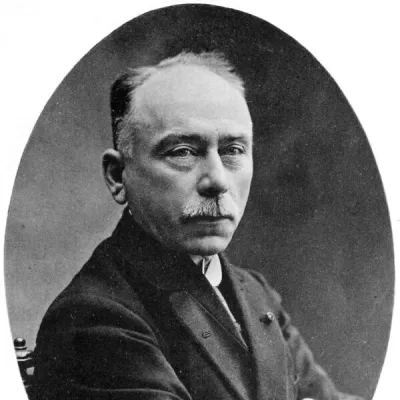
Jules Bordet
Human Design Chart
Biography
Bordet died on 6 April 1961, Brussels, Belgium.
Human Design Analysis: Jules Bordet as Generator 6/2
Generator 6/2 — Design at a Glance
Jules Bordet's design revealed a tendency towards high endurance and a specific way of working. He was a Generator, meaning he had abundant sacral energy – comparable to a strong workhorse that generates power when used for the right task. His central mechanism did not lie in initiating actions independently but rather in responding to impulses from his environment. Successfully utilizing this energy required waiting for an internal signal, such as a gut feeling impulse like “Yes! Let’s get started!” followed by taking action.
This strategy led Jules Bordet to deep satisfaction and a sense of true fulfillment. In contrast, ignoring these inner signals or constantly initiating against the flow resulted in frustration, energy depletion, and the risk of burnout. Two pitfalls shaped his design: one was wasting energy on things he had no intrinsic interest in, which even with high potential led to exhaustion. The other was holding back from working on his heart project despite still being full of power for it. Jules Bordet could only effectively materialize his energy when reacting to life impulses and acting from the gut rather than planning or initiating. Living by this design made him unstoppable; deviating from it brought persistent frustration.
Sacral Authority
Jules Bordet demonstrated a decision-making stance firmly rooted in physical resonance. As a Generator, his strategy was identical to his inner authority: sacral authority. This fundamentally simplified his decision process as he did not have to weigh different internal voices but reacted directly to the impulses of his body.
This authority expressed itself through a specific “gut feeling” or sudden surge of energy in response to external stimuli. Bordet learned to interpret these bodily signals – whether grunting, humming, or simply saying “Hmm.” As long as his Emotional Center was open, this sacral response served as a reliable compass. When his inner motor kicked in, he felt vital and alive; then an apparently inexhaustible energy was at his disposal. He tackled his tasks with great enthusiasm and immersed himself fully in his activities, free from rigid purposefulness. His design predisposed him to go through life with joy and satisfaction.
Additionally, his activated Spleen Center acted as a supportive instance for sacral authority. This connection allowed particularly quick and spontaneous reactions. He had an immediate access to his physical well-being and instinctive perception, which he could rely on to guide himself. This combination of sacral confirmation and spleen-based intuition formed the basis for his ability to act and inner balance.
The 6/2 Profile — Role Model / Hermit
Jules Bordet's design was characterized by a clear two-phase life path: an early period of experimental learning followed by a phase of detached reflection and wisdom transmission. As a carrier of Profile Line 6 in Gate 45, he first went through the “trial-and-error” phase. Before his thirtieth year, this line acted like a Three; his focus was on individual experimentation, trial and error, and the necessity of personal mutation. Here it was about learning through personal experiences and integrating foreign elements to bring in innovations.
Around thirty years old, the dynamics fundamentally changed. The specific mechanics of Line 6 came fully into play: Jules Bordet metaphorically withdrew to look back with great distance on his previous experiments. This period served for intensive reflection, healing, and deep self-knowledge. From this “cave phase,” he developed authentic wisdom. Finally, he returned as a role model, ready to pass on this introspective ability to others.
In contrast, Line 2 in Gate 36 formed the opposite pole. This line possessed the talent of freeing emotional energies and helping others during crises – selectively and often unconsciously. While Line 6 steered structural development from mutation to collective integration, Line 2 supported this process through targeted aid in emotional emergencies. The combination shaped a path from individual search over withdrawal towards wisdom-based leadership where foreigners were integrated to strengthen the collective.
Split Definition — Defined & Open Centers
Jules Bordet's Human Design profile established a fundamental stability in thought and action, characterized by four defined centers. The Sacral Center (defined) provided constant vital energy that was only correctly usable through reactions to external impulses; initiatives without prior questioning led to frustration. This power was underpinned by the Root Center (defined), which propelled him forward with a steady existential drive, transforming stress into productive movement. Simultaneously, the Ajna Center (defined) ensured consistent mental concept formation – an always active mind that generated trustworthy theories. These thoughts flowed directly into the Throat Center (defined), allowing Jules Bordet to express his mental processes reliably and clearly. The connection from Ajna to Throat created a coherent line: What was thought was also communicated.
In contrast to this inner stability, there was high permeability through six open centers. The Head Center (open) was not consistently inspired; Jules Bordet tended to engage with doubts or questions that belonged to others and sometimes desperately sought answers to problems that were not his own. Similarly, the G Center (open): There was no fixed identity or life direction from within. Instead, he reflected his environment; at wrong places, he felt lost while correct environments gave him clarity. The Heart Center (open) lacked consistent willpower. He was vulnerable to the pressure of making promises or proving his worth through performance, often ending in a cycle of overextension and disappointment due to the lack of energy for it.
The Solar Plexus Center (open) absorbed emotions from the environment. Jules Bordet had difficulty distinguishing between his own feelings and those of others, leading him to personalize emotional waves or avoid confrontation out of fear of rejection. Finally, the Spleen Center (open), which made him vulnerable to existential fears. He unconsciously sought security in others and tended to cling to unhealthy situations just for the illusory feeling of well-being. The challenge was to use the constant energy of defined centers without identifying with the fleeting impulses of open areas.
Channels for insatiable curiosity and mature growth.
Jules Bordet exhibited a fundamental orientation marked by an insatiable need not only to understand what he saw but also to convey it as a narrative experience. His design inclined him towards conveying knowledge less as a dry list of facts and more as a living story to teach or entertain others. This alignment resulted from the Channel of Curiosity 19-56, which connected his Ajna Center with his Throat Center. Through the connection of Gate of Ideas (11) and Gate of Inspiration (56), Jules Bordet constantly sought new perspectives. He was less interested in mere discovery than in the process of discovery itself to weave parables that engaged others' imagination. His stories served to make abstract information accessible and gave the collective a chance to reassess their beliefs.
Parallel to this, the Channel of Maturation 26-43 ensured a cyclical deepening of these insights. This channel connected his Root Center with his Sacral Center through Gate of Beginnings (53) and Gate of Growth (42). It drove Jules Bordet to fully experience experiences before reflecting on them. Only through this complete process could he extract wisdom relevant for future generations. This maturation process meant that each new experience built upon the previous one and was translated into a collective history. The combination of idea-driven curiosity and this deep, cycle-based processing shaped his way of structuring knowledge: He absorbed impulses, let them mature in his own life cycles, and then presented the result as an orderly, instructive narrative. Additional influences like Gate of Friction (6) promoted further development through emotional waves, while Gate of Formulation (4) provided logical structures for future security.
Collective Circuitry — Circuit Signature
Jules Bordet's design inclined him towards cyclical, emotional reflection. His experience of the past was not a continuous logical line but rather flowed in wave-like phases with clear beginnings, middles, and ends. This structure resulted from the Meaning-Making Circuit, which in his case formed two separate energetic segments: on one hand, the connection between Ajna and Throat Centers (Gate 11
Left Angle Cross of Confrontation 1
Jules Bordet's design established a fundamental orientation towards direct confrontation. His energetic signature, defined by the Left Cross of Confrontation 1, consistently channeled his inner dynamics toward confrontational processes. This structure did not view friction as an obstacle but rather as a necessary mechanism for clarification and transformation. Through this specific impulse, energy was directed in such a way that truths could only be revealed through resistance and the resulting tension. The inherent power of this cross served to make hidden things visible by challenging existing states and thereby enabling deep change. Jules Bordet followed this inner logic where confrontation was the primary means for gaining insight. This process allowed him not to settle for superficial harmony but to grasp underlying realities through active engagement. Thus, energy naturally flowed into situations seeking clarity through conflict rather than avoiding it. This orientation shaped his way of dealing with both his environment and internal processes by constantly demanding a direct experience-based scrutiny of facts.
Saturn Return · Uranus Opposition · Chiron Return · 2nd Saturn Return — Life Cycles
Jules Bordet's development followed a clear structural sequence from private bonds to professional advancement and finally to the highest recognition. In 1899, at age 29, he married Marthe Levoz. This marked his first Saturn Return, a cycle often solidifying personal commitments and long-term connections before focusing more outwardly.
The next turning point came in 1907 when Jules Bordet became Professor of Bacteriology at the Université Libre de Bruxelles. At age 37, he was experiencing the Uranus Opposition. This cycle often brings professional upheavals and breakthroughs to a new authoritative position, moving away from mere execution towards independent leadership and responsibility.
The highest confirmation of his life mission came in 1919 with the awarding of the Nobel Prize for Medicine. At age 49, he went through the Chiron Return. In this fulfillment cycle, one's incarnation cross unfolds increasingly; those who have lived according to their strategy and authority experience here meaning and purpose as tangible reality. The Nobel Prize was not a mere coincidence but the visible bloom of this inner orientation. These three cycles thus defined not only time points but structural phases: from establishing the private realm through building a career to full realization of one's purpose.
Generator · Sacral Authority — Synthesis
Jules Bordet was a Generator whose life was marked by deep sacral authority and cyclical engagement. His energy found expression in reacting to external impulses (Sacral Center), developing wisdom through phases of experimentation and reflection (Line 6) that he could later impart. This ability to gather, process, and share experiences as insight was strengthened by the Sense Finder Circuit—a constant flow from past, present, and future connecting him with the collective. The connection between Head and Throat Centers enabled him to clearly formulate and communicate his thoughts (Channel 19), while Root and Sacral Centers provided enduring energy he invested in his work (Channel 26).
A central paradox in Jules Bordet's design lay in the tension between his open heart and his ability for emotional reaction. While naturally receptive to others' feelings (open Heart Center), he could still find a clear, authentic direction through his sacral authority. This combination led to profound sensitivity paired with the ability not to lose himself in others' emotions but to use them as information and let them flow into his work.
2 Defined Channels
Incarnation Cross - Left Angle Cross of Confrontation 1
Solar Return
The Solar Return shows the moment when the sun returns to its exact birth position - your personal solar year.
Life Cycles
Discover the life cycles with a detailed triple view (birth chart, cycle chart, composite).
Human Design Profile
- Type
- Generator
- Strategy
- To respond - wait for something to respond to
- Authority
- Sacral Authority
- Profile
- 6/2 - Role Model / Hermit
- Definition
- Split Definition
- Incarnation Cross
- Left Angle Cross of Confrontation 1
- Date of Birth
- 13.06.1870 18:30
- Place of Birth
- Soignies, Belgium
Frequently Asked Questions
What is Jules Bordet's Human Design type?
What profile did Jules Bordet have?
What authority did Jules Bordet have?
What incarnation cross did Jules Bordet have?
When was Jules Bordet born?
Discover your own Human Design
Are you also a Generator? Find out in a personal reading how to use your sacral energy correctly and discover deep satisfaction.
More Personalities
Back to overviewAaliyah

Alexia

Angèle

Anne-Marie

Arcángel

Arno