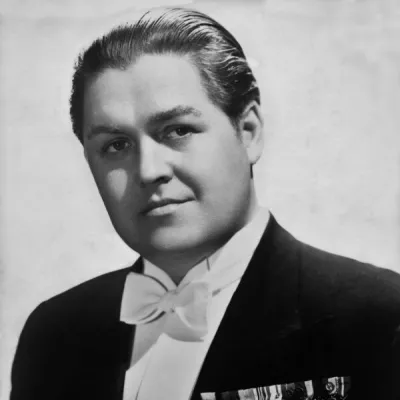
Jussi Bjorling
Human Design Chart
Biography
With natural talent, Bjorling began singing when he was a child. In 1930 he made his professional debut in Stockholm, singing the lead role in Manon Lascaut. By 1937 he was known all over Europe and the US and made his US debut at Carnegie Hall that year.
On March 15, 1960 he suffered a heart attack before he was to perform at the London Royal Opera House. His health continued to fail although he continued to record. He died six months later, on September 9, 1960, age 49.
Jussi Bjorling as a Generator 3/6 in Human Design
Generator 3/6 — Design at a Glance
Jussi Bjorling's Human Design laid the foundation for fundamental endurance, but this depended strictly on the nature of his activity. As a Generator, he had an enormous sacral energy source, comparable to a workhorse: strong and steady as long as he felt inner consent for his task. His success was directly tied to whether he responded to external signals or initiated actions himself. The strategy of his design demanded that he not anticipate but wait until life posed a question or an impulse arose. Only then, when his sacral center responded with a clear 'yes' – that gut feeling reaction – could he use his energy effectively and without loss.
This tension defined his potential: On one hand, burnout threatened if he engaged in activities that brought him no joy and wasted his strength. On the other hand, it led to deep frustration when prevented from pursuing his heart's project despite being full of energy to continue working. If Jussi Bjorling lived in harmony with this mechanism – by responding rather than initiating – his system rewarded him with a sense of profound fulfillment and inexhaustible power. Deviations from this, especially constant initiative against his inner rhythm, inevitably resulted in energy loss and persistent frustration. His endurance was thus not a trait of will but the result of correctly reacting to internal impulses.
Sacral Authority
Jussi Bjorling's Human Design inclined him towards making decisions based on immediate physical feedback rather than mental deliberation. As a Generator, he possessed sacral authority as an inner decision-making instance. This was unique to his type and simplified his process since strategy and authority were identical: the response.
His inner truth manifested through a 'gut feeling' or surge of energy in reaction to external stimuli. He learned to pay attention to bodily sounds like grunts, hums, or soft mhm's. When his sacral motor engaged with something, he felt vibrant and alive. Then, virtually inexhaustible energy was at his disposal, enabling him to tackle his work with great enthusiasm.
This design marked him as someone born to go through life with joy and satisfaction. He could immerse himself in tasks without needing a mental purpose. The necessity lay in utilizing this spontaneous energetic resonance rather than making cognitive considerations. Only then did he find the deepest contentment in what he did. His design offered him direct access to his life energy if he listened to and responded to this inner compass instead of initiating or waiting.
The 3/6 Profile — Martyr / Role Model
Jussi Bjorling's Human Design developed distinctly across two phases of life. In the first three decades, Profile 3/6 dominated as pure Line 3: an attitude of experimentation and playful search for proof. This phase was marked by internal uncertainty; while he projected external control, he often felt torn between a desire to play and the urge to question things. Gate 13 in this line promoted healthy skepticism towards abstract promises – only concrete experiences and listening provided necessary security. Satire frequently served as humorous defense against his own pessimism.
Only after the Saturn Return cycle around age 29-30 did this dynamic fundamentally change. Line 6 became active, introducing a new quality of reflection. Jussi Bjorling increasingly withdrew to organize his accumulated experiences. The earlier joy in experimentation now received wise guidance from Line 6, enabling objectivity and value assessment. Instead of blindly following trends, he learned to distinguish the true worth of creative work from fleeting fashions. This integration of skepticism and later wisdom created a deep internal tension that only time could resolve. Around age 50, this development showed as a complete synthesis: His earlier playfulness was now replaced by an endearing, reflective role model function. He embodied the essence of someone who carried both the curious child and the wise elder within, offering authentic guidance to others through this wisdom.
Split Definition — Defined & Open Centers
Jussi Bjorling's Human Design profile indicated a tendency towards constant inner stability and autonomous presence. His defined Ajna Center ensured consistent, independent conceptualization; he thought in trustworthy patterns without being easily influenced by others. This mental clarity flowed directly into his defined Throat Center, allowing him to express his thoughts reliably and authentically – communication was not an impulsive act for him but the expression of a mature internal process.
The immense power source of his design came from his defined Sacral Center. It provided daily vitality that relied strictly on reaction. Jussi Bjorling found satisfaction by waiting until life spoke to him and then responding with full energy; initiation without such prompting would have led to frustration. His defined Spleen Center offered a reliable, momentary instinct for health and survival, while his defined Root Center delivered constant pressure towards movement and material progress.
In contrast, the Head, G, Heart, and Solar Plexus Centers were open. These areas absorbed situational environmental energies rather than generating them themselves. Jussi Bjorling was sensitive to foreign inspiration, identity offers, and emotional waves. He tended to question whether he had found the right direction or place instead of determining these from within himself. His task was to use these open centers as information channels – for example, to let go of false emotional states in others – rather than treating them as authorities. The stability of his defined cores allowed him to perceive external influences without getting lost in their confusion or emotional turbulence.
Channels for change, insight and caring values.
Jussi Bjorling's Human Design profile indicated a tendency towards deep, pulsating change, flanked by the ability for structural clarity and a strong instinct for care. His energy was marked by an often melancholic rhythm that required patience until new insights emerged.
The channel of Mutation 60-3 connected the Root Center with the Sacral Center. Gate 60 stood for acceptance of limitation, while Gate 7 represented the attempt to create order out of confusion. This combination generated a powerful but unpredictable energy that caused inner tension when the pulse stopped – perceived as melancholy. Jussi Bjorling had to learn not to rationalize this mood but rather patiently wait for the correct sacral reaction to bring unique mutations into the world.
Parallel to this, the channel of Structuring 43-23 connected the Ajna Center with the Throat Center. Gate 43 received spontaneous insights that were assimilated and clearly expressed through Gate 23. This allowed Jussi Bjorling to efficiently communicate innovative perspectives. The key was waiting for the right timing; only then would his unique knowledge be understood and accepted rather than rejected as foreign.
A third pillar was the channel of Preservation 27-50 between the Sacral Center and Spleen Center. Gate 27 fostered selfless care, while Gate 50 guarded traditional values. This configuration gave Jussi Bjorling a natural instinct for responsibility and protection of the tribe. His aura attracted trust, but he had to ensure that his energy was confirmed through sacral reaction before caring for others.
Together with gates like 13 (Continuity) and 7 (Leadership), these mechanisms formed a profile that set on evolutionary change through clear communication and responsible care.
Individual Circuitry — Circuit Signature
Jussi Bjorling's Human Design profile indicated a tendency towards two parallel, separate energy fields. Through Split Definition, these forces were not directly connected but existed side by side and required situational resonance from the environment for activation.
One field was formed by the Knowledge Circuit. Here, Ajna Center connected with Throat Center as well as Sacral Center with Root Center in two distinct segments. The channel 3-60 (Mutation) promoted deviation from the known, while channel 43-23 (Structuring) helped to form these deviations into shape. This created a pulsating acoustic drive towards individual transformation and creative expression of new identity.
The second field originated from the Protector Circuit. Here, channel 27-50 (Preservation) connected Sacral Center with Spleen Center. This connection provided primordial protection, instinctive care, and preservation of genetics and family. The energy was timeless and acted through touch and smell senses.
The tension lay between the acoustic drive for personal change in the Knowledge Circuit and the tactile instinct for sustenance and preservation in the Protector Circuit. As the definition was split, these energies did not act as a continuous flow but as distinct areas that each required their own resonance to be effective.
Right Angle Cross of the Sphinx 1
Jussi Bjorling's design inclined towards a deep, intuitive perception that made the invisible visible. He functioned as a channel for archetypal energies without actively steering them from within himself. This configuration corresponds to the right cross of the Sphinx 1, a principle of association and intuition on the receptive side.
In Human Design, this element describes the ability to recognize hidden connections and make them tangible through a specific form of expression. Since it is the feminine pole, this energy in Jussi Bjorling was passively structured. He reacted to external impulses or situations that activated this intuitive connection. The structure of his associations was not self-initiated in an aggressive sense but was triggered from outside and then processed. This shaped a way of perception where he acted as a receiver and transmitter of these deep insights. He did not primarily seek the source of the energy, but stood ready to receive it and translate it into his form of expression. This receptive quality meant that his intuition was often triggered by circumstances or other people, requiring a certain degree of adaptability and openness. The Sphinx energy gave him the gift of revealing the hidden, always in response to context rather than as an independent drive.
Im Human Design ist das Profil 1/6 ein Ausdruck von Intuition und Empfänglichkeit für tiefe Verbindungen. Es repräsentiert eine Person, die durch ihre Rezeption der Umwelt tiefere Wahrheiten erkennen kann und diese in ihrer eigenen Art und Weise ausdrückt.
In Human Design, the Profile 1/6 is an expression of intuition and receptivity to deep connections. It represents a person who can perceive deeper truths through their reception of the environment and express these truths in their own unique way.
Saturn Return · Uranus Opposition · Chiron Return — Life Cycles
Jussi Björling's Human Design profile was characterized by clear phases of establishment, medial expansion, and later physical stress limits. This structure manifested concretely in his planetary cycles.
1938, at the age of 27, he made his debut at the Metropolitan Opera as Rodolfo in La Bohème. This marked his first Saturn return cycle, a phase where years of groundwork condensed into a solid, public achievement and consolidated his position.
The next turning point came in 1952 when the complete opera recording of "Il Trovatore" was made. At age 41, he was experiencing the Uranus opposition. This cycle often promoted technological or media milestones by expanding established structures through new distribution channels and sustainably changing the reach of one's impact.
The Chiron return around the age of 49 is a fulfillment cycle in which one's incarnation cross unfolds—provided that strategy and authority have been lived out. For Jussi Björling, however, this period showed an extreme physical peak: In 1960, shortly before a performance at the Royal Opera House, he suffered a heart attack. This underscores that the Chiron cycle is not only about spiritual bloom but also represents the ultimate test of one's physical resources when life energy hits its limits.
Generator · Sacral Authority — Synthesis
Jussi Bjorling's design reveals a central continuity between the ability to draw energy from the present moment and the urge to use this energy for creative processes. As a Generator, he was dependent on external impulses to release his sacral energy – reacting rather than initiating (Sacral Center). This reaction fed into a strong desire for expression through the defined Throat Center and was filtered by the connection to the Ajna Center with a specific, consistent way of thinking. The Channel of Mutation (3-60) points towards a natural aptitude for evolutionary steps and innovative approaches, while the Spleen Center supported instinctive decisions and kept him in alignment with the present moment.
A central paradox lies in the combination of an open emotional wave (Solar Plexus Center) and a defined Root Center. On one hand, he was vulnerable to the energies of others, absorbing their emotions and could be influenced by them. On the other hand, he possessed a constant source of inner pressure and the ability to engage, which potentially pushed him into a cycle of emotional reaction and the need for control – constantly navigating between adapting to the environment and persisting on his own path.
3 Defined Channels
Incarnation Cross - Right Angle Cross of the Sphinx 1
Solar Return
The Solar Return shows the moment when the sun returns to its exact birth position - your personal solar year.
Life Cycles
Discover the life cycles with a detailed triple view (birth chart, cycle chart, composite).
Human Design Profile
- Type
- Generator
- Strategy
- To respond - wait for something to respond to
- Authority
- Sacral Authority
- Profile
- 3/6 - Martyr / Role Model
- Definition
- Split Definition
- Incarnation Cross
- Right Angle Cross of the Sphinx 1
- Date of Birth
- 05.02.1911 22:00
- Place of Birth
- Borlänge, Sweden
Frequently Asked Questions
What was Jussi Bjorling's Human Design type?
What Profile did Jussi Bjorling have?
What Authority did Jussi Bjorling have?
What incarnation cross did Jussi Bjorling have?
When was Jussi Bjorling born?
Discover your own Human Design
Are you also a Generator? Find out in a personal reading how to use your sacral energy correctly and discover deep satisfaction.
More Personalities
Back to overviewAaliyah

Alexia

Alizée

Angèle

Anne-Marie

Arcángel