
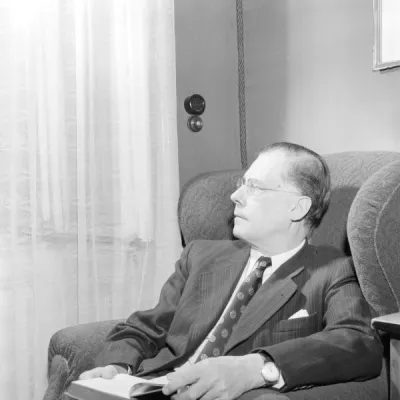
Karl Böhm
Human Design Chart
Biography
Bohm knew how to accompany singers. Unlike many of his successors, he understood the frailties of the human voice, and brought that sensitivity with him into the orchestra pit.
He died on 14 August 1981 in Salzburg, Austria, aged 86.
The Human Design of Karl Böhm: Generator 6/2
Generator 6/2 — Design at a Glance
Karl Böhm was characterized by an enormous, sacral endurance energy. His design did not define him as an initiator but rather as a reactor: his strength unfolded fully only through responding to external impulses. This configuration described the life strategy of 'Reacting Instead of Initiating'.
As a Generator, Karl Böhm possessed plenty of energy and was very enduring. One could imagine him like a strong workhorse – provided he had energy for his task. Two stumbling blocks characterized this pattern: first, persistently doing things without inner desire, which tended towards burnout as the energy was wasted. Second, holding back from working on his heart project even though he still had plenty of power.
The energy of the sacral center became free mainly when it could react to impulses. The motto was: not initiating but reacting. The most successful strategy consisted in waiting for a signal from life and then, when the sacral center said 'Yes! Let's get going!', responding with action.
If Karl Böhm lived in harmony with this design, no one could stop him. He was then rewarded with deep satisfaction or a feeling of profound fulfillment. If he did not live according to his design – especially if he constantly wanted to initiate something – he likely encountered persistent feelings of frustration and/or a lack of energy sooner or later. The polarity between deep fulfillment when reacting to inner resonance and frustration when forced to initiate was thus central to his experiential world.
Sacral Authority
Karl Böhm showed himself as someone whose decision-making did not take place in the head but was deeply rooted in the body. As a Generator, he possessed sacral authority, an internal instance that simultaneously served as strategy and source of truth for him. This configuration simplified his access to correct answers: he reacted to external stimuli not through analysis but through immediate physical signals.
His inner voice manifested itself in sounds like grunts or an affirming 'Mhm', accompanied by noticeable bursts of strength in the abdominal area. These physical impulses were his compass. When his sacral motor responded to a situation, Karl Böhm felt vital and alive. Then almost inexhaustible energy was available to him, enabling him to complete his tasks with great enthusiasm.
This state was characterized by joy in the act itself, entirely without necessary purposefulness. He was born to immerse himself in his activities and derive satisfaction from pure action. The necessity for him lay in trusting these bodily sounds and impulses rather than thinking. Only through this listening could he give the right answer and effectively utilize his natural life force, allowing him to go through life with a deep inner resonance.
The 6/2 Profile — Role Model / Hermit
Karl Böhm showed himself in his youth as an experimental seeker who gathered life experience by actively experimenting and allowing for mistakes. This behavior corresponded to the dynamics of his 6/2-line: before the age of 30, the sixth line acted like a third, characterized by the principle 'trial and error'. During this phase, openness to new experiences was paramount, with setbacks accepted as necessary steps towards understanding.
With the return of Saturn, around the age of 30, a fundamental change occurred in his design. The sixth line fully activated itself and demanded a clear withdrawal from the social experimental field. Karl Böhm metaphorically retreated into a 'cave' to reflect on the previously gathered impressions with great distance. This phase of isolation served not only for integration but also for healing and deeper self-knowledge. The selective nature of the second part of his line (Gate 16) now called for calmness and objectivity to condense what had been learned, rather than continuing to act impulsively.
Only after this inner work was completed did Karl Böhm emerge as a reflective authority. Emerging from his retreat, he embodied the role of the wise mentor. Others sought him out to benefit from the wisdom gained through introspection. His design thus described a clear developmental arc: from an unbound experimenter in the first decades of life to a distanced but profound teacher who shared insights only when internally ready and called upon.
Single Definition — Defined & Open Centers
Karl Böhm was characterized by a defined G Center, which gave him a firm sense of self-identity and clarity about his life direction. This inner coherence had a magnetic effect on those around him; he intuitively knew where life was pulling him without having to control the path. Alongside this, he also had a defined Sacral Center, the motor of his vital energy. His strategy involved not initiating but waiting for life to present an invitation that his Sacral could respond to with a clear yes or no. Only through these reactions did he have the strength needed to find satisfaction and persistence in his activities.
This stable inner structure contrasted sharply with the vulnerability of his open centers. His open Head Center made him susceptible to mental pressure and confusion from the environment; he tended to get entangled in questions that were not his own, instead of trusting his inner authority. Similarly, his open Ajna (conceptual thinking) meant he could take on concepts and opinions from others without needing to hold them as personal truths – a skill that could easily lead to conditioning if he tried to secure intellectual certainty.
His open Heart Center lacked consistent willpower; he was not designed to keep promises or prove his worth through competition. Instead, he risked frustration when trying to meet the expectations of others. His open Solar Plexus Center made him absorb and amplify emotions from his surroundings, making him vulnerable to foreign moods and complicating emotional decisions. Furthermore, his open Spleen Center was marked by a deep survival anxiety that led him to cling to uncertain situations or make spontaneous decisions for a false sense of well-being. Finally, his open Root Center absorbed external stress and adrenaline, making him susceptible to the pressure of others rather than maintaining his own rhythm.
Channels for persistent discovery and self-determined resolve.
Karl Böhm showed a fundamental approach of persistent discovery: He immersed himself in the depth of his experiences to find clarity at the end. This dynamic came from Channel 29-46 in Personality, connecting his Sacral Center with his G Center. Gate 29 offered the wellspring of endurance while Gate 46 established the connection to the direction of Higher Self. For Karl Böhm, it was essential to release all expectations and commit unwaveringly. Control did not matter; what mattered was patience with processes that could take years. Only through proper yes-saying could he remain persistent without being diverted from his course. The significance of his paths became clear only in retrospect, not during the journey.
This mechanism worked together with additional energies. Gate 59 in Sacral Center pursued a genetic strategy of bonding and unification often independent of personal preferences. Gate 55 at Solar Plexus brought emotional awareness and mood shifts, shaping the instability of his feelings. In the collective realm, Gate 16 promoted experimentation to improve the new while Gate 9 in Sacral Center enabled detailed work and perfection through repeated pattern correction. Without energy fulfillment, frustration threatened here.
On the level of personality, Gate 25 fostered a spiritual stance of innocence and individuation, combined with mystical centering. Gate 27 represented the genetic role of care and self-preservation, enriching his activities with caring warmth. Gate 15 established collective behavior and adaptation to natural rhythms, promoting humility. Finally, Gate 42 in the design supported the completion of processes to enable new commitments; lack of decisions could easily lead to blockages. Karl Böhm learned from experience: Only at the end of a phase did he analyze what was valuable and should be repeated.
Collective Circuitry — Circuit Signature
Karl Böhm exhibited a fundamental approach marked by reflecting on past experiences. His design suggested that he found meaning not through cool logic or future-oriented planning, but by processing emotions and feelings from the past. This process flowed in waves – with beginning, middle, and end – shaped by the intuitive fluctuations of his Solar Plexus Center, even though this center was not directly in focus here.
The Meaning-Finding Circuit determined this orientation. In Karl Böhm, it specifically activated the connection between Identity and Sacral Centers through Channel 29-46 (Gates 46 and 29). This configuration linked his essence with his life energy, allowing insights from the past to flow directly into his actions. It was about understanding what he had learned and sharing these emotional insights with the collective to generate shared learning value.
As Karl Böhm had a Simple Definition, Sacral and Identity Centers formed one continuous energetic group. There were no separate or conflicting forces within this circuit; instead, this connection worked as a coherent flow. The energy of perception was visually-emotionally marked and served to decipher hidden connections from the past. Karl Böhm used this structure to derive universally valid messages from personal experiences that others could relate to. His path involved gaining clarity through emotional reflection and then sharing it.
Left Angle Cross of Spirit 2
Karl Böhm was marked by the left cross of Spirit 2, forming an identity that focused strongly on inner perception and intuition. His design emphasized understanding self-discovery not as an abstract concept but through concrete life experiences. This configuration described the archetypal role of a seeker after inner truth; the energy lay in delving into the depths and developing an authentic, intuitive approach to living.
For Karl Böhm, this meant that external recognition or societal roles were often secondary to the process of understanding himself through experience. The mechanics of this cross show that the spiritual dimension was not understood as a world-renouncing ideal but rather as a practical discipline of attention inwardly directed. Thus, Karl Böhm appeared as someone whose orientation points lay less in dogmatic teachings than in direct, personal experiences of his own being. This attitude required patience and trust in his inner compass, since the answers to existential questions were not given from outside but became clearer over time through filtering life events. His path was marked by this continuous reflection, where every experience served to strengthen and deepen his intuitive connection to his essence.
Saturn Return · Uranus Opposition · Chiron Return · 2nd Saturn Return — Life Cycles
Karl Böhm's lifestyle was strongly characterized by cyclic structural breaks. His design indicated phases in which external circumstances or inner necessities required profound role changes, manifesting concretely in three prominent astrological cycles.
In 1921, at the age of 27, his first Saturn return occurred. This cycle often marks the transition to full responsibility and condensation of earlier efforts. For Karl Böhm, this meant being appointed to the Munich Opera – a step that solidified his professional establishment.
In 1934, at the age of 40, the Uranus opposition took effect. This point brings sudden changes and breaking of old structures with it. Karl Böhm experienced this as dismissal from Hamburg and the subsequent move to Dresden. The mechanics showed here a forced realignment that dissolved old ties.
In 1943, at the age of 49, his Chiron return occurred. In Human Design mechanics, this is a fulfillment cycle in which one's incarnation cross unfolds and meaning becomes experiential – provided the strategy was observed. For Karl Böhm, this phase culminated in moving from Dresden to Vienna and taking office as director of the Vienna State Opera. This step represented not only a new job but also the culmination of a long-term development line towards highest responsibility and self-realization in his role.
Generator · Sacral Authority — Synthesis
Karl Böhm was a Generator whose life was profoundly marked by reacting to the present momentum. His defined Sacral Center and the Discovery Channel (Gates 29/46) pointed to immense work capacity, which was most effectively unfolded when he responded to external impulses. This ability to flow with the current of life seems to have manifested repeatedly over time – from career shifts (1921, 1934, 1943) to how he approached his work. The open configuration of his centers for thinking, feeling, and willpower indicates that he was a mirror for the energies around him, absorbing and amplifying them, which made him particularly sensitive to perception.
A central paradox in Karl Böhm's design lies in the interplay between deep inner orientation (defined G Center) and open receptivity to external influences (open centers). On one hand, he had a clear, reliable self-identity and direction. On the other hand, he was susceptible to the energies of others, which could potentially distract him from his own inner compass. This tension field between internal stability and external influence seems to have shaped his life journey, compelling him constantly to find ways to remain authentic while simultaneously perceiving and responding to the world around him.
1 Defined Channel
Incarnation Cross - Left Angle Cross of Spirit 2
Solar Return
The Solar Return shows the moment when the sun returns to its exact birth position - your personal solar year.
Life Cycles
Discover the life cycles with a detailed triple view (birth chart, cycle chart, composite).
Human Design Profile
- Type
- Generator
- Strategy
- To respond - wait for something to respond to
- Authority
- Sacral Authority
- Profile
- 6/2 - Role Model / Hermit
- Definition
- Single Definition
- Incarnation Cross
- Left Angle Cross of Spirit 2
- Date of Birth
- 28.08.1894 18:15
- Place of Birth
- Graz, Australia
Frequently Asked Questions
What was Karl Böhm's Human Design type?
What Profiles did Karl Böhm have?
What Authority did Karl Böhm have?
What incarnation cross did Karl Böhm have?
When was Karl Böhm born?
Discover your own Human Design
Are you also a Generator? Find out in a personal reading how to use your sacral energy correctly and discover deep satisfaction.
More Personalities
Back to overviewAaliyah

Alexia

Alizée

Angèle

Anne-Marie

Arcángel
