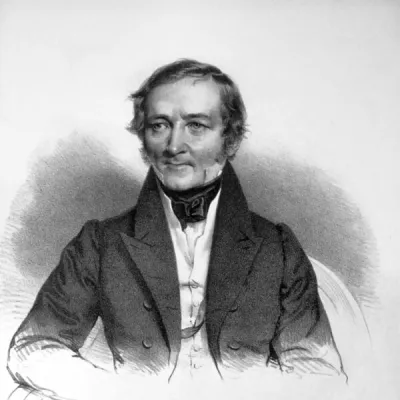
Karl Friedrich Burdach
Human Design Chart
Biography
He provided in 1822 the name, due to the arching shape of its longest fibres, of the arcuate fasciculus, the term amygdala, and in 1800 the name "Biology" in the modern sense of the term. He used the word biology and morphology as footnotes in his book Propädeutik zum Studium der gesammten Heilkunde.
He died in Königsberg on 16 July 1847 at age 71.
Karl Friedrich Burdach as a Manifesting Generator 5/2 in Human Design
Manifesting Generator 5/2 — Design at a Glance
Karl Friedrich Burdach revealed himself as someone who possessed a hybrid energy: the constant power of a Generator, paired with the lightning-fast implementation capability of a Manifestor. His design tended to quickly draw things into his life, often by skipping steps. This speed was a double-edged sword. If he rushed too much, important intermediate steps were missing, forcing him to backtrack and fill in gaps. Such setbacks caused frustration, as his non-self theme lay precisely in enforcing control through haste.
Furthermore, Karl Friedrich Burdach tended to pursue multiple projects simultaneously, driven by various impulses. Without the right inner alignment, his creative drive quickly turned into exhaustion. His strategy was not to initiate but to react to life. Only when his sacral center responded with a clear "yes" should he act. Regular checks to see if the work was still enjoyable were essential. With the correct application of this strategy, he found deep satisfaction. He thrived in a play mode where variety and parallel work were not a burden but a source of his energy. Then the demand to focus on only one thing was a hindrance rather than a help.
Emotional Authority
Karl Friedrich Burdach revealed himself as someone who never made decisions in the heat of the moment but consciously let them rest until the emotional wave had subsided. His inner authority was Emotional Authority, carried by the defined Emotional Center. In Human Design mechanics, once the Emotional Center is defined, it takes the role of inner authority – regardless of which other centers are also defined. This priority is a central mechanism that shaped his decision-making profile.
Burdach was subject to a natural emotional wave that showed in the constant ups and downs of his feelings. The world always appeared colored by his current mood; the same thing could be totally inspiring one moment and completely negative the next. His immediate feeling, however, was only a snapshot, a first impression that did not necessarily represent his truth. Quick, spontaneous decisions out of this emotional heat could have negative consequences.
Instead, Burdach used time to let decisions ripen. This process required patience and multiple nights of pondering important questions. By delaying and asking himself, he gained emotional distance. Over time, the intense feelings subsided, and clarity and calmness set in. Only when this ripening process was complete did he make a decision. This method was particularly crucial for long-term, life-defining steps, as it ensured that the choice was based on deeper, more comprehensive understanding rather than fleeting mood.
The 5/2 Profile — Heretic / Hermit
Karl Friedrich Burdach revealed himself as someone who carried a seeming contradiction within: the desire to help others and be admired, paired with the deep need to be left alone and spend time alone. His design as a 5/2 profile, the
Split Definition — Defined & Open Centers
Karl Friedrich Burdach was someone who possessed a reliable inner direction and articulated his truth with consistent clarity. His defined G Center gave him a firm sense of self-identity and the knowledge of where his life was leading him, without the need to control it. This inner security flowed directly into his defined Throat Center, which served as a pivot point for communication. Burdach did not speak out of impulsive drive but from a deep, trustworthy source, making his statements authentic and honest.
His energy source lay in his defined Sacral Center. As a Generator, he had an enormous vital force, which, however, could only be correctly activated through reaction to external stimuli. Burdach lived by the strategy of not initiating but waiting until life asked him, and then responding with full energy. This protected him from exhaustion and frustration that would have arisen if he had forced decisions based on mental planning.
Additionally, his defined Solar Plexus and Spleen Centers shaped his perception. He used the emotional wave as authority, waiting for emotional clarity before making decisions rather than acting impulsively. At the same time, he trusted the spontaneous intuition of his Spleen, which signaled to him in the here and now what was correct for his well-being. His defined Root Center provided the necessary pressure to move forward in the material world and master existential challenges.
In contrast, his open centers revealed areas of conditioning. His open Head and Ajna Centers made him vulnerable to mental confusion and the pressure to find answers to questions that were not his own. He tended to identify with foreign concepts or feel the pressure to intellectually prove what he knew. His open Heart Center led him to often feel compelled to prove his worth through promises or competitive behavior, although he did not consistently possess this energy. These pitfalls were evident when he did not trust his inner authority from Solar Plexus and Spleen but tried to gain security through willpower or mental rumination.
Channels for deep knowledge, change, leadership, intuition and emotion.
Karl Friedrich Burdach was characterized by a fundamental orientation that sought evolutionary change, yet was always coupled with the necessity of limitation and patience. This dynamic came from the Channel of Mutation 60-3, which connected the Root Center with the Sacral Center. Here, a pulsating energy linked melancholy with the potential for sudden, mutative leaps. Burdach had to learn to accept times of silence and inner tension without intellectualizing them to follow the natural rhythm of this energy.
In addition to this inner development, he possessed the ability for logical, collective leadership. The Channel of the Alpha Animal 7-31 connected the G Center with the Throat Center and gave him a voice based on tested patterns and future perspectives. His authority did not rest on coercion but on winning the trust of the community and showing the way from a position of influence, always dependent on the invitation of the majority.
In the exercise of his abilities, Burdach combined intuitive depth with technical perfection. The Channel of the Wavelength 16-48 connected the Spleen Center with the Throat Center and drove him to refine a skill into a talent through repeated practice. This development required recognition and resources to achieve mastery of a pattern and thus establish a unique wavelength.
Furthermore, he had the gift of clearly articulating intuitive insights in the present moment. The Channel of the Brainwave 20-57 also connected the Spleen Center with the Throat Center and enabled him to communicate existential truths spontaneously and directly. This gave him the ability to encourage others to activate their own inner survival intelligence by acting and speaking in the present.
Finally, his experience was marked by a restless search for new experiences. The Channel of Transience 35-36 connected the Solar Plexus Center with the Throat Center and drove him to go through emotional crises and changes to gain wisdom. This emotional wave prompted him to intensively experience life and pass on his experiences as advice to others, learning to accept the transience of every feeling.
Collective Circuitry — Circuit Signature
Karl Friedrich Burdach was characterized by his design as someone who lived between two separate energetic poles: a powerful root energy and a complex web of intellect, emotion, and intuition. This divided definition meant that these areas did not flow directly but rather worked as parallel, independent forces.
The Knowledge Circuit shaped him through the Channel of Mutation (3-60), which promoted deviation from the known, and the Channel of the Flash of Insight (20-57), which channeled creative impulses from the Spleen into the Throat zone. This connected his Throat with his Spleen Center and his Sacral with his Root Center into two isolated strands.
Parallel to this, the Understanding Circuit was at work. Here, the Channels of the Wavelength (16-48) and the Alpha Animal (31-7) directly connected his Throat Center to the Identity and Spleen Centers. This created a coherent flow for rational, future-oriented strategies that were free from emotional coloring.
A third aspect was the Meaning Circuit. Through the Channel of Transience (35-36), he connected his Throat Center with his Solar Plexus. This allowed him to reflect and express emotional waves and past experiences. While the Understanding Circuit relied on cool logic, this circuit served the emotional processing of the past. Karl Friedrich Burdach used these separate systems to develop both innovative, impulsive ideas and structured, rational concepts as well as emotional reflections – always as coexisting, not directly merging energies.
Left Angle Cross of Confrontation 1
Karl Friedrich Burdach's Human Design chart indicated a tendency towards direct, often confrontational communication. His chart featured the left cross of confrontation, a configuration that points to the necessity of putting things into the right light by clearly naming them and addressing contradictory viewpoints. It was characteristic of him not to beat around the bush but to formulate the truth in such a way that, although painful, it ultimately clarified. This mechanism described a life task aimed at resolving misunderstandings through clear words and unvarnished facts, leading to a deeper, more honest level of interaction. He was someone who took on the responsibility of speaking difficult truths, not out of malice, but from the need to create clarity. The energy of this cross acted as a catalyst for necessary confrontations, often the only way to break through stagnant situations and find a more authentic form of coexistence. Karl Friedrich Burdach lived this dynamic by not shying away from initiating or enduring conflicts as long as they served the goal of true insight. His way of naming things marked his interactions and often helped to sacrifice superficial harmony for genuine understanding. This was not arbitrary behavior, but a deeply rooted strategy in his energetic structure to move from confrontation to integration.
Saturn Return · Uranus Opposition · Chiron Return · 2nd Saturn Return — Life Cycles
Karl Friedrich Burdach's professional career was marked by clear, cyclical turning points that kept pace with his inner development. In 1807, at the age of 31, he became an extraordinary professor at the University of Leipzig. This marked his first Saturn Return, a phase where years of groundwork and discipline often condense into a solid, institutional result. The structure and weight of this appointment reflected the maturing responsibility that this astronomical cycle brings.
Six years later, in 1814, at the age of 38, he moved to the Albertus University in Königsberg. This step fell during the time of the Uranus Opposition, a phase often associated with necessary changes and a detachment from old structures. The place and position change was no mere coincidence, but aligned with the energetic demand for realignment and greater autonomy that this planetary position brings.
The peak of this development occurred in 1822, when Burdach, at the age of 46, introduced the terms 'arcuate fasciculus' and 'Amygdala'. This happened during his Chiron Return, a fulfillment cycle in which one's essence and inner purpose increasingly unfolds in the outer life. The introduction of these precise anatomical terms was an expression of this bloom: a moment when his specific knowledge and inner clarity found their final, enduring form in science.
Manifesting Generator · Emotional Authority — Synthesis
Karl Friedrich Burdach lived a life path shaped by a profound inner dynamism. His design as a Manifesting Generator (with defined Sacral Center) points to a person who both possesses the ability to quickly react to opportunities and set things in motion, as well as a constant source of life energy. However, this energy was modulated by emotional authority, meaning that decisions were not taken impulsively but required time to mature and gain clarity within the emotional wave. The Profile as Hero/Natural Talent underscored this tendency by combining the desire for recognition with the need for withdrawal and inner work.
A central paradox in Burdach's design lay in the tension between the drive to act quickly and transform (Channel of Mutation) and the necessity to filter these impulses through emotional authority. The fast, pulsating energy of the Knowledge Circuit, combined with the ability to accept limitations and create anew, seemed to intersect with the inner emotional landscape that required time for maturation and discernment. This led to a dance between initiation and reaction, between the desire to make an impact and the necessity to understand and integrate one's own feelings.
5 Defined Channels
Incarnation Cross - Left Angle Cross of Confrontation 1
Solar Return
The Solar Return shows the moment when the sun returns to its exact birth position - your personal solar year.
Life Cycles
Discover the life cycles with a detailed triple view (birth chart, cycle chart, composite).
Human Design Profile
- Strategy
- To respond - wait for something to respond to
- Authority
- Emotional Authority
- Profile
- 5/2 - Heretic / Hermit
- Definition
- Split Definition
- Incarnation Cross
- Left Angle Cross of Confrontation 1
- Date of Birth
- 12.06.1776 04:00
- Place of Birth
- Leipzig, Germany
Frequently Asked Questions
What was Karl Friedrich Burdach's Human Design type?
What profile did Karl Friedrich Burdach have?
What authority did Karl Friedrich Burdach have?
What incarnation cross did Karl Friedrich Burdach have?
When was Karl Friedrich Burdach born?
Discover your own Human Design
Are you also a Manifesting Generator? Find out in a personal reading how to unfold your multi-talents and direct your energy wisely.
More Personalities
Back to overviewAldair

Alizée

Angeli

Arletty

Artus

Balthus