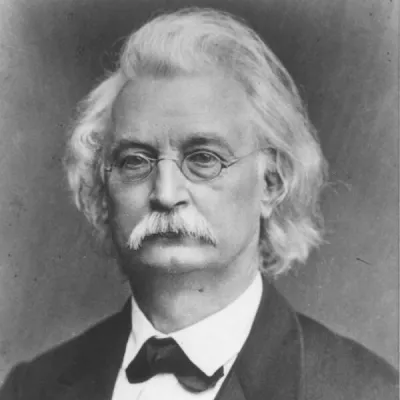
Karl Lepsius
Human Design Chart
Biography
He is widely known for his opus magnum Denkmäler aus Ägypten und Äthiopien (Monuments from Egypt and Ethiopia), one of the first scientific studies of the pyramids in Giza, Abusir, Saqqara, and Dahshur. His contributions to Egyptology as director of the German Archaeological Instititute and editor of the Zeitschrift für ägyptische Sprache und Altertumskunde have had a lasting impact on the field.
Karl Lepsius as a Projector 4/6 in Human Design
Projector 4/6 — Design at a Glance
Karl Lepsius appeared as someone who had a focusing aura and quickly identified weaknesses in other people's systems. His design tended to bring light into the dark for others, similar to a bright flashlight directed precisely on problematic areas. However, this ability to immediately identify errors could be misunderstood if addressed directly and abruptly; his counterpart often felt it unpleasant or accusatory, as though being blinded by the light.
The most effective strategy for Karl Lepsius was to wait for a respectful and sincerely meant invitation from others. Instead of actively seeking recognition or offering observations unsolicited, he shone best through his own harmonious glow. When he set an example of successful interactions himself, people were naturally drawn to him and sought his advice.
Since Karl Lepsius as a projector did not have a defined Sacral Center, he lacked a constant source of intrinsic life energy. Instead, he experienced phases of high activity followed by necessary rest periods for regeneration. Ignoring this rhythm led to losing energy and burning out. Living according to this design and waiting for the invitation rewarded him with success; resisting this strategy eventually brought his non-self theme of bitterness to the surface.
Splenic Authority
Karl Lepsius was guided by a fine, spontaneous inner voice that directed him in each moment what was right. His inner authority lay in the defined Spleen Center, which required his Emotional and Sacral Centers to remain open – a configuration only Projectors or Manifestors can carry. The Spleen functioned as his health and alarm system, equipped with pronounced survival intelligence. This intuition signaled him immediately whether environment, situation, or society was suitable for him or not. His physical well-being served as a reliable indicator.
Karl Lepsius therefore made decisions in the here and now; the first impulse was always the correct path since it directly served his health. This allowed him to rigorously distance himself from harmful influences and take good care of himself. However, this Spleen impulse was very subtle and only appeared once at a moment, posing the risk of being drowned out by external influences. Therefore, he required high vigilance; occasionally, a short retreat helped to clearly hear these fine signals.
Since knowledge about what is right was always only available in the current moment, his plans were often subject to short-term changes. Long-term commitments were difficult and often counterproductive for his design. Instead, he preferred spontaneity and held himself as little as possible. Much space and flexibility in his life were not a preference but a necessity of his energetic structure to allow the Spleen Center's intuition to work unrestricted.
The 4/6 Profile — Opportunist / Role Model
Karl Lepsius showed throughout his life that he oscillated between the urge for community and the need for detached reflection. In his first thirty years, he appeared experimental, especially in friendships, driven by an unpredictable fixation on favorable opportunities. He accepted his behavior as it was and waited patiently until external circumstances changed for a transformation.
After his first Saturn Return, this conflict deepened: His heart wanted belonging, while his head sought an overview. Karl Lepsius learned through experience to say no and only commit to obligations that aligned with his integrity. He developed a clear view of the nature of the people around him, enabling him to successfully project their future.
In his later years, he fulfilled the role of a wise example. His wisdom did not come from theoretical knowledge but from practical application in everyday life and protecting his large heart from false bonds. By teaching through his own insights, he smoothed the way for others as an instructor who offered orientation. His life was marked by the balance between cooperation and inner distance, always careful not to open too early or to the wrong people.
Split Definition — Defined & Open Centers
Karl Lepsius showed himself to be someone with a constant, trustworthy mental function. His defined Ajna Center ensured that he always created concepts and theories in the same way; his mind was always active and served as an external authority for others. This mental stability was combined with a defined G Center, which gave him a firm sense of self-identity and a clear sense of direction. He knew where he belonged without being dependent on others.
His willpower was marked by a defined Heart Center: He controlled his resources himself, kept promises, and used his energy purposefully to be successful. This was supported by the defined Spleen Center, which gave him spontaneous intuition for health and well-being. He acted in the "now" based on existential warning signals that he could not rationalize but simply trusted. The constant inner pressure of his defined Root Center drove him forward to material survival and corrections.
At the same time, Karl Lepsius was exposed to certain vulnerabilities. His open Head Center had no consistent way to process inspiration; he tended to identify with other people's questions or get mentally confused if he did not listen to his internal authority. The open Sacral Center made him vulnerable to conditioning: He absorbed the energy of his environment and risked exhaustion because he lacked a constant personal energy flow. Additionally, his open Solar Plexus absorbed emotions from the environment, which could lead him to understand foreign moods as his own or avoid conflicts to maintain stability.
Channels for clarity, logic, structure and devotion.
Karl Lepsius revealed himself as someone who radiated a quiet authority through his mere presence. The Awakening Channel 10-20 connected his inner essence with his voice and urged him to be awake in every moment. This was not intellectual contemplation, but rather a deep "I am" that served as the foundation of self-love and self-confidence for his survival. By simply being himself, he unconsciously inspired others to live their own truth without needing to lead them actively.
In addition to this inner clarity, Karl Lepsius possessed a sharp analytical tool. The Judgment Channel 58-18 drove him to constantly question and correct patterns. His instinct sought out what was out of balance in order to ensure the efficiency and health of the community. However, he exercised this critical sense most effectively when asked; unsolicited, his logic would be perceived as intrusive. His goal was always to restore harmony through precise adjustments.
Moreover, his mind worked according to the principle of Definition 23-43. Here, he received spontaneous insights that he then translated into clear and understandable concepts. The challenge lay in not controlling when these ideas came but rather patiently formulating them until the timing was right and others were ready to accept his innovative perspectives. Without the proper invitation, he often felt misunderstood.
Emotionally and instinctively, Karl Lepsius was marked by the Channel of Devotion 26-44. He had a fine sense for what others needed before they knew it themselves. This ability allowed him to persuasively communicate solutions or products. He saw himself as an entrepreneur of his own life path, generating resources and seeking recognition in exchange. His success depended on whether his tribe recognized his gifts and invited him to spread his message.
Additionally, Gates like 15 (Collective Rhythm), 46 (Devotion to the Process), and 25 (Spiritual Innocence) were present in his design, further deepening his ability to adapt and express himself authentically.
Individual Circuitry — Circuit Signature
Karl Lepsius showed himself as someone who structured new ideas into words and set great store by logical clarity and practical resource distribution. His design featured a Split Definition: two energetically separate systems worked parallel to each other without directly flowing into one another.
The first system connected the Ajna with the Throat Center (Knowledge Circuit). Here it was about bringing inner visions through the Channel "Structuring" into clear, audible form – pulsating energy of the present moment that fostered creativity and individual expressive strength.
The second system included Spleen, Root, and Heart Centers (Understanding and Ego Circuits). Through the Channel "Judgment," it connected Spleen and Root: focused, visual energy of the future that developed logical strategies free from emotion. Parallel to this, the Channel "Devotion" linked Heart and Spleen in the Ego Circuit. This promoted cooperation and the joint creation of material resources through mutual support – conservative and tradition-oriented, without direct life force from the Sacral Center, which is why rest periods were necessary.
A third aspect lay in the Integration Channel "Awakening" between Throat and Identity Centers. It channeled intuitive power (Gate 10) into immediate presence (Gate 20), to secure self-confirmation through right action.
These separate blocks – on one hand creative structuring, on the other strategic resource work – shaped Karl Lepsius’ life path as parallel forces: expression and organization existed side by side, not as a continuous flow.
Right Angle Cross of the Vessel of Love 4
Karl Lepsius demonstrated a fundamental disposition marked by the right cross of the Love Vessel. This configuration described a life task to uncover hidden connections and pass them on to others. His design architecture suggested that he sought not only truth but also wanted to convey these insights in such a way that others could truly receive them. It was an impulse to make the invisible visible and shape it into something tangible for his environment. This dynamic acted as a constant drive to carry inner truths outward, not out of a need to attract attention, but from the necessity to create clarity. The mechanics of this cross linked the search with sharing; it made it impossible to keep insights to himself. Karl Lepsius lived this tension between finding and giving, where sharing itself was part of the process of gaining knowledge. His way of moving through the world followed this rhythm: discovering something, understanding it, and then passing it on in a way that resonates with the recipient. This shaped his interactions and creative work significantly.
Saturn Return · Uranus Opposition · Chiron Return · 2nd Saturn Return — Life Cycles
Karl Lepsius appeared as someone whose professional authority and public recognition were closely tied to structural milestones. His design suggested a tendency towards systematic condensation of knowledge, manifesting in clear career phases – not as spontaneous impulses but as the result of long-term alignment.
In 1836, at age 26, he published 'Two Comparative Linguistic Essays'. This marked his first Saturn Return: a phase where years of groundwork condensed into a solid, public achievement. The structure of his design promoted the ability to transform complex linguistic connections into recognized publications.
Ten years later, in 1850 (age 40), came the Uranus Opposition. In this year, he became an ordinary member of the Royal Prussian Academy of Sciences in Berlin. This cycle represents breaking old boundaries and establishing a new, broader platform – exactly what his admission to this prestigious institution reflected.
At age 51 (1861) he entered the Chiron Return, a fulfillment cycle of bloom. Here he published 'On Arabic Phonetics...'. If he had lived according to his strategy, his incarnation purpose now unfolded increasingly: His work was not only professionally relevant but also meaningful and enduringly effective.
The second Saturn Return (1866, age 56) crowned this development with the appearance of 'The Bilingual Decree of Canopus...'. This was the final consolidation of his life's work in a monumental form – a sign that his inner structure had now fully emerged and stood as lasting legacy.
Projector · Splenic Authority — Synthesis
Karl Lepsius was a projector whose life seemed marked by a profound drive to recognize and illuminate the potential of others (Projector Type, Awakening Channel). The defined Mental Center indicates a persistent ability to develop concepts and make them accessible to others – an inner drive that showed in repeated publications. His profile as a networker/role model underscored this aspect further; he seemed destined to connect people and disseminate knowledge, especially after a phase of intense personal experience (Line 4/6).
Simultaneously, an internal tension revealed itself between the desire for belonging and the necessity to follow an individual path (Profile 4/6, Knowledge Circuit). The Spleen Authority pointed to a fine sense of one's own well-being, yet the constant analysis through the defined Ajna Center might have risked losing oneself in concepts and overthinking the spontaneous impulse of authority. This dynamic was evident in the interplay between professional successes (Saturn Returns, Uranus Opposition) and continuous striving for new knowledge (Chiron Return).
4 Defined Channels
Incarnation Cross - Right Angle Cross of the Vessel of Love 4
Solar Return
The Solar Return shows the moment when the sun returns to its exact birth position - your personal solar year.
Life Cycles
Discover the life cycles with a detailed triple view (birth chart, cycle chart, composite).
Human Design Profile
- Type
- Projector
- Strategy
- Wait for the respectful invitation
- Authority
- Splenic Authority
- Profile
- 4/6 - Opportunist / Role Model
- Definition
- Split Definition
- Incarnation Cross
- Right Angle Cross of the Vessel of Love 4
- Date of Birth
- 23.12.1810 21:00
- Place of Birth
- Naumburg, Germany
Frequently Asked Questions
What was Karl Lepsius' Human Design type?
What Profile did Karl Lepsius have?
What Authority did Karl Lepsius have?
Which incarnation cross was active for Karl Lepsius?
When was Karl Lepsius born?
Discover your own Human Design
Are you also a Projector? Find out in a personal reading how to unfold your leadership qualities and recognize the right invitations.
More Personalities
Back to overviewSissy Spacek

Alain-Fournier

Anémone

Ann-Margret

Bourvil
Hergé