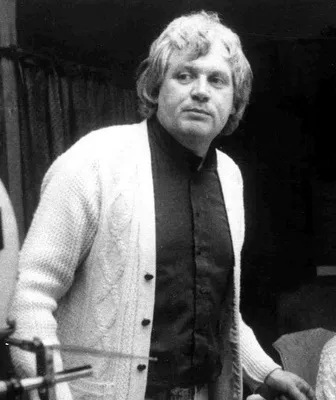
Ken Russell
Human Design Chart
Biography
Russell made four marriages, the last in 2001 to actress Lisi Tribble. He was father to seven children, five with his first wife, two with his second and one with his third.
He died at his home in Lymington, England on November 27, 2011. He was 84.
Ken Russell — Manifesting Generator with Profile 1/3
Manifesting Generator 1/3 — Design at a Glance
Ken Russell revealed himself as someone who quickly brought things into his life. As an Manifestor Generator, he had constant sacral energy that gave him immense creative power. His design allowed him to skip steps when acting and thus develop a speed that pure generators did not possess. This ability significantly shaped his work style: He tended to take on several projects simultaneously because he responded to many different impulses.
The challenge lay in balancing this speed. Often, he skipped important intermediate steps, which led him to return later and make up for these gaps. This could cause frustration, especially when inner authority did not keep pace with the tempo. Yet once he reacted to life rather than initiating it himself – and his sacral center gave a clear “yes” – he found deep satisfaction. In this state, parallel work was no obstacle but a source of joy. He fell into a play mode where variety fed his energy. The instruction to focus on one thing at a time stood against his nature; rather, he thrived in diversity as long as inner approval existed and he did not work against the natural flow of his impulses.
Emotional Authority
Ken Russell's design tended towards emotional turbulence that profoundly shaped his perception and decision-making. He was someone whose inner authority lay in the defined Solar Plexus Center – the emotional authority. A central mechanism of this design was the absolute priority of this center: Whenever the Emotional Center is activated, it takes precedence over all other defined areas regardless of further configurations in the graph.
This meant for Ken Russell that he lived under a permanent emotional wave shown through constant ups and downs of his feelings. His view on the world was always colored by his current mood; at one moment totally excited about something, the next negative about it. Yet his immediate feeling was only a snapshot, an initial impression not necessarily representing his truth yet. Quick, spontaneous decisions based on such emotion could therefore have negative consequences.
The mechanics of his inner authority required patience and conscious hesitation in important life decisions. The more time Ken Russell took to let a decision mature – ideally through multiple nights of sleep – the deeper and broader he could see. Over time, intense feelings subsided, emotional distance gained strength, clarity and calmness set in. Only then was the process complete and a well-founded choice possible.
The 1/3 Profile — Investigator / Martyr
Ken Russell showed himself as someone who not only collected knowledge theoretically but also tested it through hard practice. His design as an Investigator and Experimentor (Profile 1/3) suggested that he understood life as a process of study and trial. The Line 1 in him demanded security through thorough analysis; he sought the right consciousness to master obstacles and sort out negative influences. Yet this theoretical depth could sometimes slow him down, as fear often prevailed before acting without enough knowledge.
At the same time, Line 3 drove him: experimenting through trial and error. Here, he learned firsthand, often through confrontation with superior forces or experiences of powerlessness when external powers intervened. These experiences forced him to avoid dependencies and walk his own path. What he judged as good had been previously examined both intellectually and practically on a deep level. His insights were thus self-earned and tested. One could trust his judgment because it emerged from the synthesis of profound study and painful but instructive experimentation. He lived the balance between the need for mental security and the necessary risk of trying things out.
Split Definition — Defined & Open Centers
Ken Russell's design shows a tendency towards constant mental pressure and a strong, independent will. The connection between the Head Center and Ajna Center created an ongoing internal drive to question and form concepts. This mental process was not only private but also outwardly influential: His aura pressured others to think along with him as he served as a source of inspiration. At the same time, his defined Heart Center gave him clear willpower and the desire to determine his life himself and control resources. This combination of intellectual ambition and ego strength shaped how he approached the world – often expecting others to follow his lead.
His open Spleen Center revealed a fundamental vulnerability: fear of survival and a lack of spontaneous intuition for what was truly healthy. Instead of trusting inner security, he tended to cling to people or situations that gave him a false sense of well-being, even if they were harmful. He could act impulsively to escape this insecurity, often leading to decisions that were not sustainable in the long term.
The defined Throat Center allowed him to express his thoughts and emotions – guided by the also defined Solar Plexus Center with its emotional wave – but without waiting for emotional clarity, he risked communicating or acting impulsively. His design challenged him to endure mental pressure and refrain from premature action until the right energy was available to make his visions effective.
Channels for curious search, logic, self-expression, emotion, will & maturation.
Ken Russell's design is characterized by a sharp, skeptical intelligence paired with the drive to defend personal convictions against opposition. The Logic Channel 63-4 connects Head Center and Ajna Center; it constantly filters patterns for consistency. Doubt here was not an obstacle but a prerequisite for logical validity: Only what proved practical was considered true. This created a mind that rejected unfounded beliefs and accepted answers only if they were verifiable.
At the same time, the Money Line Channel 21-45 pushed him to gain material control. The connection between Heart Center and Throat Center created an inner conflict between the will for leadership (Gate 21) and the need for authority and resources (Gate 45). Ken Russell sought independence to determine his own rhythm; delegating was difficult as he needed control to avoid ego-center stress. Success depended on casting this tension into a structure that both served and led.
His expression was marked by the Openness Channel 22-12 between Solar Plexus Center and Throat Center. Here, the emotional wave determined the timing of social interaction. When he felt like it, his voice could deeply touch or provoke others; at the wrong moment, he appeared harsh. This emotional depth served not just for communication but for a mutative effect on the environment.
In the background, other energies were at work: The Research Channel 34-10 promoted self-love and authentic behavior as a reaction to the environment. The Curiosity Channel 11-56 transformed abstract ideas into captivating stories less for fact transmission than to stimulate imagination. The Maturity Channel 42-53 required going through cycles completely; premature endings led to repetitions, while completed experiences generated wisdom for others. Additional gates like 38 (Setting Boundaries) and 48 (Pattern Recognition) underscored his ability to manage resistance and analyze deep connections without necessarily implementing them.
Collective Circuitry — Circuit Signature
Ken Russell's design sets a tendency towards pulsating, acoustic creativity. The Knowledge Circuit connects his Throat Center with the Solar Plexus Center (Channel 12-22), translating emotional waves directly into expression. This connection fostered an authentic voice based on inner feeling.
Parallel existed the Centering Circuit as separate power. It connected Identity Center with Sacral Center (Channel 10-34). This gave him internal strength and strong convictions about his essence, without necessarily communicating them outwardly. The energy was individualistic and focused on self-affirmation.
A third independent block formed the Understanding Circuit. Here Channel 63-4 connected Head Center with Ajna Center. This allowed focused, logical strategies for improving future states, free from emotional distortion.
The Purpose Circuit showed as two separate parts: The Ajna and Throat Centers (Channel 11-56) processed past experiences through curiosity, while Sacral and Root Centers (Channel 42-53) steered a cyclical maturation of life energy. Both parts served to learn from the past.
Finally, the Ego Circuit connected Throat Center with Heart Center (Channel 45-21). This supported the accumulation of material resources through clear communication and mutual support but required pauses for regeneration. Overall, these separate parallel streams shaped his work as a complex web of individual identity, logical planning, and emotional expressiveness.
Right Angle Cross of Tension 2
Ken Russell's design carried the signature of the right cross of tension. This configuration shaped a fundamental stance where internal contradictions and external demands were not seen as disruptive factors but rather as necessary driving forces. The right cross of tension is characterized by a specific dynamic: it arises where the center of emotions is connected to the ego center, while simultaneously an external pressure – often from others or circumstances – influences this connection.
For Ken Russell, this meant that his identity and emotional rhythm were in constant interplay. He did not simply react passively to events but actively sought situations that created this tension. Only through this friction point could he gain clarity. Without external resistance or internal doubts, his energy often remained unused; it was only the conflict that made his true potential visible.
This mechanism explains why peace and harmony were less motivating for him than challenges. His design challenged him to immerse himself in the tension to draw strength from it. It was not a state of suffering but a functional necessity: by enduring and navigating these opposites, he found his direction. The tension thus served as a compass showing where his focus belonged rather than paralyzing him.
Saturn Return · Uranus Opposition · Chiron Return · 2nd Saturn Return — Life Cycles
Ken Russell's design set a tendency towards sudden, disruptive breakthroughs that challenged established structures. This dynamic was marked by the Uranus influence, often associated with unexpected turns and breaking conventions. At the age of 42 in 1969, this force became evident: Ken Russell celebrated his breakthrough as a feature film director with “Women in Love”. This success did not mark a gradual ascent but a sudden moment of visibility typical for the Uranus energy that breaks status quo and brings new realities to light. The configuration described a life task to break existing norms and establish innovative forms of expression. Instead of gradually fitting into systems, his chart showed a tendency to attract attention through radical redefinitions. The success experienced in 1969 was thus not an accidental biographical fact but the concrete effect of this mechanical driving force aimed at change and liberation from old thought patterns.
Manifesting Generator · Emotional Authority — Synthesis
Ken Russell lived a life marked by an unceasing drive for knowledge and experimentation. The combination of sacral energy (Manifesting Generator) and defined Head Center created a motor for constant questioning and pattern-seeking (Channel 63/4). This pattern manifested in the ability to quickly develop ideas and put them into practice – a process that was always accompanied by the profile of the researcher/experimenter's need for thorough testing. Emotional authority required time to let decisions mature, while the energy of the Manifesting Generator tended towards immediate action; he thus constantly moved between waiting and experimenting.
A central paradox lay in the tension between the desire for innovation (Knowledge Circuit) and the necessity to filter decisions emotionally. The defined Head Center created a constant mental pressure to develop new ideas, while emotional waves required careful consideration. This led to a dynamic interaction between impulsive creativity and the need for inner confirmation, which was evident in his documented success – a breakthrough emerged from the combination of experimental joy and thorough preparation.
6 Defined Channels
Incarnation Cross - Right Angle Cross of Tension 2
Solar Return
The Solar Return shows the moment when the sun returns to its exact birth position - your personal solar year.
Life Cycles
Discover the life cycles with a detailed triple view (birth chart, cycle chart, composite).
Human Design Profile
- Strategy
- To respond - wait for something to respond to
- Authority
- Emotional Authority
- Profile
- 1/3 - Investigator / Martyr
- Definition
- Split Definition
- Incarnation Cross
- Right Angle Cross of Tension 2
- Date of Birth
- 03.07.1927 00:05
- Place of Birth
- Southampton, UK
Frequently Asked Questions
What was Ken Russell's Human Design type?
Which profile did Ken Russell have in Human Design?
What authority did Ken Russell have in his design?
What incarnation cross was Ken Russell's design based on?
When was Ken Russell born?
Discover your own Human Design
Are you also a Manifesting Generator? Find out in a personal reading how to unfold your multi-talents and direct your energy wisely.
More Personalities
Back to overviewAldair

Alizée

Angeli

Arletty

Artus

Balthus