
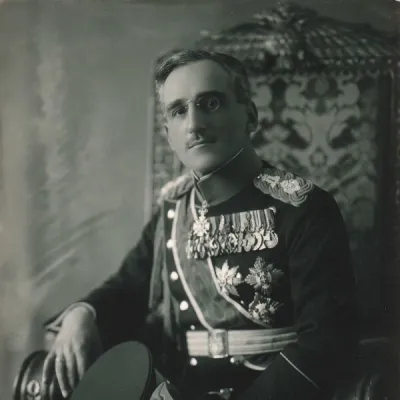
King of Yugoslavia Alexander I
Human Design Chart
Biography
He was assassinated by Croatian separatists while on a diplomatic visit to Marseille, France on 9 October 1934.
King of Yugoslavia Alexander I — Manifesting Generator with Profile 5/1
Manifesting Generator 5/1 — Design at a Glance
King of Yugoslavia Alexander I had a hybrid energy structure: the constant power of a Generator paired with the ability to skip steps and quickly produce results. This configuration as an Manifestor Generator suggested that he did not just react to impulses but could immediately turn these reactions into swift action.
The challenge in this nature lay in speed. Without considering strategy – waiting and reacting to life rather than initiating it – there was a risk of missing important stages or starting too many projects at once, leading quickly to frustration, the central non-self theme for this type. However, when the inner 'yes' impulse from the Sacral Center emerged, this quickness transformed into deep satisfaction and creative power.
For King of Yugoslavia Alexander I, this meant that parallel work did not have to be a burden but could be experienced as an enriching 'play mode', provided he regularly checked whether his inner authority still supported the current path. The mechanics show: Only through constant querying of sacral resonance was this hybrid energy productive rather than scattered. Thus, from the combination of endurance and speed came a state in which variety did not act as distraction but as a source for sustained satisfaction.
Sacral Authority
King of Yugoslavia Alexander I showed decision-making based on waiting for internal, physical signals. His design suggested that he did not act through planned strategy or intellectual analysis but waited to be spoken to from the outside. Only then could his inner authority respond. This sacral authority, unique to the Generator type, simplified his process: Strategy and authority merged here.
The reaction showed as a physical signal – a grunt, hum, or a palpable surge of energy in the abdominal area. When this impulse occurred, it followed with a state of high vitality and inexhaustible energy. King of Yugoslavia Alexander I was inclined to work with great enthusiasm and dissolve into activities without them needing an external purpose. The joy in doing itself took precedence.
Additionally, an activated Spleen acted as a supportive instance. It allowed for quick, spontaneous reactions and provided direct access to instinctive perception. King of Yugoslavia Alexander I could reliably orient himself by this physical well-being. The combination of the Generator's wait strategy and the Spleen's fast intuition created a system that set on immediate, life-affirming responses as soon as the outside world offered a stimulus.
The 5/1 Profile — Heretic / Investigator
King of Yugoslavia Alexander I showed a fundamental stance swinging between private knowledge accumulation and public problem-solving. His design suggested a tendency to collect deeply hidden experiences to later provide them as resources for others. This dynamic results from Profile 5/1: Line 1 stands for dedication in secrecy and learning through direct experience without regard for expectations. King of Yugoslavia Alexander I used this phase to develop his potential, often away from public attention.
Simultaneously, Line 5 with its magnetic projection brought hope and love for humanity, especially during crises. Others sought solutions from him as they sensed his inner treasures. This created a tension: While he researched privately (Line 1), he was perceived externally as a hero or philanthropist (Line 5). The challenge lay in protecting these resources. Without clear boundaries, there was the risk of overexertion by others seeking answers. King of Yugoslavia Alexander I had to learn to say no to maintain balance between his private research and service to the community. Only so could he effectively apply his ideas without exhausting himself. His strength showed in developing philosophical and humanitarian concepts valuable for the general public while simultaneously undergoing his own experience.
Single Definition — Defined & Open Centers
King of Yugoslavia Alexander I revealed a design that combined persistent mental conceptualization with immense reactive vitality. His defined Ajna Center ensured an independent and not easily influenced mental authority; he always thought and served as a conceptual instance for others. These thoughts, along with intuitive impulses from his defined Spleen Center – which provided spontaneous knowledge for health and survival in the "now" – were reliably translated into communication and action through his defined Throat. His expression was dependable but limited to these connected sources.
The driving force came from his defined Sacral Center, a constant energy source that was only correctly available through reaction. Initiation here led to exhaustion; patience and waiting for requests were essential to avoid frustration. The combination of constant thinking (Ajna) and reactive energy (Sacral) meant: He always had energy, but it was only available when reacting appropriately.
At the same time, he was situationally vulnerable due to open centers. His open G Center led to identity and direction not being set but reflected by the environment; at the wrong place, he felt lost. Additionally, his open Solar Plexus absorbed emotional waves from the surroundings, while his open Heart Center made him susceptible to promises he could not keep. His open Head Center was subject to mental pressure and doubts of others, and his open Root Center took in adrenalized stress from the environment. These opennesses made him sensitive to external influences that could cloud his inner clarity if he did not adhere to his reactive strategy.
Channels for curiosity, logic, charisma, intuition and power.
King of Yugoslavia Alexander I showed himself as someone who translated complex inner processes into outer expression and action. His communication united abstract storytelling with logical precision. The Channel of Curiosity 19-56 connected the Ajna Center to the Throat Center through Gate of Ideas (11) and Gate of Inspiration (56). This made him a storyteller, less interested in bare facts than in the illustrative power of his narratives. He used this curiosity to entertain or teach others by filling gaps in information and presenting them as life parables.
Parallel to this, Channel of Acceptance 18-62 also lay between Ajna and Throat. Through Gate of Opinions (17) and Gate of Details (62), he mentally organized information into a coherent system. This created an inner pressure to express his detailed opinions once he understood something. Thus, he could both tell philosophical stories and provide logically detailed explanations, making him an effective teacher or organizer of information.
The manifesting power of his design came from the Channel of Charisma 6-20. This channel connected the Sacral Center (Gate of Power 34) to the Throat Center (Gate of Now 20). His energy required a sacral reaction to external stimuli in order to act in the now. If this generative power was not blocked by mental "shoulds," it resulted in a charismatic presence and the ability to maintain activity over longer periods.
Additionally, Gate 20 shared with Channel of Flash of Insight 3-20, which connected the Spleen Center (Gate of Intuitive Understanding 57) to the Throat. This added an intuitive component to his charismatic aura: the ability to communicate immediate existential knowledge in the moment. His spontaneous truth served to reinforce his own well-being and allowed him to directly articulate penetrating self-knowledge into words. This combination of curiosity, logic, charisma, and intuition shaped his unique way of exchanging with and impacting his environment.
Individual Circuitry — Circuit Signature
King of Yugoslavia Alexander I demonstrated himself as someone who implemented new insights through logical strategy into practice. His design combined innovative flashes of inspiration with rational future planning and intuitive reaction in the present moment. The Knowledge Circuit (Channel 20-57) connected his Throat Center and Spleen, enabling the expression of creative ideas. Parallel to this, the Understanding Circuit (Channel 17-62) and the Meaning Circuit (Channel 11-56), both connecting Ajna and Throat Centers, were active. This created a focus on sharing logical insights as well as reflecting on past experiences for collective learning. The Integration (Channels 20-34, 34-57) linked Throat, Sacral, and Spleen Centers into one unit. It ensured that power from the reaction to life (Gate 34) was directed through intuitive knowledge (Gate 57) and became effective in the present moment (Gate 20). As King of Yugoslavia Alexander I had a Simple Definition, these energies flowed directly together: Ajna, Throat Center, Sacral, and Spleen formed one coherent stream. This shaped his ability to translate innovative impulses through rational structuring and emotional resonance into concrete actions that secured survival in the present moment.
Left Angle Cross of Education 2
King of Yugoslavia Alexander I was marked by the design of the 'left educational cross 2'. This configuration established a structural orientation towards education, the dissemination of knowledge, and moral imprinting. It represented a deeper energetic tendency that placed questions of development and guidance at its core.
The left educational cross archetypally describes a role within learning or teaching thought structures. Without specific gates or channels in the raw content, the concrete expression remains undetermined; it is a general thematic framework. The focus was on taking responsibility for others and conveying values, indicating that the development of knowledge dissemination structures was a central theme. The mechanics point to an inner orientation where the individual acts as a carrier or mediator of educational principles. It is less about individual achievement than systematic embedding in processes of education and moral leadership. This energy worked as a background structure shaping actions and decisions within the context of teaching and responsibility.
Saturn Return · Uranus Opposition · Chiron Return · 2nd Saturn Return — Life Cycles
King of Yugoslavia Alexander I faced the end of his life at the age of 46 in 1934, with his assassination by Croatian separatists in Marseille marking the conclusion of his incarnation. In Human Design, this period falls into the Chiron Return Cycle phase, typically beginning between the ages of 49 and 51 and understood as a time of full realization of one's purpose. Here, the design shows its maturity: the deepest inner patterns and individual mission are no longer just theoretical but become tangible reality. For King of Yugoslavia Alexander I, this means that his life up to this point represented a continuous approach towards this central life task. The cycle is not a place of healing in the traditional sense, but rather a stage of fulfillment and integration. What was planted over previous decades reaches its highest density and clarity here. Confrontation with destiny is part of this process of complete penetration of one's essence. It is about how the individual lives their unique signature until the last breath. In this context, death is not seen as an interruption but as a logical conclusion to a developmental line where all previous experiences and decisions find their meaning. The design thus describes a movement towards ultimate authenticity that takes its sharpest form in the final years of life.
Manifesting Generator · Sacral Authority — Synthesis
The central red thread in this design is the dynamic connection between inner perception and outer expression. A defined Sacral Center provides a constant energy source, which can be directly channeled through an active Throat Center – a blend of Generator and Manifestor qualities. This combination is reinforced by the open Ajna Center, which takes in and processes information to then communicate it via the Throat. The numerous connections to the Throat Center indicate that voice and expression play a central role, yet always as a reaction to inner impulses rather than an initiation of actions. Open Root and Solar Plexus Centers enhance the ability to perceive and process environmental energies, leading to an intense connection with the environment but also a constant need for boundary setting and preserving one's truth.
The central paradox lies in the tension between the desire for speed and the necessity to respond to sacral impulses. The design points to someone who can quickly tackle things but is simultaneously called upon by sacral authority to wait and respond to life. This discrepancy creates a field of tension between the desire for manifestation and the need to align with one's own inner rhythm. The open definition of many centers implies high adaptability, but also the challenge of maintaining one's identity amidst external influences.
5 Defined Channels
Incarnation Cross - Left Angle Cross of Education 2
Solar Return
The Solar Return shows the moment when the sun returns to its exact birth position - your personal solar year.
Life Cycles
Discover the life cycles with a detailed triple view (birth chart, cycle chart, composite).
Human Design Profile
- Strategy
- To respond - wait for something to respond to
- Authority
- Sacral Authority
- Profile
- 5/1 - Heretic / Investigator
- Definition
- Single Definition
- Incarnation Cross
- Left Angle Cross of Education 2
- Date of Birth
- 17.12.1888 23:55
- Place of Birth
- Cetinje, Montenegro
Frequently Asked Questions
What is the Human Design type of King Alexander I. of Yugoslavia?
What Profile does King Alexander I. of Yugoslavia have?
Which Authority determines the decision-making of King Alexander I.?
Which incarnation cross is active for King Alexander I?
When was King of Yugoslavia Alexander I born?
Discover your own Human Design
Are you also a Manifesting Generator? Find out in a personal reading how to unfold your multi-talents and direct your energy wisely.
More Personalities
Back to overviewAldair

Alizée

Angeli

Arletty

Artus

Balthus
