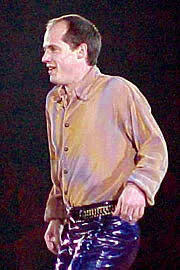
Photo: Wikimedia Commons
Kurt Browning
Human Design Chart
Biography
Browning was inducted into Canada's Sports Hall of Fame in 1994 and Canada's Figure Skating Hall of Fame in 2000. He was honoured with a star on Canada's Walk of Fame in 2001. In 2006 he appeared on the Fox television program "Skating with Celebrities". He began co-hosting "Battle of the Blades" in 2009.
Kurt Browning as a Manifestor 5/1 in Human Design
Manifestor 5/1 — Design at a Glance
Kurt Browning presented himself as someone with a clear vision who actively set the environment in motion. His design as a Manifestor marked him as a trailblazer and leader, oriented towards paving new paths and guiding others. Similar to an Emperor who expands his realm through delegation, Kurt Browning used his inner strength to initiate projects without having to lead every battle himself.
This configuration, however, brings a specific dynamic: Manifestors often think ahead of their environment, inevitably polarizing others. Kurt Browning was loved and followed by some due to his big dreams, but misunderstood or even rejected by others. This pain point of not being understood is an integral part of his mechanics.
To minimize this friction and find the right followership, the strategy of informing was crucial. By clearly communicating his intentions and visions before acting, Kurt Browning could prevent resistance. Living by this strategy and his inner authority, he is rewarded with a deep sense of inner peace. Deviating from it, however, results in a persistent, deep anger. His design thus shows that clarity in communication is the key to his inner alignment and outer effectiveness.
Emotional Authority
Kurt Browning showed himself as someone who did not make decisions in the first impulse but consciously took time to let his emotional wave subside. His design laid a tendency to always see the world through the lens of the current mood – sometimes excited, sometimes negative – without immediately accepting this snapshot as absolute truth.
This attitude stems from his emotional authority. With his emotional center defined, it functions as an inner authority, independent of other defined centers in the chart. This mechanism means that Kurt Browning was under a permanent emotional wave that could temporarily skew his judgment. Quick, spontaneous reactions to these feelings would often prove misleading, as the first impression did not yet represent the deeper clarity.
Therefore, his design strategy required patience and the conscious 'sleeping on' of important choices. By hesitating and questioning decisions multiple times, he gained the necessary emotional distance. Only when the intense feelings subsided did true calmness and insight set in. This process was especially crucial for long-term life decisions, ensuring that Kurt Browning did not act out of a temporary emotional coloring but from a mature, clear inner truth.
The 5/1 Profile — Heretic / Investigator
Kurt Browning showed himself as someone who gathered deep, specialized knowledge to provide solutions to concrete problems for others. His design as a 5/1 profile combined the magnetic pull of Line 5, which attracts others, with the necessary depth and research of Line 1. This configuration created a dynamic tension: while he unconsciously drew questions and expectations from the outside through his expertise, he simultaneously needed withdrawal to maintain and deepen his own knowledge base.
Line 5 brings a pragmatic approach that enables practical solutions in crisis times through quick adaptation. At the same time, it teaches that social interactions are often shaped by projections of others, requiring clear boundaries. Without these limits, exhaustion threatened, as there was a natural inclination to respond to the constant demands of the environment. Line 1, on the other hand, demanded challenges to center himself and unleash his potential. It stood for a selfless, spontaneous attitude that, however, rested on a solid, worked-out foundation.
For Kurt Browning, this meant that his greatest strength lay in finding the balance between serving others and nurturing his own expertise. By learning to selectively say 'no', he could maintain the beneficial dynamic between research for himself and problem-solving for the community. His path was marked by the necessity to navigate the emotional highs and lows of social interaction to ultimately emerge as an authoritative yet reserved figure who acts only when his own integrity and knowledge allow it.
Single Definition — Defined & Open Centers
Kurt Browning was characterized by a persistent mental intensity stemming from the definition of his Head and Ajna Centers. This created a constant internal pressure to question and understand connections. Since these centers do not have their own energy for implementation, Kurt Browning had to learn not to misinterpret this mental demand as a directive for action but rather as a source of inspiration. His defined Throat Center connected with this mental structure, enabling him to articulate his conceptual ideas clearly and reliably. However, his inner authority was emotional: The defined Solar Plexus Center required patience. Kurt Browning had to wait out the waves of his feelings to gain clarity rather than impulsively reacting to mental impulses.
At the same time, his design was marked by several open centers, making him vulnerable to external conditioning. His open G Center meant that Kurt Browning did not have a fixed, unchanging identity but rather reflected in relationships and environments. He tended to question whether he was in the right place rather than pursuing a rigid direction. His open Heart Center meant that he was not driven by the need to prove his worth through willpower but learned to make promises only when they aligned with his emotional clarity. His open Sacral Center made him sensitive to the energy of others; he could easily overextend himself if he understood foreign vitality as his own. Additionally, his open Root Center absorbed stress from the environment, which he could only regulate through conscious breaks and the avoidance of constant engagement. His open Spleen Center challenged him to avoid spontaneous decisions and to interpret fears as signals, not as truths. Through the balance between his mental sharpness and the waiting for his emotional authority, Kurt Browning could effectively use his specific form of communication and transformation without falling into the traps of conditioning.
Channels for emotional depth, clear insight and mental imagery.
Kurt Browning was someone whose expression was strongly guided by his inner emotional wave. The Openness Channel 22-12 connected his Solar Plexus to his Throat Center, giving his communication a character of passion, melancholy, and romance. This openness depended on the ebb and flow of mood; he acted creatively when he felt like it and withdrew when the energy was low. His voice had an emotional impact on others, yet social interactions only worked when they aligned with his inner rhythm.
At the same time, Kurt Browning possessed a mind that sought new perspectives. The Structuring Channel 43-23 connected his Ajna Center to his Throat Center. Here, spontaneous insights met the ability to assimilate and clearly express them. His thinking often felt ahead like an outsider waiting for an invitation to offer his unique knowledge. When the timing was right, he could explain innovative ways to efficiency and thereby change collective thinking.
This mental activity was further fueled by the Abstraction Channel 64-47 between Head and Ajna Centers. This channel filtered every experience through a kaleidoscope of mental images. Kurt Browning always sought a story that made sense, even if the process initially seemed confusing. Patience was the key to forming a clear, inspiring sequence from the flood of possibilities, which he could then communicate.
Additionally, individual gates shaped his approach: Gate 11 promoted visual memory and collective ideas, while Gate 46 stood for dedication and physical presence. Gate 25 brought mystical innocence and self-love. In the personality realm, Gate 35 worked with the drive for change through interaction, while Gate 37 in the design supported friendship and organic community structures. Gate 17 provided logical teaching and doubt as part of the learning process, and Gate 8 drove the individual contribution to group goals.
Individual Circuitry — Circuit Signature
Kurt Browning was characterized by a design that united emotional authenticity and structural clarity. His energy flowed in a single, continuous group, pointing to a simple definition: Head, Ajna, Solar Plexus, and Throat Centers were directly connected to each other. This created a continuous flow from inspiration to external articulation without internal energetic breaks.
The Knowledge Circuit was active in him and connected Ajna, Solar Plexus, and Throat Centers. Through the Structuring Channel (Gates 43-23), the ability to bring inner visions into tangible forms emerged. This was complemented by the Openness Channel (Gates 12-22), which established a direct connection between emotional perception and expression. This allowed not only to think of new insights but to carry them into the world pulsing and acoustically with the right emotional resonance. The energy was creative, individual, and relied on the mutations of the mind.
Parallel to this, the Meaning Circuit worked, connecting Head and Ajna Centers. The Abstraction Channel (Gates 64-47) promoted innovative flashes of insight and the ability to visually grasp complex connections. Here, it was less about cool logic but rather about the intuitive grasp of patterns and the search for meaning behind past experiences. This abstract way of thinking served to formulate insights in a way that could be taken up by the collective. Both circuits worked together to express a unique identity based on emotional depth as well as clear, structured communication.
Left Angle Cross of Education 1
Kurt Browning demonstrated a fundamental disposition characterized by a deep connection to the process of learning and imparting knowledge. His Human Design indicated a tendency not only to understand himself but also to actively share this understanding with others, often in a structured and lasting manner.
This orientation stems from the configuration of the Left Cross of Education. In Human Design mechanics, this cross describes a specific energy aimed at bringing order to complex subjects and preparing them in a way that others can absorb and internalize. It is not about superficial enlightenment but rather a fundamental support in the growth process of others.
For Kurt Browning, this meant that his natural inclination was to create structures that facilitate learning. He acted as someone who saw the potential in others and helped them realize this potential through his own clarity. The energy of this cross supports a stance of patience and systematic approach, with the focus always on the outcome: that the learner not only receives information but integrates it into their own experience.
This mechanics shaped his interactions and his approach to conveying knowledge. It was less about asserting authority and more about serving as a guide, where the structure of the teacher paves the way for the learner. Through this configuration, an atmosphere was created that fostered growth and understanding without exerting pressure or coercion.
Saturn Return · Uranus Opposition · Chiron Return · 2nd Saturn Return — Life Cycles
Kurt Browning showed a clear structuring of his life path, with the transition from training to professional practice as a decisive turning point. His design suggested that early investments in discipline and technique would consolidate into a stable foundation that would enable the step into the next phase of life. This process became visible in 1994, at the age of 28, when he ended his amateur career. For his Human Design, this marked the first Saturn Return, a cycle often symbolizing the maturation and conclusion of a long preparatory phase. Rather than dwelling on the past, Kurt Browning used this energetic turning point to transfer the learned skills into a new context. The Saturn Return functioned as a catalyst, transforming the previous efforts into a sustainable structure for the future. It was less an end in the sense of loss and more the crystallization of previous efforts into a new, mature form of expression. Through this event, it became clear how his inner rhythm corresponded with external milestones: the intensive phase of development logically led to professional engagement, with the prior dedication laying the groundwork for later mastery.
Manifestor · Emotional Authority — Synthesis
A central thread in this design is the dynamic connection between inner perception and outer expression. The emotional authority and defined Head Center generate a deep, introspective process, yet the manifesting type and open channel of openness bring an unstoppable need to communicate and influence. This cycle of inner maturation and outer articulation, reinforced by the Line 5/1 as a source of knowledge, shapes a personality that is both profound and effective – a trailblazer who inspires and moves others through the sharing of insights.
The central paradox lies in the tension between the need for emotional clarity and the impulsive nature of the manifestor. While the emotional center requires a thorough engagement with feelings, the type urges to take initiatives and instigate changes. This discrepancy between inner process and outer action generates a dynamic tension, manifesting in an interaction between cautious observation (Gate 12) and spontaneous openness (Gate 22). A notable event, the end of a career cycle, could be an expression of this inner conflict – a conscious conclusion of a chapter to make room for new impulses.
3 Defined Channels
Incarnation Cross - Left Angle Cross of Education 1
Solar Return
The Solar Return shows the moment when the sun returns to its exact birth position - your personal solar year.
Life Cycles
Discover the life cycles with a detailed triple view (birth chart, cycle chart, composite).
Human Design Profile
- Type
- Manifestor
- Strategy
- To inform others before acting
- Authority
- Emotional Authority
- Profile
- 5/1 - Heretic / Investigator
- Definition
- Single Definition
- Incarnation Cross
- Left Angle Cross of Education 1
- Date of Birth
- 18.06.1966 10:28
- Place of Birth
- Rocky Mountain House, Canada
Frequently Asked Questions
What is Kurt Browning's Human Design type?
What Profile does Kurt Browning have in Human Design?
What Authority determines Kurt Browning's decisions?
Which incarnation cross is active for Kurt Browning?
When was Kurt Browning born?
Discover your own Human Design
Are you also a Manifestor? Find out in a personal reading how to use your initiation power peacefully and dissolve resistance.
More Personalities
Back to overviewAldair
Cafu

Christian-Jaque
Joelinton

Kaká

Kesha