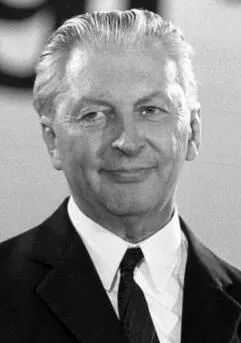
Kurt Georg Kiesinger
Human Design Chart
Biography
Kurt Georg Kiesinger was the son of a clerk. He studied at both Tubingen and Berlin universities and earned his law degree. Joining the Nazi party in 1933, he worked in the Nazi Foreign Ministry’s radio propaganda division, but became disillusioned and documentation showed that he had been denounced to the Nazi secret police. He was first elected to Parliament in 1949 and became a loyal member of Chancellor Adenauer’s inner circle. He held various important political posts, including chairmanship of the legislature’s foreign relations committee.
In 1955, Kiesinger accompanied Adenauer to Russia on a trip that helped establish diplomatic relations between Moscow and Bonn. In 1958, he became Premier of Baden-Wurttemberg and soon became a leader of the West German federalists, who wanted to increase powers of the state government. After he left the chancellorship, he continued to serve as a party chairman and parliamentary leader until 1971. He kept his seat in Parliament until 1980, when he retired to work on his memoirs, read poetry and take long hikes in the woods.
Kiesinger married Marie-Luise Schneider in 1932, and they had a son and a daughter. He died on 9 March 1988 of heart failure in Tubingen.
What does Generator 2/4 mean for Kurt Georg Kiesinger?
Generator 2/4 — Design at a Glance
Kurt Georg Kiesinger's design indicated a tendency towards high endurance and the ability to materialize things. As a Generator, he had plenty of sacral energy, characterizing him as a strong "workhorse" – effective and powerful as long as his inner resonance was in tune. His central life strategy involved not initiating himself but responding to impulses from the environment. Only through the response process did his energy fully unfold.
This mechanism manifested in a clear pattern: When Kurt Georg Kiesinger responded to a signal, and his sacral center resonated with an internal "yes," deep satisfaction and fulfillment ensued. He could then respond with consistent action without being hindered much. Conversely, ignoring this signal or forcing initiative led to frustration and energy depletion. Two pitfalls shaped his potential: First, wasting strength on tasks without inner desire, which tended towards burnout. Second, holding back from working on his heart project despite still having plenty of power available. His design thus required him to act from the gut and only become active when sacral resonance confirmed it. This ensured he had the necessary energy to bring things sustainably into his life without depleting himself.
Emotional Authority
Kurt Georg Kiesinger's decision-making process required consistent emotional detachment and time; spontaneous impulses proved unreliable. His design featured Emotional Authority, meaning his defined emotional center determined his inner guidance. This configuration was subject to a constant wave motion of feelings: perception was always colored by the current mood, swinging between enthusiasm and skepticism. However, an emotion in the moment represented only a snapshot, not necessarily the deeper truth. Quick decisions made from emotion could therefore have negative consequences.
The mechanics of this authority dictated patience. The more time Kurt Georg Kiesinger took to let a decision mature, the more comprehensive his understanding became. This required consciously "sleeping on" choices. Through this hesitation and willingness to question multiple times, intense feelings gradually subsided. Emotional distance then set in, followed by clarity and calmness. Only then was the inner process complete and a well-founded decision possible. This mechanism was particularly relevant for long-term decisions that significantly influenced life's course. The emotional wave had to run its natural course before the true essence of a situation became visible.
The 2/4 Profile — Hermit / Opportunist
Kurt Georg Kiesinger revealed himself through a constant alternation between the deep desire for withdrawal and his simultaneous attraction to his personal network. His design suggested a tension that prompted him to connect phases of intense isolation with times of active community involvement. This dynamic required clear communication about his availability: he signaled when he sought company and when he needed solitude to gain inner clarity.
This structure stems from Profile 2/4. Line 2, characterized by Gate 51, fostered the need for withdrawal to strengthen ego and willpower. During these phases, Kurt Georg Kiesinger withdrew to find rest and focus on essential impulses. Only once this internal balance was restored did Line 4 come into play. The Gate 54 of this line sought recognition within the network and transformed insights gained in solitude. Thus, a cycle emerged: withdrawal served for reflection and idea development, followed by re-emergence into social structures to share these contents and achieve impact. This rhythm of retreating and connecting shaped his way of interacting with his environment and defining himself.
Single Definition — Defined & Open Centers
Kurt Georg Kiesinger revealed himself as a person of immense inner substance and assertiveness, whose decisions were based on feeling, instinct, and physical resonance. His design featured defined G-, Heart-, Sacral-, Solar Plexus-, Spleen- and Root Centers. This formed a massive, constant energy system: an unshakeable self-identity (G), absolute willpower (Heart) as well as vital endurance (Sacral). The defined Spleen provided spontaneous survival intelligence in the present moment, while the Root Center supplied pressure for existential stability.
In contrast, Head-, Ajna-, and Throat Centers were open. There was no constant mental inspiration or controllable manifestation through speech. This openness meant situational receptivity to external ideas but no inner possession of them. Kiesinger tended to question whether he was inspiring enough or who had the answer – typical patterns of an open Head Center. The open Ajna Center could also lead him to adopt other people's concepts without owning them as his own truth.
The central conflict lay in the danger of suppressing his massive inner willpower and direction (G/Heart) to satisfy the mental pressure of the open centers. His immense energy was not channeled through constant talking – the open Throat showed that speaking only occurred upon invitation or resonance – but rather through presence and action. He lived in a mechanism that combined deep emotional authority (Solar Plexus) with the necessity of waiting for clarity before acting. Thus, he appeared as someone who was receptive to foreign thoughts yet guided his actions strictly by his own defined inner structure, instead of being driven by external mental confusion.
Channels & Gates
Kurt Georg Kiesinger exhibited a fundamental disposition shaped by the Initiation Channel 51-25: He acted as an initiator challenging others to expand their boundaries. This channel connects the competition-promoting shock pressure of Gate 51 with the universal love and individualization of Gate 25. The drive to be
Circuit Signature
Kurt Georg Kiesinger revealed himself as a personality with inner strength and strong self-esteem. His design connected the Heart Center with the Identity Center through the Initiation Channel (25-51). This connection created an individual presence characterized by firm convictions. Since this circuit did not connect to the Throat Center, this inner strength often remained unspoken or difficult to express in words.
Parallel to this, the Understanding Circuit was at work. Here, the Concentration Channel (9-52) connected the Sacral Center with the Root Center. This produced a focused, rational energy aimed at logical structure and strategic thinking, free from emotional influence.
Another aspect was the Ego Circuit. Through the Transformation Channel (32-54) and the Synthesis Channel (49-19), Spleen-, Root-, and Solar Plexus Centers were linked. This promoted cooperation, mutual support, and the joint creation of resources within a group.
Finally, Integration was achieved through the Perfect Form Channel (10-57) connecting the Identity Center with the Spleen Center. This connection supported securing one's survival through intuitive knowledge and appropriate behavior in the here and now. All these energies existed as an interconnected flow since Kurt Georg Kiesinger had a simple definition.
Right Angle Cross of Penetration 1
Kurt Georg Kiesinger's Human Design profile indicated a tendency towards strategic intelligence. He was someone who could penetrate complex relationships and look beyond the surface of phenomena. This attitude stems from the mechanics of the 'Right Cross of Penetration'. This configuration describes a deep intellectual structure designed to recognize patterns and proceed strategically. It involves understanding systems as well as uncovering hidden logic. Kiesinger used this inner orientation not only to perceive situations superficially but also to grasp their underlying structures. His design promoted a form of thinking where connections were analyzed and strategically placed. Rather than spontaneous reactions, it involved thorough analysis that allowed him to draw clear lines in complex fields. This mechanism shaped his approach to problems: it required patience and focus to distinguish the essential from the non-essential. Through this ability to penetrate, he could orient himself in his action fields by understanding systemic connections often hidden beneath the surface. The right cross of penetration thus acted as an inner compass for strategic action based on deep understanding.
Saturn Return · Uranus Opposition · Chiron Return · 2nd Saturn Return — Life Cycles
Kurt Georg Kiesinger's Human Design profile was characterized by a clear arc of institutional anchoring and mature statecraft. This path began with his first Saturn Return, a cycle of structural consolidation. In 1933, at the age of 29, he was appointed leader of the Askania corporation – a moment when early bonds solidified into a stable position.
The Uranus Opposition then marked a break from this order through external compulsion. In 1945, at the age of 41, Kiesinger was arrested by American occupation forces and spent 18 months in internment camps. This forced new beginning dissolved old structures to make way for a new orientation.
In his Chiron Return, the fulfillment cycle between ages 49 and 51, his life purpose unfolded increasingly. In 1955, at age 51, he accompanied Adenauer on a diplomatic trip to Russia. This bridge-building work contributed to establishing relations between Moscow and Bonn – an example of how his incarnation cross manifested in reconciliatory action.
The second Saturn Return crowned this arc with the highest responsibility. In 1958, at age 54, Kiesinger became Minister President of Baden-Württemberg. Here, previous efforts culminated in stable power and institutional leadership within his own country. The cycles thus shaped a path from early corporate binding through forced rupture to mature political design.
Generator · Emotional Authority — Synthesis
Kurt Georg Kiesinger lived primarily from his sacral energy (Generator type) and followed an inner emotional wave (Emotional Authority). This combination marked a life where deep engagement and endurance – especially when the task aligned with his heart – played central roles. The profile as a natural talent and networker suggests a rhythm that fluctuated between phases of withdrawal for internal clarity (Line 2) and the need to exchange and connect with selected individuals (Line 4). His defined G Center gave him a firm inner direction and the ability to lead others – an attribute evident in professional stations. The focus on details through Channel Concentration (52/9) supported this endurance and formative energy.
A central paradox lay in the tension between the need for internal clarity and emotional maturation versus the desire to maintain relationships and shape a community. Cyclical events – from early career successes (1933) through crises (1945) to diplomatic skill (1955) and renewed ascent (1958) – showed that while he relied on his inner authority, it was often challenged by external circumstances and the necessity of social interaction.
5 Defined Channels
Incarnation Cross - Right Angle Cross of Penetration 1
Solar Return
The Solar Return shows the moment when the sun returns to its exact birth position - your personal solar year.
Life Cycles
Discover the life cycles with a detailed triple view (birth chart, cycle chart, composite).
Human Design Profile
- Type
- Generator
- Strategy
- To respond - wait for something to respond to
- Authority
- Emotional Authority
- Profile
- 2/4 - Hermit / Opportunist
- Definition
- Single Definition
- Incarnation Cross
- Right Angle Cross of Penetration 1
- Date of Birth
- 06.04.1904 20:15
- Place of Birth
- Ebingen, Germany
Frequently Asked Questions
What was Kurt Georg Kiesinger's Human Design type?
What Profile did Kurt Georg Kiesinger have in Human Design?
Which Authority guided Kurt Georg Kiesinger?
What incarnation cross did Kurt Georg Kiesinger have?
When was Kurt Georg Kiesinger born?
Discover your own Human Design
Are you also a Generator? Find out in a personal reading how to use your sacral energy correctly and discover deep satisfaction.
More Personalities
Back to overviewAaliyah

Alexia

Angèle

Anne-Marie

Arcángel

Arno