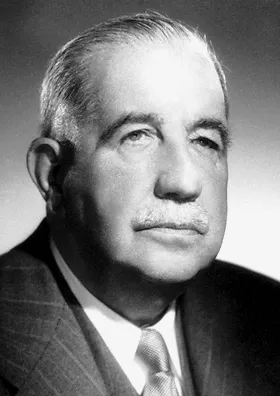
Léon Jouhaux
Human Design Chart
Biography
Jouhaux was the secretary general of the General Labor Confederation (CGT) from 1909 to 1947 and founder and president of the General Confederation of Labor - Workers' Force (CGT-FO) in April 1947, up to his death.
In November 1942 he was arrested by the Nazis and was in the concentration camps Buchenwald and Dachau. He was released on May 1945.
Long prominent in the International Labor Organization and active in the service of peace, Jouhaux received the 1951 Nobel Peace Prize. His works include studies on labor and on disarmament.
He died 28 April 1954, Paris.
Human Design Analysis: Léon Jouhaux as Generator 6/2
Generator 6/2 — Design at a Glance
Léon Jouhaux revealed himself as someone with immense inner endurance who did not unleash his strength through self-willed initiative. His Generator design had plenty of sacral energy, which enabled him to perform like a strong workhorse for sustained effort – provided he was intrinsically motivated. This energy was primarily released when his system responded to external impulses; the motto was not to initiate but to react.
His strategy involved waiting until life sent a signal and his gut feeling gave a clear “Yes” response. Only then would he act upon it. If Léon Jouhaux lived in harmony with this principle by acting on these inner responses, he was rewarded with deep satisfaction. Conversely, ignoring these signals or forcing himself to do things without inner resonance led to frustration and energy depletion. Two stumbling blocks shaped his dynamics: either he wasted energy on tasks that did not interest him, leading towards burnout, or he was held back from his heart project despite still wanting to continue working full of power. His effectiveness thus depended crucially on whether he could channel this sacral energy through reacting to impulses rather than fighting against the current of his own nature.
Sacral Authority
Léon Jouhaux revealed himself as someone whose decision-making came directly from the body. As a Generator, his strategy was identical with his inner authority: the sacral authority. This greatly simplified his process since he did not have to choose between different internal voices. The prerequisite for this was an open Emotions Center, meaning that he did not make impulsive emotional decisions but waited for physical signals.
His responses came as direct reactions to external stimuli in the form of bursts of energy or a “belly voice”. These bodily noises – like grunting, humming or simply an “mhm” — signaled whether something engaged his energy. When his sacral motor was activated, he felt vital and alive. He then had inexhaustible energy and tackled tasks with great enthusiasm. For him, it was natural to immerse himself in activities without them needing a specific purpose; the joy of work itself sufficed.
Furthermore, his activated Spleen Center acted as supporting authority. This gave him the ability to react particularly quickly and spontaneously. He had immediate access to his instinctive perception and physical well-being. This combination allowed Léon Jouhaux to reliably guide himself from these deep bodily impulses, making his actions authentic and energized.
The 6/2 Profile — Role Model / Hermit
Léon Jouhaux's design was characterized by a dynamic development: In the early years, an experimental drive dominated, marked by trial and error. As a 6/2 Profile, he acted like a 3-line before the age of thirty, learning through personal experiences and retreating after setbacks to start anew. This phase served for accumulating raw life data without pre-fabricated wisdom.
Only with Saturn's return around his thirtieth year did the sixth line fully activate. Léon Jouhaux then metaphorically retreated into a “Cave” – a phase of intense distancing and reflection on his earlier experiments. This was not a passive pause but a process of healing and deep self-knowledge. The sixth line represents peacefulness and spiritual depth; it requires, however, that the entire circuit is fulfilled before inner peace can be achieved. Neptunian influences brought the danger of self-deception, which could serve as a substitute for true tranquility.
Simultaneously, his profile contained an extreme reaction mechanism (second line). In persistent interference, he reacted surprisingly sharply – “Violence before justice”. These decisive measures deterred intruders but often left neptunian regret over his own harshness. From this long period of reflection emerged Léon Jouhaux as a wise person. Others sought him out to partake in the life wisdom he had worked on and learn the ability for deep introspection, which arose from the synthesis of earlier experimentation and later spiritual clarification.
Split Definition — Defined & Open Centers
Léon Jouhaux was someone who constantly felt mental pressure to ask questions and understand connections. His defined Head and Ajna centers generated a continuous inspiration, but lacked the direct energy for implementation; they served to inspire others to think rather than provide immediate answers themselves. This mental process culminated in his defined Throat Center, which acted as a reliable channel for communication, translating his conceptual thoughts into clear words.
As a Generator with a defined Sacral center, Jouhaux had an enormous source of vitality. His strategy was not to initiate but to react to questions or situations to ensure that his energy was truly available. This sacral power was complemented by his defined Root Center, which provided a steady, adrenalized push forward and helped him master existential challenges.
At the same time, his design revealed specific vulnerabilities. His open G Center meant he lacked a fixed identity or direction; he tended to blend with his environment and sought the right place to feel at home. The open Heart Center made him susceptible to the pressure of proving his worth through promises or competition, often leading to frustration as he lacked the consistent willpower for it. Additionally, his open Solar Plexus absorbed others' emotions, which could lead him to experience foreign moods as his own and feel emotionally overwhelmed. Finally, his undefined Spleen was vulnerable to fears about health and safety; spontaneous decisions were risky for him, often based on conditioned fear rather than intuitive wisdom. Jouhaux's path involved respecting these open fields and instead relying on his defined energies of reaction and clear communication.
Channels for logical doubt, change, acceptance and awareness.
Léon Jouhaux exhibited a fundamental disposition that combined evolutionary change with rigorous logical scrutiny. His design featured the Mutation Channel 60-3, connecting the Root Center to the Sacral Center. This connection generated a pulsating, often melancholic rhythm of chaos and order. Léon Jouhaux had to learn to accept limitations and patiently wait for the right moment for new impulses rather than reducing internal tension through hasty action. This energy repeatedly threw him into phases of silence followed by sudden, unexpected breakthroughs that forced innovation.
Parallel to this, the Logic Channel 63-4 between Head and Ajna Centers influenced his way of thinking. This doubting mind continuously filtered patterns for their consistency. For Léon Jouhaux, skepticism was not an obstacle but essential for formulating sustainable answers. He sought verifiable evidence and rejected unfounded beliefs; something had to work logically to be valid. This process served the collective by questioning until a consistent pattern became apparent.
Additionally, the Acceptance Channel 17-62 shaped how he processed information. It mentally organized details and translated visual patterns into language for clarity. Anything that did not fit his internal system remained incomprehensible. However, this drive to formulate opinions in detail required proper timing to avoid resistance.
The Awareness Channel 61-24 completed this profile by bringing forth spontaneous inspirations breaking old cycles. Léon Jouhaux could not control his thinking; knowledge emerged at its own pace, often as sudden insights. This mystical connection to inner truth complemented his logical rigor and allowed him to inspire new perspectives without forcing them.
Collective Circuitry — Circuit Signature
Léon Jouhaux's design inclined towards pulsating creativity paired with the ability to develop logical structures for the future. Through the Knowledge Circuit, he connected two separate parts: Head and Ajna Centers on one side, Sacral and Root Centers on the other. This generated innovative flashes of insight (Channel 24-61) as well as the power for mutation and deviation from the old (Channel 3-60). These energies were not directly merged but existed as parallel forces - on one hand inspiring intuition, on the other vital endurance.
Parallel to this, the Understanding Circuit connected Head, Ajna, and Throat Centers in Jouhaux. Here energy flowed from focused logic (Channel 63-4) through acceptance (Channel 17-62) to expression in the throat. This enabled him to share rational insights free of conditioning and strategically communicate societal improvements. The connection of these centers created a clear channel for visual thinking and verbal communication of complex connections.
As someone with split definition, Léon Jouhaux showed these two systems as coexisting but not directly energetically connected blocks. Thus, the emotional pulse of the Knowledge Circuit did not flow directly into the rational structure of the Understanding Circuit. Instead, pulsating individuality and focused logic complemented each other as separate yet co-existing principles in his design.
Left Angle Cross of Demands 1
Léon Jouhaux's design showed a tendency towards tireless, strategic pushing towards the goal. He was someone whose actions were driven by a deep inner logic aimed at concrete results rather than just acting on impulse. This attitude stemmed from his left cross of demands, a configuration that provides clear direction and a firm will to implement it.
In Human Design, this cross describes the connection between the energy of pushing through obstacles and the ability to develop complex strategies. It's not about spontaneous impulses but about a well-thought-out approach where every demand or action is part of a larger plan. Léon Jouhaux lived this mechanism by using his energy purposefully to bring about changes. His way of working was characterized by constant endurance and the ability to withstand resistant forces without losing sight of the overall goal.
This aspect of his design meant that his work never appeared random or chaotic. Instead, it followed an internal order aimed at establishing or changing certain states in the external world. The energy of this cross supported him in clearly articulating his intentions and pursuing them with a persistence often felt as unshakeable. It was a force that not only acted outwardly but also provided inner stability, helping him to maintain course in difficult situations. Léon Jouhaux used this innate structure to bring his visions into reality, always focusing on effective implementation.
Saturn Return · Uranus Opposition · Chiron Return · 2nd Saturn Return — Life Cycles
Léon Jouhaux's life followed the rhythmic phases of planetary cycles marking structure and transformation. The first Saturn return around age 30 served as a phase of consolidation where earlier efforts condensed into a stable foundation. This was not just aging but the process of taking responsibility for one's achievements and anchoring them sustainably.
The Uranus opposition brought a time of necessary detachment from established patterns. This cycle demanded flexibility and readiness to let go of old structures to make space for new developments. It was a moment of disruption that contributed to expanding personal freedom by loosening rigid stances.
The Chiron return between ages 49 and 51 marked the phase of fulfillment. Here, living according to one's strategy and authority led to late blooming. The incarnation cross unfolded increasingly in everyday life, making meaning and purpose tangible. It was not about healing old wounds but about realizing the deepest potential.
The second Saturn return around age 60 closed this arc. It signified another level of mastery and wisdom where what had been learned culminated in a mature, balanced stance. Léon Jouhaux moved through these cycles, each segment presenting specific tasks for maturation and expansion of his life structure.
Generator · Sacral Authority — Synthesis
Léon Jouhaux lived deeply rooted in his sacral center (Generator) and followed an inner, bodily authority. This reaction to external stimuli shaped his path by finding energy when tasks aligned with his inner truth – a constant blooming when work brought joy. His profile as a role model suggests that early years were marked by experimentation and exploring various paths before entering a phase of intense reflection and wisdom shared later on. The defined Head Center created a persistent mental pressure to question and understand things, making him an inspirator but also prone to inner worry.
A central paradox lay in the connection between deep creative drive (sacral energy) and the channel of mutation (3-60). On one hand, he was destined to materialize things through work and endurance; on the other, his channels favored deviations from the existing and a pulsating, unpredictable flow of energy. This melancholy accompanying evolutionary change points to a tension between holding onto established patterns and the drive for newness – a life marked both by constancy and transformation.
4 Defined Channels
Incarnation Cross - Left Angle Cross of Demands 1
Solar Return
The Solar Return shows the moment when the sun returns to its exact birth position - your personal solar year.
Life Cycles
Discover the life cycles with a detailed triple view (birth chart, cycle chart, composite).
Human Design Profile
- Type
- Generator
- Strategy
- To respond - wait for something to respond to
- Authority
- Sacral Authority
- Profile
- 6/2 - Role Model / Hermit
- Definition
- Split Definition
- Incarnation Cross
- Left Angle Cross of Demands 1
- Date of Birth
- 01.07.1879 01:00
- Place of Birth
- Paris, France
Frequently Asked Questions
What is Léon Jouhaux's Human Design type?
What Profile did Léon Jouhaux have?
What Authority did Léon Jouhaux have?
Which incarnation cross was active for Léon Jouhaux?
When was Léon Jouhaux born?
Discover your own Human Design
Are you also a Generator? Find out in a personal reading how to use your sacral energy correctly and discover deep satisfaction.
More Personalities
Back to overviewAaliyah

Alexia

Angèle

Anne-Marie

Arcángel

Arno