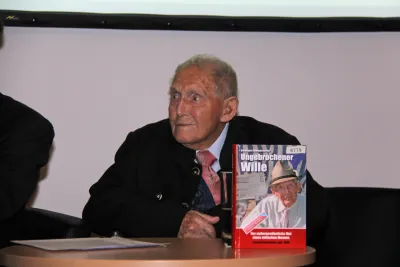
Leopold Engleitner
Human Design Chart
Biography
He died at 5:49 PM on 21 April 2013 at age 107 in St. Wolfgang im Salzkammergut, Austria.
Leopold Engleitner — Generator with Profile 4/6
Generator 4/6 — Design at a Glance
Leopold Engleitner revealed himself as someone with immense endurance and a deep inner source of strength that enabled him to undertake long-term projects. His design as a Generator endowed him with a specific kind of energy: not impulsive but steady, as long as it aligned with what truly moved him. This strength was, however, contingent upon one crucial condition – he had to react to signals from his environment rather than initiate things himself.
His life force ignited most strongly in moments of an instinctive "yes" when an external impulse resonated with his inner self. Then he could respond fully and shape things sustainably. If, on the other hand, he tried to go against this natural flow – by taking on tasks that did not suit him or letting himself be distracted from his true drive – he quickly fell into frustration. The result was often a noticeable energy drain as he then worked against his own system.
The greatest challenge lay in recognizing this reaction and not suppressing it due to external expectations or the pressure to always be "productive." When Leopold Engleitner managed to maintain this rhythm – waiting, sensing the inner signal, then acting – he experienced deep satisfaction. His path was not constant pushing forward but an art of responding correctly to what life offered him.
Emotional Authority
Leopold Engleitner showed himself to be someone who did not make decisions in the heat of the moment but rather left them to time. His design featured Emotional Authority, meaning his defined Emotional Center always served as an inner guide—regardless of all other defined Centers in his chart. This configuration subjected him to emotional waves, a constant up and down of feelings. The world often appeared colored by his current mood: a moment of excitement could quickly be replaced by a negative perception of the same thing.
For Leopold Engleitner, therefore, immediate feeling was only a snapshot, not a final judgment. Spontaneous decisions based on this initial emotional arousal could have had negative consequences as they reflected an unresolved truth. Instead, his system required patience. By letting decisions ripen and reviewing them multiple times—often alternating through the night—he gained the necessary emotional distance. Only when intense feelings subsided did clarity emerge. This process of delay was essential for him to make long-term life decisions with composure rather than being swayed by temporary mood swings.
The 4/6 Profile — Opportunist / Role Model
Leopold Engleitners design points to a dual life mission: initially experimenting in relationships, and later taking on the role of a wise networker. As a 4/6, he lived his first thirty years before Saturn's return similarly to a 3 – characterized by curiosity and trying out various friendships and partnerships.
With the activation of Line Six, an internal conflict emerged: the desire for belonging (Line Four) clashed with the urge to withdraw and reflect on the meaning of life (Line Six). This tension between heart and head shaped his development. In later years, those around him expected him to serve as a role model that shone through cooperation and wisdom. Yet, his large heart remained cautious; it only opened up to selected individuals to avoid getting hurt.
His Gate 56 in the Fourth Line promoted clever calculation and self-interest in communication. He conveyed messages like a storyteller, waiting for opportune moments to make ideas effective. At the same time, his Gate 3 in the Sixth Line showed the ability to recognize when resistance is futile. Instead of fighting against unchangeable processes, he learned to surrender to change. This step from devotion to confusion towards self-care and orderly action formed the foundation of his later life phase.
Triple Split Definition — Defined & Open Centers
Leopold Engleitner was marked by a design characterized by immense inner stability and the ability to take action. His defined centers – Heart, G Center, Sacral Center, Root Center, Solar Plexus, Spleen, and Throat – formed almost a completely closed system. This gave him a reliable willpower (Heart) and clear self-identity (G Center), which he could directly translate into actions. His defined Sacral Center generated constant vital energy, which was channeled as productive pressure through the also defined Root Center. He also possessed deep emotional intelligence (Solar Plexus) and spontaneous intuition (Spleen), which were reflected in his communication (Throat). Leopold Engleitner therefore did not speak only from reason but from a synthesis of will, identity, energy, emotion, and instinct.
In contrast, his Head Center and Ajna Center were open. This meant that he lacked a fixed mental structure for conceptualizing or answering questions. Instead, he was prone to getting caught up in the mental pressure of others or seeking answers that were not his own. The non-self pattern here consisted of feeling compelled to understand and explain everything intellectually. Leopold Engleitner tended to see this mental confusion as a personal task, although his design urged him to trust his inner authority – whether emotional or intuitive – rather than searching for solutions in the mind. His strength lay in implementation and feeling, not in theoretical discourse.
Channels for awareness, change, care and community.
Leopold Engleitner revealed himself as someone who questioned deeply rooted structures and radiated a calm yet undeniable presence. His design indicated a tendency towards evolutionary leaps, which were only possible through patience and acceptance of inner tensions.
The Channel of Mutation 60-3 connected his Root Center with the Sacral Center. This configuration brought potential for radical change, marked by pulsating, often melancholic energy. Leopold Engleitner had to learn to accept limitations (Gate 60) and move beyond the confusion of a new beginning (Gate 3). This channel generated internal pressure waves; when the pulse stopped, mechanical mood swings appeared. The key was not to argue against these moods but patiently wait for his sacral reaction to set off the next mutation.
At the same time, Leopold Engleitner radiated clarity that inspired others to be themselves. The Channel of Awakening 10-20 connected the G Center with the Throat Center. It expressed the wisdom that self-love and self-confidence are the pillars of an awakened life. Through Gate 10 (Presence) and Gate 20 (Now), he spoke for himself and transformed individual knowledge into right action. His mere presence and living out his design served as silent guidance, breaking down resistance in others.
In interpersonal relationships, Leopold Engleitner acted as a natural provider. The Channel of Preservation 27-50 connected the Sacral Center with the Spleen Center. Through Gate 27 (Care) and Gate 50 (Values), he automatically drew trust. His task was to nourish the tribe through care and preserve traditional values. He intuitively knew that he first had to take proper care of himself ("enlightened self-interest") to be able to effectively support others. Only upon genuine invitation could he sustainably give his energy.
Additionally, the Channel of Community 37-40 shaped his relationship life. It connected Solar Plexus and Heart Center through Gate 37 (Friendship) and Gate 40 (Solitude). Here it was about finding the right place in the whole and closing fair agreements. Leopold Engleitner sought recognition and belonging but also needed pauses for regeneration. His emotional waves required time before he committed to a community or partnership, ensuring that the connection would be sustainable for both sides.
Individual Circuitry — Circuit Signature
Leopold Engleitner's Human Design shows itself through three separate, parallel operating energy streams. In the Knowledge Circuit, Channel 34 connected the Sacral with the Root Center. This defined a pulsating life force that was oriented towards deviation from the known and gaining new insights. Parallel to this, in the Ego Circuit, energy flowed between Heart and Solar Plexus Centers through the Community Channel. Here it was about the relationship of giving and taking as well as mutual support, where the missing direct connection to Sacral energy made pauses necessary for resource building. A third independent stream formed in the Protector Circuit: The Preservation Channel connected Sacral with Spleen Center. This configuration emphasized instinctive protection, care, and the preservation of one's own genetics and family. Finally, in the Integration Area, the Awakening Channel linked Throat with Identity Centers. This allowed for channeling power from reacting to life through proper behavior and expressing it in the present moment. Since these four circuits were not connected to each other in Leopold Engleitner’s design, they existed as independent, parallel functional ways: on one hand, the search for new knowledge and individual identity, on the other hand, social giving and taking as well as instinctive protective drive. None of these energies flowed directly into another; instead, they formed separate pillars of his experiential world that each had their own requirements regarding timing and expression.
Right Angle Cross of Laws 2
Leopold Engleitner's Human Design was marked by the right cross of Laws 2. This configuration set a specific life direction that relied less on individual self-promotion and more on service to a higher order. In Human Design, this cross marks a turning point where energy shifts from seeking personal validation towards responsibility for the whole. Leopold Engleitner thus did not primarily present himself as someone pursuing his own ambitions but rather as one ready to contribute his strength to promote structural stability and justice. The mechanics of this cross describe the transition from individual to collective contribution; it is about living by one's laws and principles in a way that serves as guidance for others. For Leopold Engleitner, this meant an inner stance of reliability and protection. He did not make his presence known through loud assertion but rather through consistently keeping agreements and being available for his community. The energy of this cross demands discipline and the ability to put aside personal needs when it serves the greater good. Leopold Engleitner lived this dynamic by understanding himself as a stabilizing force working behind the scenes to ensure that systems function and people in their surroundings are supported. His design challenged him not to seek recognition but to quietly and effectively fulfill his role within social structures.
Saturn Return · Uranus Opposition · Chiron Return · 2nd Saturn Return — Life Cycles
Leopold Engleitner was someone who, under extreme pressure for self-assertion, was forced to assert himself when external circumstances threatened his autonomy. This attitude became acute in 1945 at the age of 40: The conscription order for the German Wehrmacht on April 17 compelled him to flee into the mountains and required a return only after the war's end. For his design, this marked the Uranus Return, a cycle of profound restructuring. The planet Uranus stands for sudden changes, liberation from old bonds, and the necessity to take new paths. In a crisis situation like the end of the war, this energy manifested as a radical break with existing order. Leopold Engleitner had to stand against a system that forced him into a role not fitting his inner truth. The flight was not merely an escape but an act of preserving himself. The Uranus Return often demands breaking old structures to make space for a more authentic existence form. In this case, it meant rejecting the imposed loyalty and shaping his survival and later return to everyday life on his own terms. This moment profoundly shaped his life as it showed that true freedom is only achievable through the courage of cutting radical ties with external constraints. The experience of isolation in the mountains served as a catalyst for an inner clarification that determined his further development after the war.
Generator · Emotional Authority — Synthesis
Leopold Engleitner lived a life marked by the dynamic interplay between internal perception and external action. As a Generator with emotional authority, he needed time to process his feelings and make decisions from deep inner clarity—a tendency strengthened by the connection of his Throat Center with the Heart Center. This ability to transform emotions into authentic communication shaped his path, always seeking new insights and forms of expression. The Channel of Mutation (3-60) indicates that he accepted limitations and moved beyond confusion to enable evolutionary change, reinforced by the right cross of Laws 2.
Engleitner seemed caught in a constant tension between the desire for community (Line 4 in Profile) and the need for individual reflection (Line 6). The emotional wave accompanying his decisions amplified this inner conflict. A critical life event of conscription and flight during a Uranus opposition at age 40 highlighted the struggle between adapting to external circumstances and holding onto his own inner truth, which radiated as pulsing and melancholic energy.
4 Defined Channels
Incarnation Cross - Right Angle Cross of Laws 2
Solar Return
The Solar Return shows the moment when the sun returns to its exact birth position - your personal solar year.
Life Cycles
Discover the life cycles with a detailed triple view (birth chart, cycle chart, composite).
Human Design Profile
- Type
- Generator
- Strategy
- To respond - wait for something to respond to
- Authority
- Emotional Authority
- Profile
- 4/6 - Opportunist / Role Model
- Definition
- Triple Split
- Incarnation Cross
- Right Angle Cross of Laws 2
- Date of Birth
- 23.07.1905 10:30
- Place of Birth
- Strobl, Australia
Frequently Asked Questions
What was Leopold Engleitner's Human Design type?
What Profiles did Leopold Engleitner have in Human Design?
What Authority guided Leopold Engleitner?
What incarnation cross did Leopold Engleitner have?
When was Leopold Engleitner born?
Discover your own Human Design
Are you also a Generator? Find out in a personal reading how to use your sacral energy correctly and discover deep satisfaction.
More Personalities
Back to overviewAaliyah

Alexia

Angèle

Anne-Marie

Arcángel

Arno