Liliana Amon
Human Design Chart
Biography
The illegitimate child of the seamstress Caecilia Brandstetter (born 17 June 1869) and the tailor Josef Amon (born 22 May 1843 in Klagenfurt), she was baptized on 24 June in the Linz parish of St. Josef (today: Heilige Familie/ Holy Family). On 19 June 1897, she was “legitimized,” meaning that the father had himself entered in the baptismal register as the father.
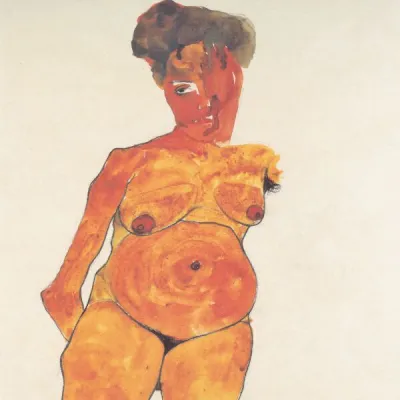
From 1909 at the latest she lived in Vienna, where she stated the following professions on the registration forms: “painter”, “business student”, “correspondent” and “singer”. In 1909 she worked as a model for Egon Schiele in his studio on Alserbachstrasse in the 9th district. On 9 August 1910, she gave birth to a daughter in the Lower Austrian maternity hospital, whom she named Liliana Marie and who was put up for adoption. The facts compiled by Walter Schübler indicate that Schiele was not the father. But Amon may have been the model for the drawings of a pregnant woman - the so-called “gynaecological watercolours”.
Liliana Amon occasionally frequented Viennese coffee houses and was involved at the regulars' table at Café Herrenhof. This brought her the acquaintance of Ernst Polak, Milena Jesenská, Gina Kaus, Otto Gross, Muhammad Asad, Albert Ehrenstein, Otto Soyka, Peter Altenberg and Franz Werfel. She was engaged to Anton Kuh for a time - he called her “the radiant one” and gave himself ten commandments with which he hoped to secure her attention.
Robert Musil may have used her as a model for Alpha in Vincent and the Girlfriend of Important Men (1924). In Karl Tschuppik's autobiographical novel A Son from a Good Home (1937) she appears as 'Bibi'. In Franz Werfel's novel Barbara or the Piety (1929) she is described as 'Angelika'.
Liliana Amon as a Projector 4/6 in Human Design
Projector 4/6 — Design at a Glance
Liliana Amon's design featured a dense, focused aura that acted like a bright flashlight, immediately spotting flaws in her environment. This ability to reveal the dark was not a universal tool of criticism but rather a specific instrument of projectors. Because her light was intense and direct, an immediate confrontation with others' weaknesses would quickly provoke resistance – akin to shining a bright light directly into someone's face.
Instead, her most effective strategy shone in harmonious brilliance. By embodying harmony herself, Liliana Amon became attractive to those around her; people naturally came to her seeking advice. This underscores the central projector strategy: waiting for a respectful invitation. Only through this acknowledgment could her leadership function operate without energetic resistance.
Her energy balance followed a specific rhythm. As a projector, Liliana Amon did not have a constant Sacral as an inexhaustible source of life energy. Instead, she experienced phases of high activity that had to be balanced by rest periods to prevent burnout. Life according to this design rewarded her with success; deviating from it and acting without invitation or against her energy cycles led to the non-self theme of bitterness. Her life task was to respect this rhythm of waiting and resting to sustainably manifest her clear vision.
Ego Authority
Liliana Amon exhibited a rare configuration: her inner authority lay in the defined Ego Center. This was possible because her emotional, sacral, and spleen centers were open – she received much from outside while her internal compass was anchored in will.
For Liliana Amon, this meant that truth did not lie in contemplative thought but in spontaneous expression. What came uncensored and directly from her throat represented her authentic direction. The challenge lay in clearly distinguishing when her own will spoke versus when she merely reflected others' interests – a danger always lurking due to her open centers. Her mind often served adaptation to the environment; her Ego Center, however, drove her toward goal achievement.
When Liliana Amon followed what truly mattered to her, she had the necessary willpower to keep promises and achieve goals. This consistent adherence to her own will could appear selfish outwardly but was essential for her authenticity. It went beyond material success to a drive to transcend boundaries and pioneer new paths.
A central mechanism of her design required pauses. After achieving a goal, Liliana Amon needed to stop. Continuous activity without these regeneration phases led to exhaustion and illness in her case. Her success thus depended on maintaining the rhythm of will deployment and necessary rest.
The 4/6 Profile — Opportunist / Role Model
Liliana Amon's design set up a lifelong inner conflict: between an emotional need for belonging and an intellectual drive for distance. In her first thirty years, before Saturn's return, the experimental energy of Line Four dominated. She appeared as someone who tried many relationships, with modesty often serving as protection against felt inadequacies. This outsider status shaped her early phase.
With the activation of Line Six, tension arose. The desire to be part of the 'inner circle' clashed with the need to stand above and seek meaning. This profile describes a development from an experimental outsider position toward the responsibility of role modeling. Line Six brought judgmental ability and spiritual stance but tended to act inappropriately in the present moment. Liliana Amon observed others' behavior while confronting the risk herself of losing her innocence through repeated misconduct.
Her entire life revolved around this conflict between heart and mind. She was expected to meet the high standards of a wise role model through cooperation. At the same time, her large heart remained cautious not to open up to false people and get hurt. The mechanics of her design showed a constant balance between seeking community and necessary withdrawal for reflection.
Single Definition — Defined & Open Centers
Liliana Amon's design established a powerful, self-determined presence: She had a defined G Center and a defined Heart Center. This gave her a firm inner identity as well as a clear sense of direction in life, coupled with the willpower to actively shape it. She was designed to be her own boss, consistently keeping promises and attracting others through her clear aura or guiding them into new directions. Her strength lay in trusting her inner authority; trying to direct others or fulfill their expectations led to energy loss and frustration for her.
In contrast, the Head Center, Ajna Center, and Sacral Center were open. The open Head Center made her vulnerable to mental confusion and the pressure of finding answers to other people's questions instead of being guided by her own inspiration. The open Ajna Center meant that her concepts and opinions weren't seen as personal truths but were flexible; she tended to feel uncertain when she didn't have clear answers at hand. The lack of consistent generative energy in the open Sacral Center made her sensitive to the vitality of her environment, risking exhaustion if she took on borrowed energy or didn't listen to her inner authority about when it was time to rest. Similarly, the open Solar Plexus Center absorbed foreign emotions, which could lead to emotional overload if she personalized these as her own instead of letting them go. These open centers did not replace personality traits but marked areas of conditioning and reflection.
Channels for pioneering spirit and universal love.
Liliana Amon's design leaned towards competitive action that served more than just personal success; it acted as a means for individuation and expansion. She was someone who strengthened the collective through authentic survival of initiation shocks, stemming from Channel Initiation 51-25, which connected the heart's competing ego energy (Gate 51) with universal love and higher self (Gate 25). For Liliana Amon, initiation was an art form: she could recognize the potential for individuation in others and, if invited, deliver the necessary shock to complete this initiation. This channel propelled a natural competitiveness that demanded being first or winning, changing both material and spiritual worlds. Mastering herself went hand in hand with mastering the world; crucial was the condition of invitation; without it, any attempt to initiate others would be doomed to failure and lead to bitterness. Liliana Amon lived this process from her inner authority, so her triumphant overcoming of challenges served as a bold example for others. Her individuation wasn't a controllable act but a mystical byproduct of her authentic life journey. Through surviving these transcendent encounters, she contributed to others finding their individual 'I' from the collective 'we'. The additional gates in her chart reinforced this dynamic through aspects like logical order (Gate 15), complex integration (Gate 10) and devoted presence here and now (Gate 46), while personality levels provided continuity (Gate 13) and creative uniqueness (Gate 1). Liliana Amon used this configuration to exert pressure on consciousness and promote deeper self-realization.
Individual Circuitry — Circuit Signature
Liliana Amon's design leaned towards inner strength and strong individuality. She was someone who firmly upheld her own convictions while also giving others the space to live out their unique identity – a 'I am as I am' that affirmed others in their uniqueness. This stance resulted from the Centering Circuit, which was specifically active through Initiation (Channel 25-51) in her case. This channel directly connected her Identity Center with her Heart Center. Since both centers lay within the same energetic group, this power flowed as a closed unit: The Heart Center provided self-worth and courage, while the Identity Center represented divine essence and the core of being. The energy was pulsing, creative, rooted in the present moment but also carried a note of melancholy. Crucial here was structure; lacking a connection to the Throat Center, these deep, entrenched beliefs often remained unspoken or hard to verbalize. Thus, this power worked primarily inward and through radiation, not words. Liliana Amon lived this individualistic affirmation not as a loud message but as a quiet yet unwavering presence that strengthened others through her own authenticity without needing to instruct them. The separate nature of her defined centers – here only Identity and Heart connected – meant that this inner security was an independent pole in her system, which did not automatically merge with other energy-charged areas but existed alongside them.
Right Angle Cross of the Vessel of Love 2
Liliana Amon's design established a foundational disposition that can be described as an open vessel for experiencing and expressing love. Her Human Design was marked by the right cross of the Love Vessel 2 configuration. This setup emphasized not the active pursuit of romantic affirmation or egocentric claims to affection, but rather the ability to serve as a container for this emotional quality.
In the mechanics of this design, it means that Liliana Amon tended to live and pass on love not primarily as an ownership claim, but as a profound, often silent experience. She functioned archetypally as a vessel in which the essence of affection and connection could find space. This created an atmosphere where others felt safe because her design allowed her to receive these feelings and reflect them authentically without being intrusive.
This was a passive reception and transmission function. Liliana Amon demonstrated herself as someone who embodied the quality of love simply by allowing this energy. The right cross of the Love Vessel 2 implies a specific orientation: love is not forced or manipulated, but it arises through the mere presence of an open space in Liliana Amon's being. This structure fostered a deep, often wordless connection with her environment based on the ability to hold and support others emotionally without dissolving her own identity. It was a design of silent presence and emotional holding.
Saturn Return · Uranus Opposition · Chiron Return · 2nd Saturn Return — Life Cycles
Liliana Amon's life followed a clear cyclical dynamic marked by two structural turning points. The first Saturn return signified the transition from development to established professional identity and responsibility, manifesting concretely in 1920 at age 28: her debut as an actress in Berlin crystallized years of preparatory work into a solid result and cemented her place in her role.
A decade later, the Uranus opposition became active, a transit signaling radical liberation and breaking with existing structures. This point of necessary change occurred in 1929 when she was 37 years old and divorced from Eberhard Leithoff. The separation was not merely a private event but corresponded to the mechanical requirement for dissolving old bonds to make space for new developments. Both transits served as architectural pillars of her life course: the Saturn return built the structure of professional existence, while the Uranus opposition later broke through this to enable a profound transformation. Thus, Liliana Amon moved between building firm identity and the necessary destruction of outdated patterns, a process that structured and shaped her lifespan.
Projector · Ego Authority — Synthesis
Liliana Amon lived a life deeply marked by the ability to recognize patterns and shed light on darkness – a trait stemming from her design as a Projector with defined willpower (Heart Center) and open Head and Ajna Centers. This constellation enabled her an intuitive understanding of how others function, coupled with inner direction that drove her to live out her own values and express herself authentically. Her profile as Networker/Role Model suggests she could illuminate the way for others through cooperation and sharing wisdom – a role she increasingly took on over time. The connection between defined willpower and open Head Center amplified her ability to speak spontaneously and unfiltered, helping her articulate truths that others might not see.
A central tension in Liliana Amon's design lay between the need for recognition and inner freedom to walk her own path. Her Ego Center demanded material affirmation and success while her open centers made her receptive to external influences, requiring constant weighing of others' needs against her authentic expression. This dynamic was evident in her willingness to do things differently (Gate 1) paired with a deep longing for connection and validation (Channel 51-25). The challenge lay in harmonizing these seemingly opposing forces and making her unique contribution to the world.
1 Defined Channel
Incarnation Cross - Right Angle Cross of the Vessel of Love 2
Solar Return
The Solar Return shows the moment when the sun returns to its exact birth position - your personal solar year.
Life Cycles
Discover the life cycles with a detailed triple view (birth chart, cycle chart, composite).
Human Design Profile
- Type
- Projector
- Strategy
- Wait for the respectful invitation
- Authority
- Ego Authority
- Profile
- 4/6 - Opportunist / Role Model
- Definition
- Single Definition
- Incarnation Cross
- Right Angle Cross of the Vessel of Love 2
- Date of Birth
- 23.06.1892 08:30
- Place of Birth
- Linz, Australia
Frequently Asked Questions
What Human-Design type was Liliana Amon?
Which Profile did Liliana Amon have?
What Authority did Liliana Amon possess?
What incarnation cross did Liliana Amon have?
When was Liliana Amon born?
Discover your own Human Design
Are you also a Projector? Find out in a personal reading how to unfold your leadership qualities and recognize the right invitations.
More Personalities
Back to overviewSissy Spacek

Alain-Fournier

Anémone

Ann-Margret

Arletty

Arno