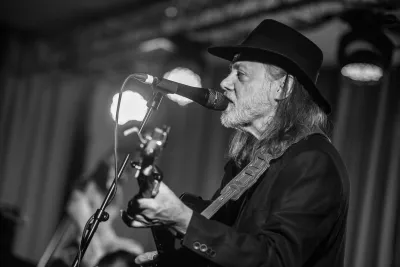
Lillebjørn Nilsen
Human Design Chart
Biography
In 1987 Nilsen received the Fritt Ord Honorary Award. In 2022 he was appointed Knight 1st Class of the Royal Order of St. Olav.
Nilsen died on 27 January 2024 aged 73.
Lillebjørn Nilsen — Projector with Profile 1/3
Projector 1/3 — Design at a Glance
Lillebjørn Nilsen appeared as a Projector, whose design had a specific, focused aura. Much like a bright flashlight, he directed his attention to weaknesses in his environment that were invisible to others. This ability to immediately identify flaws in a system could, however, be perceived as unpleasant or even aggressive if used unwisely, similar to a light beam shining directly into someone's face.
His most effective strategy was not to impose this diagnostic skill but to shine by setting a harmonious example himself. When he embodied a functioning relationship or structure, others were naturally drawn to him and would then actively seek his advice. This underscores the central Projector strategy: to wait for an honest, appreciative invitation before guiding or advising.
Since Projectors do not have a defined Sacral Center, they do not possess a constant, intrinsic life energy. Lillebjørn Nilsen therefore experienced phases of high productivity and clarity, followed by necessary rest periods for regeneration. Ignoring this rhythm often led to exhaustion. Living according to this design rewarded him with success. Failing to do so led to the Non-Self theme of Bitterness, a sign that his unique ability to illuminate the way for others was not respected or utilized.
Emotional Authority
Lillebjørn Nilsen's design showed a tendency towards emotional wave movement. He was someone whose inner compass needle was strongly influenced by the current mood. His defined Solar Plexus Center carried emotional authority. This mechanism always took precedence over all other defined centers in his chart, regardless of further configurations.
Emotional authority is subject to constant ups and downs of feelings. The perception of the world was always colored by the current mood. In one moment, he could be totally enthusiastic about something, in the next, see the same situation negatively. This immediate feeling was, however, only a snapshot, a first impression that did not necessarily reflect the truth. Quick, spontaneous decisions made directly from this emotional heat often had negative consequences.
The mechanics required patience. The more time he took to let a decision mature, the deeper and more comprehensive he could see the situation. This meant reconsidering decisions multiple times and taking his time. Over time, the intense feelings subsided, he gained emotional distance. Only then did the necessary clarity and calmness set in. This process was particularly important for long-term decisions that significantly influenced his life path. By working through this emotional wave, he found his inner truth.
The 1/3 Profile — Investigator / Martyr
Lillebjørn Nilsen was someone who not only collected knowledge theoretically but validated it through direct experimentation and learning from mistakes. His design as a 1/3 Profile ("Researcher/Experimentor") established a fundamental stance that thrived on the tension between the constant desire for more information (Line 1) and the necessity to test this through practical experience (Line 3).
This profile shaped a lifestyle where self-earned insights held the highest credibility. When Lillebjørn Nilsen gave an assessment, it was the result of an intensive review process that included both the theoretical foundation and practical application. Line 1 promoted humility and adaptability by accepting one's place in a hierarchy and warning against over-sensitivity to external corrections.
At the same time, Line 3 of Gate 46 drove a trial-and-error process that knocked him out of balance to force adaptation. The challenge here was not to prematurely project a possible future as the present, which could lead to egoism and loss of support. Instead, it was about learning from mistakes and deciding whether an action should take place immediately or be postponed. This mechanism ensured that his judgments were based on tested reality, which others could trust.
Split Definition — Defined & Open Centers
Lillebjørn Nilsen was characterized by a firm, reliable self-identity. His defined G Center gave him a clear sense of direction and the feeling of being lovable without being dependent on others. This inner security allowed him to show others new perspectives without having to control their paths.
His decision-making did not occur in the moment but through patience. The defined Solar Plexus Center served as his inner authority: He had to wait for the emotional wave to pass until clarity emerged. He avoided impulsive reactions; instead, he used the time to grasp the depth of a situation before acting. This emotional intelligence allowed him to feel the moods of his environment and shape them consciously, rather than being carried away by them.
Parallel to this, a strong body awareness guided him. The defined Spleen Center provided him with intuitive, spontaneous warning signals in the present moment. He trusted these subtle impulses of well-being and survival, which were not always rationally explainable but protected him from dangers and maintained his health. This existential instinct was in harmony with his defined Root Center, which gave him a constant, adrenalized pressure to move forward in the world and thrive materially.
In contrast, his vulnerability was revealed in the mental and communicative areas. His open Head Center made him susceptible to mental confusion and the pressure to find answers to questions that were not his own. He tended to get caught up in intellectual whirlpools when he did not listen to his emotional and intuitive authority. Similarly, his open Ajna Center was open to many ideas but lacked the consistent ability to transform concepts into firm opinions. He had to learn not to pretend to be sure when he was not.
His open Throat Center meant that he could not communicate consistently. He attracted attention by waiting rather than forcing it through constant talking. The open Heart Center protected him from having to prove himself through promises or competition; he did not need willpower to have value. Finally, his open Sacral Center showed that he did not have a consistent vital energy available. He had to learn to set boundaries and rest rather than overexert himself through the energy of others.
Channels for intuitive elegance and emotion-driven impulse.
Lillebjørn Nilsen was characterized by a deep, intuitive connection to his own essence and a clear, spontaneous way of moving in the world. His design featured the Channel of Perfect Form 57-10, connecting the Spleen Center with the G Center. This gave him the ability to guide his behavior moment by moment from inner intuition, dissolving unfounded future anxieties and fostering authentic self-love. He did not act out of reflection or emotional depth but from a direct, acoustic sensitivity to the quality of his environment, which gave him a rare clarity and the gift to move through life existentially and unburdened.
Simultaneously, the Channel of Recognition 41-30 shaped his experience. This channel connected the Root Center with the Solar Plexus and generated a constant drive for new experiences, driven by restlessness and intense emotional curiosity. For Lillebjørn Nilsen, this meant that he had to deeply feel life and use his imagination to move from unfamiliarity to experience. The challenge lay in giving the emotional wave time before he jumped into his desires to gain clarity.
Additionally, Gates like 15, which govern collective behavior and adaptation to natural rhythms, and Gate 25, which conveys a stance of spiritual innocence and individuation, influenced him. Gate 46 fostered his dedication in the here and now, while Gates like 36 and 54 pointed to crisis management and the connection of worldly success with spiritual development. This configuration described a person who perfected his unique form through authentic being and the learning of emotional patience.
Individual Circuitry — Circuit Signature
Lillebjørn Nilsen's design inclined towards emotional processing that occurred in waves. He was someone who sought meaning in past experiences and shared these felt insights with others. This corresponded to the Meaning Circuit, which in him connected the Solar Plexus Center with the Root Center. This connection ensured that emotions did not remain private but worked as shared learning experiences from the past.
At the same time, Lillebjørn Nilsen possessed a separate, parallel power source. His design connected the Identity Center with the Spleen Center through the Channel of Perfect Form. This gave him the ability to draw power from reacting to life and to be guided by intuitive knowledge. This energy served to secure individual survival and acted in the here and now.
Since Lillebjørn Nilsen had a Shared Definition, these two systems – emotional meaning-making and intuitive self-strengthening – existed side by side without directly merging. They formed two separate but equally valued energetic poles. One pole processed the past through feeling and sharing, the other secured the present through intuition and personal power. This structure shaped his way of reacting to life: once through reflecting and sharing experiences, another time through intuitive action in the moment. Both aspects were firmly anchored in his design and worked independently of each other, yet as part of the same whole.
Right Angle Cross of the Vessel of Love 4
Lillebjørn Nilsen carried the right cross of the Love Vessel 4, a configuration that marked a profound, often painful commitment to life and to others. His design inclined him towards intense emotional attachment, coupled with a drive to establish a deeper connection to human existence through personal suffering and willingness to sacrifice. This mechanism does not describe a passive victim role but an active, albeit arduous, search for meaning through the experience of loss and pain.
The right cross of the Love Vessel 4 signifies a life task where the individual develops unique wisdom and empathy through the experience of sorrow and disappointment. It is about the ability to build a bridge to others from one's own pain without completely dissolving one's identity. Lillebjørn Nilsen, through this structure, was someone who did not avoid the dark sides of human existence but integrated them into his art and work, conveying an authentic, though painful, truth.
This configuration demands an honest confrontation with one's wounds. It does not allow superficiality but forces one to delve deep. For Lillebjørn Nilsen, this meant that his creativity often sprang from a place of inner conflict and emotional intensity. He used this energy to tell stories that took the audience directly into the emotional depths and heights of life without falling into sentimentality. His design challenged him to understand and portray love not as a romantic ideal but as a hard, challenging reality.
Saturn Return · Uranus Opposition · Chiron Return · 2nd Saturn Return — Life Cycles
Lillebjørn Nilsen's design inclined him towards sudden, disruptive turning points that challenged established structures. This dynamic was particularly evident during the Uranus opposition, an astrological cycle often associated with a drive for freedom and questioning of existing authorities. During this phase of life, the system sought new forms of expression that no longer fit into old patterns.
In 1987, at the age of 37, Lillebjørn Nilsen received the Fritt Ord Prize. This success was not a random event but a concrete proof of the effectiveness of this mechanical constellation. The opposition of Uranus marks a point where internal tensions break outwards and often lead to public recognition based on the ability to break through the status quo. For Lillebjørn Nilsen, this meant that his unique voice and unconventional approach reached their full effect during this period. The prize confirmed that the energy of change and renewal that flowed through this cycle became visible in a form that was recognized by the outside world. It was a moment when the inner necessity for differentiation condensed into an external affirmation without sacrificing his own integrity.
Projector · Emotional Authority — Synthesis
Lillebjørn Nilsen lived as a Projector, distinguished by his ability to recognize in others what is not working (Gate 11). This gift went hand in hand with a deep, self-determined direction (defined G Center) that allowed him to show others new paths. His profile as a Researcher and Experimenter (1/3) reinforced this impulse by gaining insights through experience and testing, which he could then pass on. However, his emotional authority challenged him to not rush decisions but to let them ripen in the cyclical wave of his feelings – a process that allowed him to recognize and communicate deeper truths (Sensing Circuit).
A central paradox in his design lay in the tension between the need to project his intuitive insight (Gate 57) and the risk of appearing off-putting to others. While the Channel of the Perfected Form enabled him to integrate behavior based on self-love and intuitive awareness, his emotional authority required patience and waiting for the right moment to share these insights. The success that manifested in a documented event (1987) was thus the result of extensive testing followed by timely communication of his insights.
2 Defined Channels
Incarnation Cross - Right Angle Cross of the Vessel of Love 4
Solar Return
The Solar Return shows the moment when the sun returns to its exact birth position - your personal solar year.
Life Cycles
Discover the life cycles with a detailed triple view (birth chart, cycle chart, composite).
Human Design Profile
- Type
- Projector
- Strategy
- Wait for the respectful invitation
- Authority
- Emotional Authority
- Profile
- 1/3 - Investigator / Martyr
- Definition
- Split Definition
- Incarnation Cross
- Right Angle Cross of the Vessel of Love 4
- Date of Birth
- 21.12.1950 02:15
- Place of Birth
- Oslo, NOR
Frequently Asked Questions
What was Lillebjørn Nilsen's Human Design type?
What profile did Lillebjørn Nilsen have in Human Design?
What authority did Lillebjørn Nilsen have?
What incarnation cross did Lillebjørn Nilsen have?
When was Lillebjørn Nilsen born?
Discover your own Human Design
Are you also a Projector? Find out in a personal reading how to unfold your leadership qualities and recognize the right invitations.
More Personalities
Back to overviewSissy Spacek
Aaliyah

Alain-Fournier
Alexia

Alizée

Anémone