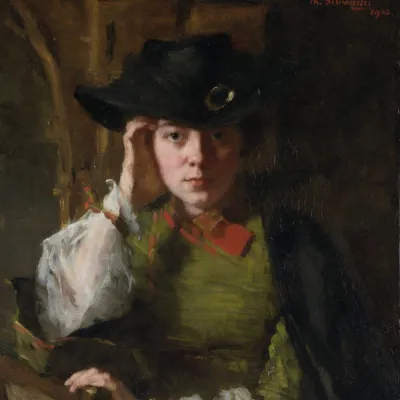
Lizzy Ansingh
Human Design Chart
Biography
Ansingh belonged to a group of female post-impressionist painters influenced by the Amsterdam Impressionism movement called the Amsterdamse Joffers. She was also a member of the (still existing) Amsterdam art circles Arti et Amicitiae and Sint Lucas. She died in Amsterdam on 14 December 1959.
Human Design Analysis: Lizzy Ansingh as Manifestor 1/3
Manifestor 1/3 — Design at a Glance
Lizzy Ansingh revealed herself as a pioneer and visionary whose design was destined to lead the world actively into new directions. Her Human Design type is that of a Manifestor, a configuration often explained with an imperial metaphor: She possessed the grand vision of an empire or project but did not fight the necessary battles herself; instead, she provided impulses that were implemented by others. This kind of leadership inevitably polarized her environment. Since her thinking often reached further than that of those around her, she was misunderstood; some people followed her great dreams enthusiastically while others rejected them outright. This split between love and hate was a central pain point in her experience world. To find the right followership and minimize friction, her design required the strategy of informing. She had to communicate her intentions and visions clearly and early on before taking action. If she adhered to this strategy and her inner authority, her system rewarded her with deep feelings of inner peace. Deviations from it did not just lead to frustration but to a persistent, deeply seated anger that served as a clear signal for non-alignment with her natural design.
Emotional Authority
Lizzy Ansingh showed a decision-making dynamic where patience preceded impulse. Her design carried emotional authority, meaning her defined Emotional Center acted as the compass for all significant life decisions. This mechanism followed a natural rhythm of emotional waves: feelings oscillated between enthusiasm and skepticism, each mood being only a temporary coloring of perception, not the final truth. Spontaneous reactions to these initial impressions were therefore risky and often led to misjudgments since the emotional wave had yet to reach its peak or trough.
The strategy of her design required consciously postponing decisions and letting them rest overnight. Only when intense feelings subsided and an emotional distance was gained did clarity set in. Lizzy Ansingh used this time of 'sleeping on it' to distinguish between fleeting mood waves and deeper inner certainty. This process of patience was not a sign of hesitation but a necessary filtering to correctly assess long-term consequences. Only after passing through the emotional wave could she act with composure, secure in the knowledge that her choice did not stem from a fleeting feeling but rested on stable inner insight.
The 1/3 Profile — Investigator / Martyr
Lizzy Ansingh revealed herself as someone who combined theoretical depth with practical endurance. Her design pointed towards a specific learning process: the constant alternation between intensive research and active experimentation. As a person of Profile 1/3, she was naturally programmed to not only consume knowledge but also test it through her own actions.
Line 1 in her chart drove the need for thorough theoretical clarification. This involved dealing with resistance and crisis as foundations for progress. Often this led to an inner tension: The fear of not knowing enough could block the step towards implementation. Yet, precisely this uncertainty was necessary since it laid the groundwork for what Line 3 demanded.
Line 3 with Gate 11 introduced the energy of 'trial and error'. Lizzy Ansingh had to practically test ideas to verify their validity. This mechanism allowed her to learn from mistakes and adapt. It wasn't about being perfect but reaching correct understanding through breaking and rebuilding connections.
The result of this interplay was a judgment one could trust. When Lizzy Ansingh made a decision or deemed something valuable, she had thoroughly examined it both intellectually and practically. Her insights were thus not abstract but validated by the hard process of personal experience. This made her perspective robust and authentic as it emerged from direct confrontation with reality and theory.
Split Definition — Defined & Open Centers
Lizzy Ansingh had a consistent inner architecture characterized by defined G-, Heart-, Solar Plexus-, and Root Centers. This configuration gave her a firm identity and willpower, which nonetheless required emotional patience. Her defined G Center provided her with clear direction and self-love; she knew who she was and where she belonged without relying on others. The defined Heart Center fostered strong willpower and the need to keep promises as well as control her own resources.
The tension in her design lay between this inner firmness and the authority of her Solar Plexus. As an emotional authority, she had to learn to wait out the waves of her emotions before acting or speaking. Impulsive decisions at the peaks of emotional excitement were a typical trap; true clarity emerged only after cycling through the process. Her defined Root Center provided existential pressure and endurance to move forward in the world, often tied to emotional stress management via its connection to the Solar Plexus.
Her open Throat functioned as a channel, not a motor. She spoke authentically only when her words came directly from her G Identity or heart. Attempts to communicate for its own sake led to energy loss. The open Head, Ajna, Sacral, and Spleen Centers acted as mirrors of the environment. Lizzy Ansingh tended to absorb mental inspirations or energies from her surroundings without identifying them as her own truth. Her open Sacral Center made her vulnerable to overexertion through "borrowed" energy; she had to learn to set boundaries and rest rather than remain perpetually available. The open Spleen Center required vigilance against spontaneous decisions stemming from fear or false security. Her strength lay in using her defined centers as a foundation while viewing the open areas as learning fields, rather than being guided by their conditioning impulses.
Channels for emotional freedom, mystical synthesis and selfless love.
Lizzy Ansingh revealed herself through a tension between the urge for tribal loyalty and the need for individual differentiation. Her design conveyed a deep sensitivity to belonging, paired with a driving force towards experience-seeking.
Channel 19-49 acted as an emotional glue that secured cohesion through principles like love and honor. This channel connected the Root Center with the Solar Plexus, making loyalty not logically grounded but governed by an emotional wave. Lizzy Ansingh sought confirmation of her position in the whole; she wanted to be needed and have her basic needs for protection and territory met within a clear belief system. At the same time, Channel 51-25 drove her towards individualization. This channel connected the Heart Center with Gate 51 (Shock) and Ego 25 (Self). It fostered natural competitiveness aimed at being first or winning. This was not tribal pressure but a mutative impulse toward personal mastery. Initiation here occurred through shock moments that expanded consciousness and enabled the leap from "we" to "I."
This inner dynamic was amplified by Channel 36-35, which connected the Solar Plexus Center with the Throat Center. This channel constantly sought new experiences, often driven by fear of inadequacy or boredom. It rejected restrictive patterns and moved things toward the new, sometimes through crisis creation as well. The emotional instability of this channel ensured that Lizzy Ansingh gained wisdom through fully experiencing highs and lows. She used her emotional waves to seize the moment and inspire others to participate in promising ventures. The combination of the binding power of the tribe (19-49), the competitive drive toward initiation (51-25), and the restless search for fleeting experiences (36-35) shaped her essence as someone who both protected community and broke through individual boundaries.
Collective Circuitry — Circuit Signature
Lizzy Ansingh revealed herself through a paradoxical tension between inner strength and the lack of direct channels for articulation. Her design connected the Identity Center with the Heart Center via the Initiation Channel in the Focusing Circuit. This created a fortified, courageous individuality with strong convictions ("I am who I am"). The energy was individualistic and inwardly directed, pulsing.
Since this circuit did not connect to the Throat Center, these firm inner beliefs were often not verbally expressible; the power remained internal.
Parallel existed a separate stream: The Meaning Circuit connected the Throat Center with the Solar Plexus Center via the Transience Channel. This was about emotions and experiences from the past that flowed in waves. These felt insights served to share with the collective to learn together from history. The energy was cyclical and visually oriented.
A third, also independent aspect came from the Ego Circuit. Via the Synthesis Channel it connected the Solar Plexus Center with the Root Center. This promoted cooperation and the joint creation of resources through mutual support. Since there was no connection to the Sacral Center, periods of rest for regeneration were essential due to the lack of constant life force.
As a person with Split Definition, Lizzy Ansingh lived these separate forces alongside each other in parallel. The inner conviction (Heart/Identity) did not directly exchange with the emotional past (Solar Plexus/Throat) or the cooperative resource creation (Root/Solar Plexus). Each of these groups formed an independent, non-interconnected energetic unit in her life.
Right Angle Cross of Eden 1
Lizzy Ansingh lived with a deep inner conviction to follow her own path. Her design laid the foundation for an identity that was not defined by external validation or conformity to societal norms, but rather through strict self-determination. This was no mere whim, but an archetypal structure: the right cross of Eden 1. This configuration grants the individual a strong right and inner authority to be independent. It is about the ability to not let others define oneself, but to embody one's own truth. For Lizzy Ansingh, this meant that her integrity depended on following this inner compass, even if it separated her from mainstream society. The mechanics of this cross support an attitude of sovereignty; it is the counterpart to dependency on group pressure or expectations of others. Those who live with this energy must learn that their worth does not lie in the approval of others but in loyalty to themselves. Lizzy Ansingh demonstrated this characteristic as a central aspect of her being: she sought no permission for her existence, but exercised the right to simply be herself. This inner strength created a basis on which she made decisions that authentically matched her nature rather than forcing herself into roles that did not belong to her. Her way of life was thus a constant act of self-affirmation through actions in harmony with this deeply rooted inner authority.
Saturn Return · Uranus Opposition · Chiron Return · 2nd Saturn Return — Life Cycles
Lizzy Ansingh reached a decisive turning point towards maturity with the first Saturn Return cycle, which typically occurs between the ages of 29 and 30. This cycle marked the transition from experimental youth to a consolidated life structure where internal values became visible externally. For her design, this meant stabilizing her position in life.
In 1906 at the age of 31, Lizzy Ansingh received the Willink van Collen Prize. This concrete success confirmed the effect of the Saturn Return process: after the inner condensation of previous years, an external recognition now took place that reinforced her established structure. The award was not a coincidence but the visible result of a phase in which life foundations solidified and became sustainable.
The first Saturn return functions as an anchoring mechanism in Human Design. It demands to organize past experiences and create a sustainable basis for the future. For Lizzy Ansingh, this process manifested through clear confirmation of her path. The award here served as a mirror of achieved inner stability. It signaled that the previous years were not just passing but laid a solid foundation for further developments. Through this consolidation, her life design became tangible and gained additional firmness through external validation.
Manifestor · Emotional Authority — Synthesis
Lizzy Ansingh lived a life marked by a profound connection between creativity and the need for authenticity. Her design as a Manifestor with emotional authority points to someone destined to initiate impulses and bring about change, yet always in consideration of their inner truths. The combination of defined centers for identity, willpower, and communication along with open Head and Sacral Centers suggests that she had both a clear internal direction and an enhanced ability to absorb information and adapt to new circumstances. Her Profile as Researcher/Experimentor underscores the necessity to try things out herself and learn through experience – a process intensified by her emotional wave.
A central paradox in Lizzy Ansingh's design lies in the interplay of initiating power and emotional waiting. As a Manifestor, she was destined to initiate things, yet emotional authority required patience and allowing an internal clarification before decisions could be made. This tension between the urge for action and the need to take time characterized her path and revealed itself in her ability to develop innovative ideas as well as refine them through thorough testing and adaptation.
3 Defined Channels
Incarnation Cross - Right Angle Cross of Eden 1
Solar Return
The Solar Return shows the moment when the sun returns to its exact birth position - your personal solar year.
Life Cycles
Discover the life cycles with a detailed triple view (birth chart, cycle chart, composite).
Human Design Profile
- Type
- Manifestor
- Strategy
- To inform others before acting
- Authority
- Emotional Authority
- Profile
- 1/3 - Investigator / Martyr
- Definition
- Split Definition
- Incarnation Cross
- Right Angle Cross of Eden 1
- Date of Birth
- 13.03.1875 22:30
- Place of Birth
- Utrecht, Netherlands
Frequently Asked Questions
What was Lizzy Ansingh's Human Design type?
Which Profile did Lizzy Ansingh have?
What Authority did Lizzy Ansingh have?
What incarnation cross was active for Lizzy Ansingh?
When was Lizzy Ansingh born?
Discover your own Human Design
Are you also a Manifestor? Find out in a personal reading how to use your initiation power peacefully and dissolve resistance.
More Personalities
Back to overviewBaekhyun

Balthus
Beyoncé

Christian-Jaque

Fergie

Halston