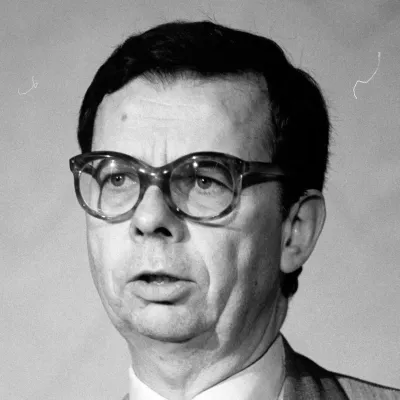
Louis Schweitzer
Human Design Chart
Biography
In 1995, the Justice Ministry investigated Schweitzer for being an "accomplice in poisoning" of hemophiliacs. The case stemmed from his tenure as Chief of Staff to Laurent Fabius and whether he knowingly allowed blood infected with HIV to be distributed to recipients. In 2003, the Court of Cassation dismissed the charges against him and several other officials.
Schweitzer was found guilty in 2002 of conducting surveillance on the phone of Jean-Edern Hallier as part of a special unit of the Elysée Palace and fined. The Court of Cassation upheld his conviction in 2008.
Louis Schweitzer was an atheist from a young age, even though he had studied at a Protestant school. He died on 6 November 2025 at the age of 83.
Louis Schweitzer as a Generator 1/3 in Human Design
Generator 1/3 — Design at a Glance
Louis Schweitzer was a Generator, a type characterized by a strong, enduring sacral energy. His design suggested that he could be extremely powerful and persistent, provided he had energy for his tasks. This strength, however, did not manifest through self-initiative but rather through reaction. The mechanics of his design called for him to wait for signals from life and then act when his sacral center gave a clear "yes."
This strategy of reacting was central to his well-being. When Louis Schweitzer responded to impulses from his gut, nothing could stop him. He was then rewarded with a deep sense of satisfaction and fulfillment. Conversely, two specific pitfalls threatened him. The first occurred when he persistently carried out tasks that did not internally resonate with him. In such cases, he wasted his energy and was prone to burnout, despite his high potential for productivity. The second danger lay in being prevented from working on his heart project, even though he still wanted to continue working with full power.
If he did not live according to his design, for example by constantly initiating himself rather than reacting, he would eventually encounter persistent frustration or a lack of energy. His path to effectiveness therefore lay in not forcing things but in listening to life and responding accordingly. Only in this way could he effectively utilize his enduring energy and experience the profound satisfaction that his type promised when applied correctly.
Emotional Authority
Louis Schweitzer's design inclines towards emotional wave motion, significantly influencing his decision-making process. As a person with defined Emotional Authority, he was subject to a constant emotional up and down, filtering perception of the world through the current mood. What appeared inspiring in one moment could be seen as negative in the next. This configuration meant that the first emotional impression did not necessarily represent the truth. Quick, spontaneous decisions based on such a momentary snapshot thus carried the potential for negative consequences.
The mechanics of this authority required patience and time to gain clarity. By letting decisions mature and sleeping on them multiple times, he could smooth out the intense feelings. Only with this emotional distance did calmness set in, completing the process. This approach was particularly crucial for long-term, life-influencing decisions. Emotional Authority always took precedence over other defined centers, regardless of additional configurations in the chart. Louis Schweitzer thus demonstrated someone who did not seek inner confirmation in the first impulse but rather through the conscious process of waiting and observing his own emotional currents.
The 1/3 Profile — Investigator / Martyr
Louis Schweitzer's design points towards a learning-oriented, experimental life path. As a person with the Profile 1/3, the Researcher and Experimenter, he demonstrated a connection between theoretical knowledge and practical application. His Line 1 emphasized the accumulation of experiences as the foundation for development and maturation. This laid the groundwork for him to explore new paths, often through fresh starts based on proper completion or the dissolution of old forms.
At the same time, Line 3 shaped his approach through trial and error. It promoted adaptability, especially in situations involving shock or unexpected challenges. In such moments, his courage for spontaneous adaptation was evident, driven by the need to learn from mistakes and behave in a life-preserving manner. When Louis Schweitzer made a decision or evaluated a method, he had thoroughly examined it both theoretically and practically. His judgment was thus the result of an intensive, self-conducted examination. He lived the process where knowledge was validated through direct experience, allowing him to adapt flexibly to changing circumstances without neglecting the necessary depth of learning.
Split Definition — Defined & Open Centers
Louis Schweitzer's Human Design profile points towards a clear, identity-defining communication style, fueled by a deep inner direction. His defined G Center provided him with a reliable sense of self-identity and a sense of his life's mission, while his defined Throat Center carried this inner truth outward. He did not speak out of impulsive mood swings but from the security of his higher self. This connection marked him as someone who articulated his messages with honesty and consistency, without limiting the freedom of others.
His defined Sacral Center formed the energy base. As a Generator, he had a vast vital energy source, which was only activated through correct reactions. His design required him to wait for an invitation or question to hear the sacral response – a clear yes or no. This protected him from exhaustion and frustration that would arise if he initiated or made mental decisions about his physical energy. His inner authority lay in his defined Solar Plexus Center. Here, the necessity was to wait for emotional waves before taking action. Truth did not reveal itself to him in the immediate now but over time. Patience was his tool to gain emotional clarity and avoid impulsive mistakes.
At the same time, he was vulnerable to external influences through open centers. His open Head Center made him receptive to mental inspirations and pressure situations not of his own making. He tended to identify with other people's questions or seek answers he did not actually need to find. His open Ajna Center amplified this: He could take on opinions and concepts, risking misinterpreting them as his own truth or showing uncertainty when he could not meet the expected intellectual pressure. His open Heart Center lacked consistent willpower; he was not designed to make promises or prove himself through competition. Instead, he learned to feel the value of others' egos without having to prove himself. His open Root Center absorbed external stress and adrenaline from the environment, making him vulnerable to overload if he did not recognize and release this foreign pressure.
Channels for intimacy, logical leadership and intuitive clarity.
Louis Schweitzer was characterized by a fundamental approach rooted in deep trust in his own intuition and the ability to lead collectively. His design combined the power of spontaneous insight with the responsibility to create logical structures for others.
The Channel of Brainwave 57-20 gave him the gift of clearly expressing intuitive truths in the present moment. This connection between Spleen and Throat Center enabled him to encourage others to awaken their own inner survival intelligence by spontaneously and directly hitting the core of a matter. Simultaneously, the Channel of Alpha Animal 7-31 shaped his profile as someone who sought logical, collective leadership. Through the connection between G Center and Throat Center, he searched for patterns that could be followed with certainty and only gained trust when he demonstrated his competence and was invited to lead by the majority. He did not lead through absolute authority but through influence and showing the way within existing structures.
Another central imprint came from the Channel of Union 59-6, connecting Sacral and Solar Plexus Centers. This channel rooted him in a powerful energy of intimacy that made relationships personal and profound. His emotional wave determined the timing of his release; he needed time to gain clarity and built healthiest connections when he first nurtured friendships before delving deeper. His intensity could be misunderstood, yet his availability allowed him to quickly build trust and promote fertility in creative endeavors.
Additionally, Gates like 53 (Freedom, Pioneer Spirit) and 54 (Connection of worldly success and spirituality) contributed to his development, while Gate 51 emphasized his willpower and adaptability. Louis Schweitzer lived this dynamic by combining intuitive insights with strategic leadership while always respecting the emotional depth of his relationships.
Individual Circuitry — Circuit Signature
Louis Schweitzer was marked by separate, parallel existing energetic blocks. One block connected the Solar Plexus to the Sacral Center, the other the G, Throat, and Spleen Centers. This separation meant that emotional impulses did not flow directly into life force but acted as separate energy fields.
In the Knowledge Circuit, the Channel of Flash of Insight connected the Throat to the Spleen Center. This created a tendency towards innovative, creative insights that were intuitively grasped through Spleen energy and articulated through the Throat Center. It was about expressing a unique identity through new insights.
Parallel to this, the Understanding Circuit worked. Here, the Channel of Alpha Animal connected the Throat to the Identity Center. This promoted the sharing of logical, rational strategies. Since the Solar Plexus Center was not involved, it was an emotionless ratio aimed at enabling improvements for the future through focus and structure.
Finally, the Protector Circuit connected the Sacral to the Solar Plexus Center through the Channel of Union. This configuration emphasized primal instincts of protection and preservation. It stood for energies of care, nourishment, and the protection of one's genetics, with the life force of the Sacral Center merging with the wave-like emotions of the Solar Plexus.
These three circuits formed three distinct experience areas for Louis Schweitzer: innovative intuition, rational strategy, and instinctive protection, which did not overlap but existed as independent forces alongside each other.
Right Angle Cross of Penetration 2
Louis Schweitzer's design carried the signature of the right cross of penetration. This configuration was characterized by a deep, often unconscious connection with collective consciousness and a specific way of perception that operated beyond pure logic. It was not an active strategy but a fundamental energetic alignment that significantly shaped his way of experiencing the world.
The right cross of penetration links the center of personality with the center of character. It described a nature that tended to process information and experiences on a very subtle, almost intuitive level. Louis Schweitzer was less someone actively seeking answers, but rather someone who absorbed and transformed answers within himself. This mechanism fostered a stance of inner reflection and a certain distance from immediate external reality, as the focus was on deeper, often hidden connections.
It was an energy of silent observation and inner condensation. Louis Schweitzer lived with a kind of wisdom that was not loudly proclaimed but was evident in his way of being and reacting. The penetration here meant less about breaking barriers in an external sense, but about penetrating into the essence of things and people. This gave him a special depth and the ability to view situations from a perspective that often remained hidden to others. His presence was marked by this silent, penetrating quality, which aimed less at action than at understanding.
Saturn Return · Uranus Opposition · Chiron Return · 2nd Saturn Return — Life Cycles
Louis Schweitzer was someone who created structural stability and strategic alliances. His design tended towards assuming responsibility in clear hierarchies and translating long-term visions into tangible alliances.
In 1970, at the age of 28, he worked as a financial inspector in the political administration. This marked his first Saturn return, a cycle in which years of groundwork often condensed into a solid, institutional foundation. Here, he established his base in the realm of order and control.
Twenty years later, in 1992, he took over the chairmanship of Raymond Levy. At 50 years old, he was in his Chiron return, a fulfillment cycle. In this phase, the individual's incarnation cross increasingly unfolds; meaning and purpose become experiential. His assumption of this leadership position was not just a career step but the concrete expression of his deepest life purpose: guiding complex systems.
In 1999, at 57 years old, he followed with his second Saturn return with the Renault-Nissan alliance. This cycle deepened the structures laid in the first Saturn return and demanded the integration of wisdom and experience. The creation of this global partnership demonstrated the maturity of his strategy: early administrative discipline now became a powerful, international architecture. His career thus followed the rhythmic demands of his design, from local order to global connection.
Generator · Emotional Authority — Synthesis
Louis Schweitzer was a Generator whose life was marked by a deeply rooted sacral energy and the drive to learn through action. The profile as a researcher and experimenter (1/3) points to a person who did not passively accept knowledge but validated and refined it through personal experience – a continuous process of theory and practice. This curiosity and the need to try things out corresponded with the emotional authority that urged him not to rush decisions but to let them mature over time and to consider the emotional wave. The connection of the Sacral Center and Solar Plexus (Channel of Union) intensified these processes, as the energy from action merged with emotional reactions.
Schweitzer's design revealed a central paradox: the tension between the need for continuous validation through experience (Line 1) and the desire to put these experiences into action (Line 3). The right cross of penetration points to a tendency to venture into new areas, while emotional authority simultaneously urged him to wait and find emotional clarity before acting. The documented career cycles showed how he lived this dynamic throughout his life, with career turning points often coinciding with phases of intense scrutiny followed by resolute action.
3 Defined Channels
Incarnation Cross - Right Angle Cross of Penetration 2
Solar Return
The Solar Return shows the moment when the sun returns to its exact birth position - your personal solar year.
Life Cycles
Discover the life cycles with a detailed triple view (birth chart, cycle chart, composite).
Human Design Profile
- Type
- Generator
- Strategy
- To respond - wait for something to respond to
- Authority
- Emotional Authority
- Profile
- 1/3 - Investigator / Martyr
- Definition
- Split Definition
- Incarnation Cross
- Right Angle Cross of Penetration 2
- Date of Birth
- 08.07.1942 09:03
- Place of Birth
- Geneva, SWTZ
Frequently Asked Questions
What is Louis Schweitzer's Human Design type?
What Profile did Louis Schweitzer have in Human Design?
Which authority guided Louis Schweitzer?
What incarnation cross did Louis Schweitzer have?
When was Louis Schweitzer born?
Discover your own Human Design
Are you also a Generator? Find out in a personal reading how to use your sacral energy correctly and discover deep satisfaction.
More Personalities
Back to overviewAaliyah

Alexia

Angèle

Anne-Marie

Arcángel

Arno