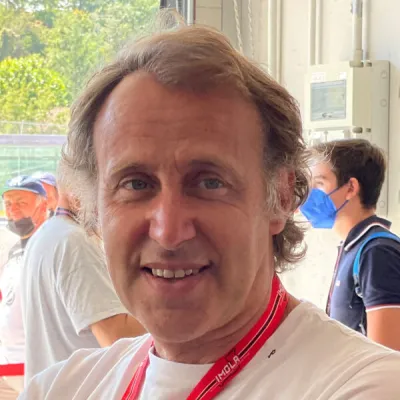
Luca Badoer
Human Design Chart
Biography
Luca Badoer — Generator with Profile 3/5
Generator 3/5 — Design at a Glance
Luca Badoer's design showed a tendency towards great endurance, which was fueled not by independent initiatives but rather through reacting to external impulses. As a Generator, he had plenty of sacral energy, comparable to a workhorse whose strength only becomes effective when it responds to a signal. The strategy involved waiting and then acting from the gut feeling as soon as his inner center signaled a clear 'yes'.
This pattern brought two central challenges: Forced activities without internal resonance quickly led to exhaustion, while suppressing his heart projects despite full power caused deep frustration. Luca Badoer's path to profound satisfaction lay exclusively in harmony with this reactive nature. When he responded to life impulses and used his energy where it was welcome, a feeling of fulfillment emerged. Acting against this logic – for example through constant initiative – met him with a lack of energy and persistent dissatisfaction. His strength thus did not lie in pushing plans forward but rather in the powerful, enduring implementation of what life presented him and which he intuitively reacted to.
Sacral Authority
Luca Badoer's decision-making was based on inner, bodily resonance instead of intellectual analysis. As a Generator with sacral authority, his strategy was inseparable from this internal guidance: He waited for an external trigger and listened to how his body responded. This response often manifested as a 'gut feeling' – a grunting, humming or clear 'mm-hm'.
This mechanism required patience since the open emotional center needed a pause before the final decision to gain emotional clarity. Positive resonance led to inexhaustible energy and vitality; negative feedback resulted in rejection. Luca Badoer was born to perform tasks with joy and without rigid purposefulness.
Additionally, the spleen center acted as a supportive instance. It enabled quick, instinctive reactions based on physical well-being. This connection grants an immediate access to intuitive perception that can prove reliable like a compass. Authenticity arose for Luca Badoer only through consistent listening in this sacral motor and trusting the spontaneous energy that sprang from it.
The 3/5 Profile — Martyr / Heretic
Luca Badoer's design was characterized by a tendency not to accept knowledge theoretically but rather validate it through personal experimentation and practical experience. This attitude of an experimenter (Line 3) formed the basis for his later role as a problem solver. He learned primarily through trial and error; every mistake was a necessary step in the individual adaptation process aimed at competence.
However, this personal learning curve served not only himself. Through Profile 3/5, this self-acquired knowledge became an attractive asset for others. Line 5 grants the individual the role of 'Hero' or rescuer who offers solutions because they have already walked that path themselves. Other people therefore sought his proximity to benefit from his practical insights. This dynamic created a specific tension: While success confirmed his authority and established him as a competent advisor, public failure could be painful since it occurred in front of the community.
The focus was on material discipline and the value of life's struggle. It was about testing whether the effort to overcome challenges was worthwhile. Luca Badoer thus showed himself to be someone who intuitively used alliances and conflicts as means for clarification, ultimately presenting a solution based on real, tested experience – not just theory.
Triple Split Definition — Defined & Open Centers
Luca Badoer's Human Design indicated an extremely high, constant energetic presence. With seven defined centers – Ajna, Throat, G Center, Heart, Sacral, Spleen, and Root – he had a firm internal structure in thinking, willpower, identity, and action. This 'wholeness' created an independent aura that was less permeable to external influences. His defined Ajna-Throat connection allowed him to consistently translate mental concepts directly into words or actions without these thought processes being externally controlled. The defined Heart Center gave him a natural sense of willpower and the urge to control resources, while the G Center provided a clear, unchanging identity and direction.
As an Manifestor Generator with a defined Sacral Center, Luca Badoer had a massive, reliable energy source for work and vitality. His strategy was to react to external impulses rather than initiate himself; only then did his full sacral power become available. The defined Spleen Center provided spontaneous intuition in the moment, while the Root Center delivered constant pressure to move forward and manage stress.
At the same time, his design revealed two specific vulnerability points through the open centers Head and Solar Plexus. The open Head Center meant that inspiration was not constantly present but situational; he tended to get entangled in mental confusion or questions from others rather than trusting inner clarity. The open Solar Plexus Center acted like an emotional barometer: it reflected the emotional climate of his environment instead of having its own constant emotional climate. This created a tension field between his enormous internal firmness and the risk of being drawn into the emotional or mental turmoil of the world, rather than maintaining his own authority and reaction strategy.
Channels for energy, insight, instinct and life purpose.
Luca Badoer was someone who transformed mutative impulses into material reality and new directions through a trusting response to his Sacral Center. This energy served innovation and breaking with the status quo, encouraging others through his healthy aura to find their own direction. Simultaneously, he carried the gift of structuring, allowing him to formulate unique insights and efficiency-enhancing concepts; this required patience and proper timing for acceptance by the collective.
This attitude was rooted in Channel 14/2. This channel connects Gate 14, skillfully handling power, with Gate 2 of higher knowledge. It links the generative energy of the Sacral Center to the identity and direction of the G Center. As one of the tantric channels, it brings mutation, innovation, and uniqueness. Luca Badoer had access to essential resources to transform mutative impulses into a material direction by simply trusting his reaction from the Sacral; through this honesty with himself, he encouraged others mechanically; people at his aura might find their own direction.
Additionally, Channel 43/23 worked. It connects the Ajna Center with the Throat Center via Gate 43 of insight and Gate 23 of assimilation. This channel forms a unique original perspective and expresses it to enhance efficiency. For Luca Badoer, the challenge was to let go of control and allow his mind to process knowledge at its own pace. His task was to develop competence in simply and clearly explaining his knowledge. When internal timing was right and insights were correctly recognized, his individual genius could be accepted by the collective; otherwise, rejection threatened. Through this combination of trusting response and structured communication, he shaped a mechanism for innovative development.
Individual Circuitry — Circuit Signature
Luca Badoer's design showed a tendency towards situational reflection: He was not a carrier of continuous internal drives in areas of personal transformation or tribal cooperation but an open field for external influences. With his triple definition, these energies did not exist as constant properties but were activated by the environment.
The Knowledge Circuit, generally revolving around new paths and identity, was split into three separate segments at him. The first connected Ajna with Throat Center: here, the ability to structure thoughts and express them was shown. The second segment linked Identity with Sacral Center; this offered a rhythmic basis for his own beat, however isolated from mental structuring. The third segment connected Spleen and Root Centers, representing the struggle for essentials – again as an independent force, not directly connected to the other two. This separation meant that creativity, identity, and survival instincts worked parallel but did not merge.
Parallel to this, the Ego Circuit, which stands for tribal cooperation and resources, was only one channel active: the connection between Heart and Spleen Centers. This allowed a form of dedication and giving in exchange with others based on intuition and appreciation. As there was no connection to the Sacral Center, constant life force was missing; rest periods were necessary to generate resources for the tribe.
As a person with open definition, Luca Badoer served as a mirror: He took these pulsating individual energies or conservative cooperative structures of his environment on without filtering them through his own channels but reacted by either reflecting new paths or integrating cooperative resource structures.
Right Angle Cross of the Unexpected 4
Luca Badoer's design established a deeply rooted foundational structure defined by the archetypal pattern of the 'Cross of the Unexpected'. This configuration fundamentally shaped his way of existence: it represents a life determined by surprises, sudden turns, and constant engagement with the unforeseeable. It was not about random external circumstances but rather an internal dynamic that worked independently of situational influences.
The mechanics of this cross describe a fateful background in which the unexpected becomes normative experience. For Luca Badoer, this meant that stability did not lie in linear predictability but in the ability to handle sudden changes. This structure often operated unconsciously and formed the backdrop of his life's journey. It conveyed no control over events but a specific resonance with the surprising as an integral part of his character. The 'Cross of the Unexpected' thus formed the basis upon which his experiences played out – not as exceptional states, but as defining qualities of his inner landscape.
Saturn Return · Uranus Opposition · Chiron Return — Life Cycles
Luca Badoer's design was characterized by a clear distinction between structural anchoring and situational responsiveness. This duality marked his professional path in two prominent phases. In 1998, at the age of 27, he became a Formula-1 test driver for Ferrari. This coincided with his first Saturn Return, a cycle often marking the condensation of years of work into a stable position and establishing professional stability.
A decade later, another pattern emerged: in 2009, at 38 years old, he appeared as a replacement driver for Felipe Massa at Ferrari after Massa's injury. This shift fell during his Uranus Opposition. In Human Design, this transit often marks moments of unexpected change or sudden responsibility when external circumstances disrupt equilibrium and require rapid adaptation. While the Saturn Return in 1998 laid the groundwork, the Uranus Opposition in 2009 demonstrated the ability to respond to immediate necessities without losing personal structure. Both events underscore a design that unites long-term dedication with agile flexibility in high-performance contexts.
Generator · Sacral Authority — Synthesis
Luca Badoer's chart reveals a deep-rooted thread of adaptability and engagement within the collective. The defined sacral authority, coupled with a Generator type, points to someone who generates energy through reacting to external impulses and finds profound satisfaction in work – provided it is authentic. This responsiveness is amplified by the defined G-Center, signaling strong awareness for direction and belonging, as well as the Heart Center, emphasizing willpower and commitment. The numerous defined centers (Mental Awareness, Communication, Identity, Physical Energy) form a solid foundation enabling him to assert himself in various contexts and effectively utilize resources, especially when interacting with others. The defined Root Center also grants him endurance and the ability to withstand pressure.
A central paradox lies in the combination of his open Head Center and the defined centers for direction and energy. While he possesses strong inner drive and reacts to external stimuli, his mind is open to diverse influences and inspirations. This can lead to a tension field between the need for internal guidance and the ability to be led by new ideas – an ongoing balance between established paths and unconventional approaches. The Cross definition strengthens this aspect of the unexpected and adaptation to new circumstances.
4 Defined Channels
Incarnation Cross - Right Angle Cross of the Unexpected 4
Solar Return
The Solar Return shows the moment when the sun returns to its exact birth position - your personal solar year.
Life Cycles
Discover the life cycles with a detailed triple view (birth chart, cycle chart, composite).
Human Design Profile
- Type
- Generator
- Strategy
- To respond - wait for something to respond to
- Authority
- Sacral Authority
- Profile
- 3/5 - Martyr / Heretic
- Definition
- Triple Split
- Incarnation Cross
- Right Angle Cross of the Unexpected 4
- Date of Birth
- 25.01.1971 07:10
- Place of Birth
- Montebelluna, Italy
Frequently Asked Questions
What is Luca Badoer's Human Design type?
What Profile does Luca Badoer have in Human Design?
Which authority guides Luca Badoer?
Which incarnation cross is assigned to Luca Badoer?
When was Luca Badoer born?
Discover your own Human Design
Are you also a Generator? Find out in a personal reading how to use your sacral energy correctly and discover deep satisfaction.
More Personalities
Back to overviewAaliyah

Aldair

Alexia

Angèle

Anne-Marie

Arcángel