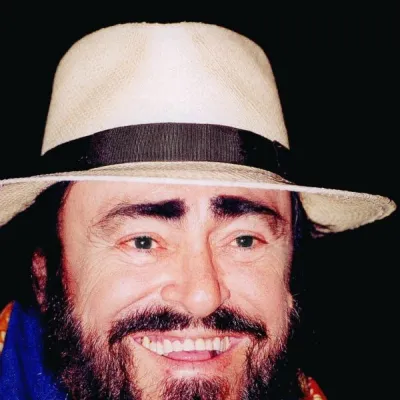
Photo: Wikimedia Commons
Luciano Pavarotti
Human Design Chart
Biography
As one of the Three Tenors, who performed their first concert during the 1990 FIFA World Cup before a global audience, Pavarotti became well known for his televised concerts and media appearances. From the beginning of his professional career as a tenor in 1961 in Italy to his final performance of "Nessun dorma" at the 2006 Winter Olympics in Turin, Pavarotti was at his best in bel canto operas, pre-Aida Verdi roles, and Puccini works such as La bohème, Tosca, Turandot and Madama Butterfly. He sold more than 100 million records, and the first Three Tenors recording became the best-selling classical album of all time. Pavarotti was also noted for his charity work on behalf of refugees and the Red Cross, amongst others. He was appointed a Knight Grand Cross of the Order of Merit of the Italian Republic in 1988, and died from pancreatic cancer on 6 September 2007.
The Human Design of Luciano Pavarotti: Generator 3/5
Generator 3/5 — Design at a Glance
Luciano Pavarotti was a Generator. His design endowed him with immense sacral endurance, comparable to that of a workhorse: strong and steady, provided he had energy for his task. However, it was necessary to use this power strategically to avoid frustration. The central dynamic of his design lay in Reacting rather than Initiating. His energy became free primarily when he responded to impulses from his environment instead of creating occasions independently.
Two specific risks characterized this mechanism. First, he tended to waste energy and burn out if he engaged in activities for prolonged periods that did not bring him inner joy. Second, there was the danger of being held back from his heart's project even though his inner self still yearned to continue. Therefore, the successful use of his power required a clear boundary: He had to wait for signals and then act when his sacral center gave a clear "yes."
If he lived in harmony with this strategy – Reacting from the gut – his system rewarded him with a feeling of deep satisfaction and fulfillment. If, on the other hand, he actively initiated against this nature or ignored inner resistance, it led sooner or later to persistent frustration and a noticeable lack of energy. His strength did not lie in pushing forward but in powerfully responding to life as it addressed him.
Emotional Authority
Luciano Pavarotti exhibited an inner decision-making structure that required time and calm as essential prerequisites for clarity. His design featured Emotional Authority, meaning his defined emotional center always held the lead—regardless of other defined areas in his chart. This configuration subjected him to a constant emotional wave, a perpetual up-and-down of feelings. The world appeared colored by his current mood: at one moment he could be totally enthusiastic, and in the next, view the same situation completely negatively.
This mechanism made it clear that an emotion in the moment was merely a snapshot, not a final judgment. Quick, spontaneous decisions from such emotional highs or lows carried the risk of having long-term negative consequences. The truth of his inner voice only became apparent after intense feelings had subsided. Luciano Pavarotti therefore needed patience and the willingness to reconsider important questions multiple times. Revisiting a decision multiple times was not a sign of hesitation, but rather the necessary process to gain emotional distance. Only when the wave receded did calmness set in and a well-founded clarity became possible. This path of delay served to distinguish snapshot moments from deeper insights and make long-term life decisions on a stable foundation.
The 3/5 Profile — Martyr / Heretic
Luciano Pavarotti's design indicated a tendency towards public presence based on personally experienced knowledge. As a person with the Profile 3/5, the Experimenter and Hero, Luciano Pavarotti emerged as someone who initially had to try everything himself in order to appear authentic. Line 3 in the lower body represented a process of trial and error. Here he learned through his own mistakes and adjustments, sharpened his intuition, and built practical life experience. This learning path was absolutely necessary; without this personal confrontation with failure, he could not generate trustworthy knowledge.
This self-acquired knowledge flowed into Line 5 in the upper body, the role of the Hero or Saviour. Luciano Pavarotti presented his insights to others, which made him attractive to those around him. People sought his proximity to benefit from his experiences and be inspired by them. However, this dynamic also created a specific vulnerability: since learning often took place publicly, failures were visible. The pressure of high expectations for the Hero role stood in tension with the necessary, sometimes chaotic process of experimentation. Luciano Pavarotti lived within this rhythm of private experimenting and public presentation, where every mistake was part of an evolutionary development to ultimately be seen as a credible authority.
Split Definition — Defined & Open Centers
Luciano Pavarotti possessed a massive, constant inner energy source. His design showed five defined centers: Heart, Sacral, Solar Plexus, Spleen, and Root. This formed a stable foundation of willpower, vitality, emotional depth, intuition, and stress resistance. He was strong-willed, competitive, and preferred to be his own boss in order to control his resources himself. His sacral energy generated an enormous daily reserve of power that he used by reacting to offers rather than initiating actions. Emotional decisions were made only after waiting for the wave movement of his Solar Plexus Center, giving him deep clarity. His Spleen Center provided spontaneous intuitive warnings in the present moment, while the Root Center supplied the necessary pressure for material growth and survival.
In contrast to this inner power stood four open centers: Head, Ajna, Throat, and G. Luciano Pavarotti was situationally open to inspiration, concepts, communication, and identity. His open Head Center tended to get lost in mental monologues or seek answers to others' questions rather than having his own consistent thoughts. The open Ajna Center made him receptive to foreign theories and opinions that he could adopt but did not need to claim as his own truth. In his open Throat Center, he felt the pressure to gain attention or speak when not invited. His open G Center meant he lacked a fixed identity or direction, instead taking these from the environment and relationships. He tended to ask who he was or where love could be found rather than radiating an unchangeable personality. The tension between his immense inner strength and the need to wait for external impulses for mental and identity aspects shaped his dynamics. He had to learn to use his inner authority so as not to fall into mental confusion or seek borrowed identity.
Channels for care, ambition and communal connection.
Luciano Pavarotti's design showed a tendency towards deep care and protection of the
Tribal Circuitry — Circuit Signature
. His aura automatically inspired trust and a desire for nurturing, stemming from Channel 27-50. This connects the Sacral Center with the Spleen Center through Gate 27 (Caretaking) and Gate 50 (Values). The energy of this channel served to preserve tribal activities by linking selfless interest in others with traditional values that should maintain order. Pavarotti was a natural nurturer, capable of taking on much responsibility but prone to overloading himself. His mechanics required
Right Angle Cross of Penetration 3
Luciano Pavarotti's design revealed a tendency towards profound, often painful clarity. He was someone whose life path was marked by the necessity to break through illusions and confront the stark reality of his own existence. This attitude stemmed from the right cross of Permeation 3, a configuration that did not allow for superficial adaptation but rather demanded a radical confrontation with the essential.
The mechanics of this circle describe a process where external circumstances or internal conflicts could not be ignored. Instead, they acted as catalysts for deep transformation. Luciano Pavarotti had to learn to navigate through resistance and challenges in order to achieve authentic self-determination. It was not about passive experience but an active, often demanding path towards gaining insight. The Permeation meant that only what stood the test of reality could be considered true and sustainable. This shaped his fundamental attitude: an uncompromising honesty with himself and his surroundings, which although burdensome, ultimately led to a clear, unadulterated identity.
Saturn Return · Uranus Opposition · Chiron Return · 2nd Saturn Return — Life Cycles
Luciano Pavarotti's design was characterized by a clear cyclical structure that divided his professional development into four decisive phases. This rhythm significantly determined the course of his career. In 1963, at the age of 28, the first Saturn Return marked a turning point: He debuted at the Vienna State Opera as Rodolfo in La Bohème. This cycle condensed years of preparatory work into a solid professional foundation.
In 1976 followed the Uranus Opposition, a moment of profound change and detachment from the familiar. At the advice of his manager Herbert Breslin, he shifted from bel canto style to dramatic and heroic parts of the tenore lirico spinto. This realignment greatly expanded his artistic range.
The Chiron Return around 1983 marked the phase of fulfillment and bloom, in which his inner purpose increasingly unfolded in life. In this year, he performed in the title role of Idomeneo at the Salzburg Festival. This engagement reflected the maturity that came with this cycle.
Finally, in 1990, the second Saturn Return and the associated consolidation shaped his further career path. At a globally televised concert in the Roman Caracalla Baths, he reached a new peak and became a pop and superstar as a result. This success confirmed the work done previously and solidified his status definitively.
Generator · Emotional Authority — Synthesis
He was a Generator who through the connection of Sacral Center and Spleen Center (Channel of Preservation) possessed a deep ability to secure and nourish resources for a larger group. This energy flowed into a life marked by constant alternation between trying out new paths (Line 3) and sharing acquired insights with others (Line 5). His emotional authority required time for decision-making, but the resulting depth of engagement allowed him to create and preserve something sustainably – a quality that manifested in repeated professional successes (documented events 1963, 1976, 1983, 1990).
A central paradox lay in the combination of his sacral energy and defined will center. He possessed the endurance to realize things but had to be careful not to waste his strength on aimless activities. The right cross of Permeation points towards a dynamic lifestyle where he constantly faced new challenges, taking into account both his own needs as well as those of the greater whole – an ongoing balance between individual drive and communal responsibility.
3 Defined Channels
Incarnation Cross - Right Angle Cross of Penetration 3
Solar Return
The Solar Return shows the moment when the sun returns to its exact birth position - your personal solar year.
Life Cycles
Discover the life cycles with a detailed triple view (birth chart, cycle chart, composite).
Human Design Profile
- Type
- Generator
- Strategy
- To respond - wait for something to respond to
- Authority
- Emotional Authority
- Profile
- 3/5 - Martyr / Heretic
- Definition
- Split Definition
- Incarnation Cross
- Right Angle Cross of Penetration 3
- Date of Birth
- 12.10.1935 01:40
- Place of Birth
- Modena, Italy
Frequently Asked Questions
What was Luciano Pavarotti's Human Design type?
What Profile did Luciano Pavarotti have?
What Authority did Luciano Pavarotti have?
What incarnation cross was assigned to Luciano Pavarotti?
When was Luciano Pavarotti born?
Discover your own Human Design
Are you also a Generator? Find out in a personal reading how to use your sacral energy correctly and discover deep satisfaction.
More Personalities
Back to overviewAaliyah

Alexia

Alizée

Angèle

Anne-Marie

Arcángel