Ludwig Schunk
Human Design Chart
Biography
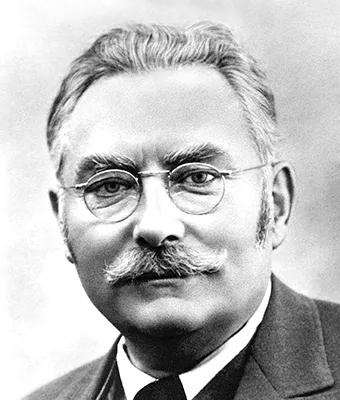
Schunk und Ebe oHG was founded in 1913 as a factory for production of carbon brushes for dynamos and electric motors in Fulda in Hesse and moved in 1918 to Heuchelheim near Giessen. By now the company has developed into being the Schunk Group, a technology concern with worldwide operations.
Ludwig Schunk did not have any children. His wife, who had collaborated very energetically in building up the company, had died early. The heirs of his deceased business partner Karl Ebe had been compensated so that he was sole owner of the corporate assets. As early as 1938 he decided in his will that those assets would be made available to the employees. He clarified this in a supplemental testament in 1942 and made the providential fund he had founded his sole heir.
Ludwig Schunk died from heart failure on 10 May 1947, aged 63, in Heuchelheim, near Giessen. As he had arranged, the providential fund became upon his death heir to the assets of the firm of Schunk & Ebe.
The Human Design of Ludwig Schunk: Projector 5/1
Projector 5/1 — Design at a Glance
Ludwig Schunk's design leaned towards precise system analysis. As a projector, he did not have an intrinsic life energy source in the sacral center but operated through phases of high intensity followed by necessary rest periods for recovery. His focus was on quickly identifying weaknesses in his environment – similar to a flashlight that shines directly into darkness to reveal errors.
This ability to see the 'error in the system' immediately required a specific approach. Directly addressing flaws often provoked resistance from his surroundings, as it could feel like being blinded by bright light. Instead, Ludwig Schunk was most effective through his own harmony and clarity. By living out how systems can function, he attracted others who then actively sought his advice.
His strategy involved waiting for appreciative invitations rather than initiating interventions on his own initiative. Only this way could he use his focused aura without being perceived as unpleasant or intrusive. Living by the principle of invitation and waiting rewarded him with success. Ignoring these dynamics and trying to swim against the current or constantly correct led sooner or later to his non-self theme: bitterness over the misunderstanding of his environment for his specific style of leadership and analysis.
Self-Projected Authority
Ludwig Schunk's design leaned towards extreme openness, coupled with the risk of being distracted by external motoric energies. As a projector with rare authority in Self, he carried this truth in his defined solar plexus center. This configuration required him not to react to external impulses but to interpret inner signals. His decision-making occurred through spontaneous expressions – whether in self-dialogues or stimulated conversations – where he had to learn to distinguish the voice of his true essence from rational thinking. This immediate speaking revealed his uniqueness to others. Additionally, he felt physical pulls that guided him geographically or thematically in certain directions or kept him away. By following this inner compass needle, he became a direction setter for his environment. The greatest challenge lay in not getting lost in the constant pursuit of external energy but using his own identity as the source of truth. Only through loyalty to these spontaneous impulses and physical sensations could he unfold his specific success potential and act authentically.
The 5/1 Profile — Heretic / Investigator
Ludwig Schunk's design leaned towards deep knowledge acquisition, which he made available to others for problem-solving. As a 5/1 – Hero/Researcher – he combined the magnetic radiance of Line 5 with the thorough research work of Line 1. Others often sought him out to find solutions for their own crises, perceiving his expertise as trustworthy. This dynamic could quickly become burdensome if no clear boundaries were set; similar to a scientist who is drained after long conferences and finds their inbox full of further inquiries.
The mechanics of his Line 1 were based on empathy and listening. It formed the foundation for exchange with others, enabling him to learn secrets and take in stories from various sources. This openness was not free from motives or the risk of being overwhelmed. The challenge lay in maintaining this empathetic basis stably.
Simultaneously, his Line 5 demanded courage to admit past mistakes. This process of 'confession' served justification and was particularly effective with strangers during crisis times. The decisive factor here was finding the right time for revealing earlier lack of knowledge. Ludwig Schunk could optimally utilize his gifts by learning to say no sometimes. Thus, he preserved a beneficial balance between his private research work and public role as problem solver without sacrificing himself or burning out.
Split Definition — Defined & Open Centers
Ludwig Schunk's design indicated a tendency towards constant mental pressure and a clear, firm identity. He was someone whose mind was constantly active – a characteristic of his defined Head and Ajna Centers – combined with reliable communication through his defined Throat Center. This configuration created a trustworthy mental function: he conceptualized information in specific ways and expressed it without being easily influenced by others. His defined G Center also gave him a stable self-identity and a sense of direction, allowing him to love others without becoming dependent.
At the same time, Ludwig Schunk was vulnerable to external conditioning through several open centers. His open Heart Center lacked consistent willpower; he tended to question whether he had enough value and risked making promises he couldn't keep to prove his worth. The open Sacral Center meant no constant energy flow; he absorbed the vital energy of his environment, which could overwhelm or exhaust him if he didn't listen to his inner authority. His open Solar Plexus picked up on others' emotions and amplified them, putting him at risk of interpreting foreign feelings as his own and avoiding conflicts. Additionally, his open Spleen Center was marked by fundamental survival fears, leading him to cling to unhealthy situations just to simulate a sense of security. Finally, his open Root Center absorbed environmental stress, which could lead to cycles of avoidable haste and burnout if he didn't recognize this external pressure as foreign.
Channels for leadership, reflection and clear awareness.
Ludwig Schunk showed himself to be someone who combined logical leadership with deep, reflective distance. His design indicated a tendency towards collective influence based not on coercion but on trust and tested patterns. This was expressed through the Alpha Animal channel 7-31: he had the ability to understand trends and act as a leader once invited by his community. His voice carried weight, yet it served to show the way rather than dictate.
Parallel to this, the Lost Son channel 13-33 influenced him. Here Ludwig Schunk gathered experiences and secrets to withdraw later and transform them into wisdom. He was a listener who possessed patience until deeper connections of a situation became clear before passing them on. This combination created a person who could lead but always acted from the perspective of a reflective observer, valuing continuity and learned lessons.
Mentally, he was marked by the channel of Awareness 24-61. His thinking wasn't linear or planning-oriented but mutative: sudden insights occurred when his mind sought silence. He couldn't force knowledge; it had to reveal itself to him. This spontaneous insightfulness contrasted with his logical leadership role and created an internal tension between a need for clear direction and the acceptance of unexpected, mystical truths.
Additionally, gates like 44 (Awareness) and 12 (emotional restraint) contributed to carefully weighing interactions and filtering expressions through emotional clarity. His personality was marked by a mix of collective responsibility awareness and individual, patient observation.
Collective Circuitry — Circuit Signature
Ludwig Schunk's design indicated a tendency towards separate, parallel functioning energetic fields. Through Shared Definition, two independent streams existed that did not directly communicate with each other but coexisted side-by-side. The first stream connected the Head to the Ajna Center through the Knowledge Circuit. Here, channel 24-61 (Awareness) promoted innovative flashes of insight and strengthened individuality through deviation from the known. This area generated pulsating, acoustic creativity in the moment. The second stream linked the Throat with the Identity Center. It split into two aspects: Understanding Circuit via channel 31-7 (The Alpha Animal), which brought focused visual logic and strategic action for the future – free of emotional coloring. Alongside this, the Meaning Finding Circuit through channel 33-13 (The Lost Son) was active. This referred to cyclical, crashing emotional waves from the past to gain insights and share them with the collective. Both parts of this second stream culminated in communication (Throat) and identity but without direct exchange with the creative Head-Ajna flow. Ludwig Schunk thus showed himself as someone where rational future strategies and emotional past reflections on one hand, and intuitive creativity on the other, worked as separate forces.
Left Angle Cross of Incarnation 1
Ludwig Schunk's Human Design indicated a tendency towards a deep, often unspoken connection to the material world. He was someone whose life path was strongly influenced by the laws of physical space and time. This configuration, the left cross of incarnation 1, described an existence closely linked with the physical. For Ludwig Schunk, this meant that his energy and focus were directed towards the here and now. He lived in a reality where material circumstances and physical limitations were not seen as obstacles but as fundamental conditions. His strategy was to accept the laws of this world and move within its structures. This created a solid foundation for his actions, as he understood that change required time and concrete steps. Ludwig Schunk did not seek abstract solutions but practical ways that worked in his immediate environment. His design promoted an attitude of grounding and realism. He learned to deal with given resources and adapt to the rhythms of daily life. This connection to matter gave him stability and helped him achieve his goals step by step. Ludwig Schunk understood that true transformation happens in physical life, not in theory. His path was one of integrating mind and body, where the body always served as the primary platform for his experiences.
Saturn Return · Uranus Opposition · Chiron Return · 2nd Saturn Return — Life Cycles
Ludwig Schunk's Human Design indicated a tendency towards structured building and creating sustainable stability. This orientation manifested concretely in his business leadership: In 1913, at age 29 during his first Saturn Return, he founded the coal brush factory Schunk & Ebe oHG in Fulda. This cycle often marked the moment when years of groundwork condensed into a viable result. The need to adapt structures and expand the foundation became evident in 1923. At age 39, during the Uranus Opposition, he acquired a coal brush holder factory and integrated it into his operation in Heuchelheim – a step that demonstrated the system's adaptability under pressure.
The phase of fulfillment and bloom began with the Chiron Return around the age of 49. Up until then, Schunk had lived according to his strategy; now, his purpose increasingly unfolded in everyday life: In 1932, at age 48, production of sinter beds was initiated. This was not just a technical step but the material expression of his incarnation goal, which became tangible. The second Saturn Return around the age of 56 deepened this stability into social responsibility. In 1940, he initiated the founding of a support facility for employees and their families. With this, he anchored the previously created economic structures in a human context – typical for this cycle: consolidating achievements through long-term care and institutional anchoring.
Projector · Self-Projected Authority — Synthesis
Ludwig Schunk lived as a Projector, distinguished by his ability to recognize patterns and point towards others' potential (Design View). This gift was always accompanied by an inner pressure to question things and understand them (mental center), driving him to accumulate profound knowledge (Profile Hero/Researcher, Knowledge Circuit). He sought solutions and offered them willingly, especially in a professional context – the founding of the factory, the integration of other businesses, the introduction of new production areas clearly showed this (documented events in cycles). This tendency towards problem-solving and knowledge dissemination was a defining characteristic of his actions.
At the same time, there was a tension between his need for recognition of his knowledge and the risk of being distracted by external influences (Authority in Self). He possessed the ability to exercise logical leadership (Channel of Alpha), yet this could easily be overshadowed by the desire to please others or meet their expectations. This dynamic between the drive to bring his unique perspective and sensitivity towards others' needs shaped his path.
3 Defined Channels
Incarnation Cross - Left Angle Cross of Incarnation 1
Solar Return
The Solar Return shows the moment when the sun returns to its exact birth position - your personal solar year.
Life Cycles
Discover the life cycles with a detailed triple view (birth chart, cycle chart, composite).
Human Design Profile
- Type
- Projector
- Strategy
- Wait for the respectful invitation
- Authority
- Self-Projected Authority
- Profile
- 5/1 - Heretic / Investigator
- Definition
- Split Definition
- Incarnation Cross
- Left Angle Cross of Incarnation 1
- Date of Birth
- 01.05.1884 20:30
- Place of Birth
- Frankfurt am Main, GER
Frequently Asked Questions
What was Ludwig Schunk's Human Design type?
Which Profile did Ludwig Schunk have?
What was Ludwig Schunk's Authority?
What incarnation cross did Ludwig Schunk have?
When was Ludwig Schunk born?
Discover your own Human Design
Are you also a Projector? Find out in a personal reading how to unfold your leadership qualities and recognize the right invitations.
More Personalities
Back to overviewSissy Spacek

Alain-Fournier

Anémone

Ann-Margret

Bourvil
Christian-Jaque