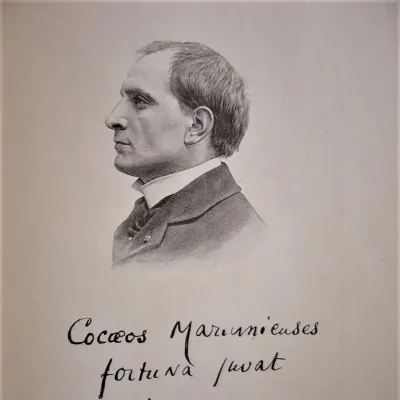
Lugné-Poe
Human Design Chart
Biography
He died on 19 June 1940, aged 70, in Villeneuve-les-Avignon, France.
Lugné-Poe as a Projector 2/4 in Human Design
Projector 2/4 — Design at a Glance
Lugné-Poe was someone who immediately recognized system errors and had a calling to bring light into darkness for others. His design tended to focus on illuminating areas in his environment that were still dark or not functioning properly, much like a bright flashlight. This ability to identify faults in the system instantly was characteristic of his Projector type.
As a Projector, Lugné-Poe had a very dense and focused aura. Without distance or invitation, this intensity could be perceived as unpleasant by those around him, similar to being directly hit by a light beam. The mechanics of his design indicated that addressing these faults head-on often led to resistance. Instead, he was most effective when living in harmony with himself, becoming so attractive that others would naturally seek out his insights.
Therefore, the central strategy for Lugné-Poe was to wait for an honest and respectful invitation before offering leadership or advice. This helped him avoid bitterness – the non-self theme of Projectors – and also allowed him to manage his undefined Sacral Center's lack of a constant energy source. He went through phases of high activity that had to be followed by rest periods for regeneration, to prevent burnout. Living according to this invitation-based rhythm earned him success; ignoring it led to frustration.
Splenic Authority
Lugné-Poe exhibited a fundamental stance of high vigilance due to the fine inner impulse required by her design, which could easily be drowned out. Her internal authority lay in her defined Spleen Center – her health and alarm system. This configuration endowed her with spontaneous survival intelligence: instinct, intuition, and physical well-being served as reliable indicators for whether an environment or society was right for her.
With the Spleen Center carrying this authority, Lugné-Poe had to make decisions in the immediate moment. The first spontaneous impulse was correct and directly served her health. This allowed her to rigorously protect herself from harmful influences and take good care of herself. However, since this spleen impulse only occurred once at a time, its use required constant attention; stepping back could be helpful during decision-making.
Due to this mechanism, it was difficult for her to make long-term commitments as she could only know what was right for her in the moment. Plans often changed short-term. Therefore, Lugné-Poe sought much freedom and flexibility, avoided rigid bindings, and preferred spontaneous arrangements based on her immediate intuition.
The 2/4 Profile — Hermit / Opportunist
Lugné-Poe's design inclined towards a cyclical shift between deep solitude and the need for familiar community. As Profile 2/4, which combines natural talent with networker traits, he exhibited tension between Line 2, the Hermit, and Line 4, oriented toward social structure. This configuration required clear communication of his needs: He had to learn to make transparent when he needed withdrawal for internal processing and when he sought company.
During his phases of retreat, Lugné-Poe delved into his own processes to gain clarity and reflect on the impressions from his network. Line 2 promoted a joy in the unusual and willingness to provide energy for unconventional projects while also pushing him to challenge authority. Once this inner need was satisfied, he returned to his familiar environment to spend time with his favorite people.
This rhythm served to create a safe space where these fluctuations were accepted. However, Line 4 brought the challenge of dealing with fear of failure and feelings of incompetence, especially when corrections seemed impossible. By navigating these internal tensions, Lugné-Poe could evaluate the knowledge from his network during his alone time and develop new ideas. Thus, his design defined a life integrated by cave and network, where transparent communication of one's needs was crucial for his well-being and creative expression.
Split Definition — Defined & Open Centers
Lugné-Poe revealed himself as a carrier of a persistent mental architecture. His design put constant pressure on questioning and understanding, driven by defined Head and Ajna centers. This inner drive generated inspiration and concepts but lacked direct energy for implementation since these centers were not connected to the body motors. Instead, Lugné-Poe functioned as a channel: The defined Throat transmuted mental contents into communication and action, while the defined Spleen center provided intuitive momentary judgments for health and survival. The constant stress of the defined Root Center ensured necessary forward movement.
In contrast, Sacral, Heart, Solar Plexus, and G centers were open. This meant a lack of persistent generative energy, willpower, or fixed identity. Lugné-Poe was vulnerable to reflecting his environment and absorbing “borrowed” energies. The challenge lay in not relieving the mental pressure through hasty actions from the open Sacral – leading to exhaustion – but by trusting strategy and authority. Instead of seeking a firm direction or love (Self-Trap of the Open G), he had to wait until the environment initiated him. His strength lay in inspiring others to think and acting intuitively at the right moment without bearing the burden of generative execution.
Channel 61-24: Awareness — Channels & Gates
Lugné-Poe revealed himself as someone whose actions were marked by an insatiable drive for pattern correction and logical perfection. This Root-driven presence stemmed from the channel of judgment 58-18, which through Gate of Vitality (58) and Gate of Correcting (18) generated a constant impulse to review and improve existing structures. It was not random criticism but a deeply rooted necessity to bring life into a perfect, functioning pattern.
Parallel to this, Lugné-Poe organized information with great detail accuracy. The channel of acceptance 17-62 connected Gate of Opinions (17) with Gate of Details (62). This allowed him to mentally sort visual patterns and translate them into precise language. His mind was constantly engaged in logically integrating new data; only what fit into this internal system was understood and communicated.
This analytical foundation complemented a mutative mindset. The channel of awareness 61-24 channeled inspiration from Gate of Secrets (61) to the Ajna Center through Gate of Rationalizing (24). Here, sudden intuitive knowledge transformed into rational answers. Lugné-Poe could not control these thoughts; they appeared as spontaneous insights that broke old cycles and opened new perspectives.
As a constant driving force, the channel of life struggle 38-28 operated. Through Gate of Fighter (38) and Gate of Player (28), Lugné-Poe actively sought meaning in his confrontations. This struggle served to preserve individual integrity against external distractions. He carefully chose his battles not only to survive but to realize a deeper purpose and serve as an example for others' own individuation process.
Individual Circuitry — Circuit Signature
Lugné-Poe revealed himself through two separate, parallel operating energy fields: an emotional-creative and a rational-strategic stream. This separation shaped his experiences as coexisting, non-directly connected forces. In the Knowledge Circuit, channel 24-61 linked Head with Ajna Center, fostering innovative flashes of insight. Parallel to this, channel 28-38 between Spleen and Root Center acted as life struggle energy. These two segments of the circuit were not connected in him; creativity and emotional transformation remained separate from physical resistance strength.
The Understanding Circuit formed the second field. Here, channel 17-62 linked Ajna with Throat Center, expressing logical insights verbally. Separately, channel 18-58 between Spleen and Root Center acted as judgment energy. Again, there was no direct connection between these groups: rational strategy and future-oriented analysis stood independent of intuitive discernment.
As Lugné-Poe had a split definition, these systems existed as separate blocks. He had to switch between the impulsive creative impulse of the first field and the cool structured analysis of the second. There was no common flow from emotional inspiration directly into rational communication or vice versa; both areas functioned as separate tools he used situationally.
Right Angle Cross of Service 4
Lugné-Poe's design suggested a deep grounding in service to others. His life goal was not personal fame or self-promotion but fulfillment through giving and support. The focus was consistently on the task itself – the pure act of helping – while his own ego receded into the background.
This orientation stemmed from the Right Service Cross 4. This configuration describes an inner motivation that does not arise from a desire for recognition, but rather from a willingness to serve others. It is an energy that finds its true satisfaction in recognizing and fulfilling the needs of others without demanding visible results or praise. For Lugné-Poe, this meant his actions were marked by quiet dedication. He did not seek validation in public acclaim but found it in consciously working for the well-being of his fellow humans. This mechanism created a way of life where his identity was defined through service, allowing him to focus entirely on the needs of others without being distracted by egoistic ambitions.
Saturn Return · Uranus Opposition · Chiron Return · 2nd Saturn Return — Life Cycles
Lugné-Poe's life followed a clear rhythmic pattern marked by four structural turning points. These cycles did not represent arbitrary events but rather defined the necessary rhythm of consolidation, rebellion, and final integration of his inner architecture.
The first Saturn Return served as a phase of serious self-confrontation and structuring. It was followed by the Uranus Opposition, a time when established patterns were often questioned to make way for new freedoms. This paved the way for the Chiron Return in midlife. This cycle was not a moment of injury but one of deep fulfillment: here Lugné-Poe's incarnation cross increasingly came into play if he had previously followed his strategy and authority. Meaning and purpose became experiential.
Ultimately, the second Saturn Return led to the final integration of these experiences. The mechanics of these four time points continually challenged Lugné-Poe to reformulate his inner structure. It was a universal process of maturation where each cycle set a specific task: building up, letting go, affirming one's essence, and finally synthesizing all previous phases into a coherent whole. This sequence formed the framework within which Lugné-Poe carried out his individual development without reference to concrete biographical data. The cycles themselves bore the burden of transformation.
Projector · Splenic Authority — Synthesis
Lugné-Poe lived a life marked by a profound ability to recognize patterns and make corrections (Channel 18-58). This judgmental capacity, fueled by a sharp mental focus (defined Head & Ajna Centers) and an intuitive understanding of survival (defined Spleen Center), enabled him to grasp underlying structures and highlight improvement potentials. He was an observer who did not simply accept what was given but constantly sought ways to optimize and harmonize things – a tendency that ran through his life, making him a pioneer in his field. His profile as a natural talent/networker (2/4) further amplified this dynamic by allowing him to gain clarity in isolation and then share this knowledge within his network.
Nonetheless, Lugné-Poe's design harbored a central paradox: the tension between his need for correction and his inherent instability (open Sacral, Heart & Solar Plexus Centers). He was destined to uncover errors and offer solutions, yet simultaneously lacked the steady energy to embody or enforce these changes himself. This discrepancy likely led to an internal struggle between wanting influence and needing not to get lost in endless battles but instead waiting for the right moment and environment to effectively communicate his insights.
4 Defined Channels
Incarnation Cross - Right Angle Cross of Service 4
Solar Return
The Solar Return shows the moment when the sun returns to its exact birth position - your personal solar year.
Life Cycles
Discover the life cycles with a detailed triple view (birth chart, cycle chart, composite).
Human Design Profile
- Type
- Projector
- Strategy
- Wait for the respectful invitation
- Authority
- Splenic Authority
- Profile
- 2/4 - Hermit / Opportunist
- Definition
- Split Definition
- Incarnation Cross
- Right Angle Cross of Service 4
- Date of Birth
- 27.12.1869 06:00
- Place of Birth
- Paris, France
Frequently Asked Questions
What was Lugé-Poe's Human Design type?
What profile did Lugé-Poe have?
What authority did Lugé-Poe have?
What incarnation cross was assigned to Lugé-Poe?
When was Lugé-Poe born?
Discover your own Human Design
Are you also a Projector? Find out in a personal reading how to unfold your leadership qualities and recognize the right invitations.
More Personalities
Back to overviewSissy Spacek

Alain-Fournier

Anémone

Ann-Margret

Arletty
Arno