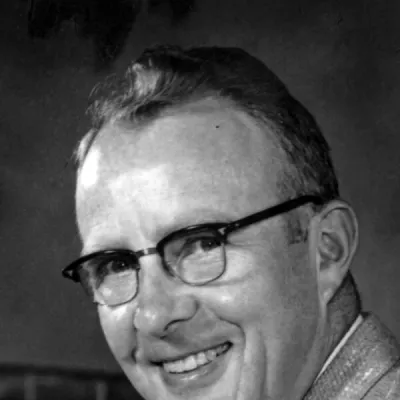
Luis Walter Alvarez
Human Design Chart
Biography
He contributed to the science of radar and gained a nick-name of "the prize wild-idea man" due his many eclectic interests, ranging from particle physics and theories on the extinction of dinosaurs to the use of cosmic rays to search for hidden treasure in an Egyptian pyramid.
Alvarez of cancer on 1 September 1988 in Berkeley, CA, at the age of 77.
Luis Walter Alvarez — Manifestor with Profile 5/1
Manifestor 5/1 — Design at a Glance
Luis Walter Alvarez revealed himself as a pioneer and visionary whose design predisposed him to lead the world into a new future. His character bore the traits of an emperor in ancient Rome: He possessed the vision of a great whole, but did not wage the necessary wars himself; instead, he sent others out to conquer foreign lands for him. This attitude made him vulnerable to being misunderstood because he often thought beyond his surroundings. His enormous visions polarized people: Some loved and followed him, while others hated him precisely because of this greatness.
To find the right followers and manage this polarization, it was crucial for Alvarez to apply his strategy of informing others in advance about his plans. He had to timely and accurately inform others about his intentions. This reduced misunderstandings and allowed like-minded individuals to recognize him. By following this strategy and his inner authority, he was rewarded with a sense of internal peace. However, if he lived against his design, he felt instead a persistent, deep anger. His Human Design as a Manifestor established this dynamic: Leadership through vision, accompanied by the necessity of clear communication to reduce resistance and find inner balance.
Emotional Authority
Luis Walter Alvarez's design imposed an imperative need for time and sleep to clarify the emotional wave. He showed himself as someone who never made decisions in the heat of emotion but consciously used the emotional ups-and-downs as a filtering mechanism. Spontaneous impulses were considered deception in his system; true clarity emerged only through distance and patience.
This attitude stemmed from his Emotional Authority, carried by the defined Solar Plexus Center. In Human Design mechanics, this authority always takes precedence over all other defined centers regardless of additional configurations in the chart. Alvarez was subject to a constant emotional wave with steady mood swings. The world appeared colored by his current mood: sometimes enthusiastic, then again negative. His immediate feeling was merely a snapshot, not the truth. Quick, spontaneous decisions from this state often had negative consequences.
Instead, he took time for decisions to mature. This process required patience and multiple nights of reflection on questions. Over time, intense feelings subsided, emotional distance grew, and calmness set in. Only then was he through with the process. This method primarily served long-term decisions with significant influence on his life course, as it allowed deeper insights than a first impression.
The 5/1 Profile — Heretic / Investigator
Luis Walter Alvarez's design established a duality: He was someone who drew knowledge from deep, private research to offer solutions in crisis situations to others. This Hero/Researcher (5/1) profile described an internal conflict between the need for service and the necessity of his own knowledge accumulation.
The mechanics explained this through Line 5, which exerted a near magnetic attraction; others instinctively sought answers from him to their problems. At the same time, Line 1 demanded an intense private research process. Without clear boundaries, exhaustion threatened because constant demand drained his energy. His natural authority did not rest on command but on respect that arose through deep understanding.
Especially in crisis times, this dynamic was evident: Line 5 (Gate 45) conveyed genetic leadership while Line 1 (Gate 36) presented a strong resistance to superficial changes. Progress was possible for his design only by penetrating uncertainty and deeply exploring crises rather than circumventing them. He had to learn to say no to maintain the balance between the role of problem-solving hero and the withdrawn researcher. Only in this way could he use his gifts without burning himself out.
Split Definition — Defined & Open Centers
Luis Walter Alvarez was characterized by a constant, willful presence that relied on clear expressiveness and intuitive certainty. His defined Throat Center connected to the Heart, Solar Plexus, and Spleen Centers, allowing him to translate his will ("I want this"), emotional depths, and spontaneous intuition directly into words and actions. This configuration created a reliable voice that did not waver but spoke from a mix of determination, emotionally deep sensitivity, and momentary perception.
At the same time, Alvarez was subject to situational influences through his open centers. His open Head and Ajna Centers made him receptive to external inspirations and mental concepts; he tended to absorb ideas from his surroundings rather than consistently generating his own questions. This required a discernment between valuable impulses and mere distractions. His open G Center meant that his identity and life direction crystallized only in correct environments and relationships; he adapted to learn what was right for him.
His energy and stress dynamics were also environment-dependent. The open Sacral Center allowed him to take on the vitality of others, leading to fluctuations in his own endurance—he had to learn to listen to his own energy level rather than being overwhelmed by the generative power of his surroundings. His open Root Center absorbed external pressure and stress, making him vulnerable to adrenalized states that were not of his own origin. Here lay his challenge to recognize this foreign pressure and not mistake it for his own drive but regulate or avoid it consciously.
Channels for emotional depth, instinct and powerful devotion.
Luis Walter Alvarez showed himself to be someone whose ability to express was strongly dependent on his inner mood. His design indicated a tendency towards cyclical communication: He waited for the right emotional wave before speaking or acting. Pressure often led him to become blunt; patience allowed him to catalyze and offer exactly what the market or community needed.
This dynamic was shaped by two channels in the Throat Center. The Openness Channel 22-12 connected his Solar Plexus Center with the throat. It expressed moodiness and passion, yet regulated through the caution of Gate 12. This meant that his social interaction was not constant but aimed at creating a receptive environment for transformative ideas. When he felt inclined, he could touch others deeply with his voice and inspire change.
Simultaneously, the Channel of Devotion 44-26 connected his Spleen Center (Instinct) with the Heart Center (Willpower). This channel gave him the ability to instinctively recognize what others needed – often before they knew it themselves – and convey this with convincing willpower. He used historical memories and a keen sense to effectively "sell" products or ideas. This allowed him to accomplish more in compressed, intense phases than others could in longer periods.
Together, these channels formed an expression that was not mere socializing but strategic waiting for the right moment. His authority lay in listening to his own emotional waves. Only when mood and timing aligned did his unique impact unleash its full power by combining instinctive insight with willpower to offer precisely what the environment needed for further development.
Individual Circuitry — Circuit Signature
Luis Walter Alvarez was shaped by two parallel, energetically separate fields. His knowledge circuit connected the Solar Plexus Center with the Throat Center (Channel 12-22). This created a pulsing impulse for individual identity formation and emotional transformation. New insights were expressed through this connection, initiating change. Parallel to this, his ego circuit linked the Heart Center and Spleen Center (Channel 26-44). This clan-oriented circuit focused on cooperation, resource management, and the balance of giving and taking. Since there was no connection to the Sacral Center, this energy required periods of rest for regeneration. The tension lay between the creative drive for individual knowledge transmission and the conservative need for community support and well-being. This divided definition meant that both systems existed side by side without directly flowing into each other. Luis Walter Alvarez lived with this duality: on one hand, the emotional wave of expression, on the other hand, the traditional search for support and prosperity for the community.
Left Angle Cross of Confrontation 1
Luis Walter Alvarez's design was characterized by the structure of the left cross of Confrontation 1. This configuration established a fundamental stance that manifested in direct confrontations and the revelation of contradictions. Since no specific Gate combinations or Centers are defined in the raw content, the mechanical impact on his behavior is generally described: It was an archetypal pattern complex that used confrontation as a means to clarity.
In Human Design, such a cross describes a specific energetic arrangement that brings certain themes into focus in life. For Luis Walter Alvarez, this manifested not through detailed channels or defined centers but as an overarching structure. The term 'Confrontation' suggests that his design tended to approach conflicts or tensions not by avoiding them but rather viewing them as necessary processes for truth-seeking or problem-solving.
Without further mechanical details such as defined Gates or Centers, no more specific behavior can be derived. Thus, the left cross of Confrontation 1 acted as a framework condition influencing how he dealt with challenges. It was a structural aspect of his design that gave him a particular perspective on interpersonal or factual conflicts without specifying individual nuances through further chart data.
Saturn Return · Uranus Opposition · Chiron Return · 2nd Saturn Return — Life Cycles
Luis Walter Alvarez's design structured life phases through cyclical maturation and confirmation processes. His path did not show as linear progression but rather as milestones carrying inner development outward. This became evident in 1936: At the age of 25, Alvarez received his doctorate and was appointed Assistant Professor at the University of Berkeley. This first Saturn Return often marked the transition from preparation to a stable professional anchoring; here years of groundwork condensed into a concrete status providing him with a stable platform.
Years later another cycle came into effect: In 1963, at age 52, Alvarez received the National Medal of Science. This fell within the Chiron Return period (around ages 49-51), a fulfillment cycle where one's incarnation cross unfolds and meaning becomes tangible. It was not a moment of healing old wounds but rather confirmation of his life task: Recognition showed that his path increasingly aligned with his inner purpose.
The process culminated in 76 when Alvarez received the Nobel Prize for Physics at age 57 during his second Saturn Return. The second Saturn Return often brings full maturity and societal recognition of long-term work. For Alvarez, this was a logical continuation of the previously set course: External accolades reflected the inner structure formed through these cyclical processes. His career thus followed a pattern where personal maturation and public acknowledgment met rhythmically without him having to assert himself against his natural rhythms.
Manifestor · Emotional Authority — Synthesis
Luis Walter Alvarez was a pioneer whose life was marked by profound inner dynamics. The combination of Manifestor type and emotional authority points towards someone who acted visionarily but made decisions only after thorough internal deliberation. This tension between the drive to initiate new things and the need for emotional clarity runs through his entire life visibly. Defined Throat and Heart Centers strengthened his ability to express visions and translate willpower into action, while openness in certain centers made him receptive to external influences – a constant adaptation to new information and circumstances. The profile as Hero/Researcher underscores this tendency: Alvarez sought solutions (Line 5) and deepened knowledge (Line 1) to make it accessible to others, yet he also had to set boundaries not to be overwhelmed by demands.
A central paradox in his design lies in the tension between the need for independent initiation as a Manifestor and the emotional wave requiring patient decision-making. Alvarez's inner world was marked by intense feelings that only through time and reflection led to clarity – a process contrasting with the impulsive nature of the Manifestor. This discrepancy likely caused internal conflicts but also manifested in his ability to deeply analyze complex problems and develop innovative solutions, both driven by willpower and emotional intelligence.
2 Defined Channels
Incarnation Cross - Left Angle Cross of Confrontation 1
Solar Return
The Solar Return shows the moment when the sun returns to its exact birth position - your personal solar year.
Life Cycles
Discover the life cycles with a detailed triple view (birth chart, cycle chart, composite).
Human Design Profile
- Type
- Manifestor
- Strategy
- To inform others before acting
- Authority
- Emotional Authority
- Profile
- 5/1 - Heretic / Investigator
- Definition
- Split Definition
- Incarnation Cross
- Left Angle Cross of Confrontation 1
- Date of Birth
- 13.06.1911 02:45
- Place of Birth
- San Francisco, CA, United States
Frequently Asked Questions
What was the Human Design type of Luis Walter Alvarez?
What Profile did Luis Walter Alvarez have in Human Design?
What Authority did Luis Walter Alvarez have?
What incarnation cross did Luis Walter Alvarez have?
When was Luis Walter Alvarez born?
Discover your own Human Design
Are you also a Manifestor? Find out in a personal reading how to use your initiation power peacefully and dissolve resistance.
More Personalities
Back to overviewChristian-Jaque
Kesha

Lucebert
Masaccio

Nadar
Papus