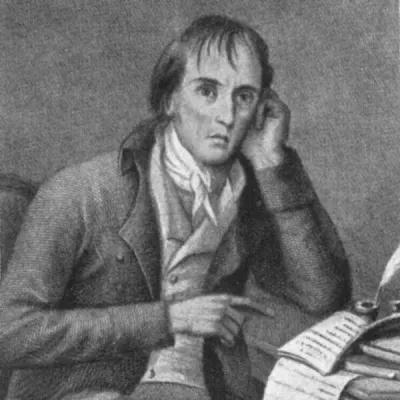
Manuel M. Barbosa du Bocage
Human Design Chart
Biography
Manuel M. Barbosa du Bocage as a Generator 1/3 in Human Design
Generator 1/3 — Design at a Glance
Manuel M. Barbosa du Bocage had a high and enduring sacral energy that enabled him to achieve great vitality – provided he used it correctly. His Generator design dictated that this power was not effectively unleashed through his own initiative but only in response to external impulses. The central mechanics of his character lay in „Reacting Instead of Initiating“. Success and deep fulfillment came about only when he responded to signals from life and confirmed his inner self with a clear „Yes“.
If he ignored this principle, he faced two specific stumbling blocks. First, there was the risk of burnout through energy waste on tasks that did not bring him internal joy. Second, it led to frustration and energy loss when he was prevented from pursuing his heart project, even though his strength remained intact. Unlike other types who actively shape their lives, Manuel M. Barbosa du Bocage had to wait until life spoke to him. The most successful strategy for him was to respond to such a signal and then act upon it. Living in harmony with this dynamic rewarded him with a deep sense of satisfaction. If he tried to go against his nature and constantly initiate action, sooner or later he encountered persistent frustration and a lack of energy. His strength thus lay not in sparking processes but in the powerful and enduring handling of what came to him and resonated internally.
Emotional Authority
Manuel M. Barbosa du Bocage appeared as someone whose inner compass was strongly influenced by the current mood state. His design indicated that his defined Solar Plexus Center carried his emotional authority – the central instance for decisions and life direction. This configuration was subject to a constant emotional wave with characteristic up-and-down movement of feelings. The world always seemed colored by the moment: A situation could be inspiring one moment, only to feel negative in the next.
This mechanism did not mean that spontaneous reactions were the truth. Immediate feelings merely represented a snapshot, an initial impression that was not necessarily aligned with deeper reality yet. Manuel M. Barbosa du Bocage had to learn to resist this distortion. Quick decisions based on current emotions risked negative consequences as they relied on fleeting wave peaks or troughs.
His design strategy required patience and time. By delaying decisions and „sleeping on them“ multiple times, he gained the necessary emotional distance. Over time, intense feelings subsided, clarity and calm emerged. This process of fading was essential to make long-term course adjustments that significantly influenced his life path. Only through this delay could he move from fleeting mood to true inner truth.
The 1/3 Profile — Investigator / Martyr
Manuel M. Barbosa du Bocage was marked by Profile 1/3 (Researcher/Experimentor), whose life was dominated by the dialectic of theoretical knowledge and practical experience. His design tended towards alternating between withdrawal into internal clarity and social experimentation. Line 1 (Gate 6) demanded intimacy and regeneration; as long as Manuel felt he did not know enough, resistance against implementation arose. This conflicted with Line 3 (Gate 12), which forced him into the process of trial and error.
This mechanism meant that Manuel had to accept uncertainties and social veiling as necessary parts of his development. Mistakes or false bonds could lead to self-hatred, yet these experiences were essential. Only through self-earned insights, both theoretically grounded and practically tested, did true authority arise. When Manuel M. Barbosa du Bocage makes a judgment, he has thoroughly examined the matter from heart and gut; one can trust this knowledge absolutely as it represents the integration of planning and hard practice.
Split Definition — Defined & Open Centers
Manuel M. Barbosa du Bocage revealed himself as a person with immense substance and assertiveness, whose design featured a massive, defined energy infrastructure. His defined Sacral Motor generated constant vital force, but this energy flowed correctly only through reaction, not initiation. This physical energy was in tension with his emotional authority in the Solar Plexus Center: While the Spleen and G Centers gave him spontaneous intuition and clear identity, patience was required for the Solar Plexus. Manuel M. Barbosa du Bocage had to learn to wait for the emotional wave before acting to avoid impulsivity. His defined Throat allowed him to clearly express this inner truth as long as he did not try to direct others or overstep their boundaries.
The challenge lay in integrating these forces. His open Root Center made him vulnerable to external stress and adrenalized pressure, which he often misinterpreted as his own drive. This led to a tendency to rush or take on tasks that were not his to escape this foreign pressure. Additionally, his open Head and Ajna Centers revealed flexibility in thinking but also a tendency to adopt mental confusion or questions from others as personal problems. Manuel M. Barbosa du Bocage was dependent on disentangling himself from these mental whirlpools and instead trusting his inner authority. Only by distinguishing between his intuitive truth (Spleen/G) and the necessary emotional clarity (Solar Plexus) could he healthily apply his powerful will in the Heart Center without overburdening himself or others.
Channels for intimacy, intuitive clarity, endurance and connection.
Manuel M. Barbosa du Bocage's design tended towards deep intimacy, but this was temporally regulated by emotional wave movement. The Channel of Union 59-6 connected sacral sexuality with the emotional wave of pleasure and pain. This created a drive for merging, yet required patience: Spontaneous action risked misunderstandings as intensity often misinterpreted as flirting. Only waiting until emotional clarity allowed true connection.
Parallel to this, the Channel of Insight 57-20 brought intuitive insight directly into the present moment from the Spleen Center. This gave him the ability to communicate penetrating self-awareness and strengthen others in their inner survival intelligence, provided he remained anchored in the present moment.
The Channel of Discovery 29-46 promoted a stance of letting go of expectations. Through the Gate of Saying Yes (29) and the determination of Self (46), persistence in long processes was enabled, with success only visible at the end of an experience.
Additionally, the Channel of Community 37-40 shaped his understanding of relationships as mutual contracts. The connection between Solar Plexus and Heart required careful weighing to create stable bonds based on mutual benefit and emotional depth.
Individual Gates complemented this picture: Gate 36 brought cyclical crises as a developmental motor; Gate 12 promoted creative mutation through restraint; Gate 11 used visual memory for situational assessment. Gate 48 recognized patterns but led to frustration without implementation; Gate 33 reflected experiences in withdrawal. Gate 8 contributed to group identity, while Gate 62 created structure through logical detail work. Gate 42 emphasized the completion of processes for new commitments.
Tribal Circuitry — Circuit Signature
Manuel M. Barbosa du Bocage's design tended towards instinctive protection and preservation of his genetic heritage. This was evident in the Archer Circuit, which connected his Sacral with Solar Plexus Center (Channel 6-59). This configuration created a timeless, primordial need for pairing and defending the closest community. The energy worked touch and smell oriented, driven by a deep urge to secure the survival of his genetics – often associated with maternal or paternal care.
Parallel to this was a separate stream: The Knowledge Circuit connected his Throat with Spleen Center (Channel 20-57). Here it was about pulsating creativity and expressing unique insights. However, this ability to transform and express the new stood energetically isolated from the familial protective energy of the Archer Circuit.
Further defined segments completed the picture: The Meaning Finder Circuit connected Identity with Sacral Center (Channel 46-29), emphasizing processing past experiences and emotions. Additionally, the Ego Circuit linked Heart with Solar Plexus Center (Channel 37-40), making themes of cooperation, mutual support in the tribe, as well as the rhythm of giving and taking effective. As Manuel M. Barbosa du Bocage had a split definition, these forces existed as parallel, not directly connected streams: on one side instinctive family preservation and emotional processing, on the other creative expression and social cooperation.
Right Angle Cross of Eden 3
Manuel M. Barbosa du Bocage had the Human Design configuration of the right Eden 3 cross, which marked a profound inner conviction of a unique mission. This pattern suggested that he saw himself as someone called beyond the ordinary – often associated with a strong sense of justice or redemption. The mechanics of this cross describe not mere vanity but structural identification with the role of the Chosen One or Saviour. It is about perceiving a nearly divine mission that places life in a larger, sacred context. For Manuel M. Barbosa du Bocage, this meant his actions and being were guided by the feeling of fulfilling a destiny specifically assigned to him. This inner compass pointed not towards career or social status but toward spiritual or moral fulfillment. The configuration demands acknowledging this deep calling as a legitimate guide, even if it appears difficult to understand from the outside. It is the architecture of a soul that believes in having to make a specific contribution to healing or ordering the world. This attitude created a fundamental divide between his mundane daily life and his perceived higher mission.
Saturn Return · Uranus Opposition · Chiron Return · 2nd Saturn Return — Life Cycles
Manuel M. Barbosa du Bocage's design was marked by two significant, existential turning points that structured his life path. The first Saturn Return cycle, typically marking the phase of professional consolidation and the first major success, occurred at age 26 for him. This was not an abstract process but a concrete one: in 1791, his first poetry collection was published. This moment condensed years of inner work into a visible, durable result that profoundly shaped his identity and life path.
The second decisive event formed the Uranus Opposition, a transit often associated with sudden breaks, unexpected changes, or violent endings. For Manuel M. Barbosa du Bocage, this mechanism was evident in its most extreme form: in 1805, at age 40, he died from an aneurysm caused by syphilis. This was not a gradual decline but an abrupt end that confirmed the Uranus influence as a force of unpredictability and destruction. His design suggested his life was determined by these two poles: structural consolidation through Saturn and sudden rupture through Uranus. This configuration describes a lifespan oscillating between achieving clear public status and an unexpected physical end, leaving no room for a long, gradual transition.
Generator · Emotional Authority — Synthesis
A central red thread runs through the design: the deep connection of reaction and authenticity. Sacral energy paired with emotional authority and the Profile of Investigator/Experimentor points to someone who is most alive when reacting to impulses and deeply experiencing their experiences – a process that requires time and an emotional wave. This reactivity is strengthened by the defined G Center, which provides clear identity and direction as long as it arises from authentic experience. The various Gates and Channels underscore the ability to feel deeply, intuitively recognize, and share this knowledge with others – provided it is lived in alignment with inner strategy.
A central paradox lies in the tension between the need for deep connection and the independent nature of the design. Defined Centers (Heart, G Center, Throat) point to strong inner power and the ability for self-determination, while open Centers (Head, Ajna, Root) suggest high sensitivity to external influences and a constant intake of information. This creates an internal conflict between the desire for autonomy and the tendency to lose oneself in relationships and experiences – a dynamic interplay that can be both a source of creative energy as well as potential frustration.
4 Defined Channels
Incarnation Cross - Right Angle Cross of Eden 3
Solar Return
The Solar Return shows the moment when the sun returns to its exact birth position - your personal solar year.
Life Cycles
Discover the life cycles with a detailed triple view (birth chart, cycle chart, composite).
Human Design Profile
- Type
- Generator
- Strategy
- To respond - wait for something to respond to
- Authority
- Emotional Authority
- Profile
- 1/3 - Investigator / Martyr
- Definition
- Split Definition
- Incarnation Cross
- Right Angle Cross of Eden 3
- Date of Birth
- 15.09.1765 15:00
- Place of Birth
- Setúbal, Portugal
Frequently Asked Questions
What is the Human Design type of Manuel M. Barbosa du Bocage?
What Profile does Manuel M. Barbosa du Bocage have?
What authority does Manuel M. Barbosa du Bocage have?
Which incarnation cross is assigned to Manuel M. Barbosa du Bocage?
When was Manuel M. Barbosa du Bocage born?
Discover your own Human Design
Are you also a Generator? Find out in a personal reading how to use your sacral energy correctly and discover deep satisfaction.
More Personalities
Back to overviewAaliyah

Alain-Fournier

Alexia

Angèle

Angeli

Anne-Marie